
 Bitaigen Research
 In this article we systematically outline the core concepts of DeFi and focus on how lending mechanisms underpin the entire ecosystem. By analyzing leading projects, beginners can quickly build a conceptual framework; subsequent sections will demonstrate practical strategies, so a thorough read is recommended.
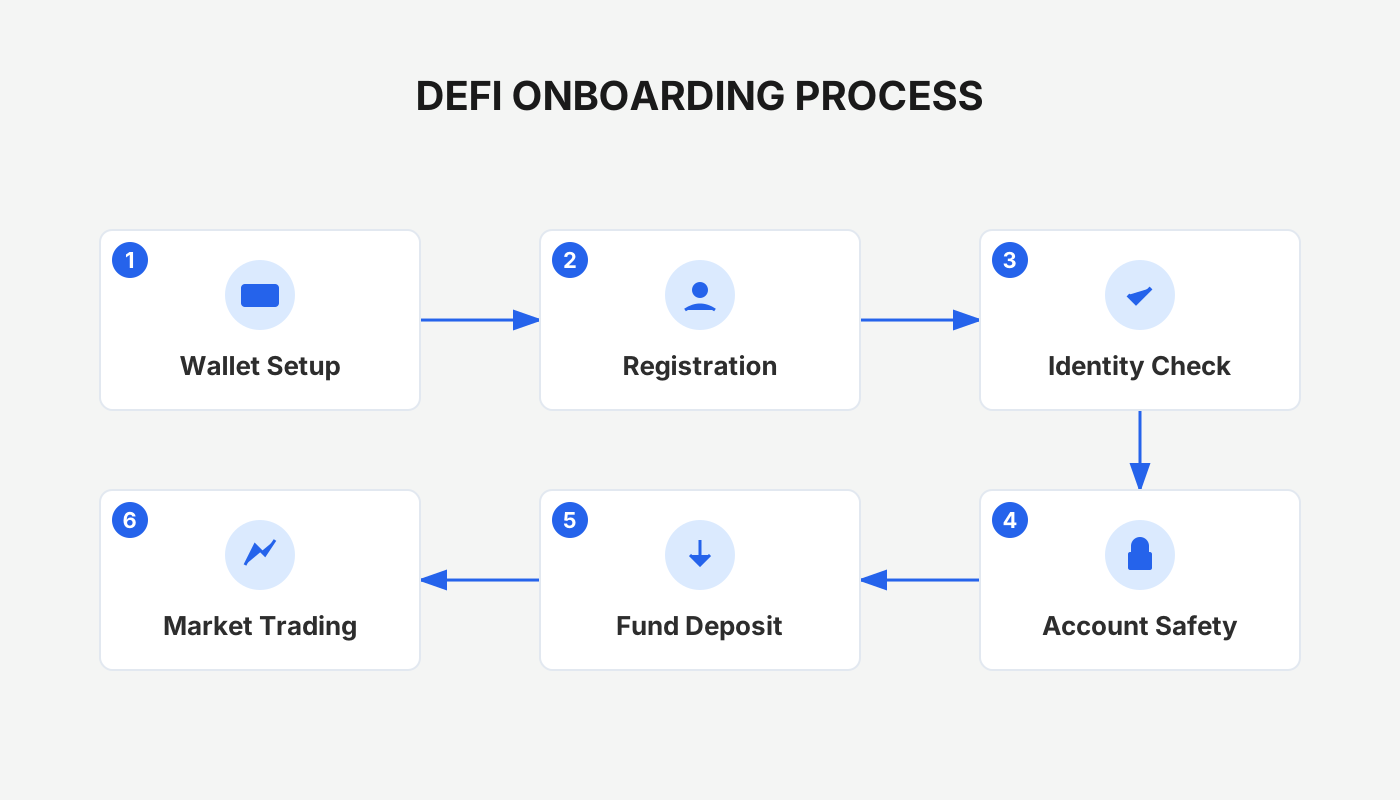
Summary
Today's content is divided into two parts:
- Essential points for newcomers to the DeFi world;
- Basic introductions to the leading lending projects in the market and their common use‑cases.
Key Takeaway: To gain a deep understanding of the DeFi space, you must comprehend the principles and applications of lending. Without that knowledge, achieving meaningful returns is difficult; focusing on the industry's core logic is the only way to stay on the right track.
Main Text
Indeed, lending is the cornerstone of the DeFi ecosystem. Through smart contracts it provides liquidity, enables price discovery, supports the operation of the whole decentralized financial services stack, and offers users a variety of financial functions such as borrowing, leverage, and yield generation.
Digital currencies have been around for more than a decade since Bitcoin’s inception, passing through phases of scams, meteoric rallies, busts, and the formation of consensus. Today, traditional financial institutions, Elon Musk, Wang Xing and other industry leaders are actively deploying blockchain solutions, making it crucial to stay informed about sector trends.
The analyst group “Prophet” has long advised newcomers to first study the Bitcoin and Ethereum whitepapers; once the underlying technologies are mastered, they should turn their attention to the DeFi track. This article provides the foundational concepts of DeFi to help you get up to speed quickly.
1. Characteristics of DeFi
DeFi (Decentralized Finance) represents a native blockchain-driven financial revolution. Compared with traditional (centralized) finance, DeFi leverages smart contracts to define and enforce rules, delivering several advantages:
- Transparency: Once code is deployed, any rule change must be publicly visible and cannot be altered privately.
- Accessibility: A smartphone or computer is all that’s needed; no physical branches are required.
- Efficiency: Blockchain transfers typically settle within seconds to a few minutes, and cross‑border transactions no longer need days of verification.
- Privacy: No KYC is required; participation is possible with just a wallet address, preserving user anonymity.
- Fairness: All participants receive the same rates and rules—for example, on Compound the borrowing rate is identical regardless of the size of the asset portfolio.
2. Architecture of DeFi
The DeFi ecosystem can be abstracted into a five‑layer structure (see Figure 1), namely the Settlement Layer, Asset Layer, Protocol Layer, Application Layer, and Aggregation Layer.
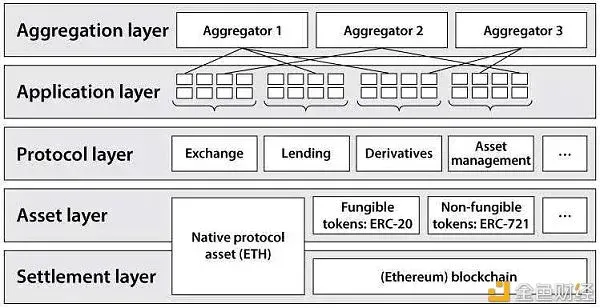
| Layer | Primary Components | Functional Overview |
|---|---|---|
| **Settlement Layer** (Layer 1) | Blockchain and native assets (e.g., BTC, ETH) | Records ownership, guarantees state transitions follow protocol rules, and provides trust‑less settlement and dispute resolution. |
| **Asset Layer** (Layer 2) | Tokens issued on top of the settlement layer (native assets + other tokens) | Creates tradable, collateralizable financial assets. |
| **Protocol Layer** (Layer 3) | Decentralized exchanges, lending markets, derivatives, asset‑management contracts, etc. | Supplies highly interoperable financial primitives. |
| **Application Layer** (Layer 4) | User‑facing front‑end applications | Wraps protocols into intuitive UI/UX for end‑users. |
| **Aggregation Layer** (Layer 5) | Multi‑protocol aggregation platforms | Connects various applications, offering comparison, composability, and automated execution features. |
After grasping this model, you can dive deeper into tokenization and the sub‑categories within the Protocol Layer. DeFi is still in its infancy; many aspects are imperfect, and developers continue to innovate across all five layers. As the Protocol Layer matures, the majority of projects will likely concentrate on the Application and Aggregation layers, meaning that ordinary users will primarily interact with those two tiers.
3. The Pillar of the DeFi Protocol Layer – Lending
Before discussing lending, it is necessary to understand the role of stablecoins. Native tokens such as Bitcoin and ETH experience high volatility; if used directly
*Note on fiat integration*: When converting crypto to fiat, the global market typically relies on USD transfers via SWIFT or SEPA corridors. U.S. residents should use Binance.US rather than the global Binance platform.
*Tax disclaimer*: Crypto‑related gains may be subject to taxation in your jurisdiction; please consult a local tax professional to ensure compliance.
---
Related Reading
- MetaMask Transaction Fees: Gas, Base & Priority
- GameFi Explained: DeFi + NFTs, Top Tokens & Market Risks
- Bitcoin & Crypto Assets: Diversify with Blockchain Trends
💡 Register on Binance with referral code B2345 for the maximum trading fee discount. See Binance complete guide.



