
 Bitaigen Research
 In this article we systematically outline the concepts and fundamental differences between DeFi and CeFi, helping readers clarify the core points of technological trust versus institutional trust, and quickly grasp the advantages and risks of the two major financial paradigms. Subsequent sections will dive deeper into real‑world use cases, so a thorough read is recommended.
What are DeFi and CeFi?
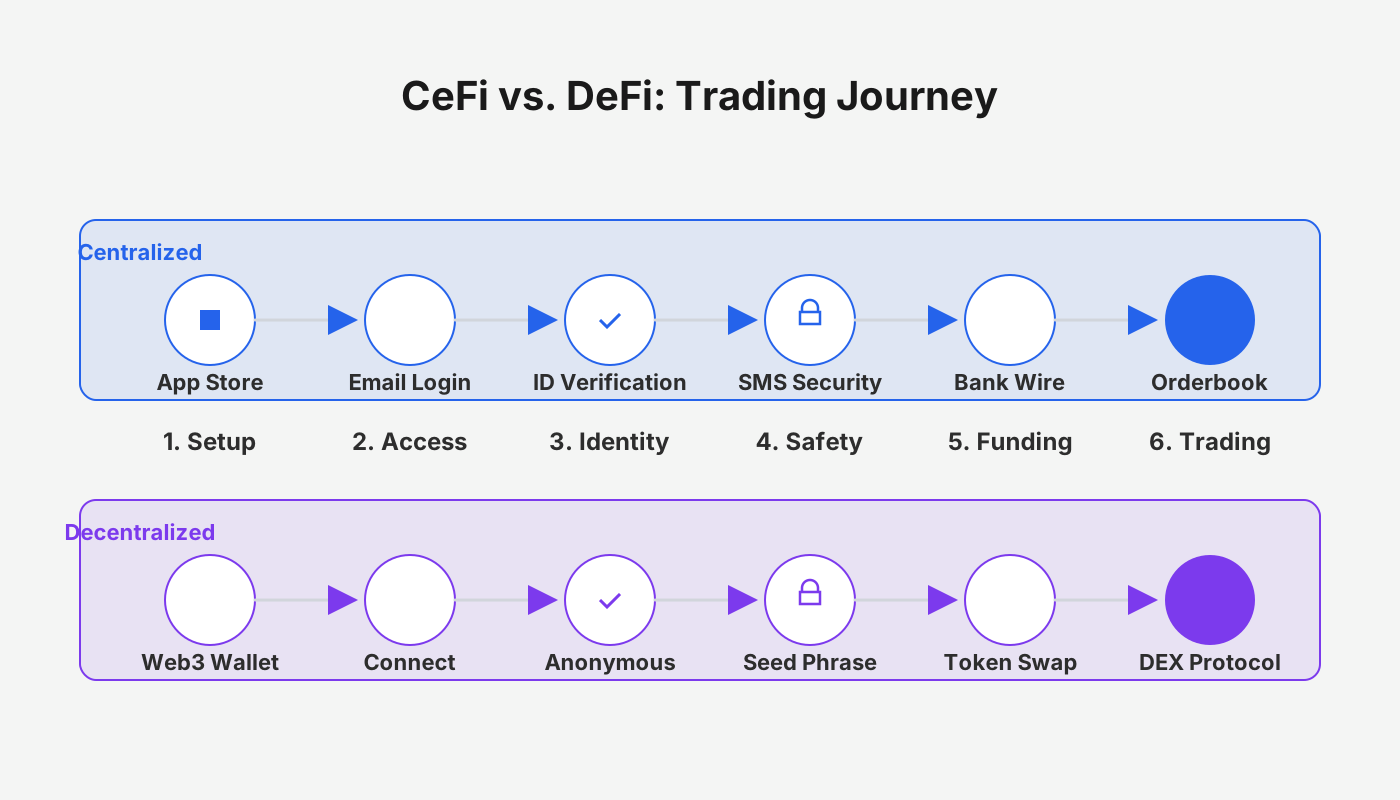
In the past few years, Decentralized Finance (DeFi) has gradually become a hot topic within the crypto community. DeFi stands for Decentralized Finance, a financial services system built on blockchain technology that aims to replace traditional intermediaries with smart contracts, enabling borrowing, trading, payments and other activities to be completed without any centralized entity. In contrast, CeFi (Centralized Finance) refers to a financial model centered on banks, securities firms, traditional exchanges and other centralized institutions, which are responsible for asset custody, transfer, credit assessment and related functions.
Decentralized finance refers to a variety of financial applications built on open blockchain networks, with the goal of reshaping and improving the existing financial system on the basis of cryptography and distributed ledgers.
The core of DeFi is technological trust: users rely on the code and consensus mechanism to execute as expected; CeFi, on the other hand, leans more heavily on institutional trust, meaning confidence that the underlying company or financial institution will manage assets responsibly.
---
Key Differences Between the Two
| Dimension | DeFi | CeFi |
|---|---|---|
| **Governance Structure** | Autonomous via distributed protocols and smart contracts, with no single controlling party | Managed centrally by an institution, usually with strict KYC/AML procedures |
| **Transparency** | All actions are publicly recorded on‑chain and can be inspected by anyone | Transaction details reside in internal systems and are difficult for external parties to audit directly |
| **Asset Control** | Assets always belong to the user; private keys are held personally | Assets are custodial in platform accounts and subject to the platform’s rules and regulations |
| **Regulatory Ease** | Decentralized nature makes direct regulator intervention challenging | Easily subject to compliance oversight, fitting existing financial regulatory frameworks |
| **Fiat On‑ramp** | Most projects do not provide a direct fiat‑to‑crypto exchange gateway | Typically support fiat deposits and withdrawals, offering a smoother user experience |
| **Cross‑Chain Capability** | Limited by token standards on a single chain; cross‑chain trades require additional bridging solutions | Achieve cross‑chain trading through multi‑chain asset custody, covering Bitcoin, Litecoin and a variety of other chain assets |
1. Exchange Forms
- Decentralized Exchanges (DEX): Match orders through smart contracts on public blockchains such as Ethereum. Users do not need to move assets out of their wallets; transfers only occur after the contract successfully executes. The entire process is verifiable on‑chain, reducing the attack surface commonly associated with centralized exchanges.
- Centralized Exchanges (CEX): Examples include Binance, Coinbase, and others. Users’ funds first enter the platform’s internal accounts and are managed by the exchange. While transaction speed and liquidity are high, assets are effectively under the platform’s security controls; any security breach can expose user funds to greater risk. *U.S. residents must use Binance.US rather than the global Binance platform.*
2. Cross‑Chain Trading
CeFi platforms hold assets on multiple blockchains, enabling direct buying and selling of independent chain tokens such as Bitcoin, Litecoin, Ripple, etc. DeFi, constrained by smart‑contract compatibility, usually processes only assets that follow the same chain’s token standard. Cross‑chain operations in DeFi require additional bridge technologies, which tend to be costlier and slower.
3. Fiat ↔ Crypto Conversion
Centralized platforms often have banking partnerships that allow fiat deposits, withdrawals, and on‑ramps/off‑ramps (typically via USD through SEPA or SWIFT), lowering the entry barrier for new users. Most DeFi projects operate exclusively on‑chain and lack a direct fiat gateway; users generally must first use a centralized service to convert fiat to crypto before entering the DeFi ecosystem. Note: crypto gains may be taxable in the user’s local jurisdiction.
4. Entry Barriers
Accessing DeFi only requires a compatible wallet—no personal identification information is needed. CeFi, to satisfy regulatory requirements, usually mandates completion of a KYC process and may impose geographic restrictions in certain jurisdictions.
---
When to Choose DeFi and When to Lean Toward CeFi?
Both models have distinct strengths, and the appropriate choice depends on the user’s priorities:
- Users who prefer transparency, privacy, and location‑independent access often gravitate toward DeFi. Its open on‑chain records enhance accountability, and participation only requires an internet connection and a wallet.
- Investors who value compliance, risk diversification, and convenient fiat on/off‑ramps may favor CeFi. Centralized platforms provide one‑stop services, operate within clearer regulatory environments, and typically offer professional customer support and insurance mechanisms.
The DeFi ecosystem is evolving rapidly; interoperability and composability allow different protocols to connect seamlessly, forming a more complete financial network. At the same time, DeFi remains in an early stage, and concerns such as security audits, regulatory compliance, and scalability continue to pose notable risks.
---
Structured Comparison: Core Distinctions Between DeFi and CeFi
- Centralized vs Decentralized: CeFi relies on a single institution for asset management; DeFi achieves self‑governance through a distributed blockchain network.
- Trust Model: CeFi requires users to trust the moral and operational capacity of the institution; DeFi places trust in code and consensus protocols.
- Transparency: All DeFi transactions are recorded on a public ledger and can be queried at any time; CeFi’s internal operations occur within closed systems, making external audits difficult.
- Accessibility: DeFi can be used by anyone with internet access and a wallet; CeFi is often limited by regional regulatory policies.
- Asset Control: DeFi enables users to hold their own private keys and retain full ownership; CeFi custodial models can result in asset freezes or restrictions.
---
From Traditional Finance to Blockchain Finance
Financial concepts have existed since antiquity, with loans, stocks, futures and other instruments constantly evolving. Historically, most financial activity revolved around tangible assets—real estate, automobiles, fiat currency. The advent of blockchain introduced tokens as a new store of value. In 2017, the maturation of Ethereum smart contracts gave rise to DApps (Decentralized Applications), i.e., decentralized apps. DApps rest on two core principles:
- On‑Chain Execution: Code runs on the blockchain, making processes automated and immutable.
- Open‑Source Transparency: The source code is public, allowing anyone to audit it and preventing hidden backdoors.
Within the DApp ecosystem, finance‑related applications constitute DeFi, encompassing decentralized exchanges (e.g., Uniswap), lending protocols (e.g., Compound), stablecoins (e.g., DAI), and more. The traditional‑finance counterpart is CeFi, which includes banks, securities firms, and centralized crypto exchanges.
Although DeFi and traditional finance appear similar in terms of service offerings, the underlying asset forms differ markedly: DeFi primarily deals with various tokens, whereas traditional finance focuses on fiat currency and physical assets.
---
Reflections on DeFi’s Development
DeFi provides a novel pathway for financial innovation but also brings several challenges. Traditional finance was originally intended to serve the real economy—facilitating corporate financing, risk hedging, etc.—yet its evolution introduced speculation and capital churn. Currently, DeFi lacks many concrete use cases that directly support the real economy; many projects are primarily used for arbitrage or speculative trading, which can amplify systemic risk. The regulatory vacuum further heightens concerns around security and compliance.
Therefore, while DeFi’s technological advantages are undeniable, participants should remain prudent, paying close attention to a project’s security audits, community governance, and emerging regulatory developments.
---
Summary
DeFi and CeFi are fundamentally both forms of finance; they differ only in implementation. DeFi leverages blockchain and smart contracts to achieve decentralization, emphasizing technological trust, transparency, and global accessibility. CeFi relies on centralized institutions to provide compliance, fiat on‑ramps, and multi‑chain asset support. The two are not mutually exclusive but can complement each other within a broader financial ecosystem. Understanding each model’s strengths and limitations enables users to make choices that best align with their individual needs.
Related Reading
- Understanding TVL in DeFi: What It Means & How to Get Started
- Understanding Total Value Locked (TVL) in DeFi: A Key Metric for Crypto Projects
- XRPL EVM: Ethereum-Compatible Sidechain for DeFi, NFTs
💡 Register on Binance with referral code B2345 for the maximum trading fee discount. See Binance complete guide.



