
 Bitaigen Research
 In this article we systematically review the core concepts of IEO, the key differences from ICO, and its unique advantages. We also highlight more than a dozen representative IEO projects to help readers quickly grasp the risks and opportunities of this financing model. It is worth a careful read, and we provide practical participation suggestions.
What is an IEO? Which tokens are considered IEO concepts?
IEO (Initial Exchange Offering) is a fundraising method in which tokens are issued directly on a cryptocurrency exchange platform. Common IEO‑related tokens include MATIC, BTT, ONE, FTM and dozens of other projects.

What is an IEO?
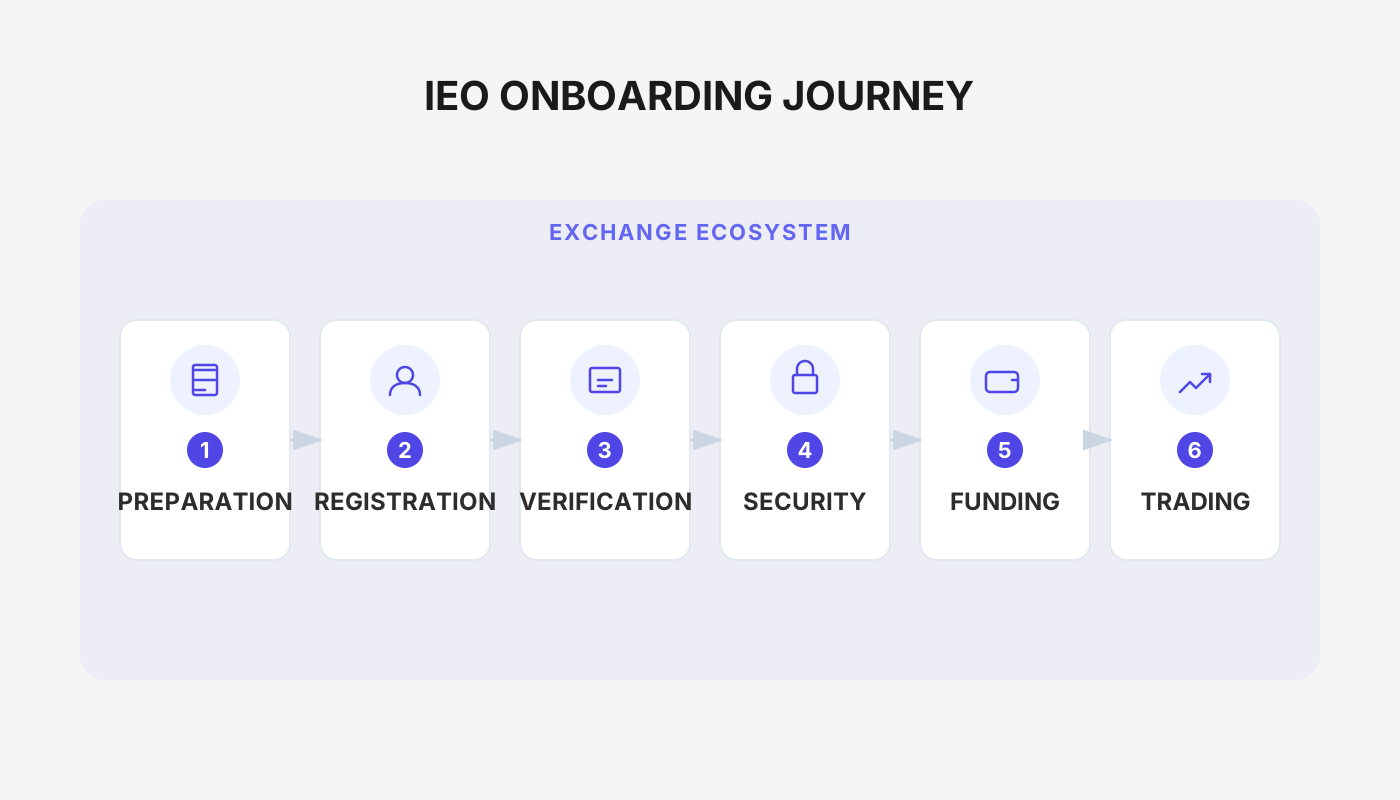
IEO (Initial Exchange Offering) – also called an “initial exchange issuance” – is a token‑issuance mechanism that places the exchange at the centre of the process. Participants must open an account on the relevant exchange and purchase the tokens during the offering period. The project team collaborates with the exchange to conduct the crowdfunding, listing, and marketing, thereby improving the efficiency of market entry.
Differences Between IEO and ICO
- Distribution channel: IEOs are listed directly on an exchange, bypassing the private‑placement stage that is typical of a traditional ICO.
- Token allocation: The founding team purchases a portion of the tokens first; the remainder is made publicly tradable on the exchange.
- Regulatory scrutiny: Exchanges perform an initial review of projects, which helps reduce the risk of non‑compliant offerings.
Advantages of IEOs
- Avoidance of policy restrictions
- Circumvents bans on private placements in certain jurisdictions; the issuance price is uniform, eliminating the multiple fee layers often seen during ICOs.
- Exchange‑provided user base
- Once a project signs a partnership with an exchange, it gains immediate exposure to that exchange’s active users, saving substantial marketing expenses.
- Wider utility
- Platform tokens are frequently used to offset trading fees, vote on listings, and perform other functions, which can enhance token value.
- Reduced investment risk
- Leading exchanges usually conduct rigorous due‑diligence, helping investors steer clear of obvious “air” tokens.
Disadvantages of IEOs
- Concentration of holdings among large accounts
- Although many exchanges impose purchase limits, a small number of “whales” may still acquire a sizable portion of the supply during the early phase, leading to price volatility.
- Uneven circulating supply
- If the circulating supply is too low and distribution is uneven, the project team may find it easier to manipulate the price, increasing risk.

Which IEO Tokens Are Currently Prominent?
Below is a list of ten actively traded IEO projects for reference (prices are typically quoted in USD; fiat deposits for global participants are usually made via SEPA or SWIFT transfers). U.S. users should use Binance.US or other U.S.-compliant exchanges instead of the global Binance platform.
| No. | Project | Key Features |
|---|---|---|
| 1 | **MATIC** | A Layer‑2 scaling solution for Ethereum that offers fast, low‑fee off‑chain transactions and side‑chain consensus. |
| 2 | **BTT** | A TRC‑10 utility token on the TRON network, building a bandwidth/storage economy for the BitTorrent ecosystem. |
| 3 | **ONE** | The native token of Harmony, employing sharding plus Effective Proof‑of‑Stake (EPoS) to achieve high throughput and security. |
| 4 | **FTM** | Governance token of Fantom, using the Lachesis DAG consensus to provide efficient validation for multi‑chain ecosystems. |
| 5 | **RSR** | Reserve’s governance token, aimed at creating a robust, on‑chain collateralised stablecoin system. |
| 6 | **FET** | Fetch.AI token that merges artificial intelligence with blockchain to create autonomous economic agents on the internet. |
| 7 | **COTI** | Payment‑network token that offers a proprietary stablecoin solution to reduce transaction volatility. |
| 8 | **SERO** | A coin supporting Turing‑complete privacy contracts, allowing anonymous asset issuance and confidential data storage. |
| 9 | **MBL** | MovieBloc ecosystem token, incentivising film creation, translation, and content curation. |
| 10 | **CELR** | Celer Network’s liquidity token, underpinning Layer‑2 scaling, payment channels, and anti‑fraud mechanisms. |
The table above provides a concise overview of the IEO concept and some of the most common tokens associated with it. For deeper analyses of additional IEO projects, stay tuned to Bitaigen’s forthcoming reports.
Related Reading
- SUI Token Listing Forecast: $0.20‑$5.20, Up to 100× Gain
- IEO Guide: Mechanism, ICO vs IDO Differences & Tips
- Initial Coin Offering (ICO): Mechanism, Benefits & Risks
💡 Register on Binance with referral code B2345 for the maximum trading fee discount. See Binance complete guide.



