
 Bitaigen Research
 In this article we systematically review the basic concepts, operational processes, and common strategies of liquidity mining, and deeply analyze its potential risks and the characteristics of leading platforms, helping you make clearer judgments within the decentralized finance ecosystem; subsequent sections will provide practical references.
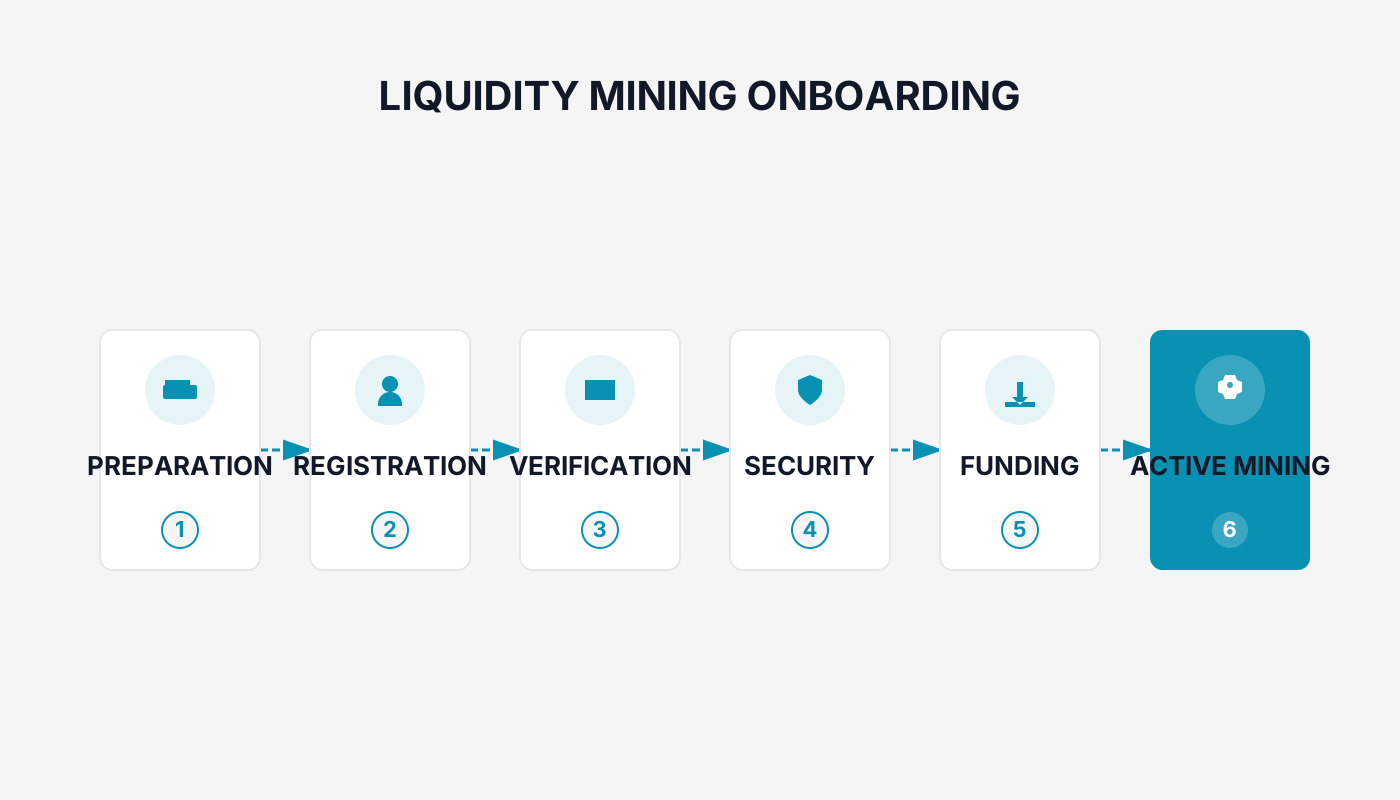
What Is Liquidity Mining? Participation Steps, Strategy Tips, Risk Analysis, and Platform Overview
Liquidity mining refers to the act of supplying assets to a liquidity pool on a decentralized finance (DeFi) platform in order to earn transaction fees and platform token rewards, with the option to stake LP tokens for additional returns.
What Is Liquidity Mining?
Origin and Development
Liquidity mining (Yield Farming / Liquidity Mining) is an investment strategy widely used in the DeFi space, centered on providing liquidity to an exchange or protocol in exchange for token rewards.
- In October 2017, the decentralized exchange IDEX launched the first program rewarding market makers.
- In June 2020, the Compound protocol formalized the concept, marking the official birth of modern liquidity mining.
Since then, liquidity mining has surged in popularity. DeFi Pulse shows that from June to October 2020, total value locked (TVL) in DeFi jumped from $1 billion to $10 billion; by October 2024, it was nearing $97 billion, underscoring the model’s strong appeal.
Comparison with Traditional Finance
| Feature | Liquidity Mining | Traditional Bank Deposit |
|---|---|---|
| Decentralization level | High, no intermediaries | Low, regulated by authorities |
| Entry barrier | Low, any token holder can participate | May require minimum deposit |
| Yield potential | Can reach tens or even hundreds of percent | Typically below 5 % |
| Risk type | Smart‑contract bugs, impermanent loss, etc. | Low market risk, protected by deposit insurance |
| Capital liquidity | High, withdrawable at any time | Depends on product, may be restricted |
Liquidity mining offers a new path for asset appreciation, but it also comes with technical and market risks.
Core Concepts of Liquidity Mining
Definition and Importance of “Liquidity”
Liquidity refers to an asset’s ability to be bought, sold, or converted to cash quickly and at low cost. High liquidity brings:
- Smoother trading
- Smaller price swings
- Lower transaction costs
Conversely, low liquidity leads to difficult trades, volatile prices, and high fees. For example, Bitcoin (BTC) averages about $30 billion in daily trading volume, whereas many niche tokens see only a few thousand dollars per day—highlighting the liquidity gap.
Evolution of the “Mining” Concept
Traditional mining relies on computational power to create new tokens; liquidity mining earns rewards by providing asset liquidity, requiring no specialized hardware. Its key characteristics are:
| Item | Traditional Mining | Liquidity Mining |
|---|---|---|
| Goal | Secure the blockchain network | Supply liquidity to DeFi platforms |
| Revenue source | Newly minted tokens | Transaction fees + platform token rewards |
| Equipment needed | ASICs, GPUs, etc. | Only crypto assets |
| Energy consumption | High | Low |
| Entry barrier | High | Low |
| Yield volatility | Affected by mining difficulty and token price | Affected by trading volume and token price |
Relationship Between DeFi and Liquidity Mining
Decentralized finance (DeFi) is an open financial ecosystem built on blockchain technology. Liquidity mining is a core component, addressing the chronic liquidity shortage that many DeFi projects face. Its workflow:
- Users deposit assets into a liquidity pool.
- The assets are used for trading, lending, and other financial activities.
- Based on each user’s share of the pool, they receive a portion of the fees and token rewards.
DeFi Pulse data shows TVL rising from $1 billion in 2020 to roughly $110 billion by November 2021, with liquidity mining being a major driver of that growth.
How Liquidity Mining Works
Liquidity Pools
Liquidity pools are asset reserves managed by smart contracts, usually presented as trading pairs (e.g., ETH/USDT). Liquidity providers (LPs) deposit equal‑value assets into the pool, making them available for traders at any time.
Trading Pairs and Pricing Mechanism
Within a pool, asset prices follow the constant product formula: `x * y = k` (where *x* and *y* are the quantities of the two assets, and *k* is a constant). For instance, a pool containing 100 ETH and 200,000 USDT implies a price of 1 ETH = 2,000 USDT.
Automated Market Makers (AMM)
AMMs use algorithms to calculate trade prices automatically, eliminating the need for a traditional order book. When a trade occurs, the asset ratios shift, automatically updating the price and enabling continuous trading.
Liquidity Providers (LP)
After depositing assets, LPs receive LP tokens that represent their share of the pool. Transaction fees are distributed proportionally to LPs, and many platforms also dispense additional token rewards. A simplified flow:
```
LP deposits assets → receives LP tokens
↓
Liquidity pool ↔ AMM ↔ Trader
↓
Fees generated → distributed to LPs
```
How to Participate in Liquidity Mining
Step 1: Choose a Reputable DeFi Platform
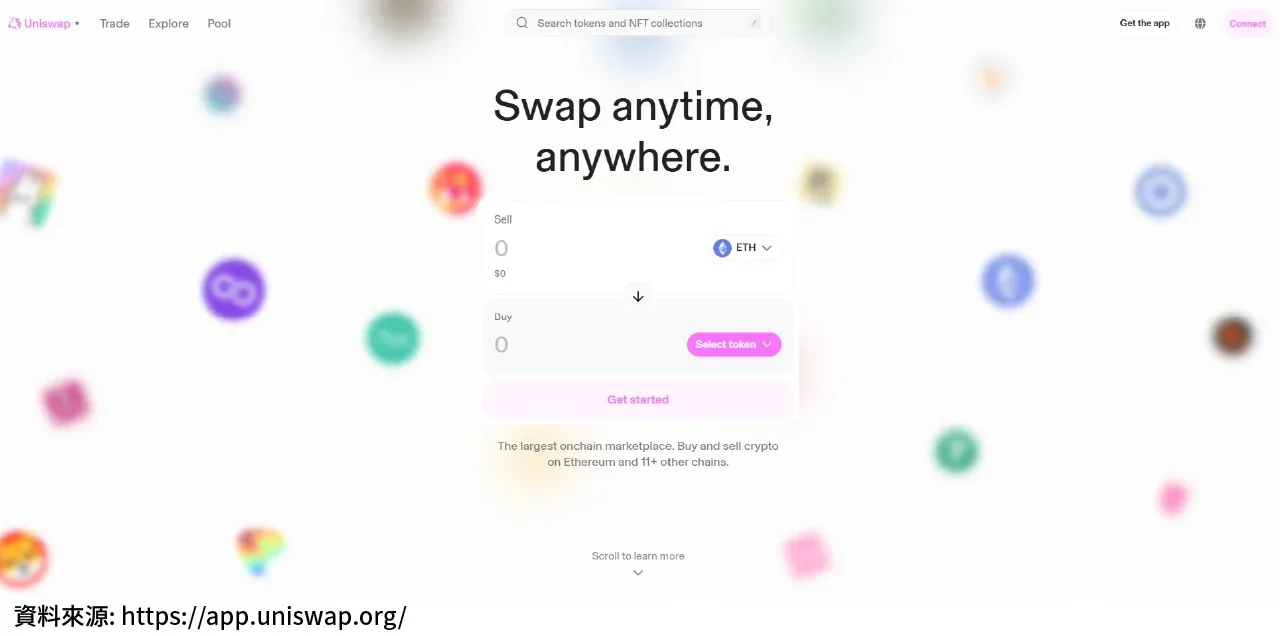
Popular platforms include Uniswap, PancakeSwap, SushiSwap, and others. Evaluation criteria: security audits, pool size, historical yields. PancakeSwap runs on the Binance Smart Chain (BSC), offers low fees, and is beginner‑friendly.
Step 2: Prepare the Required Tokens
Usually you need a pair of equal‑value tokens (e.g., ETH/USDT, BNB/CAKE) and a small amount of native blockchain currency to cover transaction (gas) fees.
Step 3: Deposit into a Liquidity Pool
- Connect your wallet (e.g., MetaMask) to the platform.
- Click “Add Liquidity” or “Provide Liquidity”.
- Enter the amount you wish to deposit; the interface will automatically calculate the required amount of the paired token.
Step 4: Receive LP Tokens and Stake Them
After providing liquidity you will obtain LP tokens. Transfer these to the platform’s “Farm” or “Staking” page to start earning fee shares and token rewards. Some platforms support automatic compounding.
Sources of Returns and APY Calculation
Transaction Fee Share
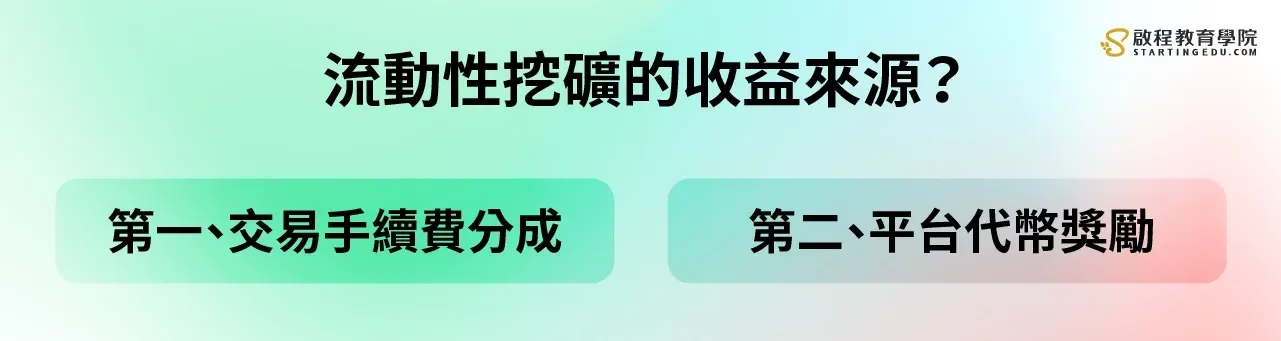
On DEXs such as Uniswap and PancakeSwap, traders pay a fee (e.g., 0.3 %). The majority of that fee (e.g., 0.25 %) is sent directly to LPs.
Platform Token Rewards
Most protocols also distribute governance tokens (e.g., COMP, UNI). Holders can participate in platform governance, and token price fluctuations may generate extra upside.
Annual Percentage Yield (APY) Formula
```
APY = ((1 + daily return) ^ 365 – 1) * 100%
```
The daily return comprises fee income plus token rewards. Example: In PancakeSwap’s CAKE‑BNB pool, a daily return of 0.1 % translates to an APY of roughly 44 %.
Risk Analysis
| Risk Type | Description |
|---|---|
| **Impermanent loss** | When the price ratio of the two assets in a pool changes, LPs may end up with less value than if they had simply held the assets. |
| **Smart‑contract vulnerabilities** | Bugs in contract code can be exploited, potentially resulting in loss of funds. |
| **Project‑team risk** | Fraudulent or abandoned projects can lead to total asset loss. |
| **Market volatility** | Sharp token price swings may wipe out reward earnings. |
| **Regulatory environment** | Changes in jurisdictional regulations can affect the legality and operational space of liquidity mining. |
Liquidity mining opens a novel route for asset growth, but it carries both technical and market‑related hazards.
Common Strategies and Tips
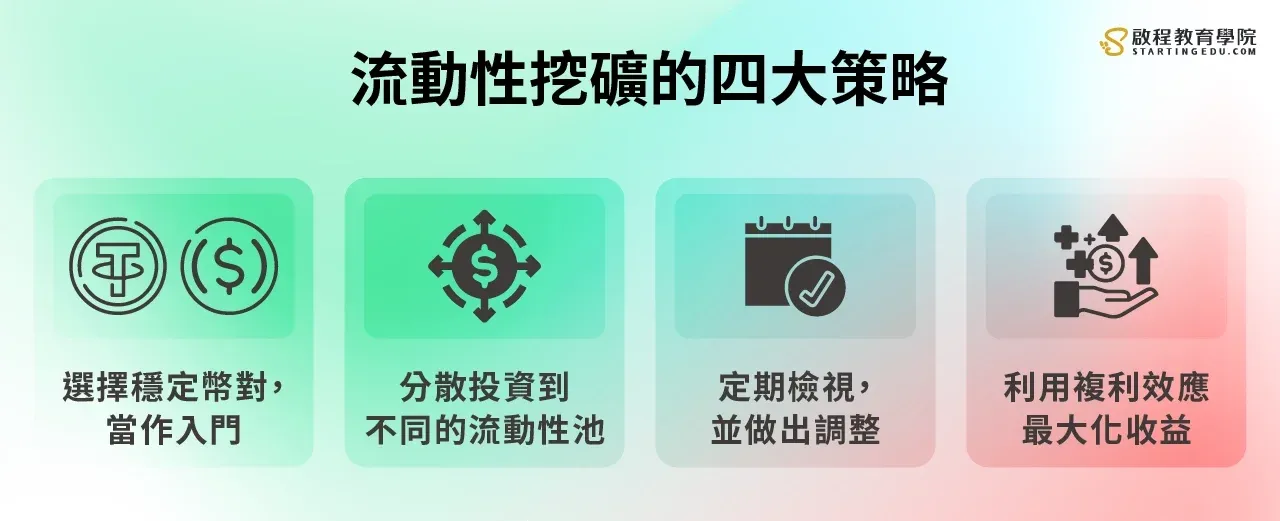
- Stablecoin pairs for beginners – e.g., USDT/USDC have minimal price movement, reducing impermanent loss. Curve’s stablecoin pools typically offer 1‑5 % APY.
- Diversify across pools and platforms – spreads risk rather than concentrating on a single pool.
- Regular review – check pool performance and risk metrics weekly; rebalance when necessary.
- Leverage compounding – use platforms that auto‑reinvest rewards (e.g., Yearn Finance) to boost long‑term returns.
New participants are advised to start with modest capital, gain experience gradually, and stay informed about market developments.
Overview of Leading Liquidity Mining Platforms
Centralized Exchanges (CEX)
- Binance: Offers “Liquidity Mining” and “Dual‑Asset Investment” products with a user‑friendly interface, suitable for beginners. U.S. users must use Binance.US rather than the global Binance platform.
Decentralized Exchanges (DEX)
| Platform | Underlying Chain | Highlights |
|---|---|---|
| Uniswap | Ethereum | Largest Ethereum DEX, provides fee sharing and UNI rewards |
| PancakeSwap | Binance Smart Chain | Low fees, ideal for small‑scale participants |
| SushiSwap | Multi‑chain | Supports many chains, offers extra SUSHI incentives |
| QuickSwap | Polygon | Very low gas fees, good for high‑frequency trading |
| Raydium | Solana | High speed, low cost, supports diverse pool types |
| Trader Joe | Avalanche | Varied yield models, active community |
Cross‑Chain Liquidity Mining Opportunities
- Cosmos IBC: Enables cross‑chain asset transfers, laying groundwork for cross‑chain liquidity mining.
- Cross‑chain bridges such as Wormhole and LayerZero are exploring synchronized liquidity provision across multiple chains.
Future Development Focus
- Cross‑chain liquidity mining – Bridging assets across chains to expand yield sources.
- Integration with other DeFi products – Liquidity providers can simultaneously engage in lending, derivatives, etc., creating “double‑dip” earnings. Aave’s liquidity mining program exemplifies this synergy.
- Regulatory landscape – Balanced regulation could attract institutional participation, while overly restrictive rules may stifle innovation. Ongoing SEC scrutiny of whether tokens constitute securities has already influenced several projects’ operating models.
Frequently Asked Questions (FAQ)
Q1: What concepts should a liquidity‑mining beginner master?
A: Understanding liquidity pools, impermanent loss, APY (annual percentage yield), and smart‑contract risks are essential fundamentals.
Q2: How do I perform liquidity mining on Binance?
A:
- Log in to the Binance app or website.
- Navigate to Earn → Liquidity Mining.
- Choose a trading pair and deposit funds (single‑asset or dual‑asset).
- Confirm the transaction; the platform will automatically allocate your capital to the selected pool and start generating returns.
Q3: What is a “liquidity miner” (or “liquidity mining rig”)?
A: It is not a physical device; the term refers to the smart‑contract or protocol that supplies liquidity via an AMM model. Users simply lock assets to participate.
Q4: What is the PTT community’s view on liquidity mining?
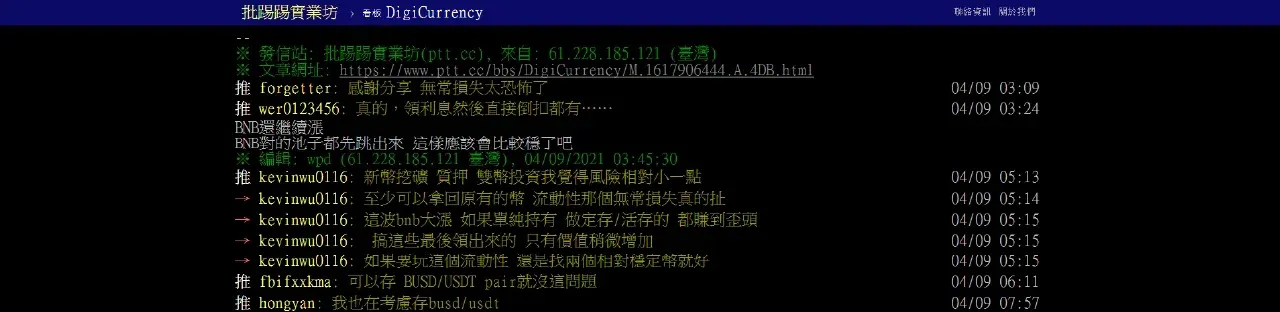
A: Community members generally acknowledge the high upside but also the significant risk. They recommend newcomers start with stablecoin pairs, verify platform security, diversify investments, and avoid blind capital allocation.
Q5: What practical precautions should I take during actual operations?
A:
- Choose platforms with solid reputations and audit reports.
- Begin with a small amount of capital and scale up gradually.
- Monitor yields and risk metrics regularly.
- Calculate and assess potential impermanent loss.
- Stay updated on market and regulatory developments; adjust strategies promptly.
- Diversify across multiple pools to avoid concentration risk.
- Be aware that crypto gains may be taxable in your jurisdiction; consult a tax professional if needed.
- Safeguard private keys and passwords diligently.
This guide provides a comprehensive overview of liquidity mining, covering concepts, steps, strategies, risks, and platform information. For deeper insights, follow Bitaigen (比特根) and its upcoming articles.
Related Reading
- Liquidity Mining in DeFi: Risks & How to Safeguard Funds
- Liquidity Mining Explained: Core Concepts, LP Roles & Yield Sources
- Liquidity Mining Guide: Earn Rewards on DeFi Platforms
💡 Register on Binance with referral code B2345 for the maximum trading fee discount. See Binance complete guide.



