
 Bitaigen Research
 The Global Transformation of Asset Ownership, Trading, and Valuation
The way assets are owned, traded, and valued worldwide is undergoing a profound shift. Blockchain technology has already reshaped the financial landscape through cryptocurrencies and decentralized finance (DeFi), and the next wave is being driven by Real‑World Asset (RWA) Tokenization.
RWA tokenization uses blockchain to turn tangible assets into digital tokens that can be traded on‑chain, with each token representing a fractional ownership or entitlement to the underlying asset.
As institutions, retail investors, and governments increasingly accept digital representations of real‑estate, commodities, equity, and even intellectual property, it is projected that by 2030 the global asset market will be deeply dominated by RWA tokenization. This transition will remodel liquidity, ownership models, and financial inclusion on an unprecedented scale.
This article systematically analyzes why RWA tokenization is set to dominate the asset market before 2030, the advantages it brings, the key sectors it will affect, the challenges it faces, and the future market landscape.
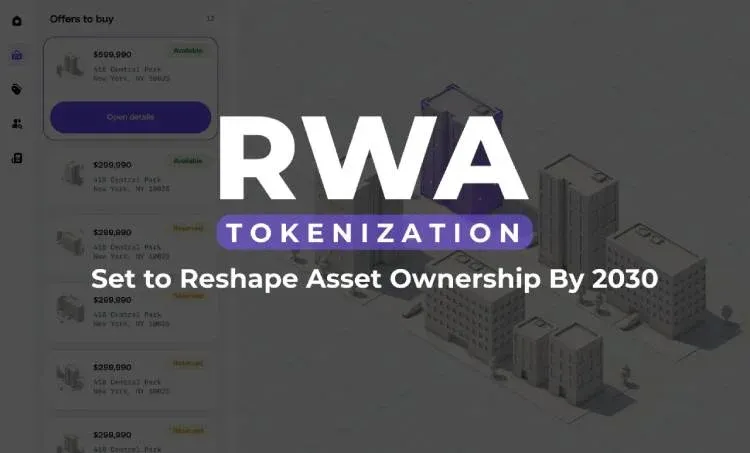
In this piece we outline the core concepts of RWA tokenization and its far‑reaching impact on traditional asset circulation, focusing on technical implementation, regulatory barriers, and market opportunities. The goal is to give readers a comprehensive view of the logic and challenges behind this emerging trend. Subsequent sections will dive deeper into case studies and future directions, making it a worthwhile read.

What Is RWA Tokenization?
RWA tokenization refers to the process of converting real‑world assets—such as real estate, gold, artwork, equity stakes, and more—into digital tokens via blockchain. Each token represents a fractional ownership or entitlement to the underlying asset, and holders can trade it 24/7 on the chain without the cumbersome paperwork typically required by traditional financial intermediaries.
- Programmable: Asset attributes can be encoded into smart contracts, enabling automated settlement.
- Globally Accessible: Anyone with an internet connection can participate across borders.
- High Liquidity: Tokens can be bought or sold instantly on secondary markets, breaking the liquidity constraints of conventional assets.
The Global Asset Market in 2030
- The total valuation of real‑world assets worldwide is roughly USD 8 trillion, but most suffer from poor liquidity.
- Forecasts suggest that by 2030, USD 16‑30 trillion worth of real‑world assets will be tokenized, creating an efficient, open investment ecosystem.
- As blockchain infrastructure matures, RWA tokenization will shift from a niche concept to an industry standard.
Why RWA Tokenization Will Dominate Before 2030
1. Enhanced Liquidity
Traditional real‑estate or private‑equity transactions can take weeks or months. Tokenization fragments assets into small‑value tokens that can be traded instantly on secondary markets, dramatically improving liquidity.
2. Global Accessibility
Blockchain removes geographic borders. An investor in Singapore can purchase a Brazilian farmland plot or a New York rental property via a mobile app, achieving true cross‑border investment.
3. Fractional Ownership
High‑value assets no longer remain exclusive to the ultra‑wealthy. Tokenization breaks assets into affordable digital units, allowing a broader pool of investors to participate.
4. 24/7 Market Operation
Blockchain‑based assets can be traded around the clock, enhancing price discovery and providing continuous liquidity.
5. Greater Transparency and Trust
Every transaction and ownership change is recorded on an immutable ledger, offering an auditable trail that reduces fraud risk and bolsters confidence among regulators and investors.
Key Sectors Affected by RWA Tokenization
| Sector | Tokenization Value | Future Trend |
|---|---|---|
| **Real Estate** | Enables global reach, rapid settlement, and streamlined documentation | City‑level blockchain land registries will gradually roll out |
| **Equity / Venture Capital** | Assets become divisible, allowing global capital raises | Startup financing channels become more diversified |
| **Commodities** (gold, oil, agricultural products) | Existing tokens such as PAX Gold and Tether Gold | Deep integration with DeFi, serving as collateral or trade assets |
| **Art & Collectibles** | Fractional ownership makes high‑value pieces tradable | Museums or galleries may launch tokenized exhibitions |
| **Infrastructure & Public Assets** | Token‑funded roads, airports, renewable‑energy projects | Citizens can directly share in public‑project revenues |
Institutional Adoption Fuels Growth
Early platforms focused on retail users; the next growth phase will be driven by banks, hedge funds, and asset‑management firms. Institutions such as BlackRock, JPMorgan, and Goldman Sachs are already piloting tokenized assets on blockchain. Once regulatory frameworks solidify, RWA tokenization is expected to become a standard component of institutional portfolios.
Regulatory Evolution Accelerates Tokenization
Regulatory uncertainty remains the primary obstacle today. Recent developments include:
- European Union: The MiCA framework provides a unified regulatory regime for token markets.
- United States: The SEC and CFTC are engaging with tokenization platforms to explore compliant pathways. (U.S. residents should use Binance.US or other locally authorized exchanges.)
- Asia‑Pacific: Singapore, Hong Kong, and other jurisdictions have launched regulatory sandboxes to encourage innovative experiments.
It is anticipated that by 2030 a harmonized global regulatory framework will emerge, offering a legally sound environment for large‑scale tokenization.
Tax note: Gains from cryptocurrency and tokenized asset transactions may be taxable in the holder’s jurisdiction. Participants should consult local tax advisors and comply with reporting obligations, such as using SEPA or SWIFT for fiat settlements where applicable.
Synergy Between RWA Tokenization and DeFi
RWA tokens can serve as collateral for DeFi loans, act as assets in liquidity pools, or be traded directly on decentralized exchanges (DEXs). This synergy will:
- Unlock the security of real‑world assets for blockchain finance
- Bring blockchain’s efficiency and low‑cost settlement to tangible assets
- Spawn novel financial products (e.g., tokenized carbon credits, patent‑revenue NFTs)
Challenges and Potential Solutions
- Cross‑jurisdictional Ownership Enforcement: Requires multi‑country legal coordination mechanisms.
- Technical Standardization: Token metadata and interoperability standards (e.g., ERC‑3643) are gradually converging.
- Physical‑Asset Custody: Trustworthy custodians and insurance schemes are being established.
- Education and Trust: Industry associations and regulators need to strengthen investor education.
Blockchain alliances, regulators, and leading platforms are actively building the needed infrastructure. By 2030, these challenges are expected to be largely mitigated by mature solutions.
Real‑World Examples
- MakerDAO – Accepts tokenized real‑estate as collateral.
- Securitize – Partners with Polymath to issue SEC‑compliant tokenized securities.
- Centrifuge – Enables tokenized invoices and supply‑chain assets for DeFi use.
- RealT – Implements fractional ownership of U.S. real‑estate on Ethereum.
- BlackRock & UBS – Experimenting with tokenized bond markets.
These cases demonstrate that RWA tokenization has moved from theory to concrete implementation.
The 2030 Global Market Landscape
- Scale: Sub‑markets collectively valued in the multi‑trillion‑USD range.
- Secondary Markets: Provide global trading channels for traditionally illiquid assets.
- Real‑Time Peer‑to‑Peer Settlement: Investments and trades settle instantly.
- New Financial Instruments: Tokenized carbon credits, patent‑revenue streams, yield‑bearing NFTs, and other innovations emerge.
- Economic Inclusion: Billions of people may obtain their first asset ownership, making the financial system faster, fairer, and more accessible.
Final Reflections
RWA tokenization is redefining how assets are perceived, valued, and exchanged. As blockchain infrastructure matures, regulatory environments solidify, and institutional participation deepens, tokenized real‑world assets are set to become a core pillar of the global asset market by 2030. For investors, entrepreneurs, and policymakers, the future of assets is tokenized, borderless, and operational 24/7.
This article focuses on “What Is RWA Tokenization? – Market Outlook and Challenges.” For more related content, search for historical pieces by Bitaigen or continue reading the articles linked below. Thank you for your interest and support!
Related Reading
- OKX Referral Code: Step-by-Step Registration Guide
- LBank Review: Global Crypto Exchange Features, Fees & Volume
- Real‑World Asset Tokenization: Concepts, Asset Classes & Top 10 Projects
💡 Register on Binance with referral code B2345 for the maximum trading fee discount. See Binance complete guide.



