
 Bitaigen Research
 Cryptocurrency spot trading involves actually holding the coin, while contracts are derivative agreements on price movements. The two differ markedly in how assets are held, how trades are executed, fee structures, leverage options, and risk profiles.
Cryptocurrency trading is primarily divided into spot trading and futures (contract) trading as two distinct tools.
Spot trading means truly owning a specific cryptocurrency, and the holder can transfer it to any wallet address.
Contract trading, on the other hand, involves holding a futures contract whose value mirrors a certain amount of cryptocurrency, but the investor does not actually own the underlying coin; the contract is issued by the exchange for both buyers and sellers.
Many newcomers, when they first encounter crypto, mistakenly assume that every transaction is simply a buy or sell.
In reality, the operational logic, profit mechanisms, and risk exposures are fundamentally different.
Are you holding the actual cryptocurrency, or merely betting on price movements? This article will thoroughly compare the core differences between cryptocurrency spot and contract trading, helping you choose the method that best fits your trading style.
In this article we systematically outline the key distinctions between spot and contract trading, covering positions, leverage, fees, and risk. The goal is to help both beginners and more experienced traders clarify the trading logic and make choices that align with their personal needs. If you want to understand which approach better suits your investment strategy, keep reading.
What Is Cryptocurrency Spot Trading?
Cryptocurrency spot refers to assets that can be physically owned. In simple terms, spot trading is the direct purchase of a target coin using fiat currency (e.g., USD) or another cryptocurrency, followed by genuine ownership.
Key characteristics of cryptocurrency spot:
- The cryptocurrency is actually held and can be moved to other wallets.
- Trading fees are slightly higher than those for contracts.
- Only long (buy) positions are possible; direct shorting is not supported.
- No leverage is available.
On the blockchain, the purchased Bitcoin is recorded on the ledger of the corresponding address; users can see the real BTC in their wallet or exchange account and then freely transfer, stake, or sell it. Spot trading is straightforward: buy low, sell high, profiting from price appreciation, conceptually similar to stock trading. Spot positions are long‑only, and the transaction price is the current market price rather than a future contract price.
What Is a Cryptocurrency Contract?
Cryptocurrency contracts are perpetual futures contracts that use a cryptocurrency as the underlying asset, falling under the category of derivative financial products.
Key characteristics of cryptocurrency contracts:
- The underlying coin is not actually held and cannot be transferred to a wallet.
- Transaction costs are generally lower than spot trading.
- Both long and short positions are allowed.
- Leverage is supported (but comes with liquidation risk).
- Most are perpetual contracts with no expiry date, but they feature a Funding Rate mechanism.
Contract trading amplifies positions through leverage, allowing traders to control a large exposure with a relatively small margin deposit. Fees can be as low as 20 % of spot fees or even less, making contracts attractive for short‑term speculation or hedging. The ability to short enables profit when prices fall, or to hedge spot holdings. Overall, contracts offer greater flexibility in fees, trading tactics, and strategy choices, but the leverage and margin system increase operational risk, so participants should fully understand the mechanics before engaging.
Contracts vs. Traditional Futures
Although both are called “Futures” in English, perpetual contracts differ from traditional futures: perpetual contracts have no expiry date and can be held indefinitely. The comparison table below highlights the differences:
| Item | Perpetual Contract | Delivery (Traditional Futures) |
|---|---|---|
| Issuer | Crypto exchange | Traditional futures exchange |
| Margin required | Yes | Yes |
| Leverage ratio | Flexible, adjustable | Fixed or limited |
| Physical coin held | No | No |
| Expiry date | None | Yes |
| Settlement method | Daily funding rate adjusts price gap | Settlement at expiry based on spot price |
| Fee structure | Trading fee + Funding Rate | Trading fee + Delivery fee |
For details on Binance’s perpetual contracts, see “What is contract trading? A comprehensive guide to Binance US‑margin and coin‑margin contracts.”
Binance (global) is the world’s largest cryptocurrency exchange, serving over 200 million users and offering a wide range of spot and contract services. U.S. residents should use Binance.US instead of the global platform.
Spot Trading vs. Contract Trading: The Differences
| Comparison Item | Spot Trading | Contract Trading |
|---|---|---|
| Asset ownership | Actual cryptocurrency owned, free to use | Pure price contract, no coin ownership |
| Trading method | Buy → Hold → Sell, suitable for long‑term or short‑term | Go long or short via contracts, no need to actually buy the coin |
| Fee structure | Only trading fee | Trading fee + Funding Rate (paid by long or short side depending on market) |
| Profit source | Gains from price increase | Gains from price movement in either direction |
| Leverage usage | No leverage; full capital required | Leverage available to amplify position |
| Directionality | Long‑only | Both long and short |
| Risk | Price decline leads to loss, no liquidation risk | Leverage amplifies risk; insufficient margin triggers forced liquidation |
1. Asset ownership
Spot trading gives you actual coins that can be transferred or staked. Contract trading only bets on price direction; you do not own the coin.
2. Trading method
Spot follows a linear “buy‑hold‑sell” flow. Contracts allow profit from price swings by taking long or short positions on the contract itself.
3. Fee structure
Spot incurs only the exchange’s trading fee. Contracts require the fee plus a Funding Rate, which is periodically exchanged between long and short participants based on market conditions.
4. Profit source
Spot profits arise solely from price appreciation. Contracts can generate profit whether the price rises or falls, as long as the trader’s directional view is correct.
5. Leverage usage
Spot demands the full amount of capital (e.g., buying $100,000 worth of Bitcoin requires $100,000). With contracts, a $500 margin could control a $5,000 position, depending on the chosen leverage. Before using leverage, verify the actual position size and ensure it matches your risk tolerance.
6. Directionality
Spot is long‑only; you must own the asset before you can sell it. Contracts support both long and short, allowing you to trade during market downturns.
7. Risk
The primary risk in spot is a price drop that reduces the value of your holdings. Contracts carry additional liquidation risk due to leverage; if margin falls below the maintenance level, the exchange will automatically close the position.
Tax note: Crypto gains may be taxable in your jurisdiction. Be sure to consult local tax regulations and consider reporting requirements for both spot and contract profits.
How to Access Cryptocurrency Markets
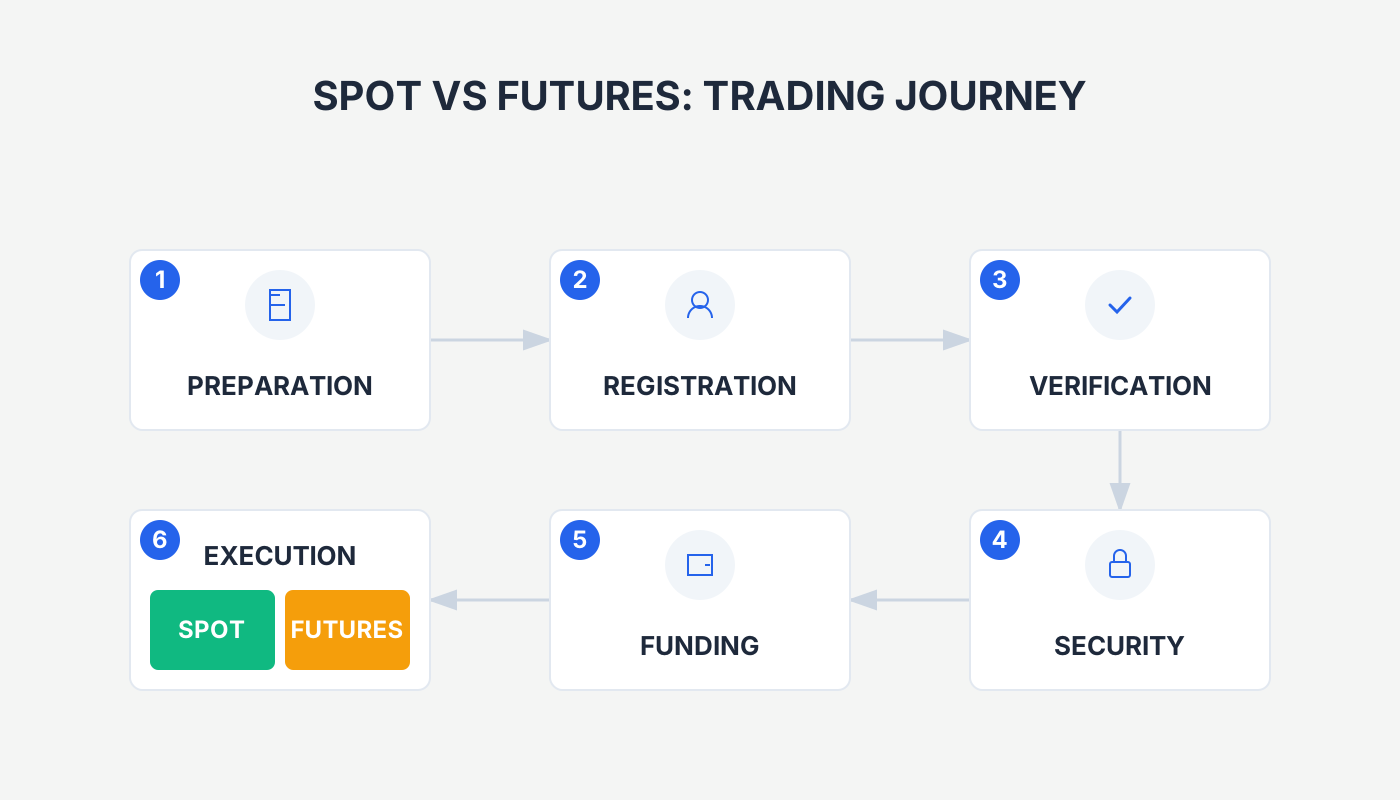
Both spot and contract products are available on cryptocurrency exchanges.
Centralized Exchanges (CEX)
Choose an exchange that offers fiat on‑ramps for your region (e.g., SEPA for Euro users, SWIFT for USD transfers) or a major global platform such as Binance.
Reference guide: “2025 Binance Beginner’s Tutorial” covering account creation, two‑factor authentication, and buying/selling procedures.
Decentralized Exchanges (DEX)
DEX trading only requires a wallet‑to‑wallet connection, with no centralized custody.
- Verify that the target DEX supports the cryptocurrency you wish to trade.
- Connect the appropriate blockchain network and hold enough native tokens to cover gas fees.
- Spot DEXs and contract DEXs are usually separate, so you’ll need to use different platforms for each.
---
This completes the comprehensive side‑by‑side comparison of “Cryptocurrency Spot vs. Contracts: What’s the Difference?” For more practical information on spot and contract trading, you can search the Bitaigen (比特根) archive or continue reading the related articles below. Thank you for your attention, and we hope you make smarter choices in the crypto world!
Related Reading
- Beginner's Guide to Passive Crypto Investing with Binance Earn
- Crypto Spot Trading Guide: Basics, Risks & BTCC Steps
- Ethereum Liquid Staking Tokens: Yields, Platforms & Risks
💡 Register on Binance with referral code B2345 for the maximum trading fee discount. See Binance complete guide.



