
 Bitaigen Research
 Bitcoin Price Tracking Complete Guide: Real‑Time Chart Tools, Buying & Selling Tutorial, and Future Trend Analysis
Tags: Bitcoin, BTC, price tracking, price prediction, market watching, trend analysis
In this article we systematically outline the core drivers of Bitcoin’s price, provide tips for using real‑time charting tools, highlight key points for buying and selling, and deliver an in‑depth analysis of future price movements. By combining macro‑economic, industry‑chain, and market‑sentiment dimensions, we help readers make more rational judgments across different time frames. Want to learn how to capture critical market signals? Keep reading.
2. The Three Key Factors Influencing Bitcoin’s Market
Bitcoin’s price swings are not random; they result from a combination of macro‑economic conditions, internal industry dynamics, and market sentiment. Understanding these drivers helps investors assess market conditions with greater confidence.
1. Macro‑Economic Perspective: U.S. Interest Rates, Inflation Data, and Regulatory Trends
- U.S. interest rates: When the Federal Reserve raises rates, traditional low‑risk assets become more attractive, prompting some capital to flow out of high‑risk markets like Bitcoin and putting downward pressure on its price. Conversely, rate cuts can stimulate capital inflows and lift prices.
- Inflation indicators: When indices such as the Consumer Price Index (CPI) show rising inflation, a segment of investors treats Bitcoin as “digital gold” to hedge fiat‑currency depreciation.
- Regulatory policies: The stance of major financial hubs—including Hong Kong and the United States—directly influences market sentiment and capital flows.
2. Internal Industry Dynamics: Halving Events and ETF Capital Flows
- Bitcoin halving: Approximately every four years the block‑reward is cut in half, sharply reducing the rate of new supply. If demand stays steady or rises, theory suggests this creates upward price pressure. All previous halvings have been accompanied by pronounced bull markets.
- ETF capital flows: Spot Bitcoin ETFs give traditional institutions a compliant entry point. Monitoring daily net inflows or outflows of these funds can quickly reveal shifts in institutional sentiment.
3. Market Sentiment and Technical Indicators
Short‑term volatility is often driven by trader psychology. The Fear & Greed Index aggregates volatility, trading volume, social‑media buzz, and other data to reflect overall market mood. Extreme greed frequently hints at a pending correction, while extreme fear can signal buying opportunities on the dip.
1. Overview of the Latest Real‑Time Market Data and Charting Tools
Key takeaway: To fully grasp BTC’s price rhythm, combine professional charting platforms with the real‑time quotes from exchanges, creating a multi‑dimensional view of price, depth, and volume.
1. TradingView: An All‑Round Charting Platform
TradingView acts like a “Swiss Army knife” for financial analysis. It not only aggregates BTC quotes from multiple exchanges (e.g., Binance, Coinbase, Kraken, etc.) but also offers hundreds of technical indicators and community scripts, catering to beginners and advanced users alike. Frequently used features include:
- Cross‑exchange price comparison: Instantly switch between BTC/USD or BTC/USDT quotes from different venues to spot arbitrage opportunities.
- Advanced drawing tools: Moving Averages (MA), Relative Strength Index (RSI), Fibonacci retracements, and many more are available with a single click.
- Price alerts: Set critical price levels and receive instant notifications via the app, email, or browser pop‑ups, ensuring you never miss important moves.
Example: If you believe a breakout above $70,000 signals a buying opportunity, you can set a corresponding alert on TradingView; once triggered, execute your trade plan immediately.
2. Real‑Time Quotes on Major Exchanges: Binance and Coinbase
While TradingView’s charting capabilities are powerful, actual buying and selling happen on exchanges. Therefore, keeping an eye on the live quotes of the platforms you intend to trade on remains essential.
- Binance: The world’s largest exchange, offering deep liquidity, tight spreads, and a variety of products (spot, futures, etc.). Suitable for users with trading experience. U.S. residents should use Binance.US instead of the global platform.
- Coinbase: A U.S.-listed, heavily regulated exchange with a clean UI and user‑friendly experience, ideal for beginners and those who prioritize custodial security.
Both exchange pages display the last trade price and an “Order Book” depth view, providing intuitive cues for short‑term support and resistance levels.
3. How to Buy Bitcoin
After mastering the market tools, the next step is to execute an actual purchase. Below is a three‑step guide tailored to the Hong Kong market, designed for newcomers seeking a safe entry.
1. Choose and Register with a Reputable Crypto Exchange
Selecting a platform that holds a regulatory license, offers transparent fees, and delivers a smooth user experience is the foundation. Evaluate potential exchanges on the following dimensions:
- Regulatory compliance: Prioritize exchanges licensed by the local securities regulator or equivalent authority.
- Fee structure: Compare maker/taker fees as well as deposit and withdrawal costs.
- User experience: Check whether the web or mobile app runs smoothly and whether customer support responds promptly.
Below is a concise comparison of popular platforms (fees, deposit methods, and promotional codes are retained exactly as in the source).
| Exchange | Spot Fee | Futures Fee | Deposit/Withdrawal Methods | New‑User Benefits | Official Link |
|---|---|---|---|---|---|
| OKX | 5.0% | 0.08% – 0.1% | 0.02% – 0.05% | Alipay, WeChat P2P / Bank Card – Invite code `B2345` for new‑user promo +20% fee discount | [Official Registration](https://www.bitaigen.com/binance) |
| Binance (global) | 5.0% | 0.10% | 0.02% – 0.05% | Alipay, WeChat P2P / Bank Card – Invite code `B2345` for new‑user promo +20% fee discount | [Official Registration](https://www.bitaigen.com/binance) |
| Gate.io | 5.0% | 0.10% | 0.02% – 0.05% | Alipay, WeChat P2P / Bank Card – Invite code `VLIWUGTFAA` for new‑user promo +20% fee discount | Official Registration |
| Bybit | 4.9% | 0.10% | 0.01% – 0.055% | P2P, Bank Card, Apple Pay / Google Pay – Invite code `B2345` for new‑user promo +20% fee discount | Official Registration |
| Bitget | 4.9% | 0.10% | 0.02% – 0.06% | Bank Card, P2P Credit Card deposit – Invite code `vxje` for new‑user promo +20% fee discount | Official Registration |
| Huobi | 4.9% | 0.20% | 0.02% – 0.06% | Alipay, WeChat P2P / Bank Card – Invite code `b6yq8223` for new‑user promo +20% fee discount | Official Registration |
Note for U.S. users: Use Binance.US or another U.S.-registered exchange instead of the global Binance platform.
2. Complete Identity Verification (KYC)
KYC (Know‑Your‑Customer) is mandatory on compliant exchanges. You’ll need to upload a government‑issued ID (passport, national ID, etc.) and undergo facial recognition to prevent financial crime and secure your account. The steps below illustrate the process on Binance (the flow is similar on other platforms).
- After logging in, click the avatar in the top‑right corner and select “Identity Verification.”
- On the “Personal Identity Verification” page, tap “Start Verification.”
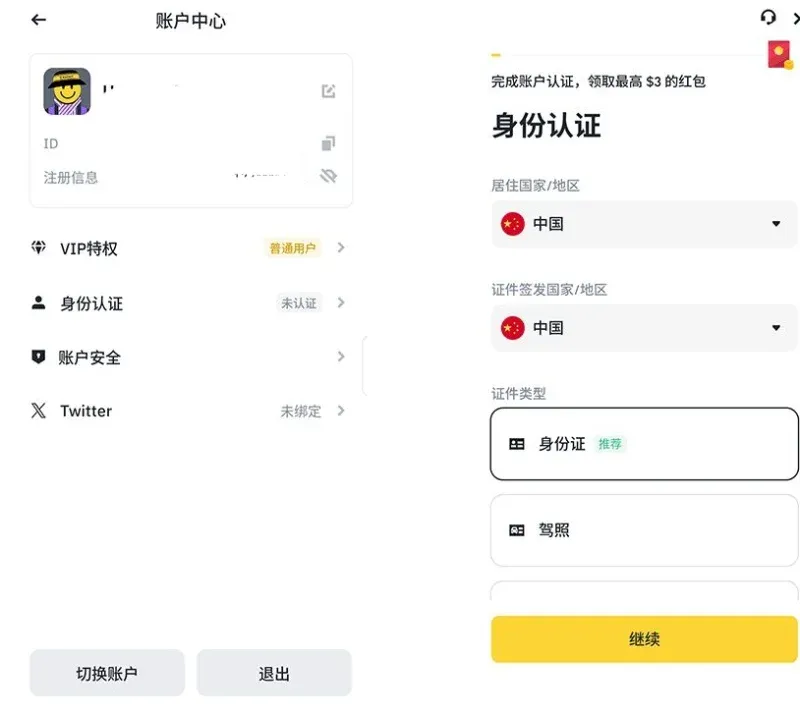
- Upload a clear photo of your ID (passport, national ID, etc.) ensuring there’s no glare or obstruction.
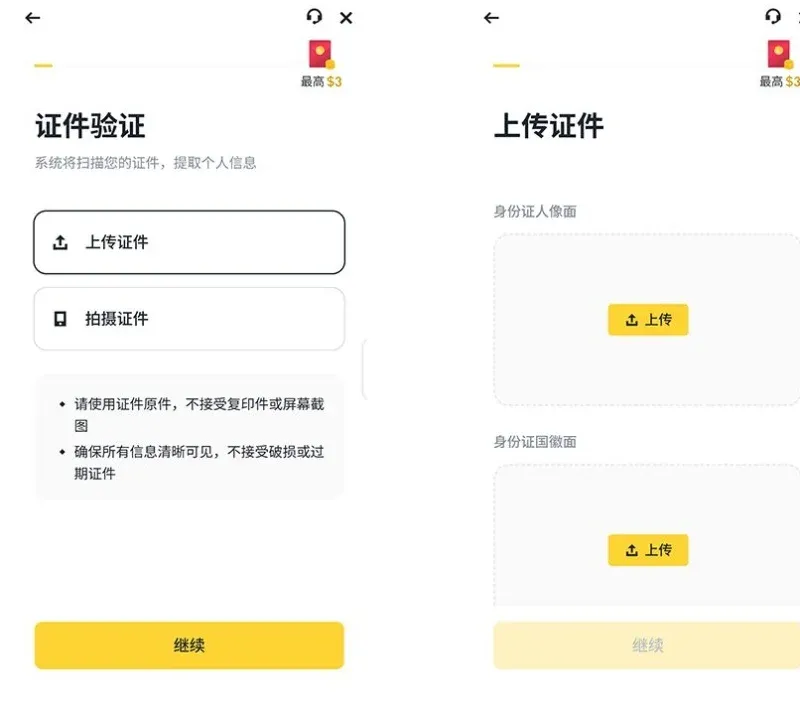
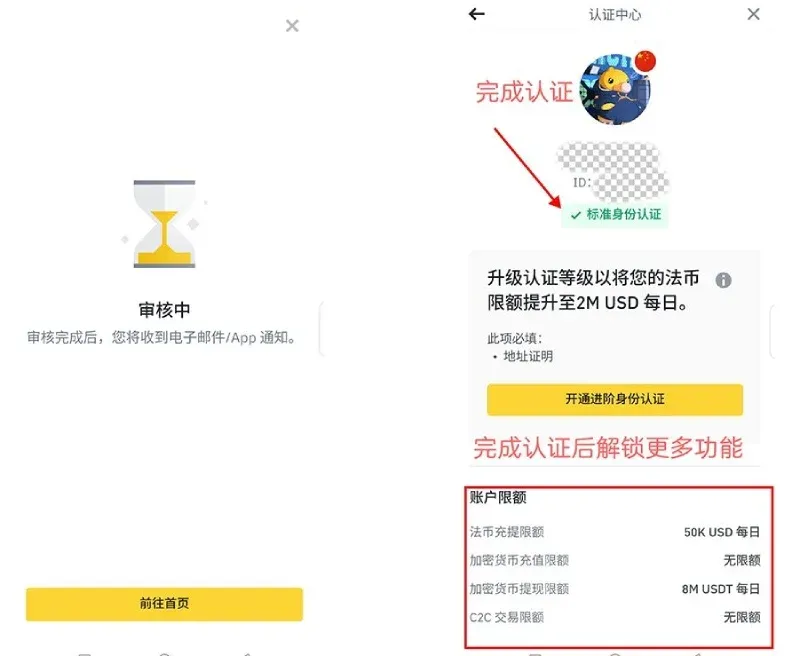
- After submission, the platform typically completes the review within 2 hours. Once approved, higher trading and withdrawal limits become available.
3. Deposit via P2P or Credit Card and Place a BTC Order
There are two primary deposit routes:
- P2P (peer‑to‑peer): Supports local payment methods (e.g., FPS, bank transfers). Exchange rates are often competitive, but you must choose reputable counterparties.
- Credit Card: Extremely convenient and near‑instant, though fees are higher (typically 2 %–4 %) and some banks impose limits.
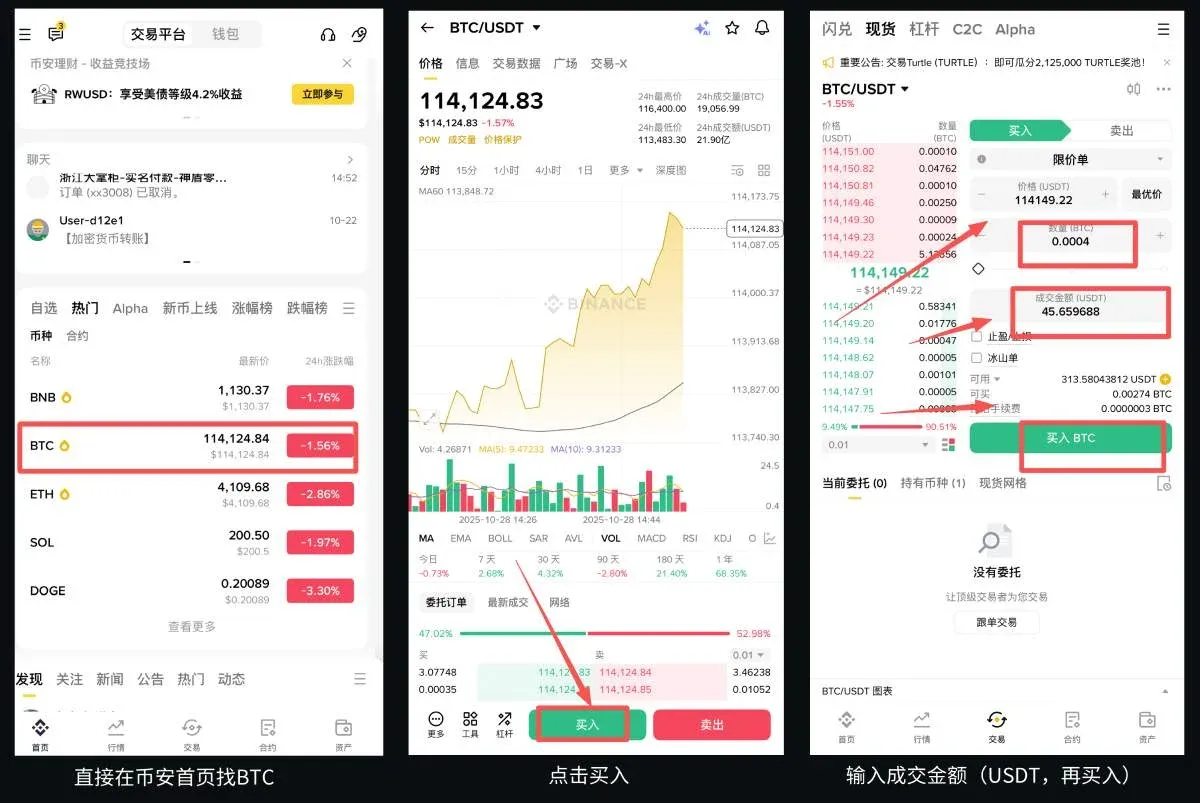
Beginners should start with a modest amount to familiarize themselves with the workflow before scaling up. The example below walks through buying BTC on Binance.
- Open the app and tap the “Trade” tab at the bottom.
- In the top‑left corner, select the trading pair, type “BTC,” then choose “BTC/USDT.”
- Tap “Buy.” You’ll see two order types:
- Market order: Executes instantly at the best available price; fast but price‑uncertain.
- Limit order: Set your desired entry price (e.g., if you expect BTC to dip to $65,000). The order fills automatically when the market reaches that level.
- Enter the price (for limit orders) and quantity (in BTC or USDT), double‑check the details, then press the green “Buy BTC” button.
4. Bitcoin Investment for Beginners: Essential Strategies and Risks
Bitcoin’s high volatility offers the potential for sizable gains but also carries significant downside risk. A disciplined mindset and robust risk management are far more important than chasing every upward swing.
1. Long‑Term Holding vs. Short‑Term Swing Trading
- Long‑term holding (HODL): Resembles a “Zen” approach—believing Bitcoin will eventually become a mainstream store of value, you buy and keep it regardless of short‑term noise. Requires conviction and patience.
- Short‑term swing trading: Mirrors a “sword‑master” style—using technical analysis to capture price swings, buying low and selling high repeatedly. This demands considerable time spent on chart study, strict discipline, and is better suited for more experienced traders.
For newcomers, starting with a long‑term position while gradually learning chart patterns can be a sensible path before attempting active swing trades.
2. Risk Assessment and Stop‑Loss Placement
- Asset diversification: Do not allocate all capital to Bitcoin. Balance your portfolio with stocks, bonds, and other crypto assets to mitigate systemic risk.
- Stop‑loss orders: Predetermine a sell price so that if the market falls below that threshold, the position closes automatically. For instance, after buying at $65,000, you might set a 10 % stop‑loss at $58,500.
- Continuous learning: The industry evolves rapidly; staying informed about new technologies, regulatory developments, and market hotspots is essential for reducing risk and improving decision quality.
Risk warning: Crypto markets can experience extreme price swings within seconds. Only invest funds you can afford to lose.
Tax note: Gains from cryptocurrency transactions may be taxable in your jurisdiction. Consult a tax professional to understand your obligations.
5. Frequently Asked Questions
1. What factors determine Bitcoin’s price?
Supply‑and‑demand dynamics are shaped by macro‑economic variables (interest rates, inflation), regulatory policies, internal industry events (halving, ETF flows), and market sentiment (fear & greed index).
2. Is now a good time to invest in Bitcoin?
There is no universal answer. Conduct your own research (DYOR), understand Bitcoin’s historical context and intrinsic value, and consider a staggered purchase strategy (e.g., dollar‑cost averaging) to smooth out entry prices.
3. Besides exchanges, what other ways can I acquire Bitcoin?
- Bitcoin ATMs: Available in certain Hong Kong districts; allow cash purchases but typically charge higher fees.
- Over‑the‑counter (OTC) trades: Suited for large‑volume transactions, conducted via specialized platforms or dealers, often offering more flexible pricing.
6. Conclusion
Investing in Bitcoin is a systematic endeavor. This article dissected the selection of real‑time charting tools, examined macro and industry influences on price, and walked through a complete purchase workflow for the Hong Kong market. Whether you rely on TradingView for technical analysis or monitor Federal Reserve policy and ETF fund flows, each element enriches your decision‑making toolkit. At the same time, risk management—asset diversification, stop‑loss orders, and ongoing education—must remain paramount to navigate a volatile market safely. Choose a compliant exchange, take the first step into the crypto world, and may your investment journey be successful.
---
For more tips on tracking Bitcoin prices and the latest market updates, search Bitaigen to find additional articles. Happy reading, and we look forward to your continued engagement!
Related Reading
- BTC & Crypto Investment: Short, Medium & Long-Term
- Understanding Bitcoin Staking: Concepts, Benefits, and Implementations
- Bitcoin Open Interest 454K: Risk Management Tips
💡 Register on Binance with referral code B2345 for the maximum trading fee discount. See Binance complete guide.



