
 Bitaigen Research
 In this article we systematically outline the operating principles and core responsibilities of oracles in DeFi scenarios, explain how they securely bring off‑chain data such as prices and weather into smart contracts, and describe the risks that arise from missing oracle inputs. Read on to quickly master the concepts and applications of this critical infrastructure.
In blockchain DeFi, oracles are the bridge that connects on‑chain smart contracts with real‑world off‑chain data. They cryptographically transmit information such as prices, weather conditions, and event outcomes to contracts, ensuring that protocols can function correctly.
What Is an Oracle in Blockchain DeFi?
An oracle serves as the data entry point for a decentralized network.
Specifically, an oracle is a one‑way digital agent that can look up and verify real‑world data, then submit it to a smart contract in a cryptographically secured form. Without an oracle, DeFi protocols would be unable to obtain the external information required for operation.
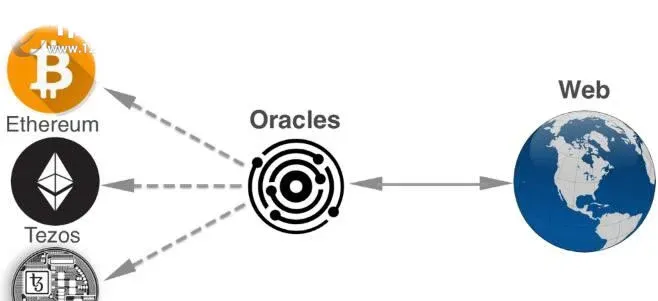
Oracles act as third‑party data agents for the blockchain world. When an on‑chain contract issues a data request, the oracle collects and validates the corresponding information off‑chain and feeds the result back to the on‑chain contract. Its core duties are:
- Receive requests from on‑chain contracts
- Retrieve the relevant data off‑chain
- Perform trustworthy verification of the data
- Write the verified result back onto the chain
Consequently, an oracle is regarded as the bridge between the blockchain and external data sources, and its existence enables DeFi protocols to use asset prices, sports results, weather information, and other data that cannot be obtained directly on‑chain.
The following analogy can help clarify the concept:
- Mysterious messenger → Oracle
- Us → Smart contract
- Primeval forest → Blockchain (closed environment)
- Modern advanced city → Off‑chain real world
In this metaphor, the mysterious messenger freely traverses between the forest and the city, continuously delivering outside information into the forest—just as an oracle brings off‑chain data into the blockchain.
DeFi emphasizes decentralization, so reliance on centralized data sources must be avoided—centralized feeds can be tampered with, forged, or concealed. Oracles provide a reliable, decentralized data entry point that allows smart contracts to safely and accurately acquire off‑chain information such as market prices, weather data, and more.
What Are the Functions of an Oracle?
- Provide trigger conditions: When contract terms are met, the oracle supplies the necessary data (e.g., temperature, payment status, price movement) so the contract can execute.
- Build a trustworthy data network: Establish a secure channel between the blockchain and the internet, overcoming the data‑access limitations of smart contracts.
- Ensure data authenticity: Through multiple cryptographic proofs and consensus mechanisms, create a trustworthy environment that prevents data tampering.
- Reduce traditional contract execution costs: Automate data acquisition and verification, cutting down on manual intervention and associated fees.
- Enhance transparency and decentralization: All data sources and processing steps are publicly auditable, reducing bureaucratic opacity.
It is important to note that oracles themselves represent a potential risk vector within DeFi systems. Feeding prices by simply taking a median from a few nodes is a basic oracle function, but a truly reliable oracle must employ a sound decentralized aggregation scheme to guarantee data accuracy and low latency. For DeFi applications, an oracle with high trustworthiness and minimal delay is essential for overall system security.
The above provides a complete analysis of “What Is an Oracle in Blockchain DeFi? What Are the Functions of an Oracle?” For more oracle‑related content, please follow Bitaigen (比特根) and its other articles.
Related Reading
- Blockchain Oracles: How They Work and Why They Matter
- Understanding Blockchain Oracles: Bridging On-Chain and Off-Chain Data
- Understanding Liquid Staking: Concepts & Operational Flow
💡 Register on Binance with referral code B2345 for the maximum trading fee discount. See Binance complete guide.



