
 Bitaigen Research
 In this article we systematically outline the concept of main‑net launch and the underlying processes, helping readers distinguish between testnets and the official chain, and analyzing the potential impact of a main‑net launch on project timelines, community governance, and token value. After grasping these points, you will be able to assess a blockchain project's maturity more objectively; we recommend continuing to read for the full picture.
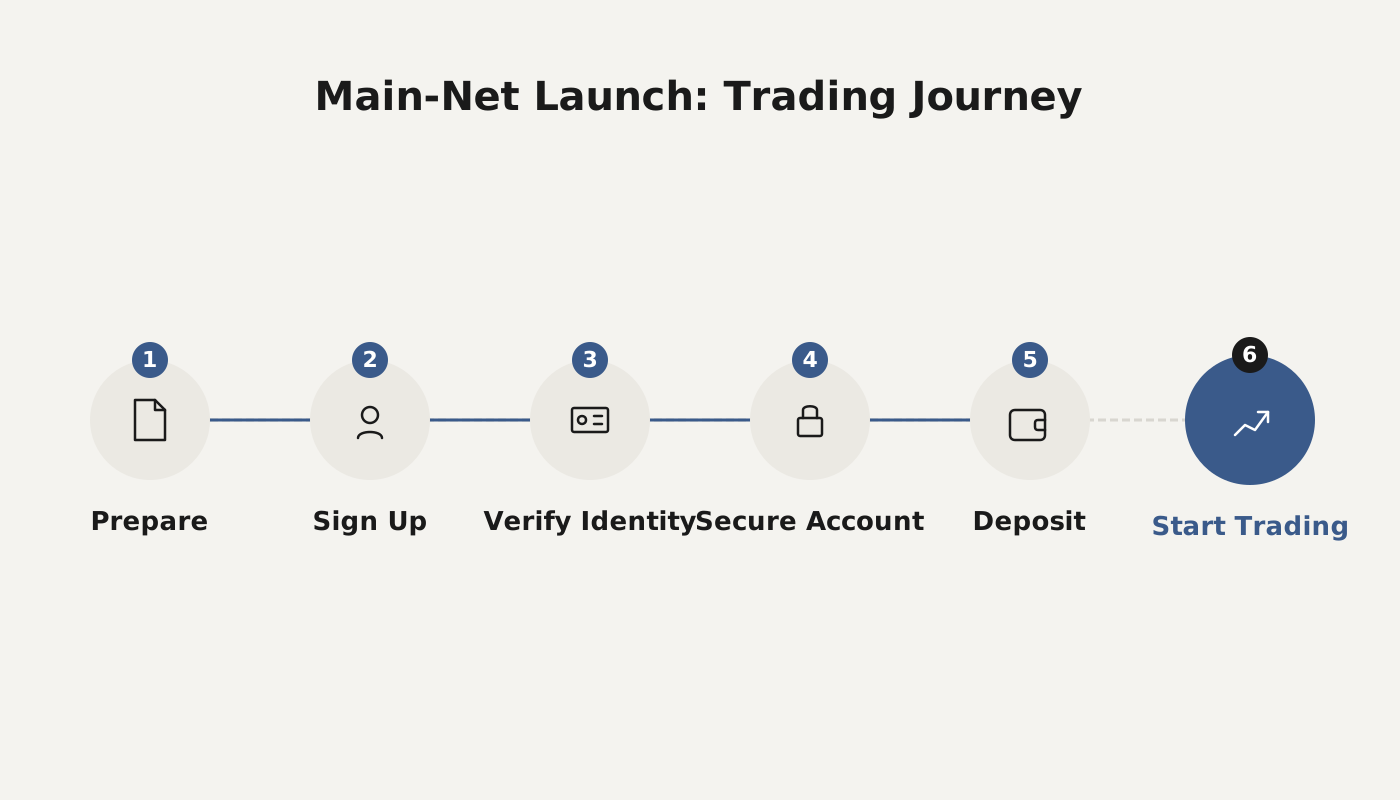
What Is a Main‑Net Launch?
Main‑net launch refers to the moment when a blockchain project, after completing development and testing, officially activates its independent main‑chain network, marking the transition from the testing phase to a production environment that users can interact with.
In the article “Why Can Ethereum Wallets Hold So Many Different Tokens?” we focused on ERC‑20 tokens. Many projects raise funds (often in USD via SEPA/SWIFT transfers) by issuing ERC‑20 tokens through an ICO, using the proceeds for technology development and operational costs. In short, when a project issues an ERC‑20 token on Ethereum, it is essentially promising token holders that “the raised funds will be used for project development and operation, and upon completion holders will enjoy the corresponding rights.” This promise is backed solely by the project team.
The main net is the formal product the project intends to release. All systems undergo internal testing before going live, and many also invite external users for a public beta to ensure security and stability of the final version. Because blockchain networks are decentralized, upgrades require community consensus, making the process slower than in centralized systems; a critical bug in the live network can cause catastrophic damage to the entire chain. Therefore, teams first deploy a test net for validation. Once testing is complete and consensus is reached, the team launches the main net, which is functionally similar to the test net but is the community‑approved production version.
What Does a Main‑Net Launch Signify?
- Development Completion: Launching the main net indicates that core development work is largely finished, shifting the project from a “theoretical blueprint” to a “bare‑bones structure,” laying the groundwork for subsequent feature enhancements.
- Vision Realization: With a main net in place, the community can directly assess how much of the roadmap described in the whitepaper has been achieved.
- Ecosystem Building: The main net serves as the foundational platform for DApp development, ecosystem expansion, and commercial applications.
Thus, for the project team, a main‑net launch is not the end point but a brand‑new starting line for ecosystem operation.
Where Do ERC‑20 Tokens Go?
After the main net is launched, the previously issued ERC‑20 tokens usually complete their purpose and are converted into the native token of the new main net. Two common conversion methods are:
- Mapping
- Before the main net goes live, the project team allows users to claim corresponding accounts and link those accounts to their Ethereum wallet addresses.
- A snapshot of ERC‑20 balances is taken prior to launch; once the main net is active, an equal amount of native tokens is distributed to users’ main‑net accounts.
- Gateway Conversion
- The project team sets up a dedicated gateway address; users send their ERC‑20 tokens to this address.
- Upon receipt, the gateway returns the same quantity of native main‑net tokens.
In most cases, exchanges handle the conversion on behalf of users, so no manual action is required. For exact details, follow the official announcements from the project team or the exchange. *(U.S. users should use Binance.US rather than the global Binance platform for such operations.)*
Summary
- Main Net vs. Test Net: The main net is the community‑consensus, production‑grade version, signifying the birth of an independent blockchain network.
- Significance: Launching the main net moves the project from a conceptual stage to a usable product, providing the essential infrastructure for ecosystem growth.
- Market Perspective: Some view a main‑net launch as a bullish signal, interpreting the shift from “air” to “tangible.” Others adopt a more cautious stance, noting that the visions outlined in the whitepaper still require time to materialize on the main net, and discrepancies between expectations and reality may arise.
The above provides a detailed answer to “What is a main‑net launch? What does it mean?” For more related information, please follow other articles from Bitaigen (比特根)!
Related Reading
- EOS Smart Contracts Explained: How They Work & Benefits
- Understanding Smart Contracts and ERC Standards on Ethereum
- TRUST Token Overview: Allocation, Staking, Governance & Rewards on Intuition Pro
💡 Register on Binance with referral code B2345 for the maximum trading fee discount. See Binance complete guide.



