
 Bitaigen Research
 Arbitrum is a Layer 2 Rollup network on Ethereum developed by Offchain Labs, and its governance token is ARB.
Arbitrum (ARB) is the governance token of the Ethereum Layer 2 scaling solution Arbitrum, primarily used for on‑chain governance rather than paying gas. Whether it is worth investing in depends on individual risk tolerance and one’s assessment of its technology and ecosystem.
Arbitrum employs Optimistic Rollup technology, bundling a large number of transactions and submitting the batch to the Ethereum mainnet for settlement. This improves transaction throughput and reduces fees while still relying on Ethereum’s consensus mechanism for security.
ARB tokens are mainly used to participate in the Arbitrum DAO’s on‑chain governance; holders can vote on protocol upgrades, treasury usage, and ecosystem development direction.
This article provides a complete analysis of ARB’s technical positioning, token mechanics, and key data, and combines market‑side and fundamental analysis to help you build a more logical decision‑making framework.
From the perspectives of technology, governance, and ecosystem, we conduct an in‑depth dissection of Arbitrum (ARB), explaining the core advantages of its Layer 2 architecture and the practical role of the token within the DAO. By objectively assessing market trends and project risks, we help readers develop a more rational investment viewpoint. The following sections present a complete analytical framework.
What Is Arbitrum
Arbitrum official homepage banner
Arbitrum is an Ethereum Layer 2 Rollup network launched in 2021 by the blockchain team Offchain Labs. The three co‑founders are chief scientist Ed Felten, Steven Goldfeder, and Harry Kalodner.
The founding mission of Arbitrum is to address three long‑standing problems of the Ethereum mainnet (Layer 1):
- Limited transaction speed
- Network congestion
- High gas costs
Why Does Ethereum Need Layer 2
Ethereum prioritizes decentralization and security, which leads to limited TPS (Transactions Per Second), high gas costs, and restricted scalability.
Layer 2 solutions aim to increase transaction throughput and lower costs without sacrificing security.
- Layer 1 = Security & Settlement Layer
- Layer 2 = Expansion & Efficiency Layer
Arbitrum is one of the leading Ethereum Layer 2 solutions today. By moving most computation off‑chain and only feeding essential data back to L1, it dramatically cuts costs while inheriting Ethereum’s security model. It has become critical infrastructure for DeFi, NFTs, on‑chain gaming, and derivatives protocols.
How Arbitrum Works
Arbitrum uses Optimistic Rollup technology. The core idea is:
Batch and compress multiple transactions on Layer 2, then submit the final result to the Ethereum mainnet for settlement.
This model is often described as “off‑chain computation, on‑chain settlement”, and its characteristics include:
- Massive numbers of transactions are executed on L2
- Only compressed, essential data is synced to Ethereum
- Final security is still guaranteed by Ethereum’s consensus mechanism
Consequently, Arbitrum can alleviate network congestion and high gas fees without any modifications to Ethereum Layer 1.
Fee and Efficiency Advantages
According to real‑time L2 fee statistics (values fluctuate with market conditions), Arbitrum One’s average transaction cost is far lower than that of the Ethereum mainnet. For example, on 2026‑02‑16, the fee on Arbitrum One was roughly 0.09 USD, whereas the Ethereum fee was about 1.10 USD – a roughly ten‑fold difference. Actual fees still depend on mainnet congestion, batch compression efficiency, and Blob costs.
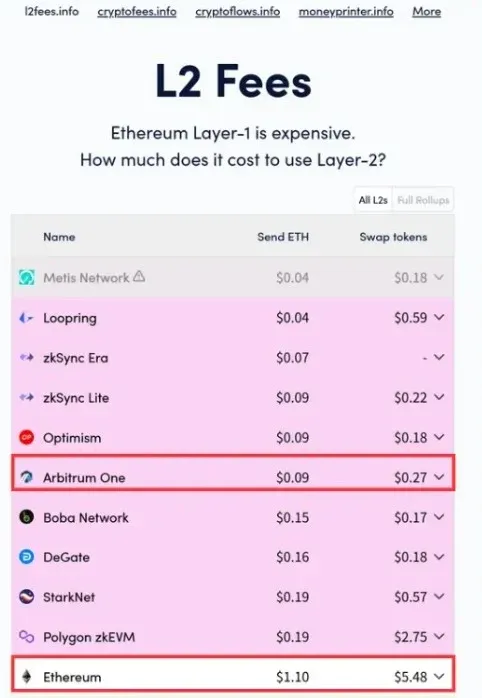
L2 vs. ETH Fee Comparison
Faster Transaction Confirmation
- Arbitrum (L2): Transactions typically confirm within a few seconds (final security still relies on L1)
- Ethereum (L1): Block time is about 12 seconds and can be longer during congestion
It is important to note that final settlement still occurs on the Ethereum mainnet.
Security Mechanism: Fraud Proofs
As an Optimistic Rollup, Arbitrum’s core security mechanism is the Fraud Proof system, which follows a “trust‑but‑verify” model, allowing suspicious transactions to be challenged and malicious actors penalized. The workflow is:
- Transaction results are assumed valid by default (Optimistic)
- A Challenge Window is opened
- Anyone detecting an error can submit a fraud proof to challenge the result
- If the challenge succeeds, the malicious actor’s bond is forfeited
This mechanism ensures that not every transaction needs to be verified on L1, yet decentralised security is maintained because the cost of cheating is prohibitively high.
What Is the ARB Token
After understanding Arbitrum as an Ethereum Layer 2 technical architecture, we now explain the positioning and purpose of ARB.
ARB is the governance token of the Arbitrum ecosystem, officially launched in March 2023 by Offchain Labs to power the decentralized governance mechanism of the Arbitrum DAO.
Important Note: ARB is not a gas token; transaction fees on the Arbitrum chain are still paid in ETH.
Basic Information Overview
| Item | Details |
|---|---|
| Total Supply | **$10 billion** (USD‑denominated) |
| Launch Date | **March 2023** |
| Token Standard | **ERC‑20** |
| Primary Use | DAO governance & proposal voting |
| Gas Payment | **ETH** |
Circulating supply, market cap, and ranking fluctuate with market conditions; please refer to real‑time data platforms such as CoinMarketCap or CoinGecko.
Core Uses of the ARB Token
1. DAO Governance Voting
Holding ARB enables participation in the Arbitrum DAO’s on‑chain governance, covering:
- Protocol upgrade proposals
- Treasury fund allocation
- Ecosystem incentive schemes
- Major technical change decisions
Voting power follows a token‑weighted model: the more ARB you hold or delegate, the greater your influence.
2. Vote Delegation
Token holders may vote directly or delegate their voting power to a representative address (delegation transfers voting rights only, not the tokens themselves), improving governance efficiency.
3. Treasury Management Rights
The Arbitrum DAO controls an ecosystem fund used for:
- Developer grants
- Ecosystem incentive programs
- DeFi growth initiatives
- Public‑good infrastructure
ARB holders can vote on how these funds are distributed.
Key Points of ARB Token Positioning
- Governance Token (used for voting)
- Not a Gas Token (transactions still use ETH)
- Not a Staking‑Yield Token (no mandatory staking at present)
- Serves as a credential for participating in DAO decisions
Its value derives from governance rights, not direct revenue sharing. Understanding this helps assess its risk profile.
Factors Influencing ARB Price and Historical Performance
Since the airdrop and exchange listing in March 2023, ARB has exhibited noticeable price volatility, reflecting both the high‑growth potential and high‑risk nature of the Layer 2 arena.
- Reached an all‑time high of approximately $2.425 in January 2024
- Subsequently entered a prolonged consolidation phase due to overall market pull‑back, token unlock pressure, and intensified competition
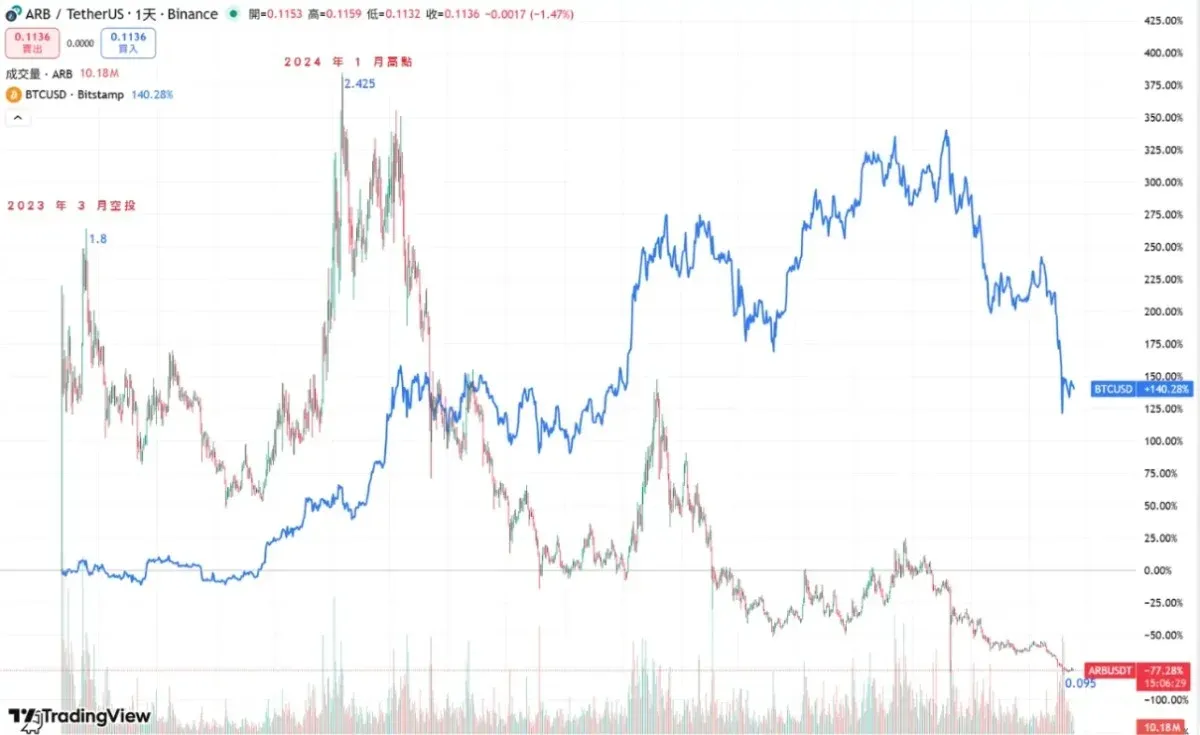
Key Influencing Factors
- Token Unlocks & Supply Increases – Large unlock events raise circulating supply and can create short‑term selling pressure. Monitor upcoming unlock schedules and percentages.
- Ecosystem Growth & TVL – On‑chain TVL, active addresses, transaction counts, and the number of protocols directly affect market expectations.
- Market Cycles & Risk Appetite – Overall crypto sentiment and Bitcoin price movements have a strong correlation with ARB price.
- Layer 2 Competitive Landscape – Upgrades and ecosystem progress from rivals such as Optimism and zkSync can exert pressure on ARB.
Long‑Term ARB Price Forecast (Reference)
| Year | Estimated Low (USD) | Estimated Mid (USD) | Estimated High (USD) |
|---|---|---|---|
| 2026 | 0.026483 | 0.060000 | 0.093779 |
| 2027 | 0.025423 | 0.049804 | 0.074184 |
| 2028 | 0.045599 | 0.089021 | 0.132443 |
| 2029 | 0.115766 | 0.320998 | 0.526231 |
| 2030 | 0.080395 | 0.224118 | 0.367842 |
| 2031 | 0.098296 | 0.166443 | 0.234591 |
| 2032 | 0.144198 | 0.305989 | 0.467782 |
| 2033 | 0.397894 | 1.030000 | 1.662034 |
| 2034 | 0.254230 | 0.554776 | 0.855322 |
| 2035 | 0.315233 | 0.528535 | 0.741838 |
| 2036 | 0.490657 | 1.090000 | 1.702037 |
| 2037 | 1.600000 | 3.430000 | 5.260000 |
The above projections are for reference only and do not constitute investment advice.
Major Applications in the Arbitrum Ecosystem
DeFi Landscape
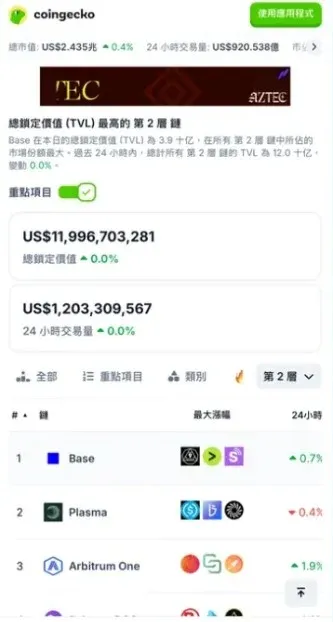
Arbitrum’s TVL consistently ranks among the top Layer 2s. Core projects include:
- Uniswap – Leading DEX providing primary liquidity
- GMX – Perpetual contracts platform with low slippage
- Radiant Capital – Cross‑chain lending protocol
- Aave – Mainstream lending platform
- Pendle – Yield‑tokenisation protocol
Institutional & Real‑World Asset (RWA) Development
Several financial institutions (e.g., Robinhood, Franklin Templeton, WisdomTree) are experimenting on Arbitrum with tokenised funds, stablecoins, and on‑chain settlement services. Although still early‑stage, this signals growing institutional interest.
Gaming & Arbitrum Nova
Arbitrum Nova utilizes an AnyTrust architecture, tailored for high‑frequency gaming and social applications. Representative projects include Treasure DAO and Beam, emphasizing ultra‑low gas costs.
Arbitrum Orbit & Layer 3
Through Arbitrum Orbit, developers can launch bespoke Layer 3 chains atop Arbitrum, enabling:
- Custom gas tokens
- Tailored governance frameworks
- Dedicated application‑specific chains
- Enhanced scalability
This “chain‑on‑chain” approach fosters a modular rollup ecosystem.
Comparison Between Arbitrum and Other Layer 2 Solutions
| Project | Technical Type | Security Mechanism | Withdrawal Mechanism | EVM Compatibility |
|---|---|---|---|---|
| **Arbitrum** | Optimistic Rollup | Interactive Fraud Proofs | ~7‑day challenge period | Fully compatible |
| Optimism | Optimistic Rollup | Fault Proofs | ~7‑day challenge period | Fully compatible |
| zkSync | ZK‑Rollup | Zero‑Knowledge Proofs (ZK‑SNARK) | No challenge period (instant) | Fully compatible |
- Optimistic Rollup (Arbitrum, Optimism): Transactions are assumed valid; disputes are resolved during a challenge window.
- ZK‑Rollup (zkSync): Each batch includes a mathematical proof, theoretically enabling faster withdrawals but requiring more complex technology.
All Layer 2 solutions dramatically reduce gas costs compared with Ethereum mainnet; differences lie mainly in security models, technical complexity, and ecosystem development trajectories.
Risks and Controversies Surrounding Arbitrum
Arbitrum is not a scam; it is an Ethereum Layer 2 scaling solution built by Offchain Labs and has received backing from several crypto investment firms.
Token Distribution Risks
- Total supply of $10 billion is primarily allocated to community & ecosystem, team & advisors, and early investors.
- The team and investors hold a notable share, released via linear vesting schedules, which could increase circulating supply and generate selling pressure in the future.
DAO Governance Controversies & Concentration
- The DAO manages the ecosystem treasury, deciding on protocol upgrades, fund allocation, and other critical matters.
- Early governance rounds saw disputes over proposal processes and fund usage, prompting community scrutiny of transparency and voting power concentration.
- Vote delegation means large holders can wield significant influence, potentially affecting decision‑making efficiency.
Overall Assessment
There is currently no evidence suggesting Arbitrum is a fraudulent project. The team operates transparently, the codebase is open‑source, the mainnet has been live for an extended period, and a substantial number of protocols are built on it. Nonetheless, investors should monitor token unlock schedules, competitive dynamics, and governance structures for possible risk exposure.
How to Purchase ARB on Binance (Global)
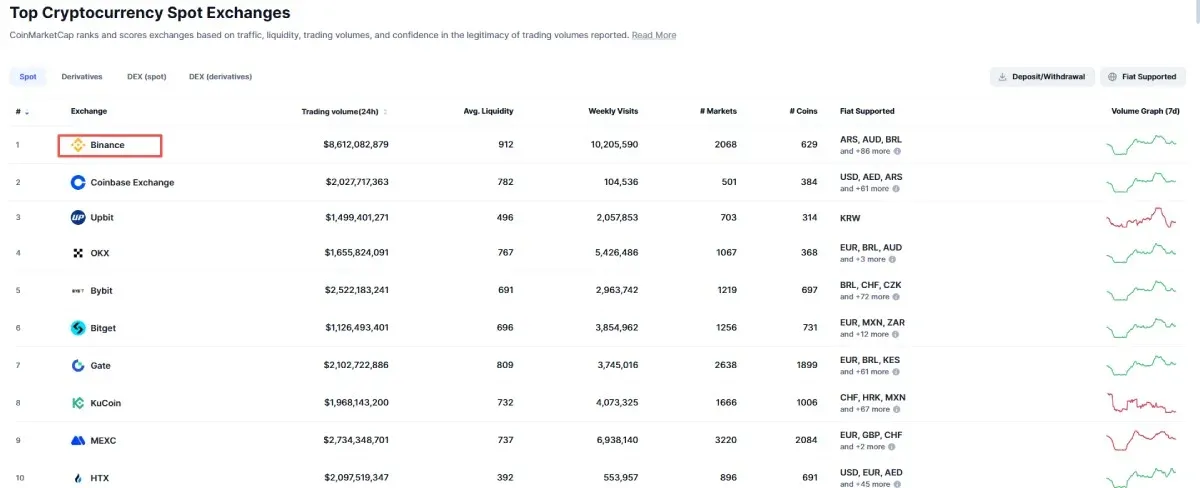
ARB is listed on most major exchanges. Below is a step‑by‑step guide using the world’s largest exchange, Binance. U.S. residents should use Binance.US instead of the global Binance platform.
- Create a Binance (or Binance.US) account – Follow the official Binance onboarding guide. Using referral code B2345 may grant additional benefits.
- Complete KYC and enable security settings (e.g., 2‑FA).
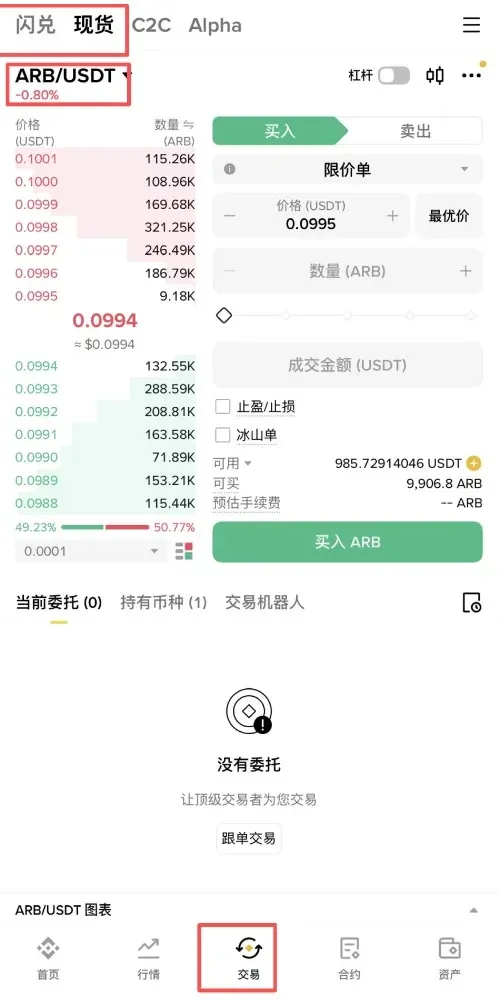
- Open the mobile or web app and tap “Trade.” You can choose “Convert,” “Spot,” or “Margin” modes for ARB transactions.
Spot Trading
In the “Spot” market, search for “ARB”, select the desired order book depth, and place your buy or sell order.
Futures & Margin Trading
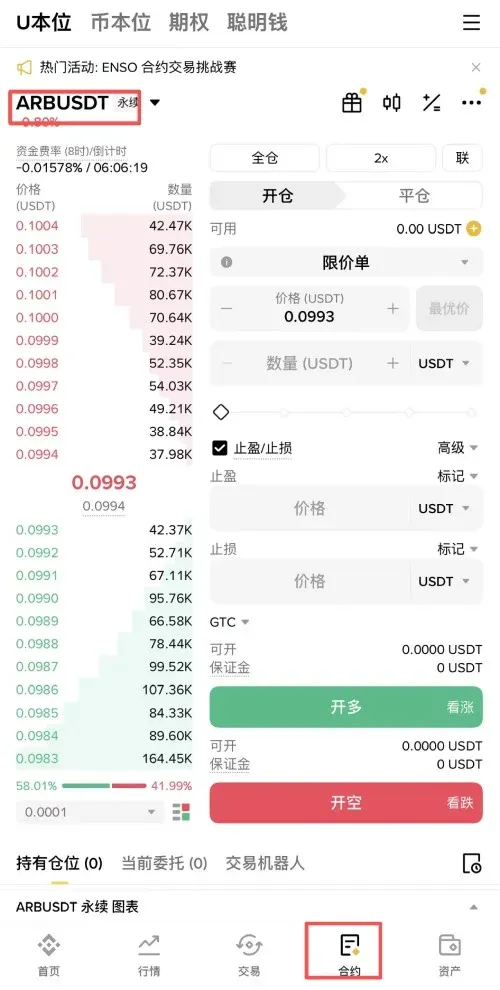
Binance also offers ARB futures and margin products. When using leverage or futures, exercise strict risk management, especially during periods of high volatility, as leveraged positions can erode capital rapidly.
Frequently Asked Questions
1. Is ARB a scam?
Arbitrum is developed by Offchain Labs, its mainnet has been operational for several years, the code is open‑source, and the ecosystem is active. No evidence indicates it is a scam.
2. Is ARB a gas token?
No. ARB is
Related Reading
💡 Register on Binance with referral code B2345 for the maximum trading fee discount. See Binance complete guide.



