
 Bitaigen Research
 Enso: A “Blockchain Shortcut” for Cross‑Chain Interaction
Enso abstracts cross‑chain interactions as a “blockchain shortcut,” allowing developers to avoid the tedious process of connecting contracts and routing on a per‑chain basis. Leveraging a unified execution engine, users can perform reads, writes, and strategy execution atomically on a single platform, aiming for faster deployments and lower implementation difficulty. The team simultaneously disclosed the ENSO token supply, inflation model, and cross‑chain rollout. This article systematically reviews Enso from four angles—product overview, core capabilities, developer onboarding, and tokenomics—to clarify its positioning, implementation, and impact on delivery efficiency.
In this piece we dissect the core principles behind Enso’s cross‑chain innovation, decode the functional role, economic model, and developer entry path of the ENSO token. By systematically outlining the product architecture and governance mechanisms, readers can assess its potential value within the cross‑chain ecosystem. Subsequent sections will dive deeper into practical details and future outlook—please continue reading.
What Is the ENSO Token?
ENSO is the native token of the Enso network, which is built on the Tendermint consensus protocol. It serves as a critical asset within the ecosystem; without it, the network cannot operate.
Core functions include:
- Gas fees – Used to submit requests and modify on‑chain state on the Enso network.
- Governance rights – Holders can vote on protocol upgrades and influence governance decisions.
- Network participation – Validators, graph generators, and action providers must stake ENSO to bolster network security and deter misbehavior.
- Delegator incentives – Staking attracts more participants, further strengthening the network’s robustness.
ENSO Token Economics
Fundamentals and Inflation Schedule
- Genesis supply: 100,000,000 ENSO
- Maximum supply: 127,339,703 ENSO; annual inflation starts at 8 % in the first year and declines each month until it reaches roughly 0.35468 % by the tenth year, after which no new tokens are minted.
- Contract address (Ethereum): `0x699F…0C66`
Cross‑Chain Compatibility
Both the official team and CoinCarp confirm that ENSO has been deployed on Ethereum and the BNB Chain, with a unified token page and address. Always use the official channels to avoid the risk of unofficial transfers.
Token Allocation Overview
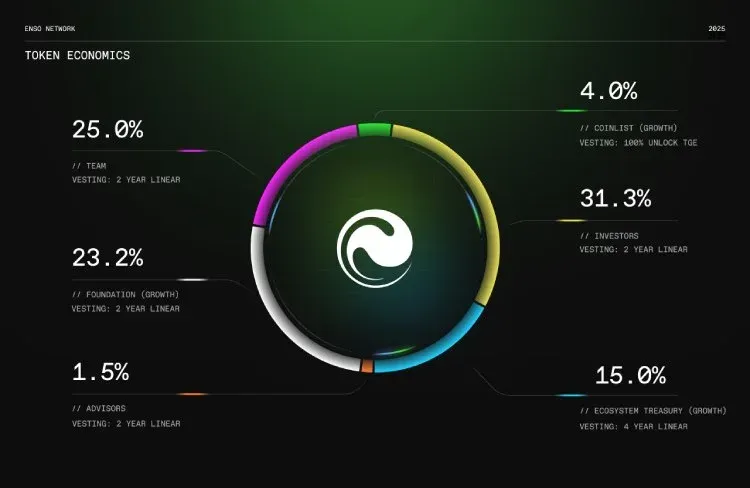
- Investors: 31.3 %
- Team: 25 %
- Foundation / Growth Fund: 23.2 %
- Ecosystem Treasury: 15 %
- Advisors: 1.5 %
- CoinList (growth incentives): 4 %
*(Exact vesting schedules and lock‑up periods are subject to the official disclosures of the project and the issuance platform.)*
What Is Enso?
Enso bills itself as a “unified execution and data network,” mapping cross‑chain and cross‑protocol interactions through a shared engine. Developers can write cross‑chain strategies, migrate positions, or batch operations without building a separate adaptation layer for each target chain—Enso’s runtime and gateway absorb all the complexity. The official documentation summarises its value proposition as: build faster, integrate easier, and avoid common pitfalls.
Problems Enso Solves
Traditional dApps must manage multi‑chain RPC endpoints, ABIs, routing, signatures, as well as bridging, approvals, and ordered execution risks. Enso pre‑packages these steps into “shortcuts” and offers a one‑stop API that delivers carefully orchestrated workflows.
Core Capabilities of Enso
Shortcut Engine and Atomic Execution
Enso enables developers to collapse multi‑step processes (e.g., approve → swap → deposit → stake) into a single atomic transaction. This reduces round‑trip calls and potential failure points, unifies permission checks, and lowers the likelihood of errors.
Unified API/SDK with Multi‑Chain Read‑Write
Through Enso’s API/SDK, developers can read state and invoke existing protocols on any supported chain without writing custom adapters. The team claims the network is “connected to all blockchains,” highlighting its composability and scalability.
Real‑World Adoption and Scale
According to data from CoinList, Enso already underpins large‑scale migrations and multi‑chain activities covering over 250 protocols, providing foundational services for enterprise‑grade products and launches.
Developer Onboarding and Integration Path
Three‑Step Quick Integration
- Generate an API key on the Enso portal and configure network permissions.
- Select an existing shortcut from the platform or design a custom workflow such as cross‑chain lending or LP construction.
- Trigger atomic execution using the front‑end or back‑end SDK and subscribe to status callbacks.
When to Use Enso
- When a single‑shot cross‑chain, cross‑protocol strategy (e.g., LP migration, airdrop orchestration, cross‑chain capital deployment) is required.
- When an MVP or rapid‑iteration business demands ultra‑fast time‑to‑market.
- When complex operations need to be wrapped behind a simple UI/button for end‑users.
Latest Enso (ENSO) Updates
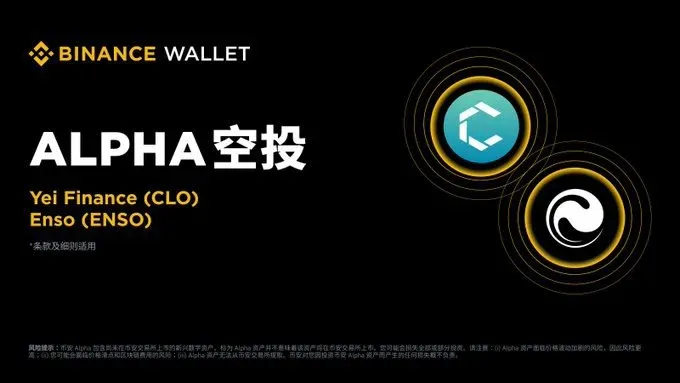
Binance Alpha will list Enso (ENSO) for the first time on October 14. Eligible Binance users can use Alpha points to claim a 10‑ENSO airdrop within 24 hours after trading begins.
The airdrop is distributed in two phases:
- Phase 1 (first 18 hours): Users holding ≥ 245 Alpha points may claim.
- Phase 2 (last 6 hours): Users holding ≥ 225 Alpha points can participate on a first‑come, first‑served basis. If the event is not exhausted, the threshold drops automatically by 15 points per hour.
Claiming the airdrop consumes 15 Alpha points; users must confirm within 24 hours, otherwise the allocation is considered forfeited.
Ecosystem Progress
By the end of 2025, Enso completed community/platform token sales and officially released token and network details. The official blog and partner articles showcase real‑world cases—from the Berachain large‑scale migration to multi‑protocol promotional campaigns—further validating the “faster launch” promise. The GitHub repository continues to update components and utility tools, improving the developer experience (DX).
Risks and Limitations
- Dependency on routing/aggregation services: Upgrades of upstream protocols may introduce compatibility work, requiring continuous updates to the SDK and shortcuts.
- Cross‑chain atomicity constraints: Bridge latency, message delays, and failure rates still affect cross‑chain workflows, necessitating retry mechanisms and graceful fallback logic.
- Token‑economic factors: Inflation and token unlock schedules can influence participant incentives and network security; dynamic assessment based on actual usage and fee recovery is advisable.
Tax reminder: Crypto gains, including those from ENSO, may be taxable in your jurisdiction. Users should consult local tax regulations and consider filing obligations for any realized profits.
Roadmap
Enso’s network rollout will occur in stages:
- Phase 1: Launch the initial network with independent validators simulating byte‑code solutions. At this stage, a centralised Enso service co‑exists with the network; developers may contribute to the centralised service to keep the network operational.
- Phase 2: Transition to a fully permissionless contribution environment where any “graph creator” can participate. The network will become self‑sustaining and expand beyond the Ethereum Virtual Machine (EVM) to support the Solana Virtual Machine (SVM) and Mobile Virtual Machine (MVM), further enhancing the experience for developers across multiple ecosystems.
Frequently Asked Questions
Why is Enso faster than traditional integration?
By abstracting multi‑step on‑chain actions into shortcuts and executing them atomically, Enso eliminates the need to manually handle multi‑chain ABIs, routing, signatures, and rollback logic, dramatically shortening delivery cycles.
Does Enso support cross‑chain reads/writes and composable strategies?
Yes. Enso, as a “unified execution and data network,” allows state reads and combined calls to any integrated protocol.
What are the supply and inflation rates?
Genesis supply: 100 million ENSO.
First‑year inflation: 8 % annually, decreasing each month to about 0.35468 % by year 10, after which minting stops.
Maximum supply: 127,339,703 ENSO.
Where is ENSO deployed?
Primarily on Ethereum, with support for the BNB Chain. Use the official token page and social channels; beware of unofficial contracts.
Are there large‑scale use cases already?
Official and partner disclosures indicate multiple protocols and products have leveraged Enso for cross‑chain migrations, incentive programs, and API integrations at scale.
Key Takeaways
- The combination of shortcuts + atomic execution + API/SDK markedly reduces the complexity of multi‑chain integration and accelerates project launches.
- ENSO features a 100 million‑token genesis supply, with transparent inflation and a capped maximum supply; contract address and cross‑chain data are publicly verifiable.
- Token distribution: investors 31.3 %, team 25 %, foundation 23.2 %, ecosystem 15 %, advisors 1.5 %, CoinList 4 % (subject to final official disclosures).
- Developers can encapsulate multi‑step processes into a single atomic transaction; however, cross‑chain workflows still rely on the reliability of underlying bridge layers.
This concludes the comprehensive overview of the Enso (ENSO) token, covering its definition, acquisition methods, tokenomics, and future development direction. For more Enso‑related content, you can search past articles on Bitaigen or continue browsing the recommended links below. Thank you for supporting Bitaigen!
*Note for U.S. users:* Access to Enso’s token trading on Binance should be done via Binance.US (or other regulated U.S. exchanges) rather than the global Binance platform. For fiat transactions, the platform accepts USD via SEPA/SWIFT where applicable.
Related Reading
- Reef Finance Analysis: Tech, Governance & REEF Token Outlook
- Reef Finance: Multi‑Chain DeFi for Easy Yield Optimization
- REEF Token Surge: $0.00172, +146% Return & DeFi Outlook
💡 Register on Binance with referral code B2345 for the maximum trading fee discount. See Binance complete guide.



