
 Bitaigen Research
 We take a full‑stack view—from token design and governance mechanisms to cross‑chain innovation—to systematically dissect Enso’s core principles and ecosystem layout, helping you gauge its potential value. Subsequent chapters will further reveal the project’s technical implementation and key considerations. From token economics to the cross‑chain execution framework, we provide a comprehensive assessment of risks and opportunities.
Enso (ENSO) Token Economics
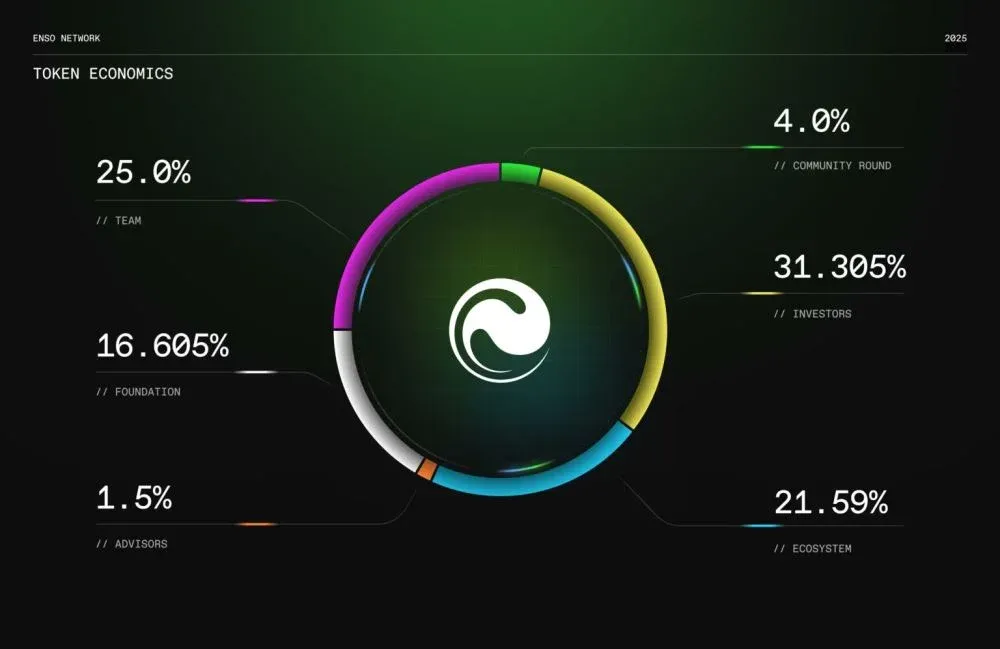
The Enso network uses the ENSO token to pay for gas, participate in governance, stake, and grant permissions. The total supply is fixed at 100 million tokens, allocated as follows:
- Team: 25%
- Foundation: 16.605%
- Advisors: 1.5%
- Community travel: 4%
- Investors: 31.305%
- Ecosystem: 21.59%
The token’s concrete functions include:
- Gas: Provides the fuel for network execution.
- Governance: Holders can vote on protocol upgrades.
- Staking: Locking tokens enhances network security and deters malicious behavior.
- Authorization: Used to improve system security and reliability.
Project Goals and Value Positioning
Enso aims to alleviate the fragmentation and usability bottlenecks that currently affect the blockchain ecosystem. Traditionally, developers who need cross‑chain integration must write a separate adapter for each chain, become familiar with the contract specifics of every target chain, and maintain those code bases—a process that is both time‑consuming and costly. Enso allows developers to simply declare an “intent” (e.g., token swap, NFT minting); the network then automatically generates the corresponding bytecode, enabling cross‑chain, composable business logic while avoiding vendor lock‑in and related issues.
High‑Level Overview of How It Works
Enso functions as a coordination layer, offering four categories of participants and three core components to complete the end‑to‑end flow from intent to executable bytecode.
Main Participants
| Role | Responsibilities |
|---|---|
| **Action Provider** | Submits on‑chain abstractions (function signatures, input/output tokens, preconditions, etc.) and receives a share of fees proportional to the amount of ENSO staked. |
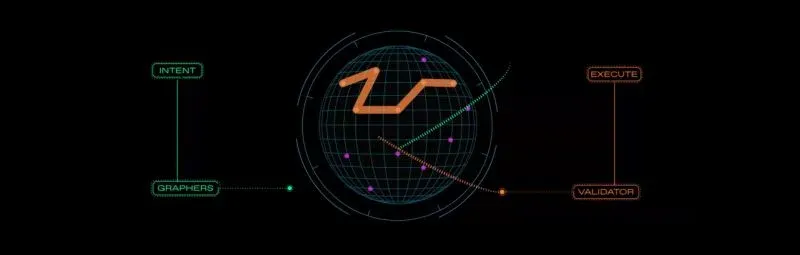
| **Graphers** | Apply algorithms such as k‑shortest‑path to combine abstractions and generate the optimal bytecode solution. |
| **Validators** | Simulate requests, abstractions, and generated solutions, using ViewFunctions to verify correctness, and select the highest‑throughput, lowest‑cost option. |
| **Consumers** | Submit intent requests to the network and may choose to pay an additional fee to accelerate processing. |
Core Components
- Request – Developers describe the desired business outcome in the form of an intent.
- Abstraction Contribution – Action Providers submit abstraction data via messages like `MsgAddDeposit`; the system parses these into Action types and stores them after a nine‑step verification process.
- Solution Aggregation – Graphers fetch abstractions from the network, generate the optimal bytecode, and Validators simulate the proposals on a forked chain. After verification with ViewFunctions, the best solution is retained while the others are discarded to reduce network load.
Fee and Incentive Model
Executing cross‑chain contracts incurs on‑chain fees. Enso collects these fees through a token auction mechanism, granting the winner the right to receive fees denominated in ENSO. The collected fees are then redistributed to participants based on their contributions to abstraction provision, solution generation, and validation, forming a closed‑loop incentive system.
Applicable Scenarios
Enso provides technical support for the following domains:
- Cross‑Chain Integration – Unified calls to smart contracts on any chain.
- DeFi & NFT – Simplifies multi‑chain trading and asset minting.
- Gaming & AI Bots – Intent‑driven automated execution frameworks.
- Data Marketplaces – Manage cross‑chain data flows via smart contracts.
Typical usage flow:
- Submit an intent request to the Enso network.
- Action Providers or Graphers contribute abstractions and algorithms.
- Integrate the generated bytecode into your business logic.
Key Advantages
- Usability – Abstracts away the complexities of cross‑chain integration.
- Composability – Enables free assembly of cross‑chain modules.
- Security – Multi‑layer verification and simulation ensure solution validity.
- Scalability – Compatible with multiple virtual machines (EVM, SVM, MVM) and on‑chain environments.
Roadmap
- Phase 1 – Centralized simulation environment and Enso‑hosted abstraction contribution service.
- Phase 2 – Open, permission‑less abstraction submissions with broader Graphers participation.
- Phase 3 – Ecosystem expansion, full support for multiple chain virtual machines such as EVM, SVM, and MVM.
Investors and Funding Status
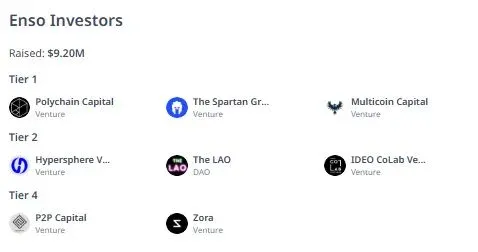
Enso has raised a cumulative US $9.2 million in financing, with major backers including:
- Series A – Polychain Capital, The Spartan Group, Multicoin Capital.
- Series B – Hypersphere Ventures, The LAO, IDEO CoLab Ventures.
- Series D – P2P Capital, Zora.
Core Team
- Connor Hao – Founder & CEO, responsible for overall strategy and project execution.
- Milos Costantini – Co‑founder, brings deep Solidity development expertise.
- Peter Phillips – Co‑founder, focuses on software engineering and system architecture.

Project Overview
Enso (ENSO) is a Tendermint‑based Layer‑1 blockchain designed to offer developers a unified cross‑chain smart‑contract execution layer. By mapping all contract interactions, Enso enables developers to declare a single intent and have the corresponding functionality invoked on any chain, addressing ecosystem fragmentation and usability challenges. This facilitates the creation of frictionless, composable, and continuously operating decentralized applications.
Note for U.S. participants: Access to ENSO tokens may be restricted to Binance.US, whereas users in other jurisdictions can trade on the global Binance platform using USD, SEPA, or SWIFT transfers.
Tax reminder: Crypto gains may be taxable in your local jurisdiction; consult a tax professional for guidance.
The above provides a complete analysis of Enso (ENSO) token mechanics, tokenomics, and its potential value proposition. For further details, stay tuned to Bitaigen’s upcoming reports.
Related Reading
- Enso: Unified Cross‑Chain Network for Rapid DeFi & Web3 Development
- idOS Decentralized Identity Framework: Cross‑Chain Compatibility & Token Model E
- Snowball Meme‑Coin & FLAP Cross‑Chain Platform Overview
💡 Register on Binance with referral code B2345 for the maximum trading fee discount. See Binance complete guide.



