
 Bitaigen Research
 By using a concise schematic, we help readers quickly clarify EOS’s overall architecture, core components, and the way its smart contracts are implemented, allowing you to grasp the platform’s key features without consulting technical documentation. Subsequent sections will delve into the details.
Understanding EOS at a Glance with One Diagram
EOS is a blockchain platform built on the open‑source EOSIO software, featuring a native EOS token, a mainnet maintained by Block Producers (BPs), and support for smart contracts written in C++. It offers high throughput and a fee‑free transaction environment.
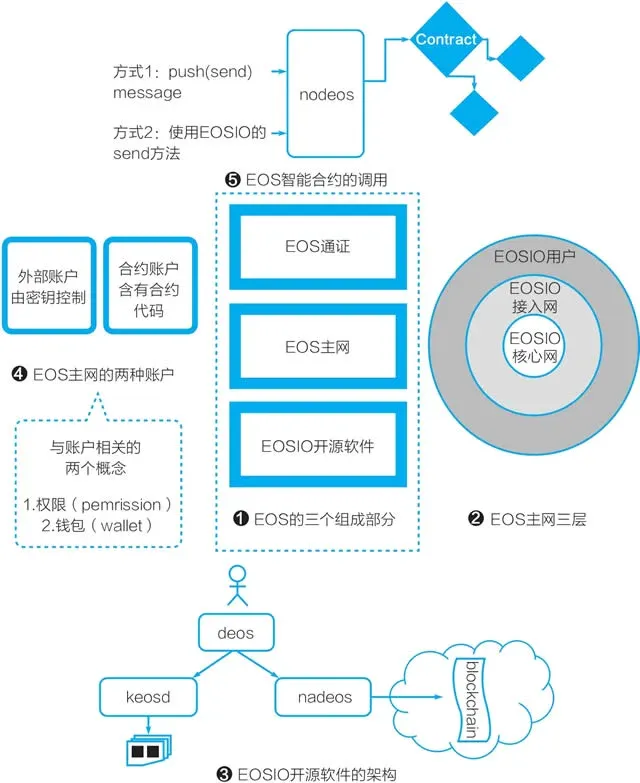
From Bitcoin to Ethereum and then to EOS, the underlying organizational structures have become increasingly complex. The overall EOS architecture can be summarized into three core components:
1. EOSIO Software
- EOSIO is an open‑source blockchain framework released by Block.one, and anyone can contribute to its codebase.
- The framework supports the creation of single‑node or multi‑node testnets and can also be used to build independent alternative networks (altnets).
2. EOS Token (EOS Coin)
- EOS was initially issued as an ERC‑20 token on the Ethereum network; the ETH raised from the sale belongs to Block.one.
- After the token sale concluded on June 2 2018, the tokens were mapped onto the EOS mainnet, becoming the native digital asset of the live network.
- Note: In many jurisdictions, profits from the sale or trade of EOS may be subject to taxation; users should consult local tax regulations.
3. EOS Mainnet
- The mainnet relies on a Block Producer election mechanism that selects a set of super‑nodes responsible for block production and network maintenance.
- The mainnet launched in June 2018, and Block.one retains a significant influence over community governance.
Alternative Networks (altnet)
Beyond the official mainnet, several alternative networks—commonly referred to as altnets—have emerged. These are not widely recognized by the broader community and aim to provide experimental environments that differ from the mainnet.
---
EOSIO Open‑Source Software Components
| Component | Description |
|---|---|
| **nodeos** | The core daemon of an EOS node, handling block production and peer‑to‑peer communication. |
| **cleos** | A command‑line interface used to manage the EOS blockchain, query state, and operate wallets. |
| **keosd** | A local wallet daemon that securely stores private keys and provides signing services. |
---
EOS Mainnet Account Types
- External Account: Controlled by a private key and can initiate transfers and other actions directly.
- Contract Account: A dedicated account that hosts a deployed smart contract; it is linked to contract code and can be invoked by other accounts.
The account system also involves wallets (client software that stores keys) and permissions. Permissions are split into owner and active categories, and developers can extend or customize the permission hierarchy as needed.
EOS Smart Contracts
- Within the EOSIO ecosystem, a “contract” functions similarly to a background Linux application; when a node starts, it automatically loads four foundational contracts (e.g., `eosio.bios`, `eosio.token`, etc.).
- Smart contracts can be triggered in two ways:
- A user calls the contract directly via the `cleos` command‑line tool;
- A contract internally invokes another contract using EOSIO’s `send` method for cross‑contract calls.
- Contract code is written in C++, with source files using the `*.hpp` and `*.cpp` extensions. After compilation, the code is turned into WebAssembly (WASM, `*.wast`) and an accompanying ABI file (`*.abi`) that the blockchain can execute.
---
This article explains the basic concepts behind “Understanding EOS with One Diagram” and the EOSIO open‑source software, as well as the fundamentals of EOS smart contracts. For more EOS‑related information, search the historical articles of Bitaigen (比特根) or continue browsing the related posts below. We appreciate your ongoing interest and support!
Related Reading
- EOS Smart Contracts Explained: How They Work & Benefits
- Top 10 Platforms to Buy EOS – Trade on 180+ Exchanges
- Staking Pools Explained: How They Work, Rewards & Risks
💡 Register on Binance with referral code B2345 for the maximum trading fee discount. See Binance complete guide.



