
 Bitaigen Research
 This article introduces the Ethena blockchain project and its on‑chain collateralized stablecoin USDe, which is currently the third‑largest stablecoin worldwide by market size.
USDe is the global third‑largest USD‑pegged stablecoin issued by the Ethena protocol, backed by on‑chain assets and employing a delta‑neutral hedging strategy to maintain a 1:1 peg to the US dollar while generating yield.
Ethena’s goal is to create a dollar alternative that operates independently of traditional banks, allowing investors to enjoy the stability of the US dollar while also earning returns.
Ethena differs from conventional stablecoins such as USDT and USDC. Traditional stablecoins are issued against fiat reserves (e.g., US dollars), whereas Ethena’s stablecoin USDe is backed by a basket of on‑chain assets, including BTC, ETH, USDT, USDC and other digital assets.
Consequently, USDe is more decentralized than traditional fiat‑backed stablecoins.
To achieve this, Ethena relies on three tokens that work together: the global third‑largest stablecoin USDe, the native governance token ENA, and the GENIUS‑compliant hedging stablecoin USDtb.
In this article we conduct an in‑depth analysis of the Ethena protocol and its core stablecoin USDe, explaining its decentralized reserve mechanism, delta‑neutral hedging principle, and how it differs from traditional dollar alternatives. We also assess its potential impact on the global stablecoin landscape. To understand how it balances on‑chain yield and safety, keep reading.
Ethena’s Objective: Building USDe to Supplant Traditional Stablecoins
Ethena is a synthetic US‑dollar protocol that aims to construct a dollar alternative in the crypto space that does not rely on conventional banking. Its issued stablecoin is denoted USDe (some exchanges list it as USDE).
Traditional stablecoins involve off‑chain fiat handling and custodial processes.
Ethena belongs to the CeDeFi (centralized + decentralized finance) category: all reserve assets are on‑chain, eliminating the need for off‑chain financial interfaces and enabling fully on‑chain operation. By applying delta‑neutral hedging financial engineering, it creates a dollar‑denominated asset capable of earning yield.
Because the reserve basket still contains centralized stablecoins such as USDT and USDC, USDe is not fully decentralized.
Primary Tokens in Ethena
- USDe stablecoin: Maintains a 1:1 USD peg through a delta‑neutral hedging strategy; when staked it can be converted into sUSDe, with the long‑term aim of becoming an “Internet bond.”
- ENA native token: Handles governance, rewards, and protocol security, forming the foundation for Ethena’s sustainable development.
| Category | Name | Symbol | Type | Issuing Chain | Issuer | Launch Year | Approx. Market Cap | Approx. Circulating Supply | Official Site |
|---|---|---|---|---|---|---|---|---|---|
| Stablecoin | Ethena USDe | USDE | Synthetic stablecoin | Ethereum Mainnet (L1) | Ethena Lab | 2024 | ≈ $9.3 billion | ≈ 9.3 billion USDe | https://ethena.fi/ |
USDe is the world’s third‑largest USD‑stablecoin
As of August 2025, USDe’s market capitalization ranks behind only USDT and USDC, placing it third globally.
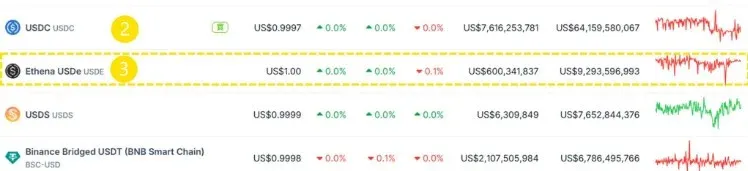
USDe now occupies the global third spot, trailing USDT and USDC, while USDtb is the first compliant stablecoin under the U.S. GENIUS Act. Ethena combines USDe and USDtb to construct a complete risk‑management and yield model.
The whitepaper discloses potential risks, including financing negative interest rates, derivatives liquidation events, custodial‑provider risk, and liquidity risk.
Primary Use Cases for USDe
- Dollar anchor for the crypto market: Provides a stable store of value for investors during periods of high volatility.
- Staking for yield: Users can stake USDe within the Ethena protocol, converting it to sUSDe and participating in profit distribution.
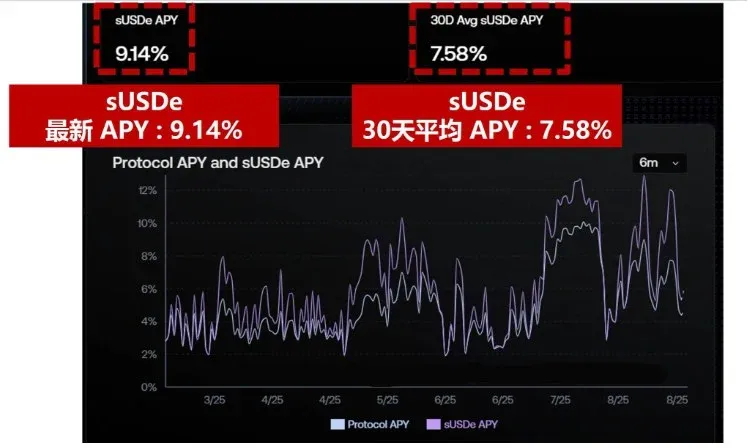
sUSDe’s yield is driven by three components: delta‑neutral hedging returns, earnings from holding other stablecoins, and ETH staking rewards. Official figures show a current APY of 9.14 % for sUSDe, with a 30‑day average APY of 7.58 %.
How USDe Uses a Delta‑Neutral Strategy to Keep a 1:1 USD Peg
Exchange‑Rate Performance
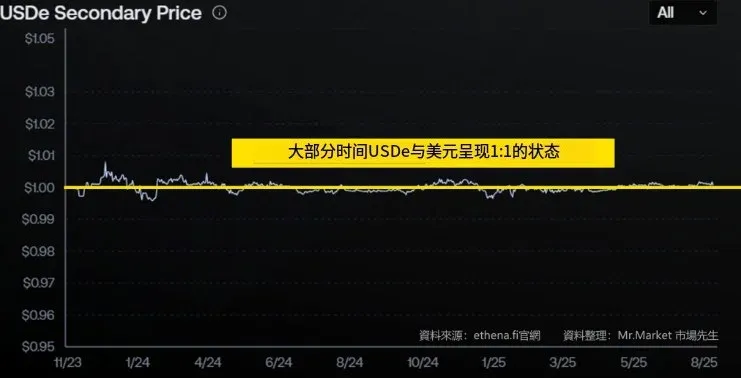
USDe aims to sustain a long‑term 1:1 exchange rate with the US dollar. Historically, its price has hovered around $1 for the majority of the time. Although its stability is marginally lower than that of USDT and USDC, it has demonstrated relatively robust peg maintenance.
Mechanics of the Delta‑Neutral Strategy
When users supply assets such as ETH or BTC as collateral, Ethena simultaneously opens an equivalent short position in the perpetual futures market. This creates a mirror between spot holdings and futures contracts, effectively offsetting price movements and locking in the overall asset value.
- Long side: Holds spot assets that generate yield (e.g., ETH LST).
- Short side: Takes an equal‑size short position in the perpetual futures market.
This configuration ensures that even if the underlying assets experience extreme volatility, USDe can still retain its 1:1 USD peg. The hedging process also generates funding‑rate income and staking rewards, which become revenue streams for the protocol.
Diversified Asset Portfolio
Initially, Ethena relied primarily on ETH staking and hedging. Over time, it has incrementally added BTC, SOL, and several stablecoins (USDtb, USDT, USDC) to reduce dependence on a single asset and to improve system scalability and liquidity.
USDtb as a Hedging Asset
USDtb is issued by Pallas and backed by the BUIDL fund. When USDe faces market stress, the protocol can convert part of its holdings into USDtb to bolster overall stability. The BUIDL fund is an on‑chain tokenized dollar money‑market fund that supplies USDtb with high liquidity and low‑risk asset backing.
Decentralization Level of USDe: A CeDeFi Hybrid Model
Compared with traditional stablecoins, USDe is more decentralized, yet it still relies on centralized exchanges for hedging and holds centralized stablecoins (USDT, USDC) as part of its reserve. Therefore, its architecture falls under a CeDeFi (centralized + decentralized) hybrid model.
USDe Security: Weekly Public Reserve Audits
Since April 2025, Ethena has partnered with multiple audit firms to publish USDe Proof of Reserves reports, enhancing transparency. The audit dated 29 August 2025 shows:
- Total USDe supply: $12.229 billion
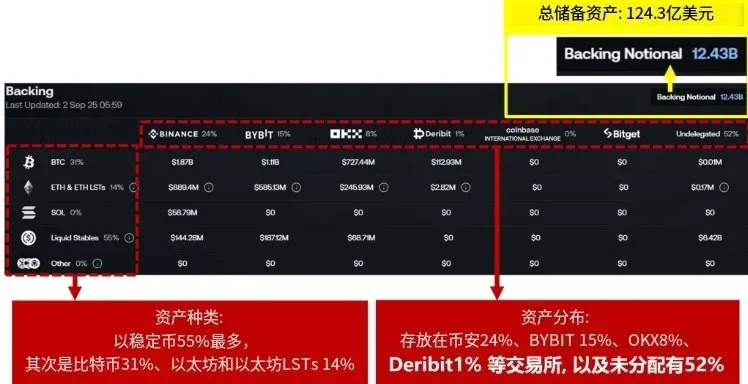
- Total reserve assets: $12.3094 billion
- Assets held by Copper and Ceffu custodians: $6.904 billion
- Assets in Coinbase Web3 wallet: $5.277 billion
- Instant‑redeemable contract assets: $66.5891 million
- Reserve fund: $61.763 million
The reserve ratio stands at 100.66 %, exceeding total supply and indicating full solvency.
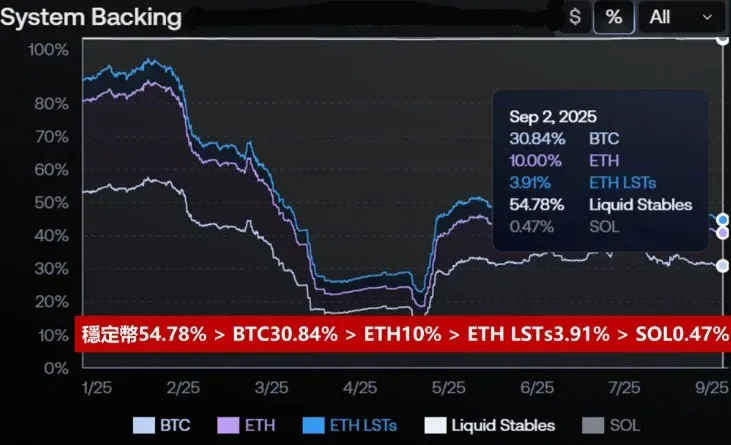
Reserve Asset Allocation (2 September 2025)
- Stablecoins: ≈ 55 %
- BTC: ≈ 31 %
- ETH and ETH LST: ≈ 14 %
- SOL: ≈ 0.5 %
Custodian Distribution
Stablecoins dominate the asset mix, followed by BTC, ETH, and ETH LST.
Dynamic Rebalancing Strategy
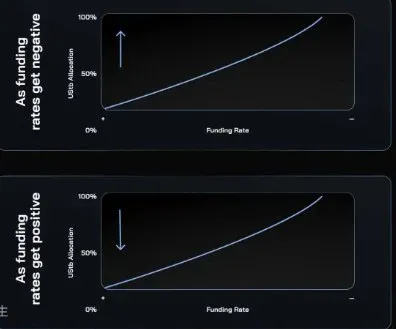
The whitepaper states that Ethena will actively adjust asset weightings based on market conditions:
- Bear market or low funding rates: Increase stablecoin holdings and reduce perpetual‑contract exposure to safeguard liquidity.
- Bull market or favorable funding rates: Raise perpetual‑contract exposure while lowering stablecoin weight, aiming for higher yield.
Funding rates are used to align perpetual‑contract prices with spot prices, preventing prolonged divergence.
Sources of Yield for USDe
USDe itself does not generate yield; it must be converted into sUSDe (a yield‑bearing token) to accrue returns. sUSDe functions similarly to interest on a traditional bond, with yield derived from three main sources:
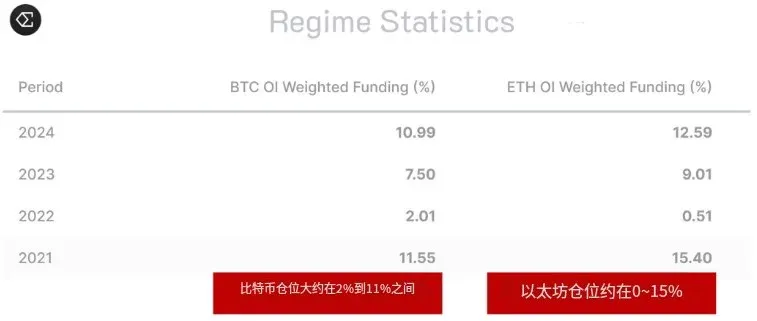
- Delta‑hedging profits (≈ 92 % of total yield)
- Earned via funding rates and basis spreads on perpetual contracts.
- Between 2021 and 2024, BTC‑related positions yielded roughly 2‑11 %, while ETH‑related positions yielded 0‑15 %.
- Stablecoin earnings (≈ 7 %)
- Generated by holding USDtb, USDT, USDC and earning yields on platforms such as Coinbase.
- ETH staking rewards (≈ 6 %)
- Comes from consensus‑layer inflation, execution‑layer fees, and MEV rewards on ETH LST, all paid in ETH.
sUSDe vs. iUSDe
- sUSDe: Yield‑bearing USD‑denominated asset for retail users (not currently available to EU residents).
- iUSDe: Institutional‑focused version with identical mechanics, limited to qualified professional investors.
ENA: Core Token for Governance, Rewards, and Security
Within the Ethena ecosystem, ENA fulfills several roles:
- Governance rights: Holders can vote on critical protocol parameters, such as adding new reserve assets (e.g., SOL) or allocating funds to real‑world‑asset (RWA) pools.
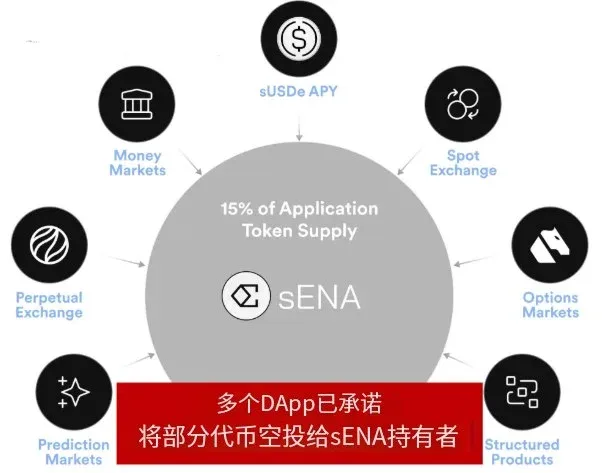
- Reward rights: Staking ENA yields sENA, which entitles participants to a share of protocol revenue and a portion of Ethereal exchange fees (15 % earmarked).
- Security enhancement: Through restaked ENA, the protocol bolsters cross‑chain transmission security and reduces the risk of LayerZero DVN attacks.
Restaking ENA
Ethena collaborates with Symbiotic to create a restaking pool that provides an additional economic penalty layer for cross‑chain assets, thereby improving overall network security.
USDtb: A Compliant Hedging Asset Within the Ethena Ecosystem
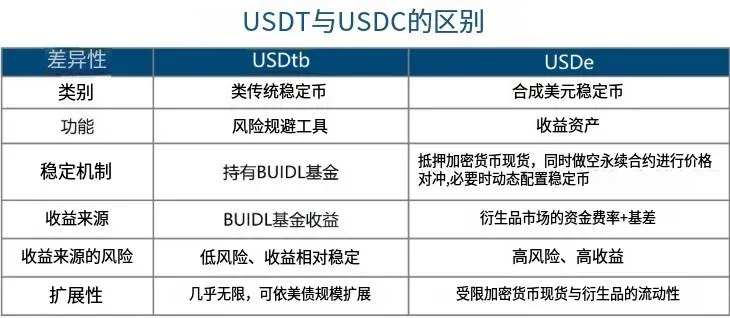
USDtb is operated independently by Pallas (BVI) Ltd. and a Cayman‑registered foundation, backed primarily by the BlackRock‑managed BUIDL fund (≈ 90 %) and a smaller portion of stablecoins (≈ 10 %). It maintains a 1:1 USD peg and is the first compliant stablecoin under the U.S. GENIUS Act, offering short‑term USD interest rates independent of the core Ethena protocol.
Differences Between USDtb and USDe
- USDe: An aggressive yield‑generating asset whose performance depends on the liquidity of crypto derivatives markets.
- USDtb: A defensive, hedging‑oriented asset whose scale can expand with the BUIDL fund and is effectively uncapped.
Together, the two tokens form Ethena’s risk‑management and yield‑generation ecosystem.
Potential Risks Associated with Ethena
The whitepaper enumerates the following primary risks:
- Funding‑rate risk: Elevated funding rates could erode hedging profitability.
- Derivatives risk: Extreme market moves may trigger liquidations or render hedges ineffective.
- Liquidity risk: Insufficient market depth could lead to slippage or an inability to close positions promptly.
- Positioning controversy: Some analysts argue that USDe resembles a bond more than a conventional stablecoin.
- Custodian and exchange risk: Hedging depends on centralized custodians and exchanges; failures could jeopardize asset safety.
- Geographic restrictions: sUSDe is not currently offered to residents of the European Union.
- USDtb risk: Heavy concentration of assets in the BUIDL fund means that limited fund liquidity could affect overall risk mitigation.
*Note: Crypto‑related gains may be subject to taxation in the holder’s jurisdiction; users should consult local tax regulations or a qualified professional.*
How to Acquire USDe and ENA
Centralized Exchanges (CEX)
After creating an account on a reputable, high‑volume centralized exchange—such as Binance (U.S. users should use Binance.US)—you can purchase USDe and ENA directly.
Decentralized Exchanges (DEX)
Connect a compatible wallet, ensure you are on the Ethereum mainnet and have enough ETH for gas, then execute trades on supported DEXs.
Ethena Project Summary
- Protocol positioning: Ethena is a CeDeFi synthetic protocol whose flagship products are the USDe stablecoin and the ENA governance token.
- USDe characteristics: Achieves a 1:1 USD peg through on‑chain asset reserves and a delta‑neutral hedging mechanism, and has risen to become one of the top three USD‑stablecoins by market cap.
- Yield model: Staking USDe to obtain sUSDe yields a composite return derived from hedging activities, stablecoin holdings, and ETH staking rewards, effectively creating an “Internet bond.”
- ENA’s role: Supplies governance, reward distribution, and cross‑chain security, serving as the cornerstone for the protocol’s long‑term viability.
Since its launch, Eth
Related Reading
- Stablecoin Safety Analysis: USDC, USDT, EURC & USDe Compared
- Understanding Stablecoin De‑peg: USDe, UST & Other Cases
- USDe Stablecoin Slides 35% Off Peg on Binance
💡 Register on Binance with referral code B2345 for the maximum trading fee discount. See Binance complete guide.



