
 Bitaigen Research
 We analyze the Katana project from the perspectives of technology, governance, and ecosystem, dissecting its cross‑chain aggregation and zero‑knowledge proof implementation, evaluating its liquidity integration scheme and potential yield mechanisms, and projecting the long‑term value trajectory of the KAT token. If you want to understand how its core architecture influences the DeFi user experience, this article provides a complete breakdown—please continue reading.
Overview of the Katana Project
Katana aims to improve liquidity and deliver sustainable high returns through cross‑chain aggregation and secure governance, making the DeFi experience smoother and more efficient. The project is backed by Polygon Labs and market‑making firm GSR, and combines zero‑knowledge proofs (ZK‑proofs) with Agglayer technology to accelerate transactions, lower fees, and enable rapid on‑chain withdrawals.
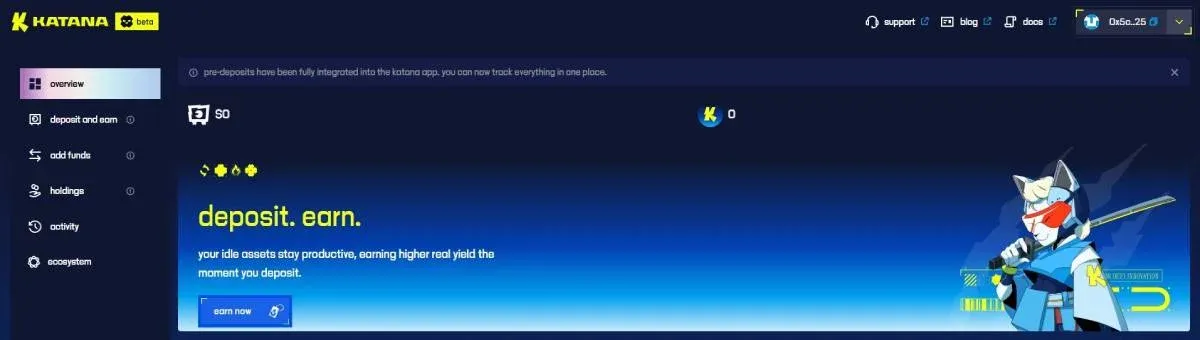
The core of the protocol revolves around three major DeFi building blocks—Morpho, Sushi, and Vertex—with the goal of solving the liquidity fragmentation that plagues traditional DeFi and offering users a one‑stop shop for deep liquidity and yield opportunities.
---
Core Technology and Architecture
Vault Bridge
Vault Bridge acts as an asset bridge, allowing users to deposit USDC, USDT, WBTC and ETH into an Ethereum‑based yield vault and receive corresponding vbTokens on the Katana chain (e.g., vbUSDC, vbWBTC, WETH). These vbTokens carry both a value‑preservation function and a yield‑generation function; the yields they generate are funneled back into Katana’s core applications to reinforce overall liquidity.
On‑Chain Native Liquidity (CoL)
Katana allocates all sequencer fees to build native liquidity (CoL), deploying that liquidity across core modules such as Sushi, Morpho, and Vertex. This design helps maintain low slippage and high‑quality pricing even during periods of market volatility.
Key Applications
- Sushi – a decentralized spot‑exchange offering fast order matching and abundant liquidity.
- Morpho – a lending protocol focused on maximizing yields for lenders and borrowers.
- Vertex – a perpetual‑contract trading platform that supports complex financial derivatives.
Together, these applications form the profit engine of the Katana ecosystem. Generated profits are reinvested into the system, creating a closed loop where “assets never sit idle and yields keep compounding.”
---
KAT Token Overview
| Item | Details |
|------|---------|
| Token name | Katana |
| Symbol | KAT |
| Chain | Polygon |
| Total supply | 10,000,000,000 KAT |
| Circulating supply | 2,260,000,000 KAT |
Katana launched its mainnet on June 30 and raised over US$248 million within the following two weeks, directing the majority of the capital straight into Yearn V3 vaults so early participants could start earning yields immediately.
The project also distributed “Katana Krates” NFTs to early contributors; holders of these NFTs are entitled to claim KAT tokens. The token allocation plan is as follows:
- Sushi: 400 million KAT (4% of total)
- Morpho: 250 million KAT (2.5% of total)
- Future modules (perpetual DEX, launchpad, yield tokenization, etc.): up to 350 million KAT (3.5% of total)
KAT will remain locked until February 20, 2026. After the lock‑up expires, tokens can be staked as vKAT, which grants voting power in reward pools and a share of protocol fees, following a model similar to ve‑tokens. Users can acquire KAT by depositing ETH, USDC, USDT, or WBTC.
Note for U.S. readers: Trading of KAT on Binance is only available through Binance.US for U.S. residents, as the global Binance platform is not accessible in the United States.
---
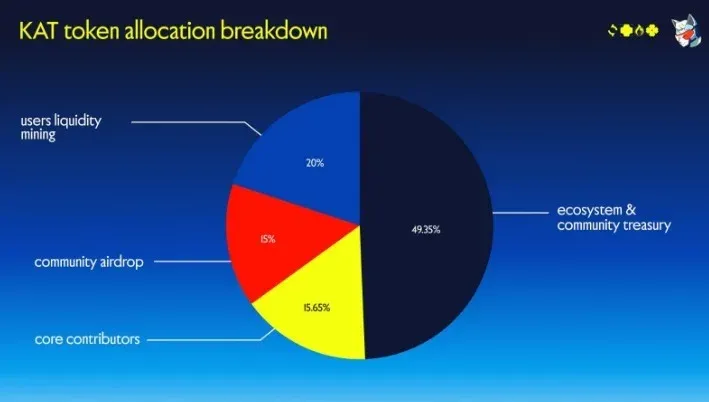
Tokenomics
- Team, advisors, contractors: 15.65%
- Treasury (national‑bond‑style reserve): 47.35%
- Ecosystem incentives: 10%
- Liquidity reserve: 10%
- Airdrops / bounties: 15%
- Public (miners, ICO participants, traders): 2%
---
Market Performance and Trading Channels
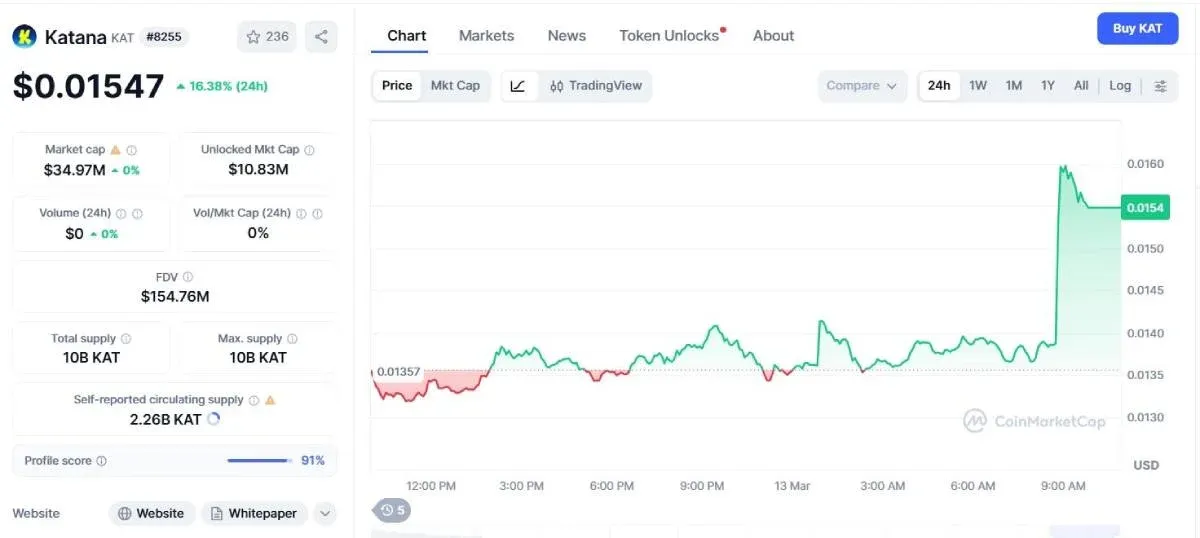
After being listed on Binance at 13:00 UTC on March 18 (trading pairs KAT/USDT, KAT/USDC, KAT/TRY), the price jumped 17.69% within minutes, reaching $0.01566 USD and giving the token a market cap of roughly $31.4 million USD.
KAT is also tradable on decentralized exchanges such as Uniswap, Raydium, and Pumpswap. The official circulating supply figure is 2.26 billion, representing about 22.6% of the total issuance, indicating that there is still considerable upside potential for market‑cap growth as more tokens become available.
---
Factors Influencing Price
- Technical sentiment: According to the CoinDataFlow model, the technical outlook through the end of 2025 is neutral, with no strong buy or sell signals emerging.
- Market‑volatility risk: The model assumes typical crypto volatility patterns and does not factor in macro‑economic shocks or exchange delistings. Should liquidity thin out, the probability of a sharp price correction rises.
- Bitcoin correlation: In a scenario where Bitcoin experiences a modest 1–2% post‑halving rally, the model still predicts KAT to hover near $0.00 USD in 2026, suggesting that macro‑level tailwinds alone are insufficient to lift valuation dramatically.
- Liquidity structure: Current trading volume is limited; therefore, price sustainability depends more on depth of order books than on speculative demand.
---
Price Forecast and Volatility Expectations
Short‑term (0–3 months post‑launch)
The first month may see pronounced volatility as airdrop recipients and early holders tend to sell once trading opens. If liquidity‑mining incentives are sufficiently attractive, the price could stabilize in the $0.006 – $0.012 USD range.
Mid‑term (6–12 months)
Mid‑term price movements will largely reflect ecosystem expansion and the rollout of partner integrations. Should layer‑2 infrastructure, DeFi tooling, and cross‑chain bridge services gain traction, analysts estimate KAT could trade between $0.02 – $0.05 USD.
Long‑term (2–5 years)
Long‑term value is highly contingent on real‑world usage and network scale. If the project continues to attract users, deepens collaborations, and upgrades on‑chain functionality, the token could climb to $0.08 – $0.20 USD or higher during a strong crypto market cycle.
Tax reminder: Crypto gains may be subject to taxation in your jurisdiction. Always consult a qualified tax professional to understand your reporting obligations.
---
Core Tokens and Assets
ETH and WETH
Native Ethereum (ETH) is not an ERC‑20 token and therefore has certain usability constraints. Katana introduces Wrapped ETH (WETH), which conforms to the ERC‑20 standard and implements the WETH9 interface. WETH can directly replace ETH within the platform and generate yield, thereby improving the overall trading experience for users.
AUSD
AUSD is Katana’s native stablecoin, fully collateralized and equipped with a yield‑distribution mechanism. Yield is allocated based on the total value locked (TVL) on‑chain, incentivizing liquidity provision and delivering long‑term returns to the ecosystem.
---
Governance Structure
Katana employs a two‑layer governance model:
- Katana Administrators (3‑of‑5 multisig): Managed jointly by the foundation, Polygon Labs, and GSR. This body proposes system‑upgrade proposals, each of which undergoes a 10‑day review period.
- DeFi Security Committee (10‑of‑13 multisig): Composed of leading infrastructure and DeFi integration partners, this committee holds the authority to veto or fast‑track proposals, ensuring both decentralization and rapid response to security concerns.
This design balances decentralized decision‑making with the flexibility needed for safe upgrades.
---
Operational Model
Katana’s “flywheel” can be summarized in five steps:
- Asset deposit – Users send ETH, USDC, USDT, or WBTC through the Vault Bridge.
- Yield generation – Deposited assets flow into an Ethereum yield vault where they earn compounded returns.
- Yield allocation – Generated yield is transferred back to Katana and allocated to core modules such as Sushi, Morpho, and Vertex.
- User rewards – Active depositors, traders, and liquidity providers receive additional incentives.
- Liquidity accumulation – Sequencer fees and application fees fund on‑chain native liquidity (CoL), further bolstering system robustness.
The model ensures that assets are constantly working to produce returns; the more capital users lock in, the higher the potential reward.
---
Future Vision
Katana is not merely a DeFi‑focused blockchain; it is a cross‑chain aggregation ecosystem that leverages Agglayer and other chains for seamless interoperability. By employing zero‑knowledge proofs and CDK‑opgeth technology, the project claims competitive advantages in speed, security, and scalability.
Supported by Polygon Labs, GSR, Chainlink, and other industry players, Katana aspires to become a leading provider of deep liquidity and high‑yield opportunities. Although still in its early stages, the launch of a private mainnet and the innovative Krates model have already attracted community attention. If KAT can be listed on more mainstream exchanges and integrated with a broader set of protocols, the growth potential of the project could expand dramatically.
---
This article systematically outlines Katana (KAT)’s concept, tokenomics, price performance, and outlook for reference purposes. For more information, you can search the Bitaigen (比特根) archive or continue browsing the related links below. Happy exploring and stay rational in your blockchain endeavors.
💡 Register on Binance with referral code B2345 for the maximum trading fee discount. See Binance complete guide.



