
 Bitaigen Research
To date, Pi has not officially launched its mainnet, and the project team has not authorized any exchange to list the token. This creates a degree of risk, so investors should exercise caution.
Huobi (Huobi Global) opened Pi (Pi Network, “Pi Coin”) spot trading pairs at 17:00 (UTC+8) on the afternoon of the 29th. The coin, which opened at $0.01, surged to nearly $62 within half an hour, and later that evening broke a new high, briefly touching $345 – an increase of roughly 30,000 ×.
However, Pi’s listing on Huobi is disputed because the project has not granted permission. Some members of the crypto community even label it a “pyramid scheme.” To help readers better understand the project, 120BTc.com has compiled the following nine frequently asked questions (FAQ) with answers.
From technical, compliance, and market perspectives, we carefully review Pi’s latest developments and controversies, and provide objective answers to the most common concerns of investors. This analysis will enable you to quickly assess the project’s risk profile and make a rational decision about participating in its future ecosystem.
Nine Common Questions About Pi Coin
1. What is Pi? Is it a scam?
Pi claims that users can continuously earn tokens simply by downloading the official app and tapping a button each day, aiming to create a low‑barrier, low‑cost cryptocurrency network. According to Google Play statistics, the app has been downloaded more than 50 million times, and the team says daily active users exceed ten million.
In practice, Pi’s architecture remains highly centralized. The so‑called P2P transactions are recorded on a central server after users complete KYC verification, which functions similarly to traditional centralized systems.
Although the entry threshold is low, users should still be wary of personal‑information leakage and the potential for malicious software bundled with the app.
2. Why is Pi’s market cap said to exceed Bitcoin’s?
Pi Network’s whitepaper (released at the end of 2021) sets the maximum supply at 100 billion Pi. Using Huobi’s current peak price, the diluted market cap would be about $34.5 trillion, nearly a hundred times larger than Bitcoin’s approximate $348.7 billion market cap.
It is important to note that Pi’s mainnet has not launched, and Huobi’s trading is not authorized by the project. The price therefore behaves more like a futures contract and does not reflect an intrinsic value.
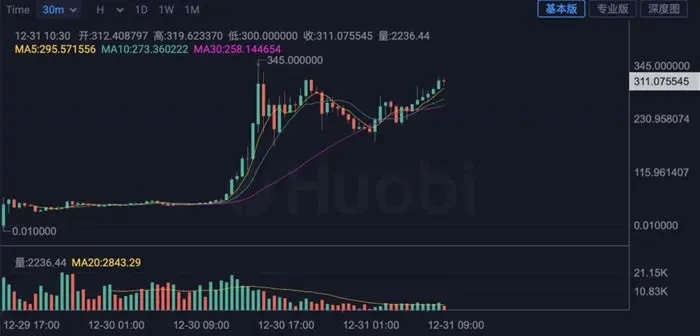
3. After listing on Huobi, Pi rose tens of thousands of percent. Is this just “air‑trading”?
Huobi does not currently support Pi deposits or withdrawals, meaning users are not buying spot Pi but rather a Pi futures‑like instrument with no settlement date. This allows a small amount of capital to generate large short‑term price swings.
On May 30, Pi Network’s official Twitter account posted: “We have not authorized any exchange to list Pi. Do not purchase the token from third parties; you do so at your own risk.”

Consequently, many observers argue that the current trading activity lacks real underlying value and amounts to “air‑trading.”
4. I hold a large amount of Pi. How can I transfer it to Huobi for sale?
Huobi announced on the 29th that deposits and withdrawals will remain disabled until Pi Network’s mainnet is successfully launched. Therefore, users must wait for further official updates.

5. When will the Pi mainnet go live? When can its value be realized?
Pi Network was founded in March 2019. In December 2021, the team announced that the mainnet was being prepared in two phases:
- Closed‑test mainnet (launched in mid‑2023) – provides basic functions such as the Pi wallet and browser.
- Open mainnet – originally slated for March or June 2022, but as of now there is no confirmed timeline.
6. How do I obtain Pi? Why are so many users “mining” it?
Pi’s “mining” process is deliberately simple: users open the app and tap once per day to receive tokens. Registration only requires a mobile phone and internet access, making participation virtually universal.
Unlike Bitcoin, Ethereum, or other traditional blockchains, Pi does not implement a genuine proof‑of‑work or validation mechanism. Rewards are stored locally on the mobile device, and the full source code has not been publicly released.
7. Someone claims they want to sell me Pi. Is this trustworthy?
Besides Huobi, a few smaller exchanges have listed Pi, but they also lack deposit/withdrawal capabilities, and quoted prices vary widely. If a counter‑party asks you to transfer funds via a platform, proceed with extreme caution.
P2P transfers on these platforms require KYC verification before the function is unlocked. Because the mainnet is still pending, thorough due diligence is essential, and you should be aware of the inherent risks.
8. What is the significance of Pi’s total supply and market cap?
The whitepaper caps total supply at 100 billion Pi. Using Huobi’s highest trade price, the diluted market cap would be roughly $34.5 trillion, nearly a hundred times Bitcoin’s diluted market cap and over 40 times the total market cap of all cryptocurrencies combined.
Compared with traditional finance, this figure equals about three times the total market value of gold, or 90 % of the entire U.S. stock market. Whether the token is over‑valued remains to be proven by the market.
9. I tried to cash out Pi on Huobi but was blocked. What happened?
Earlier this week, several users who realized profits from Pi trading on Huobi encountered withdrawal restrictions and were asked to explain “abnormal gains.” Customer support said the platform detected three accounts with unusually large profit spikes and, after a risk‑control audit, temporarily suspended trading for those accounts.
While Huobi issued a quick clarification, some users expressed dissatisfaction with the exchange’s adjudication role and questioned the “front‑running” narrative, noting that Pi’s mainnet has not yet launched.
---
*Note on taxation:* Crypto gains may be taxable in your jurisdiction. Please consult a qualified tax professional to understand your obligations, especially if you are trading on a platform that processes fiat via SEPA, SWIFT, or other international channels.
*Regional note for U.S. users:* If you reside in the United States, you must use Binance.US or another U.S.-compliant exchange for fiat‑crypto transactions; the global Binance platform is not available to U.S. residents.
These are the nine most common questions regarding whether Pi has launched its mainnet and whether Pi is a scam. For more updates on Pi Coin, follow Bitaigen’s subsequent reports.
Related Reading
- Huobi New User Registration & Usage Guide – Step-by-Step
- Pi Network Mobile Mining: Earn Crypto Daily with One Tap
- Huobi vs OKX vs Binance: Spot, Derivatives & Service Suite Comparison
💡 Register on Binance with referral code B2345 for the maximum trading fee discount. See Binance complete guide.



