 Bitaigen Research
Lombard (BARD) is a Bitcoin DeFi (BTCFi) infrastructure protocol designed to solve a long-standing capital inefficiency in the cryptocurrency space: currently, approximately $2 trillion worth of Bitcoin sits idle in cold wallets, failing to participate in the on-chain economy it helped build. Supported by top-tier institutions such as Polychain Capital, Franklin Templeton, and YZi Labs (formerly Binance Labs—note that US-based users must use Binance.US rather than the global platform), Lombard provides the critical infrastructure necessary for Bitcoin to act as productive capital in decentralized finance without requiring holders to sacrifice custody or security.
The core of the Lombard ecosystem consists of the governance and utility token $BARD and the liquid staking token LBTC. LBTC is backed 1:1 by native BTC. In early March 2026, the price of $BARD surged by more than 60%, significantly outperforming the broader cryptocurrency market. This rally was primarily driven by growing investor interest in Bitcoin DeFi infrastructure and technical breakthroughs that pushed the token to new all-time highs.
This article provides an in-depth analysis of how Lombard’s Bitcoin capital market infrastructure works, explores the core role of the $BARD token, and analyzes the key factors influencing its market trajectory in 2026.
As the Bitcoin ecosystem explodes, activating massive amounts of dormant liquidity has become a central focus for the industry. In this article, we provide a deep dive into Lombard, a BTCFi infrastructure protocol favored by top-tier institutions. By dissecting the core mechanisms of the governance token BARD and the liquid staking token LBTC, we aim to reveal how it balances asset efficiency with security, offering insights into its unique position and future potential within the Bitcoin capital market.
What is Lombard (BARD)? How Does It Work?
Lombard is dedicated to building a Bitcoin capital market on-chain, playing a role similar to that of stablecoins in expanding crypto liquidity. Lombard provides a comprehensive infrastructure stack designed to allow Bitcoin to function as productive capital in decentralized finance, rather than merely serving as a passive store of value.
The protocol introduces an institutional-grade security architecture, with its primary components including:
- Babylon Bitcoin Staking Integration: BTC deposited by users can be staked via the Babylon protocol to secure Proof-of-Stake (PoS) networks while generating native yields denominated in BTC.
- Chainlink CCIP-Based Cross-Chain Infrastructure: Leveraging Chainlink’s Cross-Chain Interoperability Protocol, Lombard assets can flow freely across more than 15 blockchains while maintaining the verifiability of the underlying BTC reserves.
- Institutional Validator Security Consortium: System security is collectively maintained by a consortium of institutional validators, including major centralized exchanges, Galaxy Digital, DCG, Wintermute, Figment, Kiln, and Antpool.
- Vault Strategies and Developer SDK: Automated vault strategies assist users in deploying Bitcoin into DeFi yield opportunities, while the Lombard SDK allows wallets, exchanges, and applications to integrate BTC deposits, LBTC minting, and yield distribution features.
What are Lombard's Core Products?
The Lombard ecosystem revolves around two Bitcoin assets designed for different DeFi use cases. LBTC allows holders to earn yield through staking, while BTC.b provides permissionless Bitcoin liquidity. Both assets are backed 1:1 by native Bitcoin and protected by the institutional validator consortium.
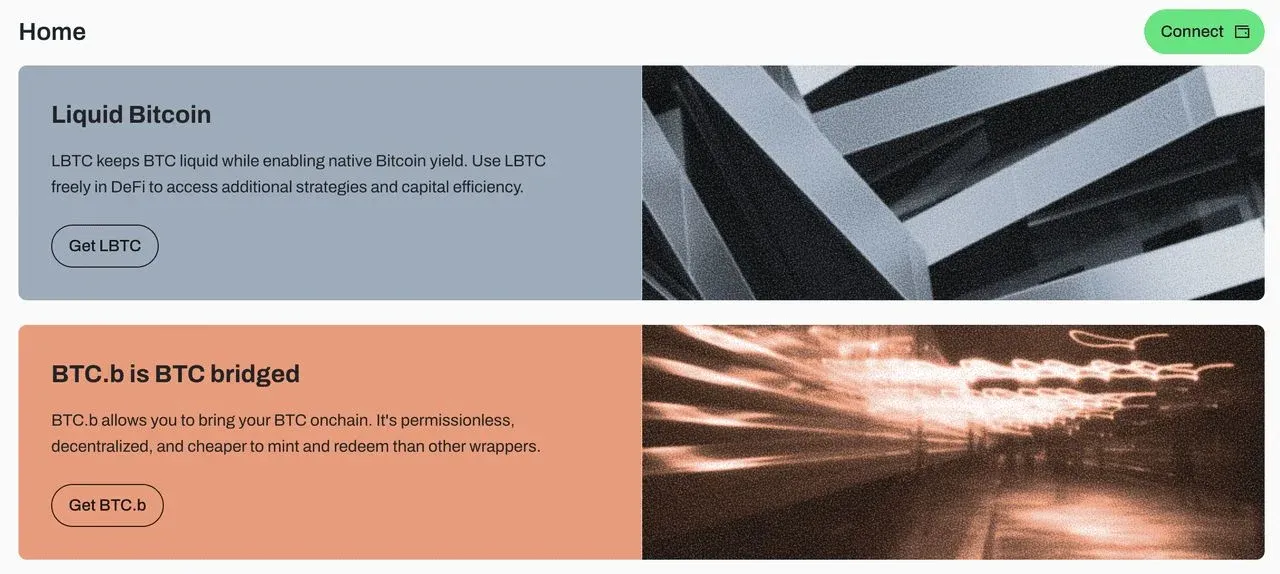
1. LBTC — Yield-Bearing Liquid Staking Bitcoin
LBTC is Lombard’s flagship product. After users deposit native BTC, they receive LBTC at a 1:1 ratio.
The deposited BTC is staked through the Babylon protocol, providing security for PoS networks such as BOB, Osmosis, and TAC. Staking rewards are converted back into BTC and reflected in the value of LBTC, enabling automatic yield accumulation. Currently, LBTC has been integrated into 14 blockchains and is widely used in DeFi protocols like Aave, Morpho, Pendle, and EtherFi for lending and liquidity strategies. It is important to note that redeeming LBTC back to BTC typically requires an unbonding period of 7 to 9 days.
2. BTC.b — Permissionless Non-Yield Bitcoin
BTC.b is a permissionless wrapped Bitcoin asset that Lombard acquired from Ava Labs in October 2025. Originally launched in 2022 as the official bridged Bitcoin for the Avalanche network, it has since been migrated to Lombard's infrastructure and shares the same institutional validator security model.
Unlike LBTC, BTC.b does not generate staking yields and is designed specifically for users and developers who need "neutral" Bitcoin liquidity within DeFi. The asset maintains 1:1 BTC backing and can be used as collateral or integrated into various protocols, providing holders with direct exposure to Bitcoin prices.
The Complementary Relationship Between LBTC and BTC.b
Through these two products, Lombard has become one of the few platforms capable of simultaneously providing yield-bearing and non-yield cross-chain Bitcoin assets. Users seeking yield can opt for LBTC, while those requiring high composability and neutral assets for trading or collateral can utilize BTC.b.
Both assets are distributed via the Lombard SDK, making it easy for exchanges, wallets, and DeFi protocols to integrate them directly into their own infrastructure.
Why $BARD Surged Over 60% in March 2026
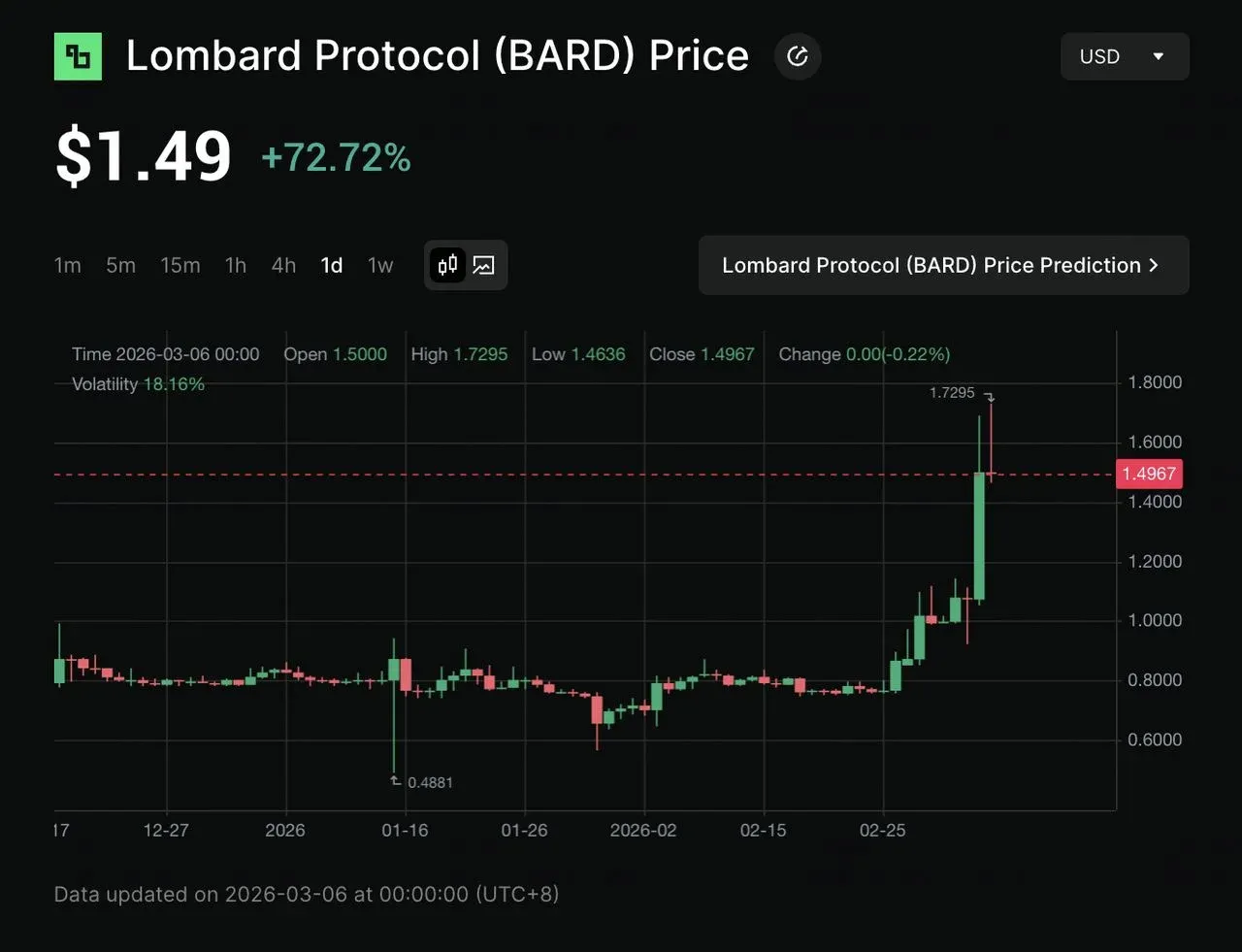
In the week spanning late February to early March 2026, $BARD rose by more than 60%, hitting a new all-time high on March 5. Daily trading volume consistently broke above $160 million (USD), indicating high activity relative to its market capitalization and showing strong participation from both retail and institutional investors. Two primary factors drove this rally:
1. Capital Inflow into BTCFi Infrastructure: At the end of February, the crypto market entered a "risk-on" phase, with capital flowing from large-cap assets toward mid-cap DeFi and infrastructure tokens. Due to surging demand for yield-bearing Bitcoin assets, Lombard—with over 50% market share and more than $3 billion in locked BTC—became a primary beneficiary of the BTCFi narrative.
2. Technical Breakout and Volume Resonance: $BARD broke through a key resistance level on March 1, ending a multi-week consolidation range. Subsequently, spot and perpetual contract trading volumes surged sharply, confirming the market trend. As the price approached previous highs, momentum-driven buying further accelerated, ultimately pushing the token to a new milestone on March 5.
The Utility of the $BARD Token
According to Lombard’s official documentation, $BARD possesses four core functions designed to secure the protocol, drive ecosystem growth, and provide utility to holders:
- Governance: Holders can participate in on-chain governance, voting on decisions regarding validator composition, fee structures, product roadmaps, and the distribution of grants from the Liquid Bitcoin Foundation (LBF).
- Security: Users can stake $BARD to help secure the LBTC cross-chain infrastructure built via Chainlink CCIP and Symbiotic. Stakers receive $BARD rewards and partner incentives; however, unstaking requires a 21-day waiting period.
- Ecosystem Development: Through the Liquid Bitcoin Foundation, $BARD is used to fund ecosystem grants, partnership programs, and research projects aimed at expanding Bitcoin's use cases in DeFi.
- Protocol Utility: Holders enjoy enhanced access within Lombard products, such as staking vaults and DeFi markets. As the ecosystem expands, this utility is expected to extend to future institutional-grade products.
$BARD Tokenomics
The total supply of $BARD is fixed at 1,000,000,000 tokens, with full unlocking expected to be completed within four years of the Token Generation Event (TGE). The token distribution structure is as follows:
- Community & Ecosystem (35%): Allocated for user incentives, ecosystem activation, partnerships, and long-term growth initiatives.
- Core Contributors (25%): Allocated to the development team with long-term vesting schedules to ensure alignment with the protocol's growth.
- Early Investors (20%): Allocated to early backers such as Polychain, Franklin Templeton, and YZi Labs.
- Liquid Bitcoin Foundation (20%): Managed by the foundation to fund research, grants, and other public goods.
Furthermore, Lombard plans to introduce protocol fee structures and buyback mechanisms linked to LBTC minting, vault management, and Lombard Ledger transaction revenue, thereby establishing a direct link between protocol growth and the long-term value of $BARD.
Lombard vs. Other Bitcoin DeFi Protocols
The Bitcoin DeFi sector is developing rapidly, with different protocols focusing on various aspects. Lombard positions itself as a full-stack infrastructure layer. The following table illustrates the differences between Lombard (BARD), Wrapped Bitcoin (WBTC), Babylon, and EtherFi eBTC:
| Dimension | Lombard (BARD) | Wrapped Bitcoin (WBTC) | Babylon (BABY) | eBTC (EtherFi) |
| :--- | :--- | :--- | :--- | :--- |
| Core Model | Yield-bearing Liquid BTC + Infra | Custodial BTC Wrapped Asset | Native BTC Staking Protocol | Ecosystem Liquid Staking BTC |
| Yield Mechanism | Babylon Staking + Vault Strategies | No native yield | Native BTC Staking Rewards | EtherFi Staking Yield |
| Security Model | Consortium + CCIP | Centralized Custody (BitGo) | Bitcoin PoW Finality | EtherFi Validator Set |
| Cross-Chain Support | 15+ Blockchains | Primarily Ethereum | Bitcoin Mainnet Only | Primarily Ethereum |
| Governance Token | $BARD | None | TBD | $ETHFI |
4 Key Factors to Consider Before Trading $BARD
Before participating in $BARD trading, investors should pay attention to the following structural factors that may affect price volatility and long-term adoption:
- Token Unlock Schedule: As of March 2026, approximately 73% of the supply remains locked, with releases continuing until 2029. An unlock event on March 18 will release 30 million $BARD (3% of the total supply) to airdrop recipients, which could lead to short-term selling pressure.
- Growth of the LBTC Ecosystem: The long-term value of $BARD is positively correlated with the adoption rate of LBTC. Key metrics to observe include LBTC's Total Value Locked (TVL), the depth of its DeFi integrations, and cross-chain activity.
- BTCFi Market Competition: Lombard faces stiff competition from protocols like WBTC, Babylon, and EtherFi. The battle for liquidity and integration resources will impact its market standing.
- Cross-Chain Infrastructure Risk: Despite the dual protection of the validator consortium and Chainlink CCIP, any protocol involving cross-chain asset movement faces inherent industry bridge security risks.
Additionally, investors should be aware that cryptocurrency gains may be subject to capital gains tax depending on their local jurisdiction. For those using traditional banking, fiat on-ramps often support SEPA or SWIFT transfers for USD or EUR.
Conclusion
From the perspective of 2026, Lombard (BARD) combines early adoption arguments with an ambitious vision for Bitcoin DeFi. In less than two years, Lombard has successfully attracted over $3 billion in Bitcoin and captured half of the yield-bearing BTC market.
In the short term, the token unlock on March 18 represents a major supply-side test. In the long term, its prospects depend on the ubiquity of LBTC, the breadth of Lombard SDK integrations, and the position of the Lombard Ledger within the on-chain Bitcoin economy. If the BTCFi sector continues to expand, Lombard is well-positioned to benefit from its first-mover advantage and institutional-grade architecture. However, investors must remain vigilant regarding token unlock dynamics and the uncertainties brought by market competition.
💡 Register on Binance with referral code B2345 for the maximum trading fee discount. See Binance complete guide.



