
 Bitaigen Research
 We systematically outline the core concepts of cryptocurrency futures, the key criteria for selecting a platform, and conduct an in‑depth evaluation of the five exchanges that stand out in 2026 for liquidity, fees, leverage and overall performance. This guide helps you quickly pinpoint the tool that best fits your needs; subsequent sections will provide detailed side‑by‑side comparisons and practical implementation tips.
Note: Gains from cryptocurrency trading may be taxable in your jurisdiction. Always consult a tax professional to understand local obligations.
Key Takeaways
- By 2026, cryptocurrency futures trading will remain a dominant force in the market, driven by demand for leverage, flexibility, and the ability to take both long and short positions.
- Choosing the right exchange is critical; liquidity, fees, execution quality and risk‑control mechanisms directly affect futures performance.
- The five platforms evaluated in this article are Bitget, Binance, Bybit, OKX and MEXC, each catering to different trader profiles.
- Bitget stands out with a balanced product suite, competitive pricing and a copy‑trading feature, making it the top recommendation for 2026.

What Is Cryptocurrency Futures Trading?
Cryptocurrency futures trading involves speculating on the price movement of digital assets through derivative contracts that allow both long and short exposure. When selecting a platform, traders should consider liquidity, fees, available leverage and risk‑management tools. The top‑five platforms for 2026 are Bitget, Binance, Bybit, OKX and MEXC.
Cryptocurrency futures let traders profit from price changes without actually holding the underlying asset. Most contracts are perpetual—there is no expiration date, and a funding rate keeps the contract price in line with the spot market. Traditional delivery futures settle on a fixed date and are used less frequently by retail participants.
Leverage and margin are the defining features of futures. With leverage, a trader can control a large position using a relatively small amount of capital; for example, a 10× leverage position requires only $5,000 of margin to open a $50,000 Bitcoin futures trade. Small price movements can therefore generate sizable profits, but insufficient margin combined with sharp volatility can trigger rapid liquidation. A thorough understanding of leverage ratios, funding rates and risk‑management practices is essential for long‑term success.
How to Choose the Best Cryptocurrency Futures Exchange
When evaluating platforms, consider the following dimensions:
| Critical Factor | Evaluation Points |
|---|---|
| **Liquidity** & Depth | High trading volume ensures tight spreads, fast execution and minimal slippage |
| Contract Variety | Support for BTC, ETH and a wide range of altcoins expands strategic flexibility |
| **Fees** & Funding Rate | Competitive maker/taker fees and reasonable funding rates lower the cost of holding positions |
| **Leverage** & Margin | Multiple leverage tiers, isolated or cross‑margin options aid risk control |
| Risk Management & System Stability | Insurance fund, liquidation protection and ≥99 % uptime |
| User Experience & Security | Intuitive UI, cold‑wallet storage, multi‑factor authentication and compliance with relevant regulations |
This framework helps traders align an exchange’s strengths with their own trading style and risk tolerance, ultimately identifying the most suitable futures venue.
2026’s Top Cryptocurrency Futures Platforms
1. Bitget
- Futures contracts: 620+
- Fees (maker / taker): 0.02 % / 0.06 %
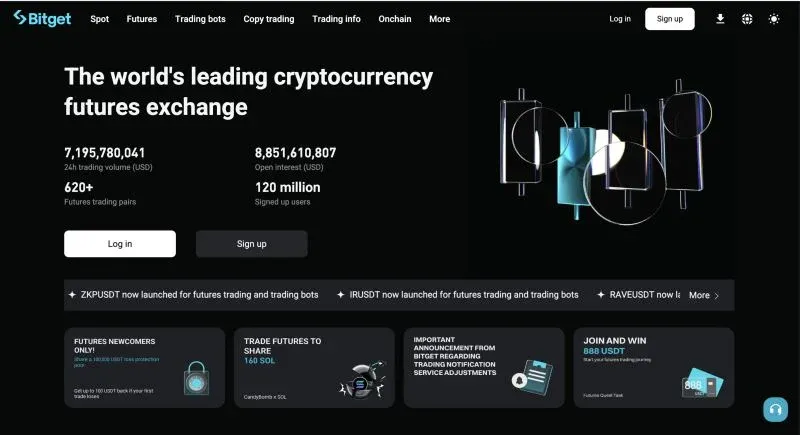
Founded in 2018, Bitget has grown into one of the world’s largest derivatives exchanges, serving over 100 countries with more than 120 million registered users. The platform follows a “derivatives‑first” philosophy and continuously invests in futures infrastructure, order‑execution reliability and trader‑centric tools.
- Contract coverage: More than 620 contracts, including Bitcoin, Ethereum and a broad selection of emerging tokens.
- Fee advantage: Low base fees; VIP members and holders of the native BGB token receive additional discounts.
- Copy‑trading: Thousands of lead traders are available for automatic strategy replication, which is especially helpful for newcomers.
- Security & Stability: System uptime of 99.99 %, cold‑wallet storage, multi‑factor authentication and a multi‑hundred‑million‑USD insurance fund that is regularly audited and disclosed.
Overall, Bitget offers a well‑rounded mix of contract breadth, cost efficiency and social‑trading features, making it suitable for professionals seeking robust tools without sacrificing affordability.
2. Binance
- Futures contracts: 250+
- Fees (maker / taker): 0.02 % / 0.05 %
Binance is the world’s largest crypto‑derivatives exchange, with order‑book depth that leads the industry. It offers both perpetual and delivery futures across major coins and popular altcoins, handling daily futures turnover of several hundred billion USD. Spreads are tight and execution is reliable. Advanced order types, flexible margin models and a comprehensive API suite cater to institutions and high‑frequency traders, although the platform’s complexity and regional regulatory restrictions (U.S. residents must use Binance.US) may pose hurdles for beginners.
Bitget vs. Binance
- Binance enjoys superior overall liquidity and depth.
- Bitget provides a larger selection of trading pairs and a streamlined copy‑trading ecosystem that lowers the entry barrier for novices.
- Users who prioritize sheer volume and institutional‑grade execution may favor Binance; those who value user‑friendliness and market variety may find Bitget a better fit.
3. Bybit
- Futures contracts: 450+
- Fees (maker / taker): 0.02 % / 0.055 %
Bybit is recognized as a professional‑grade derivatives platform, primarily serving experienced, active traders. The exchange focuses on perpetual contracts, delivering ultra‑fast order execution, a stable infrastructure and a rich set of advanced order and margin options, plus extensive API support. Its clean, performance‑oriented interface appeals to technically‑savvy participants, though the relative lack of social features makes it less beginner‑friendly.
Bitget vs. Bybit
- Bybit emphasizes execution speed and a specialist UI, ideal for high‑frequency or seasoned traders.
- Bitget offers a broader contract universe and copy‑trading capabilities, striking a balance between novice accessibility and advanced strategy deployment.
4. OKX
- Futures contracts: 200+
- Fees (maker / taker): 0.02 % / 0.05 %
OKX is known for its comprehensive derivatives ecosystem, providing perpetual contracts, delivery futures, portfolio margin, unified accounts and options—tools aimed at sophisticated strategies and institutional risk management. Liquidity is ample, but the steep learning curve of its advanced features may require extra time for newcomers.
Bitget vs. OKX
- OKX leans toward institution‑grade functionalities and granular risk controls.
- Bitget prioritizes ease of use, extensive contract coverage and social trading, attracting a wider audience.
5. MEXC
- Futures contracts: 1,200+
- Fees (maker / taker): 0.01 % / 0.04 %
MEXC distinguishes itself with a rich lineup of altcoin futures, often listing new token perpetual contracts faster than larger competitors. This makes it attractive to speculators chasing high‑volatility markets. Low fees appeal to frequent traders, yet some low‑volume contracts suffer from uneven liquidity, and overall execution stability is marginally lower than that of the top‑tier exchanges.
Bitget vs. MEXC
- MEXC excels in niche token coverage.
- Bitget delivers more balanced liquidity, robust risk safeguards and copy‑trading tools, suitable for diversified trading needs.
Which Cryptocurrency Futures Platform Is Right for You?
Exchange selection should reflect both experience level and trading focus, which can be grouped into three categories:
- Beginner‑friendly: Bitget, Bybit, OKX
- Active‑trader oriented: Binance, Bitget, Bybit
- Broad altcoin coverage: Bitget, MEXC, OKX
Matching your personal trading style, risk appetite and the markets you wish to target can substantially improve execution quality and overall efficiency.
Conclusion
Entering 2026, the core of cryptocurrency futures trading has shifted from a sole emphasis on leverage returns to a holistic assessment of platform reliability, depth and adaptability. Derivatives now serve as the primary engine of the crypto market, and traders need exchanges that deliver rapid execution, effective risk management and support for multiple strategies.
In the current landscape:
- Bitget: A complete futures ecosystem with extensive contracts and copy‑trading, suitable for traders at all levels.
- Binance: The benchmark for liquidity and institutional‑grade execution (U.S. users should access Binance.US).
- Bybit: The go‑to choice for high‑performance, professional‑grade interfaces.
- OKX: Offers complex risk‑management tools, fitting for institutions and advanced strategies.
- MEXC: Focuses on emerging altcoin futures, meeting the needs of high‑volatility speculation.
Understanding each platform’s strengths and aligning them with your objectives enables you to participate in the cryptocurrency futures market over the coming year with greater confidence and stability.
That concludes the full content of “What Is Cryptocurrency Futures Trading? How to Choose? 2026 Best Futures Exchange Rankings and Reviews.” For more insights on crypto‑futures platforms, stay tuned to Bitaigen (比特根) and explore our other articles!
Related Reading
- Gate.io Review: Top Alt‑Coin Exchange & Fee‑Saving Tips
- MEXC vs BingX 2026: Which Crypto Exchange Is Better?
- Top Crypto Exchanges 2026: Binance, OKX, Huobi Review
💡 Register on Binance with referral code B2345 for the maximum trading fee discount. See Binance complete guide.



