
 Bitaigen Research
We have prepared a complete practical guide for investors who are new to Bitcoin options, showing every step from entering “Option Quick‑Pick” on the OKX platform to placing an order, accompanied by clear screenshots to help readers get started quickly. The article also breaks down common buying and selling logic as well as risk points, assisting you in making more rational decisions during live trading. Continue reading to see the full workflow.
OKX Options Step‑by‑Step Illustrated Tutorial
For friends who are just stepping into the world of options, OKX’s Option Quick‑Pick feature helps you quickly locate suitable contracts. Simply tap the nine‑grid icon on the top‑left of the app’s home page to open the “Options” section, then click the “Simple Options” button in the top‑right corner to reach the Option Quick‑Pick page. The page lists BTC‑USD and ETH‑USD options; a green arrow indicates a call (bullish) option, while a red arrow indicates a put (bearish) option. After selecting a target price, the system automatically recommends matching contracts. Click Buy, enter the desired quantity, and confirm to complete the order.
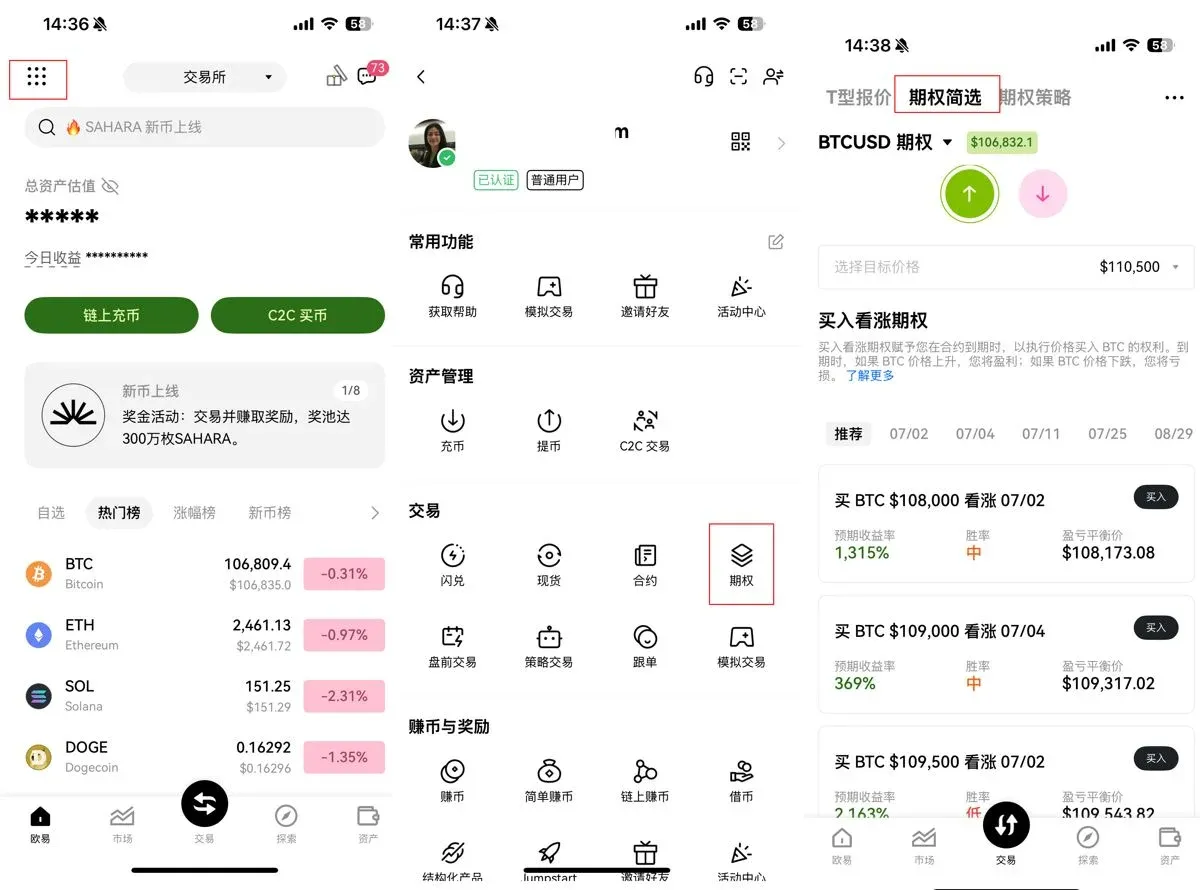
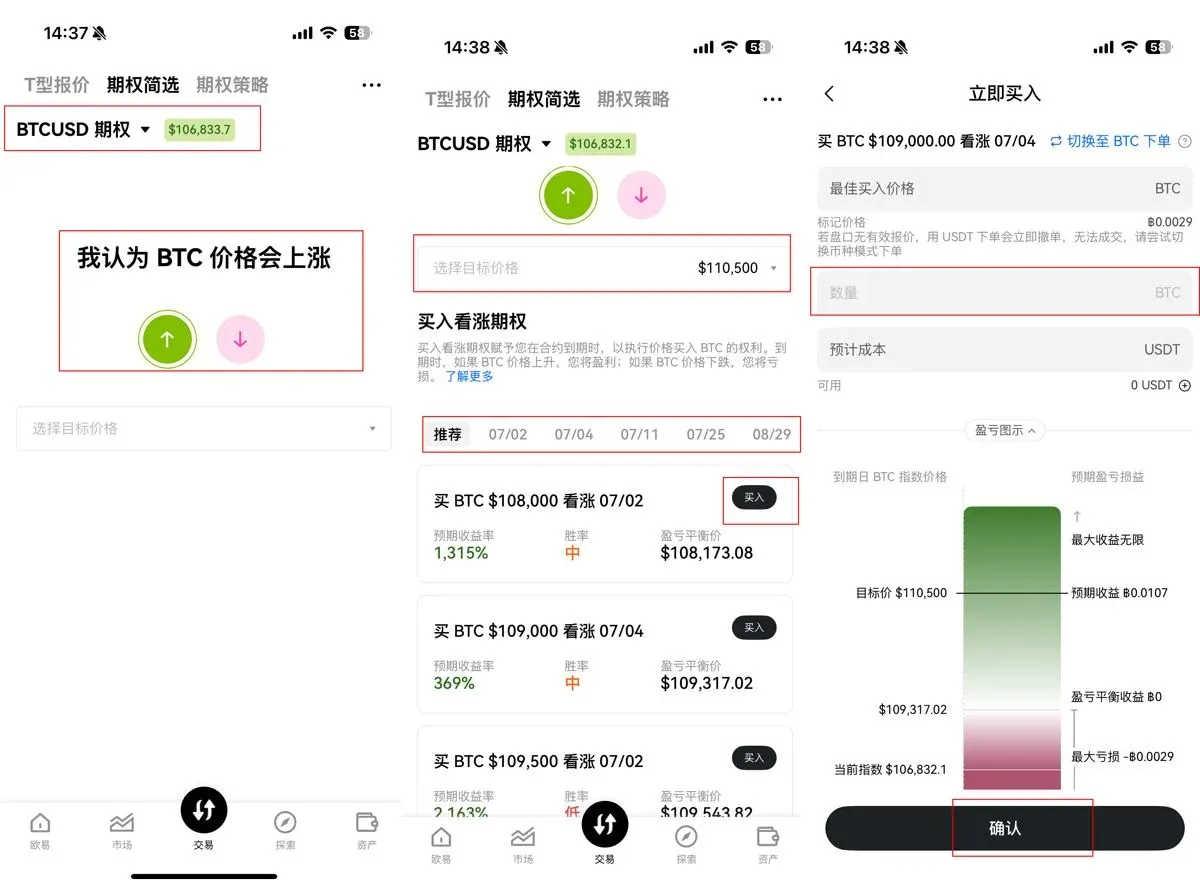
Quantity and Mark Price of Options
OKX defines a minimum order unit for each contract. A Bitcoin option contract corresponds to 0.01 BTC, so the order quantity can only be 0.01, 0.02, 0.05, 0.10 … (multiples of 0.01). An Ethereum option corresponds to 0.1 ETH, and the quantity must be 0.1, 0.2, 0.5 … (multiples of 0.1).
In the upper‑right corner of the quantity input field, a Mark Price is displayed; this value fluctuates with the market. The actual fee you pay is roughly Underlying price × Mark price × Contract quantity. After you input the quantity, the system automatically calculates an Estimated Cost, adds the transaction fee, and shows the total—no manual calculation is required.
Example: If Bitcoin is trading around 106,000 USDT, the mark price shows 0.0007, and you enter 0.3 contracts, the system will display an estimated outlay of about 22.26 USDT (plus a small fee).
How to Sell Bitcoin Options
Option trading is not limited to exercising for profit; you can also arbitrage the mark‑price movement. When the mark price rises from 0.0007 to 0.001, a holder can close the position at the higher price to lock in the spread; if the mark price falls to 0.0001, closing the position will result in a loss. Below is a brief description of the buy‑sell flow:
- Enter the Bitcoin options contract page, click Buy, fill in the quantity, and confirm.
- After the order is filled, the Positions page shows the average entry price, current mark price, and profit‑and‑loss (P&L) status.
- When the P&L meets your target, click Close to realize profit or stop‑loss.
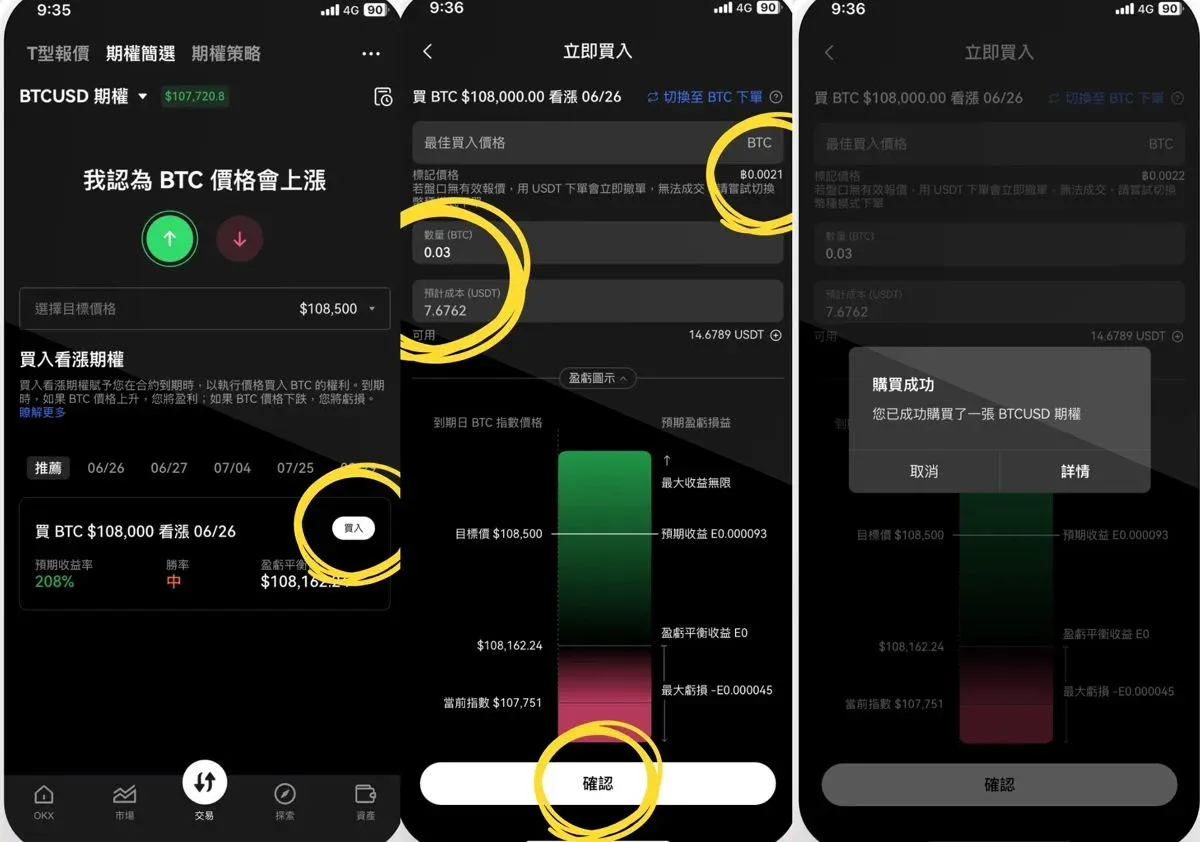
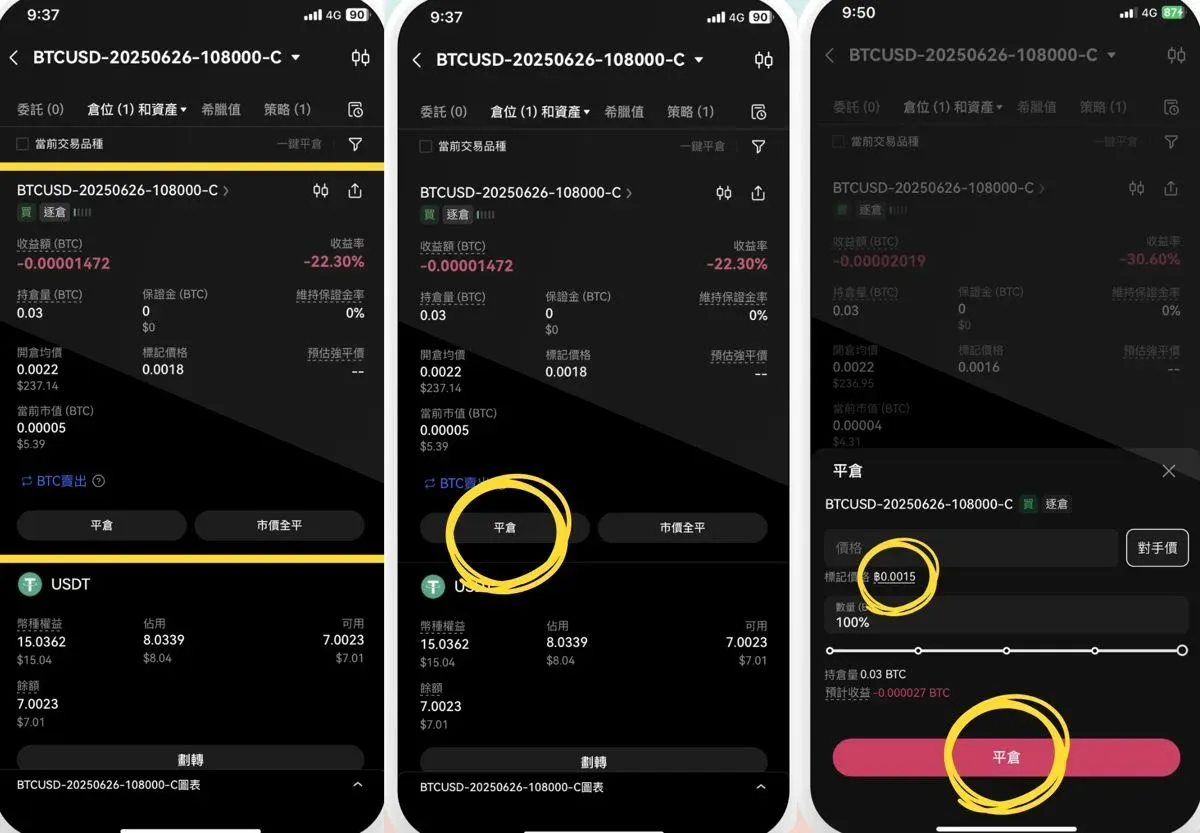
From the example screenshot you can see that buying 0.03 BTC (approximately 3,200 USDT) with a mark price of 0.0022 costs about 7.67 USDT. If you close the position when the mark price drops to 0.0018, you retain roughly 5 USDT; if you close at 0.003, the net profit is about 9 USDT, which after deducting the initial cost yields an actual gain of roughly 1.33 USDT.
OKX Exchange
Options trading differs from traditional spot or futures trading because it grants the holder the right, but not the obligation, to buy (call) or sell (put) the underlying asset at a predetermined price before a set expiration date. After paying the premium, investors can decide whether to exercise, providing a flexible risk‑management tool especially useful in the highly volatile crypto market.
As of 2026, OKX options have undergone three core upgrades: T+0 instant settlement, American‑style exercise (exercise at any time before expiry), and institution‑grade liquidity depth. Whether you are hedging a spot position, seeking leveraged returns, or trading volatility, mastering options can significantly improve your competitive edge. Below we start from the most basic contract elements and gradually unveil the mechanics of Bitcoin options.
Introduction to OKX Options
As one of the world’s top three exchanges, OKX launched a Dubai‑compliant version of its options business in 2025, supporting call and put contracts on the two major assets Bitcoin (BTC) and Ethereum (ETH). Although the concept of options can be complex, this tutorial presents the material in plain language to help you get up to speed quickly.
Five Core Elements of OKX Options
| Element | Description |
|---|---|
| **Underlying** | Currently only BTC and ETH are supported (SOL has been discontinued) |
| **Strike Price** | The price at which the option can be exercised, also called the **exercise price** |
| **Expiration Date** | The specific date on which the contract becomes invalid |
| **Contract Type** | OKX uses **European‑style** options, exercisable only on the expiration date |
| **Premium** | The fee paid to purchase the option; it is non‑refundable regardless of whether the option is exercised |
Naming Convention for Options
Option symbols follow the pattern “Asset‑Expiration‑Strike‑Type”, for example:
```
BTCUSD-20250627-160000-C
```
- BTCUSD – underlying pair Bitcoin / US Dollar
- 20250627 – expiration date 2025‑06‑27
- 160000 – strike price 160,000 USD
- C – call (use P for put)
The code instantly reveals the contract’s basic parameters.
OKX Options Profit Model
Assume Bitcoin is trading at 100,000 USDT and you anticipate it will break 140,000 USDT in two days. You could purchase a 110,000 USDT call option and pay the associated premium. If at expiry BTC indeed reaches 140,000 USDT, you can buy at the strike price of 110,000 USDT and immediately sell for a profit of 30,000 USDT; the system will settle automatically and credit the gain to your account. Another way to profit is by trading the option itself—buying low and selling high—which will be discussed later.
Practical OKX Bitcoin Options Trading Tutorial
Part 1: Options Basics and Platform Preparation
1. Core Element Breakdown
- Underlying asset: BTC (ETH options added in 2025)
- Contract size: 1 BTC (minimum purchase of 0.1 contracts)
- Expiration cycles: Weekly, bi‑weekly, quarterly (monthly options added in 2025)
- Strike price: Set in ~10 % increments above and below the spot price
- Premium: Denominated in USDT, paid by the buyer, received by the seller
Key Concept Comparison Table
| Term | Call (Bullish) | Put (Bearish) |
|---|---|---|
| **Buyer’s Right** | After paying the premium, the buyer may purchase BTC at the strike price within the agreed timeframe | After paying the premium, the buyer may sell BTC at the strike price within the agreed timeframe |
| **Seller’s Obligation** | After receiving the premium, the seller must sell BTC at the strike price if the buyer exercises | After receiving the premium, the seller must buy BTC at the strike price if the buyer exercises |
| **Profit Condition** | Spot price at expiry > strike price + premium | Spot price at expiry < strike price – premium |
| **Maximum Loss** | Limited to the total premium paid | Same – limited to the premium paid |
2. Detailed Trading Interface
- Contract selection area: Switch expiration dates, toggle call/put |
- Chart area: Displays Greek metrics (Delta, Gamma, Vega) |
- Order‑book depth: View pending orders at various strike levels |
- Trading panel: Supports limit, market, and conditional orders |
- Position monitor: Real‑time P&L, margin ratio, and mark price |
New features added in 2025:
- Volatility surface chart – visual comparison of implied volatility across strikes |
- Strategy simulator – drag‑and‑drop builder for straddles, wide‑straddles, etc. |
- Risk warning system – automatically calculates stress‑test results and alerts you |
Part 2: Long Call (Buying a Call)
1. When to Use a Long Call
- Strong bullish outlook with risk limited to the premium |
- Trend‑following after a key resistance level is broken |
- Anticipating a major catalyst (e.g., Bitcoin ETF approval) and wanting to position early |
Step‑by‑Step Procedure
- Navigate to Derivatives → Options |
- Select the BTC‑USD underlying and choose an expiration date |
- In the strike list, pick a price above the current spot (e.g., spot = 70,000 USD, choose 75,000 USD) |
- Click Buy Call to open the buyer interface |
- Enter the desired quantity (minimum 0.1 contracts) |
- It is advisable to use a limit order priced 2‑3 % below the best ask |
- Review the premium and potential payoff, then submit |
Profit‑Loss Example
- Strike: 75,000 USD |
- Premium: 2,000 USD per BTC |
- Break‑even: 77,000 USD |
- If BTC closes at 80,000 USD, profit = (80,000 − 75,000) − 2,000 = 3,000 USD per BTC |
2. Short Call (Selling a Call)
##### Suitable Scenarios
- Expectation that price will not rise sharply in the short term |
- Holding spot BTC and looking to boost overall yield by collecting premium |
- Implied volatility is near historic highs, indicating potentially overpriced calls |
##### Key Points
- Must have the appropriate seller permissions (Level 3 verification) |
- Prepare sufficient margin (initial margin around 15 % as of early 2025) |
- Choose out‑of‑the‑money contracts (strike 5‑10 % above spot) |
- Monitor the implied volatility percentile; > 70 % is generally favorable |
- Set profit‑taking/stop‑loss rules: close when premium income declines by 30 % |
##### Risk Management
- Maximum profit: premium received |
- Maximum loss: theoretically unlimited (requires strict stop‑loss) |
- Maintain a margin ratio ≥ 10 % |
Part 3: Long Put (Buying a Put)
1. When to Use a Long Put
- Anticipating a clear market decline |
- Hedging downside risk on an existing spot position |
- Acting after a key support level has been broken |
Execution Flow
- Switch to the Put tab on the options page |
- Select a strike 5‑15 % below the current spot |
- Compare premiums across expirations: short‑dated options are cheaper but decay faster; longer‑dated contracts suit a sustained bearish view |
- Enter the quantity and submit the order |
Time‑Value Strategy
- Ahead of a major risk event, buy 1‑2‑week short‑dated options to capture rapid moves |
- For a longer‑term bear market outlook, select quarterly contracts to mitigate time decay |
Part 4: Short Put (Selling a Put)
1. When to Use a Short Put
- Expecting a sideways or modestly rising market |
- Wanting to acquire BTC at a price lower than the current market |
- Implied volatility is at historic lows, making premiums relatively cheap |
Advanced Tips
- Choose liquid, at‑the‑money or slightly out‑of‑the‑money contracts |
- Ensure the premium collected covers the potential downside (effective purchase price = strike − premium) |
- Implement a roll‑over strategy: close three days before expiry and move to the next cycle |
- Combine with technical analysis to avoid being assigned below strong support levels |
Profit‑Loss Illustration
- Spot price: 70,000 USD |
- Sell a put with a 65,000 USD strike |
- Collect premium: 1,500 USD per BTC |
- Worst‑case: you are assigned at 65,000 USD, net cost = 65,000 − 1,500 = 63,500 USD |
Part 5: Combination Strategies & Risk Management
1. Main Strategy Matrix (2025)
| Strategy | Construction | Ideal Market Condition | Max Profit | Max Loss |
|---|---|---|---|---|
| **Protective Put** | Spot BTC + Long Put of equal size | Spot holder worried about short‑term dip | Unlimited upside on spot | Premium paid for the put |
| **Covered Call** | Spot BTC + Short Call of equal size | Sideways or mildly bullish market | Premium received | Spot upside capped at strike price |
| **Straddle** | Same strike, same expiry Call + Put | Expecting large movement around an event, direction unknown | Large move either way beyond combined premiums | Sum of both premiums |
| **Wide Straddle** | Different strikes, same expiry Call + Put | Anticipating volatility larger than a regular straddle’s breakeven zone | Profit once price breaks either high or low strike | Sum of premiums (generally lower than a plain straddle) |
| **Bull Call Spread** | Long low‑strike Call + Short high‑strike Call | Mildly bullish outlook, desire to limit cost | Strike‑price spread minus net premium paid | Net premium paid |
2. Greeks in Practice
- Delta Management: An at‑the‑money call has a Delta ≈ 0.5. By adjusting spot holdings, you can bring the overall portfolio Delta close to zero for a hedged position. Re‑calculate and rebalance each time Bitcoin moves by roughly 1,000 USD.
- Volatility Trading: When implied volatility exceeds historical volatility by 30 % or more, consider selling volatility (e.g., shorting options). If you expect volatility to rise, strategies such as straddles or calendar spreads can capture the upside.
3. Risk‑Control System
- Margin Warning: Set the alert threshold at 120 % of the initial margin and enable automatic position reduction.
- Stop‑Loss Rules: Buyers must exit when premium loss reaches 50 %; sellers should close if position loss exceeds 30 % of the margin; for multi‑leg strategies, trigger rebalancing when net‑asset‑value drawdown exceeds 15 %.
- Stress Testing: Periodically run extreme‑scenario simulations to evaluate how the portfolio behaves under sharp price swings.
Part 6: Advanced OKX Options Features
1. AI Strategy Engine
Related Reading
- Binance Copy Trading 2025: Benefits, Risks & Top Picks
- Dollar-Cost Averaging (DCA) for Crypto: Pros, Cons & Setup Guide
💡 Register on Binance with referral code B2345 for the maximum trading fee discount. See Binance complete guide.



