
 Bitaigen Research
 From 200,000 Orders per Second to DAO Governance: An In‑Depth Look at How Two Major DEXes Are Redefining the Crypto Derivatives Market
In this article we conduct a full‑scale comparison of the two leading decentralized perpetual‑contract platforms, Hyperliquid and dYdX. We focus on trading speed, governance structures and market dominance, helping readers understand the competitive logic behind each technical roadmap and uncover each platform’s potential strengths and risks. If you want to know which solution better fits future high‑frequency‑trading needs, keep reading.
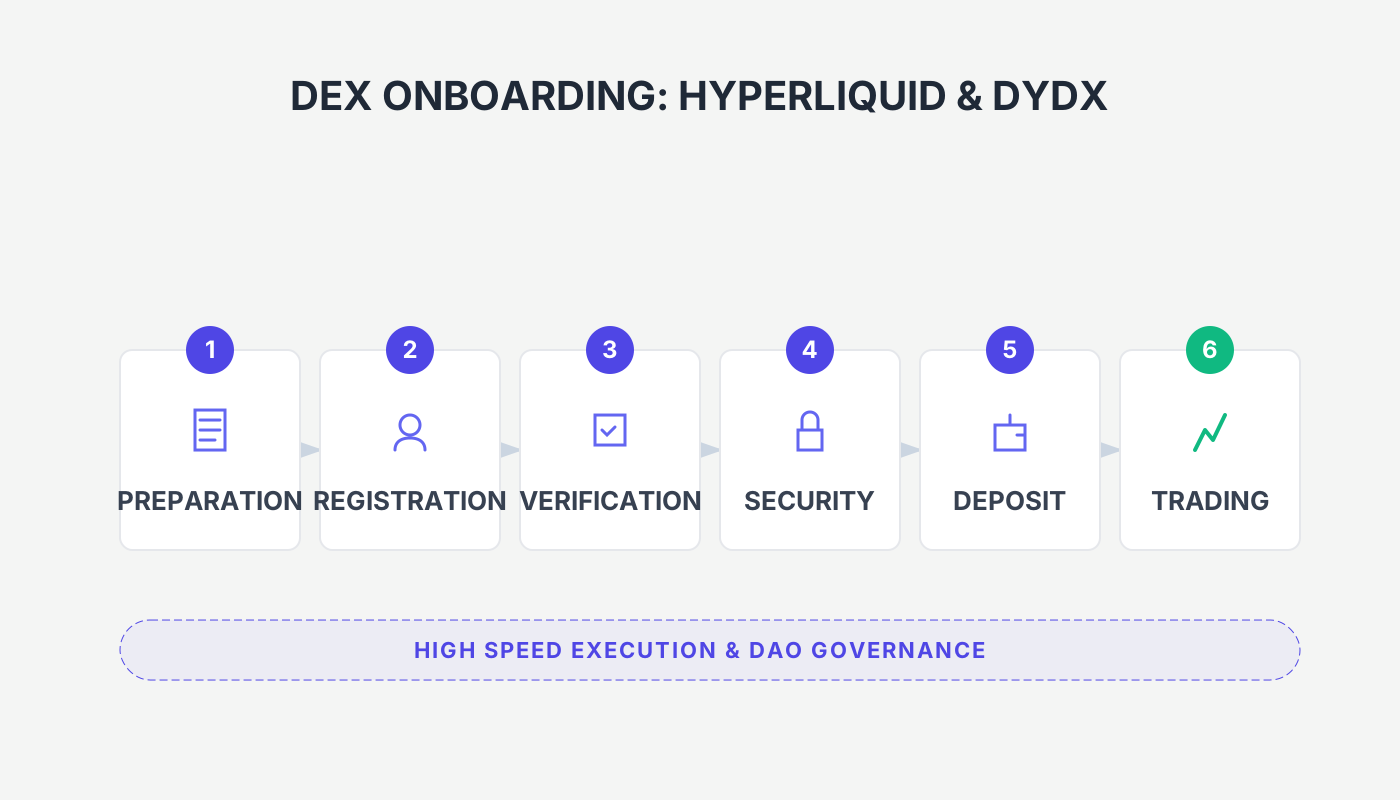
What Are Hyperliquid and dYdX Decentralized Exchanges?
Hyperliquid and dYdX are the two core players in the decentralized perpetual‑contract market, both aiming to replicate the user experience of centralized exchanges while keeping assets self‑custodied. Their technical implementations and development trajectories, however, are fundamentally different.
- Hyperliquid runs on a proprietary Layer‑1 blockchain built specifically for high‑frequency trading, leveraging the HyperCore infrastructure to achieve a processing capacity of 200,000 orders per second. Although the platform launched only recently, it has quickly captured a notable market share.
- dYdX was founded in 2017 and has undergone several upgrades: it started on Ethereum, later migrated to StarkWare’s L2 solution, and in October 2023 launched its own Cosmos‑based chain (the dYdX Chain), claiming roughly 2,000 TPS on a single chain and at one point holding the highest daily volume among decentralized exchanges.
The fundamental distinction lies in philosophy: Hyperliquid puts ultimate speed first, while dYdX emphasizes incremental optimization and regulatory compliance.
Hyperliquid’s Technical Architecture and System Design
Hyperliquid’s blockchain operates under the HyperBFT consensus algorithm, a custom protocol derived from HotStuff that enables instant finality per block, ensuring that order placement, cancellation and forced liquidation are settled on‑chain immediately.
The system is divided into two core modules:
- HyperCore – manages the order book for perpetual contracts and spot markets on‑chain.
- HyperEVM – provides an Ethereum‑compatible smart‑contract environment; developers can access HyperCore liquidity directly through HyperEVM without needing additional authorizations.
The unique aspect is that the order‑matching logic is fully embedded on‑chain, removing the need for cross‑chain bridges or external matching layers and allowing traders to interact directly with the protocol core. This design reduces latency and system complexity, but it also means that any abnormality in the order book can impact the entire chain, because the trading layer and consensus layer are not strictly separated.

*Blockchain carrying all financial activity, image source: Hyperliquid*
Timeline: dYdX Development Milestones and Current Status
| Phase | Version | Time Span | Key Information |
|---|---|---|---|
| Ethereum Era | v1 | 2017‑2021 | Offered spot trading and 5× leverage; halted due to high gas fees |
| StarkWare Upgrade | v3 | 2021‑2023 | Migrated to StarkWare L2, supported 25× leveraged perpetuals, retained some centralized components |
| Cosmos Transition | v4 | Oct 2023‑present | dYdX Chain built on Cosmos achieves full decentralization, >2,000 TPS, orders stored off‑chain until matched, gas‑free submit/cancel |
Governance is led by the dYdX DAO; token holders submit formal proposals that decide protocol upgrades, asset listings and treasury allocations. The platform also issues Hedgies NFTs, granting holders a 3 % fee discount and community privileges, aiming to align user and protocol interests.
Moving to Cosmos provides greater independence and customizability, but it also sacrifices Ethereum’s security guarantees and native composability with other DeFi protocols.
Team Backgrounds and Funding Models Compared
- Hyperliquid Labs is led by Jeff and iliensinc (Harvard alumni). Team members hail from Caltech, MIT, as well as institutions such as Citadel, Hudson River Trading and Airtable. The project began as an in‑house market‑making operation in 2020 and entered DeFi in 2022. It follows an all‑self‑funded model, with no external venture capital, preserving independence in product development.
- dYdX was founded by Antonio Juliano, a former Coinbase employee. Since its 2017 inception the project has completed multiple funding rounds, reaching an early valuation of $10 million and relying on traditional venture‑capital backing to accelerate growth.
Strategic Initiatives and Future Roadmaps
Telegram Trading Integration
In July 2025, dYdX acquired Pocket Protector and incorporated a Telegram trading tool into its ecosystem, targeting roughly 800 million Telegram users and enabling order placement without logging into the platform. This could boost user penetration but may introduce additional network latency.
U.S. Market Expansion
The platform plans to roll out spot trading in the United States by December 2025 (initially focusing on mainstream assets such as Solana), with fees reduced to 0.5 %‑0.65 %. Due to regulatory constraints, perpetual contracts will remain unavailable to U.S. residents, limiting revenue potential in the world’s largest crypto market.
Note for U.S. users: Trading on dYdX’s perpetual contracts is not permitted in the United States. U.S. traders wishing to use Binance must do so via Binance.US, which operates under separate regulatory compliance and does not offer the full global Binance product suite.
Ecosystem Funding Program
The dYdX Foundation will allocate $8 million from its treasury to support research and development, developer tooling and infrastructure upgrades, with a focus on scalability solutions and trading incentive mechanisms. The program’s success will depend on efficient capital deployment and measurable outcomes.
Technical Performance and Scalability Indicators
| Metric | Hyperliquid | dYdX Chain |
|---|---|---|
| Order/Transaction Throughput | 200,000 orders / second (TPS) | 2,000 orders / second |
| Consensus Mechanism | HyperBFT (instant finality per block) | Cosmos SDK + Proof‑of‑Stake |
| Order‑Book Location | Fully on‑chain | Off‑chain until match |
| Latency Optimisation | Dedicated network stack tuned for HFT | Reliability via Cosmos SDK |
In highly volatile market conditions, both platforms face cascade‑liquidation risks from large leveraged positions. Recent massive liquidation events showed that Hyperliquid can maintain system stability under pressure, while dYdX is also improving its fault‑tolerance capabilities.
Risk Factors and Market Dynamics
- High‑Leverage Risk: Both platforms offer up to 25× leverage, magnifying profits but also intensifying losses and the potential for chain‑reaction liquidations.
- Token‑Price Decoupling: dYdX’s native token fell roughly 68 % over the past year, indicating a mismatch between usage volume and token valuation, which raises concerns among investors.
- Regulatory Restrictions: Policies in the United States and other key jurisdictions limit the rollout of dYdX’s perpetual contracts, constraining its global revenue outlook.
- Market Concentration: Hyperliquid currently holds about 22 % of the decentralized perpetual‑contract market share; a failure on the platform could create systemic shock across the ecosystem.
The Future of Decentralized Perpetual Trading
Hyperliquid and dYdX embody two distinct pathways for decentralized exchanges: the former pursues technical extremity, pushing speed and efficiency to the limit; the latter focuses on compliance and ecosystem building, aiming for broader user coverage. Their competition is likely to drive industry progress in several areas:
- Fee Structures – balancing token‑holder incentives with sustainable platform economics.
- Risk Management – constructing stronger liquidation and insurance frameworks to prevent cascade failures.
- User Experience – achieving (or surpassing) the smoothness of centralized exchanges in order to attract mainstream traders.
Future outcomes may see multiple winners: professional traders demanding ultra‑low latency may gravitate toward Hyperliquid, while users prioritising regulatory compliance and community governance may prefer dYdX. Together, they push the technical boundaries of decentralized exchanges.
Frequently Asked Questions
What is Hyperliquid?
Hyperliquid is a DEX built on a proprietary Layer‑1 blockchain capable of processing roughly 200,000 orders per second, supporting a fully on‑chain order book and perpetual‑contract trading.
How does dYdX differ from Hyperliquid?
After several chain migrations, dYdX now runs on a Cosmos‑based chain with about 2,000 TPS, emphasizing DAO governance and regulatory compliance. Hyperliquid centers on ultra‑fast matching using a custom consensus and a fully on‑chain order book.
Where does Hyperliquid obtain its funding?
The project is entirely self‑funded by its founding team, with no external venture‑capital involvement, preserving independence in research and operations.
What happened to dYdX’s token price?
Despite growing trading volume, the token declined roughly 68 % over the past year, reflecting a disconnect between platform usage and token market value.
How much leverage do these decentralized exchanges allow?
Both platforms can provide up to 25× leverage (or higher in some cases), amplifying potential returns while also increasing liquidation risk.
Can U.S. users trade perpetual contracts on dYdX?
Currently they cannot. The platform intends to launch spot‑trading services for U.S. users by the end of 2025, but perpetual contracts will remain unavailable due to regulatory restrictions.
---
That concludes the comprehensive analysis titled “Hyperliquid vs dYdX: Speed, Governance and Market Dominance”. For additional insights, search for previous articles by Bitaigen or continue browsing the related pieces below. We appreciate your continued interest and support for Bitaigen!
*Disclaimer: Cryptocurrency gains may be taxable in your jurisdiction. Consult a tax professional to understand your local obligations.*
Related Reading
- Hyperliquid vs Binance: Contracts, Fees & Security
- Hyperliquid DEX: Architecture, Trading Benefits & HYPE Token
- Analyzing Hyperliquid & Polymarket Pricing During Geopolitical Crises
💡 Register on Binance with referral code B2345 for the maximum trading fee discount. See Binance complete guide.



