
 Bitaigen Research
 We dissect the Web3 wallets of OKX, Bitget, and Binance from the perspectives of product form, technical roadmap, and user experience. By comparing functional depth, asset coverage, and trading strategy dimensions, we help you capture industry trends and assess which solution fits best. If you want to understand each platform’s deployment of frontier technologies such as MPC and AA and get a feel for the user experience, read the full article for comprehensive insights.
3. Summary
By contrasting the three exchange‑issued Web3 wallets, we derive the following key conclusions:
- Market Landscape: The current leaders in the Web3 wallet space are all launched by exchanges. OKX and Bitget have already created a noticeable gap in user base and feature depth compared with other competitors.
- Product Form: The typical path starts with integration inside the exchange’s mobile app, followed by a browser extension after traffic is funneled, and finally, depending on demand, the development of a standalone app.
- Data Performance: Since May 2023, the OKX Wallet leveraged the Bitcoin inscription boom to grow rapidly and overtook rivals; in April 2024, Bitget reclaimed the lead by issuing its own token and running an airdrop campaign.
- Wallet Types: Externally Owned Accounts (EOA) remain the most basic account model, Multi‑Party Computation (MPC) is becoming mainstream, and Account Abstraction (AA) is the exploratory direction for the future. Overall, OKX’s deployment in this dimension is the most advanced.
- Asset Coverage: OKX leads both in the speed of onboarding new chains and the number of DeFi protocols it parses, giving it the strongest asset‑management capability among the three.
- Trading Experience: Multi‑chain environments fragment liquidity, so all three wallets rely on 1inch for aggregated swaps. OKX delivers the lowest slippage and the best MEV mitigation, and it does not charge any transaction service fee. Future enhancements could enrich limit‑order, order‑book, and derivatives tools.
- Trading Strategies: For power users, market information and “smart‑money” tracking are especially important; Bitget provides the most complete set of features in this regard.
- NFT Support: Bitcoin inscriptions are a current hot topic. OKX shows the highest compatibility with the three major protocols—Ordinals, Runes, and Atomicals—thereby attracting a large community of inscription enthusiasts.
- DeFi Module: User demand for on‑chain wealth management is rising. OKX’s DeFi suite is the most comprehensive, supporting over 200 protocols and offering cross‑token investment, yield calculation, and other auxiliary functions. This makes the wallet a bridge from pure asset management to an investment platform.
- DApp & Airdrop: Airdrop missions are an effective way to boost user activity and educate users. All three wallets feature a task center where users can earn rewards while exploring on‑chain projects.
- Risk Control & Security: Security is the lifeline of any wallet. Both OKX and Bitget publish security audit reports (OKX focuses on the private‑key module, Bitget on Swap and NFT market), and they implement multi‑dimensional risk controls such as risky‑token alerts, contract‑authorization management, and phishing‑site warnings. Binance does not disclose comparable information. Bitget also operates a risk‑guarantee fund and provides security education.
- Overall Assessment: Scoring across functional completeness, resource commitment, hot‑topic responsiveness, security level, and user experience yields 80 points for OKX, 70 for Bitget, and 60 for Binance, highlighting OKX’s superior overall user perception.
In summary, exchange‑issued Web3 wallets are evolving toward a “one‑stop super‑app” model capable of serving the layered needs of beginners through advanced traders.
---
1. Basic Introduction
1.1 What Is a Web3 Wallet?
A Web3 wallet is the bridge that lets users interact with decentralized applications (DApps). It handles core operations such as digital‑asset creation, management, and signing. While it belongs to the decentralized‑wallet ecosystem—meaning users retain control of their private keys—it places a stronger emphasis on the upper‑layer user experience, aiming to guide everyday users into the Web3 world with a simple and intuitive interface.
From a technical standpoint, a decentralized wallet can be broken down into three layers:
- Key Layer: Generates, imports/exports, and computes signatures for private keys.
- Address Layer: Derives blockchain‑specific addresses according to each public‑chain standard.
- Application Layer: Executes business logic such as receiving and sending assets, token transfers, and more.
Traditional decentralized wallets mainly satisfy basic send/receive functions. Web3 wallets build on that foundation by enhancing DApp compatibility and user interaction, making on‑chain operations smoother and more user‑friendly.
1.2 Why Focus on Exchange‑Issued Web3 Wallets?
Exchanges sit at the top of the crypto‑industry ecosystem, boasting massive user bases and abundant project resources. For most newcomers, the first step into the on‑chain world is buying or selling assets on a centralized exchange. Consequently, exchanges enjoy a natural traffic‑inflow advantage while also facing pressure to migrate users toward on‑chain solutions. Developing a proprietary Web3 wallet enables an exchange to retain that traffic, creating a closed loop from trading platform to wallet service.
1.3 Why Choose OKX, Bitget, and Binance for This Study?
Most major exchanges have already launched Web3 wallets, making the competition fierce. The three products we selected share the following commonalities:
- They are all led by domestic (Chinese) development teams capable of innovating at the application layer.
- They exhibit clear differences in functional depth and user scale, providing a solid basis for comparison.
- As long‑time users of multiple wallets, we can offer first‑hand experience rather than relying solely on secondary sources.
---
2. Detailed Analysis
2.1 Basic Information
2.1.1 Product Background
- Bitget Wallet: Originally launched as Bitkeep in 2018, it was the first to propose a complete ecosystem of “wallet + Swap + NFT market + DApp”. After being acquired by the Bitget exchange, it leveraged the exchange’s resources to compete at scale.
- OKX Web3 Wallet: Although it entered the market a bit later, continuous investment and iterative improvements targeting user pain points propelled it to rapid growth during the Bitcoin inscription craze.
- Binance Web3 Wallet: The most recent entrant, its core assets stem from Trust Wallet (founded in 2017). Early on, the dominant exchange business diverted resources away from wallet development, causing slower progress. Recently, Binance has intensified integration with Trust Wallet in an effort to close the gap.
2.1.2 Product Form
Decentralized wallets typically appear in three formats: embedded in the exchange app, standalone mobile app, and browser extension.
- OKX: Currently offers services both inside its exchange app and as a browser extension; a dedicated mobile app has not yet been released.
- Bitget: Initially launched as an independent app (Bitkeep), later merged into the exchange app while retaining the extension version.
- Binance: At present, the wallet is only accessible inside the exchange app; neither a browser extension nor a standalone app is available.
This “integrate first, expand later” approach reflects a common strategy where exchanges use their existing user pool to drive traffic. Browser extensions have become especially popular because they work seamlessly with web‑based DApps and sidestep app‑store policy restrictions.
2.1.3 Data Comparison
On‑chain public data can be used to gauge each wallet’s Swap activity on EVM‑compatible chains such as Ethereum.
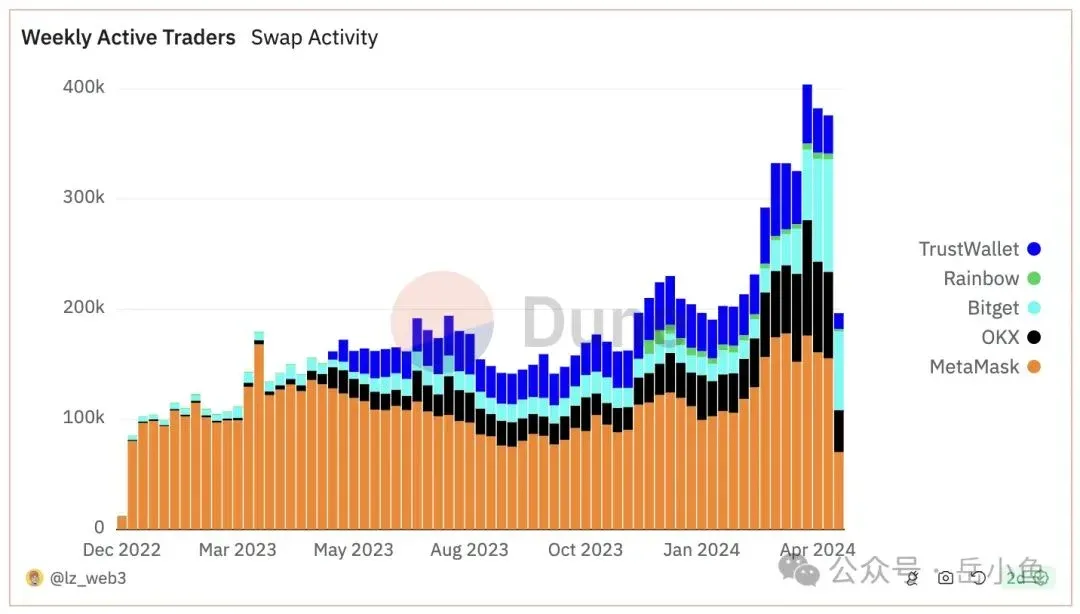
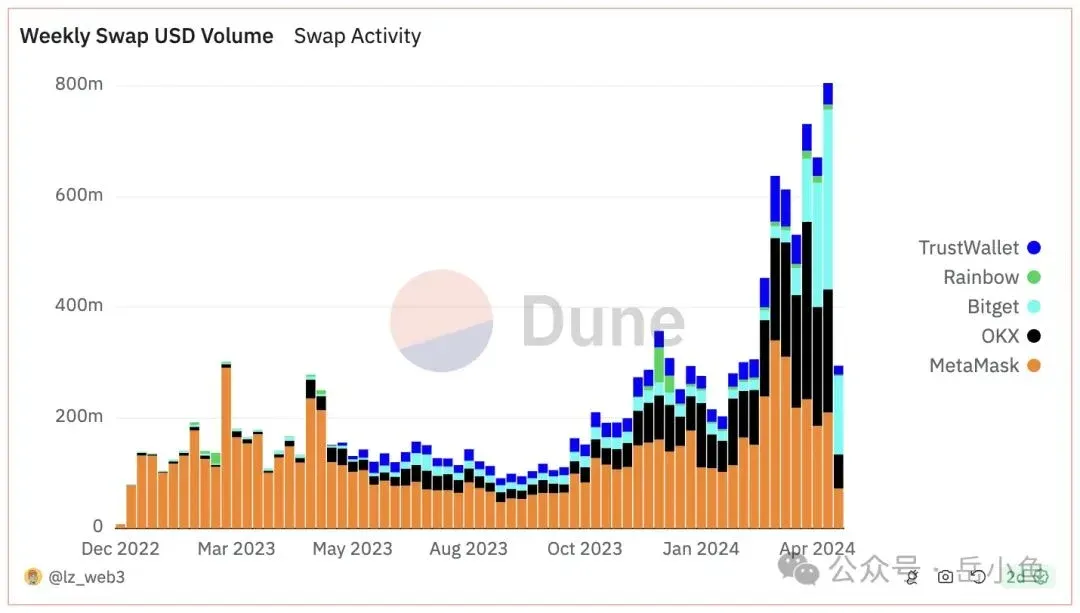
Overall, the trend shows a notable rise in active users and transaction volume for decentralized wallets since October 2023, with exchange‑backed wallets (OKX, Bitget, Trust Wallet) outpacing traditional independent wallets. MetaMask held the largest market share before May 2023, but its dominance has been eroded by the rapid growth of the three exchange‑issued solutions.
- OKX: Benefited from the Bitcoin inscription traffic surge, achieving simultaneous growth in user numbers and transaction volume.
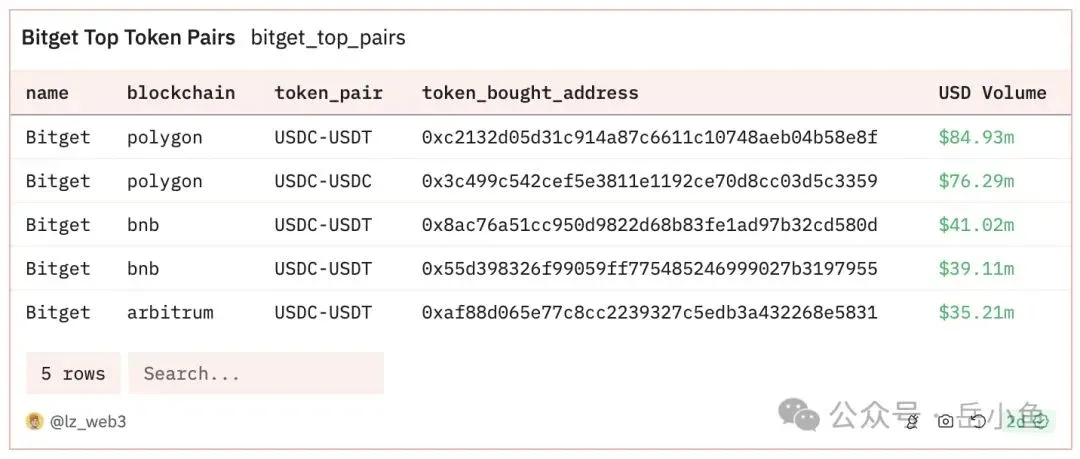
- Bitget: After launching an airdrop campaign in March 2024, transaction volume spiked, especially for low‑gas stablecoin swaps on fee‑friendly chains, indicating users were repeatedly swapping to earn points.
2.2 Feature Comparison
2.2.1 Asset Management
Wallet Types
- All three products support basic EOA accounts.
- OKX additionally offers an HD wallet and AA accounts, allowing multi‑chain address management via a single mnemonic and enabling contract abstraction.
- MPC solutions have been fully rolled out only on OKX; Bitget and Binance are still in early testing phases.
Asset Coverage
- Number of supported public chains: OKX and Bitget each cover roughly 100 chains, whereas Binance supports about 20.
- Speed of new‑chain onboarding: OKX reacts the fastest, promptly adding support when a hot chain emerges.
- DeFi protocol parsing: OKX parses the most (over 200 protocols), Bitget covers the major ones, and Binance has yet to implement comprehensive parsing.
2.2.2 Trading
- Swap & Cross‑Chain: All three rely on the 1inch aggregation protocol to provide instant on‑chain swaps and cross‑chain bridging.
- Trading Costs: OKX employs a proprietary routing‑splitting algorithm that reduces slippage, integrates Flashbots private pools to mitigate MEV, and charges no service fee. Bitget applies a 0.30 % fee, while Binance has not publicly disclosed its fee structure.
- Advanced Trading Tools: Bitget offers a more complete suite—including order‑book, limit orders, and derivatives—than the other two.
- Market Data & Strategies: Bitget pioneered a market‑panel feature and “smart‑money” tracking, helping users monitor large‑holder movements and potentially copy their trades.
2.2.3 NFT
NFT services split into the Ethereum ecosystem and Bitcoin inscriptions. OKX supports all three major Bitcoin inscription protocols—Ordinals, Runes, and Atomicals—making it the go‑to wallet during the inscription boom. Bitget and Binance provide more limited Bitcoin‑inscription support.
2.2.4 DeFi
DeFi is a critical lever for wallet value. OKX has wrapped more than 200 protocols, offering “one‑click investment”, automatic cross‑token swaps, and yield‑forecast tools, and it frequently runs interest‑boosting incentives. Bitget and Binance currently only provide basic staking and re‑staking functions, lacking the depth of OKX’s suite.
2.2.5 DApp & Airdrop
Airdrop missions are a common tactic to increase engagement. All three wallets host a task center that regularly publishes token‑airdrop activities, enabling users to earn rewards while exploring on‑chain projects.
2.3 Risk Control & Security
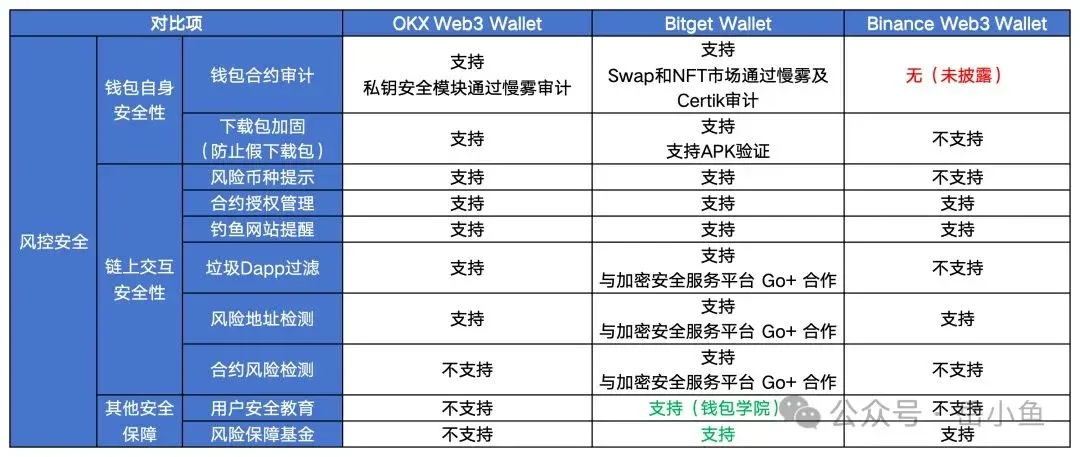
Security underpins wallet longevity. We evaluate three layers:
- Code Audits: OKX and Bitget both publish audits conducted by renowned security firms (OKX focuses on the private‑key module; Bitget on Swap and NFT market). Binance has not disclosed comparable audit reports.
- On‑Chain Interaction Safety: Includes risky‑token warnings, contract‑approval management, phishing‑site alerts, risky‑address detection, and contract‑risk warnings. OKX builds most of these in‑house; Bitget partners with third‑party security firms; Binance’s related features are not publicly visible.
- Additional Guarantees: Bitget operates a risk‑guarantee fund. After the Bitkeep hack in December 2022 that resulted in a $31 million loss, the fund fully compensated affected users and the platform launched a “Wallet Academy” for security education.
2.4 Comprehensive Evaluation

Scoring across five dimensions—functional completeness, exchange resource commitment, hot‑topic responsiveness, security level, and user experience—yields the following table:
| Dimension | OKX Web3 Wallet | Bitget Wallet | Binance Web3 Wallet |
|----------------------|-----------------|---------------|---------------------|
| Functional completeness | High | Medium | Low |
| Resource commitment | High | Medium | Low |
| Hot‑topic responsiveness | High | Medium | Low |
| Security | High | High | Medium |
| User experience | Smooth | Detail‑oriented improvements needed | Many missing features |
| Overall Score | 80 | 70 | 60 |
---
The Future Direction of the Web3 Wallet Landscape
From an industry‑need perspective, a wallet’s core mission can be distilled into three pillars: enabling projects to issue assets, facilitating user trades, and safeguarding asset security. Consequently, future competition will likely focus on the following areas:
- More Efficient Asset‑Issuance Channels: One‑click token creation, cross‑chain bridges, and other tools that lower the cost for projects to launch on multiple networks.
- End‑to‑End Trading Experience: Ongoing optimization of aggregation routing, further slippage reduction, and the introduction of additional derivatives instruments to satisfy diversified trading strategies.
- Deepening the Security Ecosystem: Broader code‑audit coverage, enhanced on‑chain risk monitoring, and the establishment of user compensation funds to provide multi‑layered protection.
Only by continuously advancing in these dimensions can wallet products secure a lasting foothold in the fierce battle for entry‑traffic and earn the loyalty of long‑term users.
*Note: Cryptocurrency gains may be subject to tax in your jurisdiction. Users should consult local regulations and consider professional tax advice, especially when converting crypto to fiat currencies such as USD via SEPA or SWIFT transfers.*
*For users located in the United States, the Binance Web3 wallet is accessible through Binance.US rather than the global Binance platform.*
💡 Register on Binance with referral code B2345 for the maximum trading fee discount. See Binance complete guide.



