
 Bitaigen Research
 2025 Perpetual‑Contract Decentralized Exchange (Perp DEX) Boom
In 2025, the market for decentralized perpetual‑contract trading exploded. In October, monthly trading volume on these platforms surpassed $1.2 trillion for the first time, drawing the attention of retail traders, institutional investors, and venture‑capital firms alike.
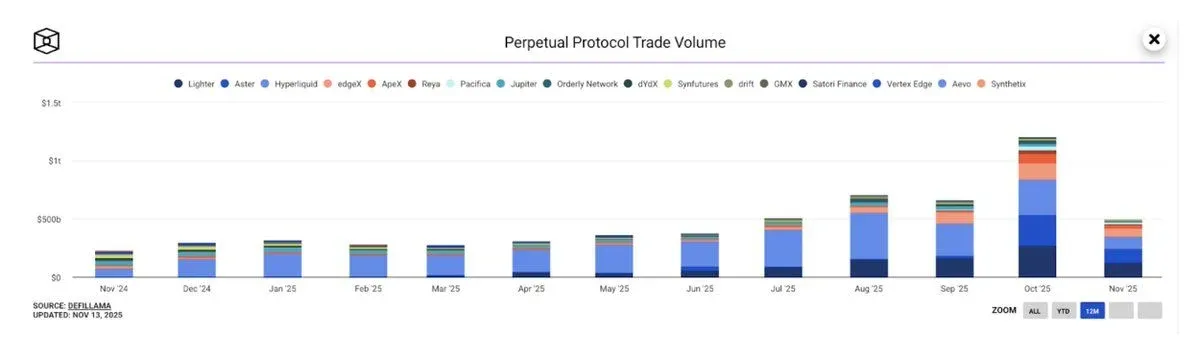
Hyperliquid, Aster, Lighter and EdgeX are the four dominant platforms in the Perp DEX space, each offering distinct technology, liquidity, and institutional backing.
As the ecosystem evolves rapidly, the four leading players are locked in an intense battle for industry leadership:
- Hyperliquid – The veteran on‑chain perpetual‑contract champion
- Aster – A high‑volume “rocket” that is constantly mired in controversy
- Lighter – A zero‑fee disruptor built on native zk (zero‑knowledge proof) technology
- EdgeX – A low‑profile, institution‑friendly dark horse
This article examines the four platforms from the perspectives of technology, data, controversies, and long‑term viability, helping readers separate hype from reality.
In this piece we systematically review the core technical roadmaps, liquidity deployments, and institutional support behind Hyperliquid, Aster, Lighter and EdgeX. We dissect the competitive focal points and potential risks, enabling participants in the fast‑changing Perp market to clarify concepts and avoid pitfalls. For a deeper look at each platform’s genuine strengths and sustainable prospects, keep reading.
Part 1: Hyperliquid – The Undisputed Leader
Dominant Factors
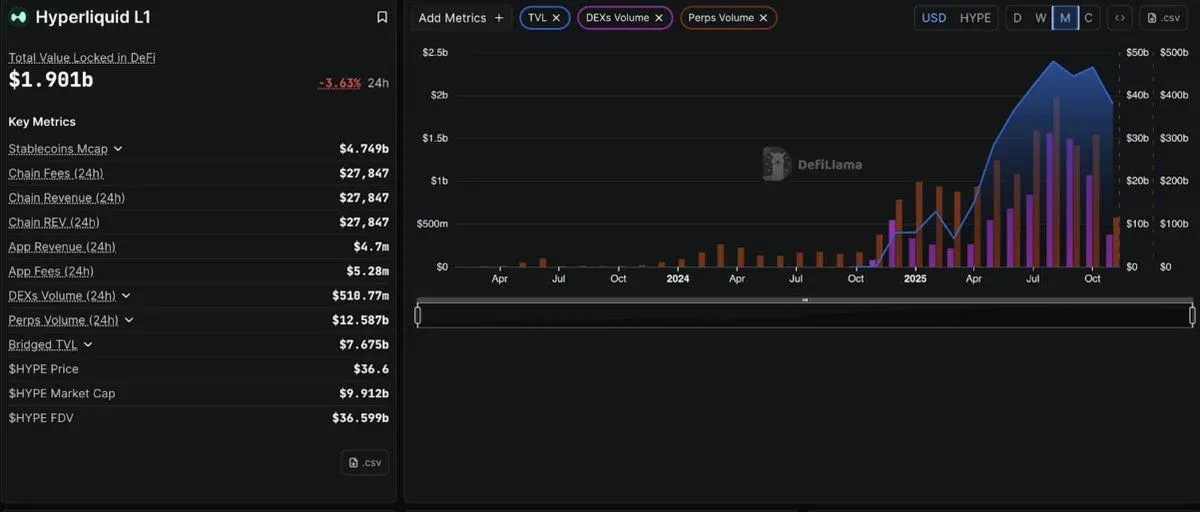
Hyperliquid has cemented its position as the industry‑leading decentralized perpetual‑contract exchange, once commanding a market‑share peak of 71 %. Even when rivals capture headlines with short‑term trading‑volume spikes, Hyperliquid remains the cornerstone of the Perp DEX ecosystem.
Technical Architecture
Hyperliquid runs on a custom Layer 1 blockchain built expressly for derivatives, employing the HyperBFT consensus mechanism. This delivers sub‑second order confirmation and a throughput of 200 k transactions per second, outperforming most centralized exchanges.
Open‑Interest (OI) Perspective
Open‑Interest (OI) measures the total value of outstanding perpetual contracts and is a key indicator of long‑term capital commitment. By contrast, raw trading volume can be distorted by incentives, rebates, or wash‑trading.
- Trading volume reflects short‑term activity.
- Open‑Interest reflects capital commitment.
Data from 21Shares for September 2025 shows:
- Aster accounted for roughly 70 % of total trading volume.
- Hyperliquid’s share of volume fell to about 10 %.
The latest 24‑hour Open‑Interest figures (in USD millions) are:
| Platform | Open‑Interest (USD M) | Market Share |
|---|---|---|
| **Hyperliquid** | 80.14 | 63.0 % |
| **Aster** | 23.29 | 18.3 % |
| **Lighter** | 15.91 | 12.5 % |
| **EdgeX** | 7.80 | 6.1 % |
| **Total (Top 4)** | 127.14 | 100 % |
The OI‑to‑Volume ratio (24 h) further illustrates capital efficiency:
- Hyperliquid: 0.64 (high)
- Aster: 0.18 (low)
- Lighter: 0.12 (low)
Holistic Assessment
- Trading Volume (24 h) – short‑term liquidity.
- Open‑Interest (24 h) – size of risk exposure.
- OI/Volume Ratio – authenticity of activity vs. incentive‑driven spikes.
Based on these metrics, Hyperliquid leads structurally:
- Highest Open‑Interest, indicating the greatest capital commitment.
- Strongest OI/Volume ratio.
- Open‑Interest exceeds the combined total of the other three platforms.
October 2025 Liquidation Event
During a $19 billion market‑wide liquidation episode, Hyperliquid remained stable with no abnormal downtime.
Institutional Recognition
- 21Shares has filed a product application with the U.S. SEC for the HYPE token (ticker).
- A regulated HYPE ETP is listed on the SIX Swiss Exchange.
- Multiple data aggregators (e.g., CoinMarketCap) now track Hyperliquid’s ecosystem expansion.
These developments signal growing institutional integration of HYPE, further solidifying Hyperliquid’s status as the premier decentralized derivatives platform.
Part 2: Aster – Explosive Growth Coupled with Controversy
Project Overview
Aster is a multi‑chain perpetual futures exchange that launched in early 2025, covering BNB Chain, Arbitrum, Ethereum and Solana. Its goal is to enable high‑leverage cross‑chain trading without the need for asset bridges.
The project originated from the late‑2024 merger of Asterus and APX Finance, combining APX’s perpetual‑contract engine with Asterus’s liquidity technology.
Explosive Growth
- Launch day (Sept 17) price: $0.08 → $2.42 within seven days, a ~2,800 % increase.
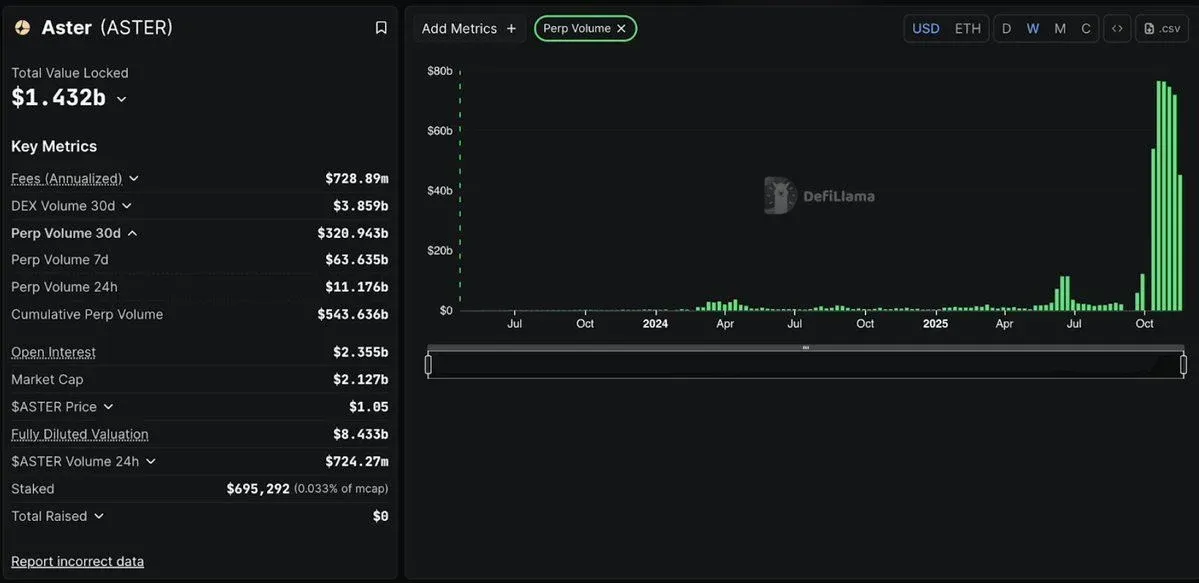
- Peak daily volume topped $70 billion, briefly representing >50 % of the entire perpetual‑contract market.
This surge was publicly endorsed by CZ, founder of Binance, who backed Aster through YZi Labs.
DefiLlama Delisting
On 5 Oct 2025, DefiLlama removed Aster’s data, citing a 1:1 match between Aster’s reported volume and Binance’s on‑chain activity—suggesting possible wash‑trading.
Key evidence:
- Volume patterns mirrored Binance’s exactly across all pairs (including XRP, ETH, etc.).
- Aster refused to provide raw transaction data for verification.
- 96 % of the ASTER token supply is held by six wallets.
- Volume/OI ratio reached >58 (healthy threshold is < 3).
Consequently, ASTER’s price fell from $2.42 to roughly $1.05.
Aster’s Official Response
CEO Leonard claimed the volume correlation stemmed from “airdrop farmers” hedging on Binance, but supplied no verifiable data.
Core Features
- 1,001× leverage – attracts ultra‑high‑risk traders.
- Hidden orders – enhances privacy.
- Cross‑chain support – BNB Chain, Ethereum, Solana.
- Yield‑bearing collateral – staked assets generate returns.
Aster is also developing an Aster Chain built on zero‑knowledge proofs, though transparency concerns remain.
Verdict
- Volume tightly linked to Binance → high risk of wash‑trading.
- Opaque data → trust deficit.
- Token concentration → centralization risk.
These factors have tarnished Aster’s reputation; participants should proceed with caution.
Part 3: Lighter – Strong Technical Potential, Still Questionable Data
Technical Highlights
Lighter was founded by a former Citadel engineer and backed by Peter Thiel, a16z, and Lightspeed, raising $68 million and achieving a $1.5 billion valuation. The platform employs zero‑knowledge proofs (ZK) to cryptographically validate each trade, marrying transparency with security.
Operating as an Ethereum Layer 2, Lighter inherits Ethereum’s security guarantees and introduces an “Escape Hatch” mechanism that lets users withdraw assets via smart contracts even if the platform experiences a failure.
After its 2 Oct 2025 main‑net launch, Lighter quickly amassed:
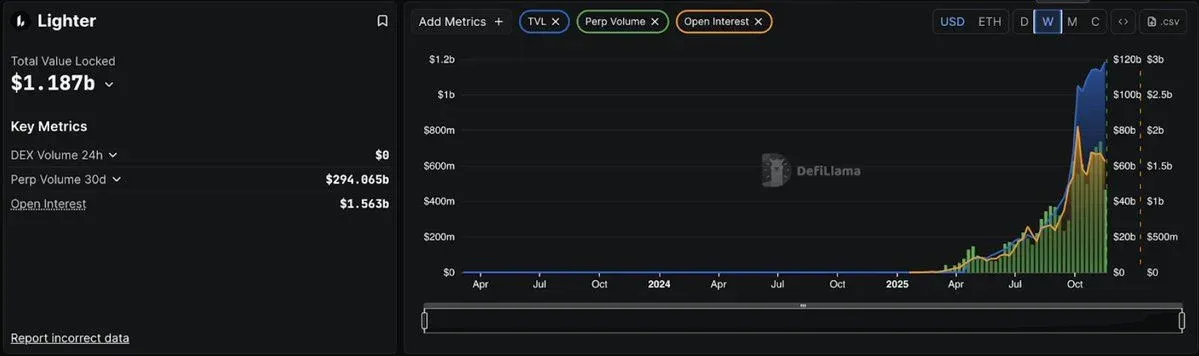
- Total Value Locked (TVL): $1.1 billion.
- Daily volume: $700–$800 million.
- Registered users: > 56,000.
Zero‑Fee Strategy
Lighter charges 0 % maker and taker fees, using an aggressive subsidy model to capture market share. Profitability is pursued through ancillary revenue streams (e.g., staking, token sales).
October 11 Stress Test
Ten days after main‑net activation, the platform faced a $19 billion liquidation episode:
- Positive: The system stayed online for 5 hours, with the Lighter Liquidity Pool (LLP) supplying needed liquidity.
- Negative: The database crashed after 5 hours, resulting in a ~4‑hour outage.
- Risk: LLP incurred losses, whereas rival pools (e.g., Hyperliquid’s HLP) posted profits.
Founder Vlad Novakovski explained that a planned database upgrade for Sunday was triggered early by Friday’s extreme market volatility.
Abnormal Volume/OI Ratio
| Metric | Value |
|---|---|
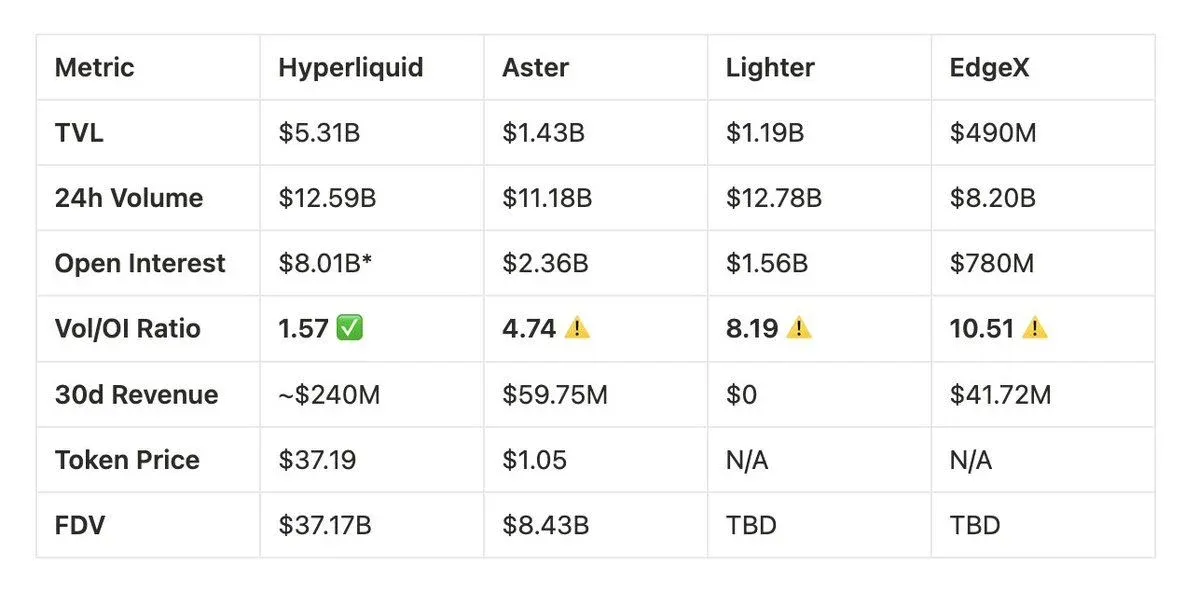
| 24 h Trading Volume | **$12.78 billion** |
| 24 h Open‑Interest (OI) | **$1.591 billion** |
| Volume/OI Ratio | **8.03** |
A healthy ratio is ≤ 3; 8.03 suggests a large amount of “points‑grabbing” activity. Comparisons:
- Hyperliquid: 1.57 (organic trading)
- EdgeX: 2.7 (moderate)
- Aster: 5.4 (elevated)
- Lighter: 8.03 (anomalous)
Airdrop Incentive Scheme
Lighter’s points will be convertible to LITER tokens at the Token Generation Event (TGE), anticipated for Q4 2025 or Q1 2026. Market estimates for the points have ranged between $5–$100, implying a potential airdrop value of several thousand USD per participant—an incentive that explains the inflated trading volume.
Overall Assessment
Strengths
- Cutting‑edge ZK technology.
- Zero‑fee competitive edge.
- Ethereum security plus Escape Hatch safety net.
Risks
- Volume/OI ratio of 8.03 indicates incentive‑driven high‑frequency wash trades.
- LLP losses under stress conditions.
- 4‑hour outage raises reliability concerns.
- Post‑airdrop user retention remains unproven.
Unlike Aster, Lighter has not been delisted by DefiLlama and faces no direct wash‑trading accusations, yet its data still warrants ongoing scrutiny.
Part 4: EdgeX – An Institution‑Grade Professional Platform
Background & Advantages
EdgeX was incubated by Amber Group, which manages roughly $5 billion in assets. The team includes alumni from Morgan Stanley, Barclays, Goldman Sachs, and Bybit. EdgeX aims to fuse deep TradFi liquidity with DeFi’s self‑custody benefits.
The platform is built on StarkEx (StarkWare’s zero‑knowledge engine), supporting 200 k orders per second with latency under 10 ms, performance comparable to Binance.
Fee Competitiveness
| Role | EdgeX Fee | Hyperliquid Fee |
|---|---|---|
| Maker | **0.012 %** | 0.015 % |
| Taker | **0.038 %** | 0.045 % |
For a user trading $10 million per month, EdgeX can save roughly $7,000–$10,000 annually versus Hyperliquid.
Revenue & Health Metrics
- TVL: $489.7 million
- 24 h Trading Volume: $8.2 billion
- Open‑Interest: $780 million
- 30‑day Revenue: $41.72 million (month‑over‑month growth +147 %)
- Annualized Revenue: $509 million (second only to Hyperliquid)
- Volume/OI Ratio: 10.51 (still high, but gradually improving thanks to the points program)
October Stress Test
During the $19 billion liquidation episode, EdgeX demonstrated:
- Zero downtime (contrast with Lighter’s 4‑hour outage).
- eLP (EdgeX Liquidity Pool) remained profitable.
- Liquidity providers earned a 57 % annualized return—the highest in the sector.
Unique Selling Points
- Multi‑chain support: Ethereum L1, Arbitrum, BNB Chain; collateral options include USDT and USDC.
- Mobile experience: Official iOS and Android apps let users manage positions on the go.
- Asian market focus: Localized support and partnerships with Korea Blockchain Week to capture Asian users.
Transparent Points Program
- 60 % of points derived from trading volume.
- 20 % from referrals.
- 10 % from TVL/liquidity‑pool contributions.
- 10 % from liquidation/OI activity.
The platform publicly states it does not reward wash‑trading; data shows the Volume/OI ratio is trending downward.
Challenges
- Market share sits at 5.5 % (OI view), requiring incentives or partnerships to boost.
- Lacks a clear “killer feature,” positioning itself as a stable “business‑class” alternative.
- Fee advantage is modest compared with Lighter’s zero‑fee model.
- TGE slated for Q4 2025, later than most rivals.
Comprehensive Evaluation
Strengths
- Backed by Amber Group, ensuring robust liquidity.
- Sustainable revenue stream with $509 million annualized earnings.
- Lower fees than Hyperliquid and a polished mobile interface.
- Transparent data, no wash‑trading allegations.
Potential Weaknesses
- Limited market share; growth hinges on incentive schemes.
- Volume/OI ratio remains above the healthy threshold, requiring further optimization.
Market‑Level Comparative Analysis of Perpetual‑Contract DEXs
Volume/OI Ratio Benchmark
| Platform | Volume/OI Ratio | Healthy Threshold (≤ 3) |
|---|---|---|
| **Hyperliquid** | **1.57** ✅ | Normal |
| **Aster** | **4.74** ⚠️ | Elevated |
| **Lighter** | **8.03** ⚠️ | Anomalous |
| **EdgeX** | **10.51** ⚠️ (improving) | High |
Practical Considerations for Global Users
- Fiat On‑Ramp/Off‑Ramp: Most platforms accept USD via SEPA or SWIFT transfers. Users should verify KYC/AML requirements for their jurisdiction.
- U.S. Residents: Access to
Related Reading
- Aster Exchange: ASTER Token & Cross‑Chain Perpetual DEX
- Hyperliquid vs Aster: Decentralized Perpetual Trading Review
- Trade XAU & XAG on Binance: Spot vs Perpetual Contracts
💡 Register on Binance with referral code B2345 for the maximum trading fee discount. See Binance complete guide.



