
 Bitaigen Research
 In this article we will dissect Bybit’s newly launched TradFi service, explaining how to complete the full workflow of trading both crypto assets and U.S. equities on a single platform. With illustrated step‑by‑step guidance, you’ll be able to get started quickly while avoiding common pitfalls. Subsequent sections will cover the platform’s security mechanisms and fee structure, so a thorough read is recommended.
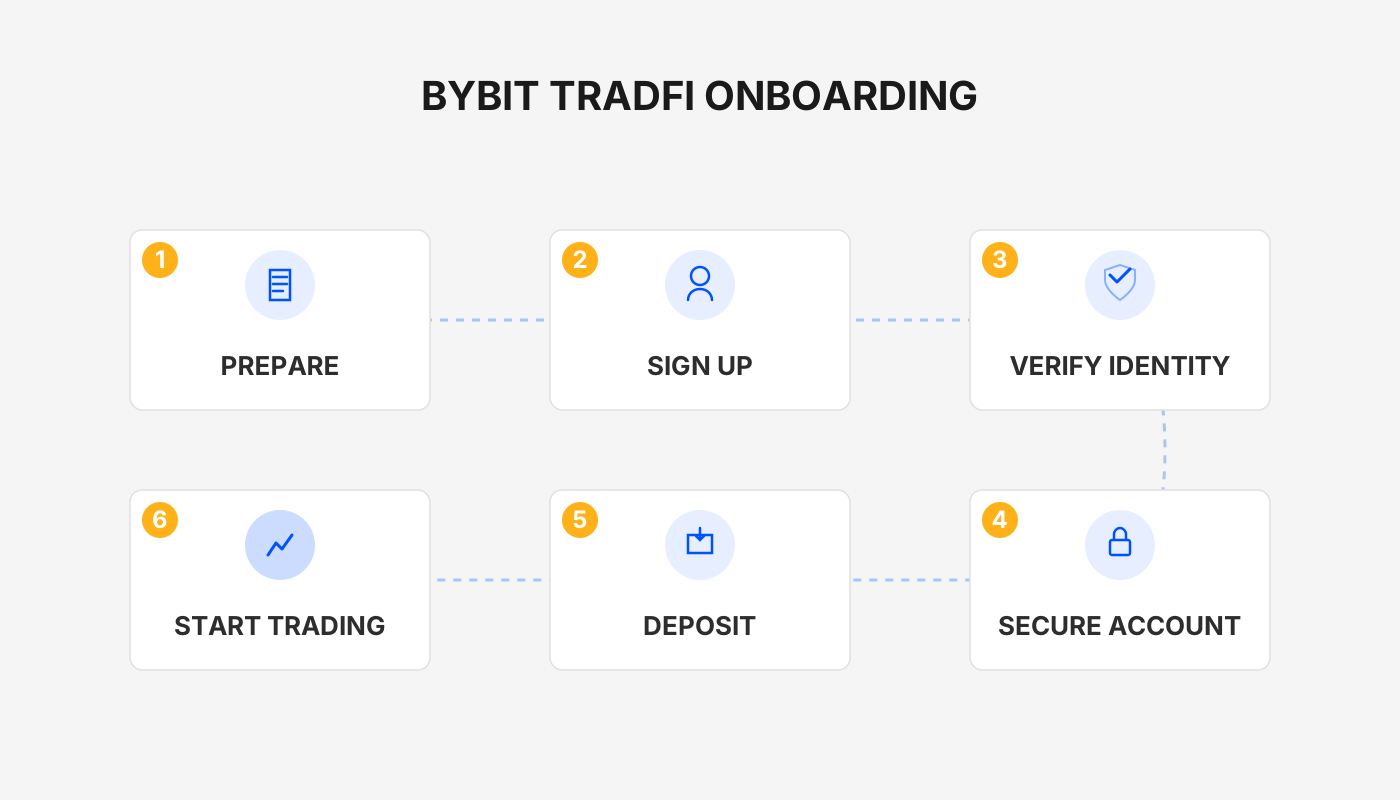
Bybit TradFi Launch: Open Access to Stocks and U.S. Equity Trading
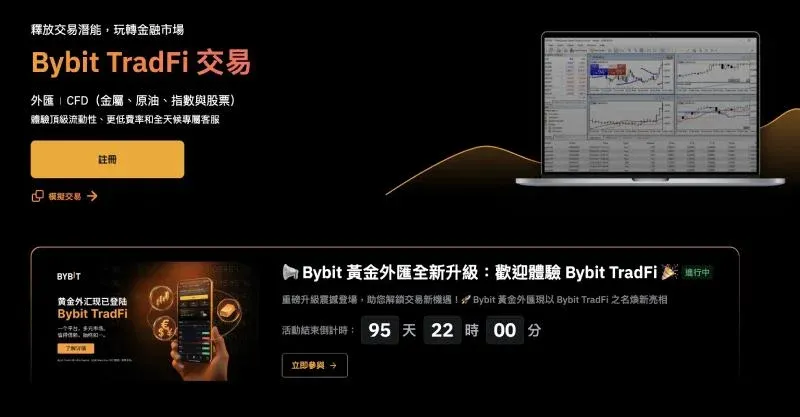
As the cryptocurrency industry matures, the world’s fifth‑largest digital‑asset exchange Bybit (official registration official download) officially rolled out its TradFi offering in 2025, enabling more than 70 million users to operate crypto assets and traditional financial products from the same interface. This move blurs the line between digital and conventional finance and gives investors in Taiwan and other regions a new gateway to the U.S. stock market.

Bybit TradFi is the first mainstream crypto exchange to provide a complete solution for trading gold, foreign exchange, global indices, commodities, and stock contracts for difference (CFDs). Users do not need to download separate MT5 software; they can place orders on the five major global markets directly within the same client.
Core Advantages of Bybit TradFi
- Unified Trading Entry: The same account and crypto wallet can switch between traditional and digital‑asset trading screens.
- Global Asset Coverage: Supports 78 U.S. stock CFDs, including FAANG representatives such as $AAPL, $AMZN, $TSLA, $GOOG, etc.
- Cross‑Category Positioning: Allows traders to build diversified portfolios and hedge across asset classes.
- Bidirectional Participation: Traditional finance investors can also experiment with the crypto market within the same app.
The service is backed by Infra Capital, which holds a Mauritius Financial Services Commission (FSC) licence to provide compliance and security guarantees.
---
Bybit Stock & U.S. Equity Trading: Features and Drawbacks
Main Feature Highlights
| Feature | Description |
|---|---|
| **CFD Trading** | Capture U.S. equity price movements via contracts for difference, without owning the underlying shares, offering flexible execution. |
| **High Leverage** | Certain categories provide up to 500× leverage, enhancing capital efficiency. |
| **Bidirectional Orders** | Supports both long and short positions, allowing profit from price rises or falls. |
| **Broad Selection** | 78 U.S. stock CFDs spanning multiple sectors, facilitating diversified portfolio construction. |
| **MT5 Platform** | Utilises MetaTrader 5, delivering a clean interface and automated‑trading tools. |
| **Unified Account** | USDT can be freely transferred between the main account and the TradFi account for easier management. |
Potential Risks and Limitations
- No Shareholder Rights: No voting rights, dividend distribution, or split entitlements; profits come solely from price movements.
- Leverage Risk: High leverage can cause losses that exceed the initial margin; positions are automatically liquidated when margin falls below 50 %.
- Overnight Fees: Positions held overnight incur interest charges; weekend fees are three times the standard rate.
- Trading Hours Restricted: Limited to U.S. market hours; not a 24‑hour continuous market.
- Fee Structure: Minimum fee of 5 USDT per order makes small‑size trades relatively costly.
- Regulatory Scope: Classified as a derivatives product, it is not covered by traditional securities regulators and lacks SIPC‑type investor protection.
- Regional Restrictions: Some jurisdictions (e.g., the European Union) are currently unavailable; users must verify local compliance.
- Liquidity Transparency: Pricing mechanisms are not fully disclosed, potentially leading to significant slippage during extreme market conditions.
Comparison with Traditional U.S. Brokerage Services
| Item | Bybit TradFi | Traditional U.S. Broker |
|---|---|---|
| Trading Method | CFD (no share ownership) | Direct stock ownership |
| Shareholder Rights | None (no voting, dividends) | Full shareholder rights |
| Fees | 0.04 USDT per share, minimum 5 USDT | Many platforms offer $0 commissions |
| Leverage Cap | Up to 5× for U.S. stock CFDs | Approximately 2× margin financing |
| Overnight Fees | Interest applied to carried positions | No overnight fee for holding actual shares |
| Account Minimum | No minimum deposit required | Most brokers require a minimum balance |
| Trading Hours | Constrained to U.S. market sessions | Some brokers provide pre‑/post‑market trading |
| Regulatory Protection | FSC‑regulated, not SIPC | SIPC protection up to USD 500,000 |
| Asset Variety | 78 U.S. stock CFDs | Thousands of stocks, ETFs, etc. |
---
User Experience Tips
- Minimum Trade Size
Because each order incurs a minimum fee of 5 USDT, it is advisable to place orders of 500‑1,000 USDT or more to keep the per‑unit cost reasonable.
- Nature of CFDs
- You are trading a contract on the stock’s price, not the actual share.
- No participation in shareholder meetings or voting rights.
- Cash adjustments only; dividends are not received directly.
- Stock splits or consolidations do not generate additional units.
- Long‑term holding erodes returns due to overnight financing charges.
- Liquidation risk exists; CFDs are best suited for short‑term or swing strategies.
- Suitable Use Cases
- Existing crypto holdings and a desire to capture U.S. equity volatility quickly.
- Short‑term tactics, such as trading around earnings releases or news events.
- Practising U.S. equity trading without opening a conventional brokerage account.
---
Bybit Stock & U.S. Equity Trading Tutorial
Step 1: Register and Complete KYC
- Visit the Bybit website to create an account.
- Complete KYC Level 2 (individual) or corporate verification.
- Enable Two‑Factor Authentication (2FA) for added security.
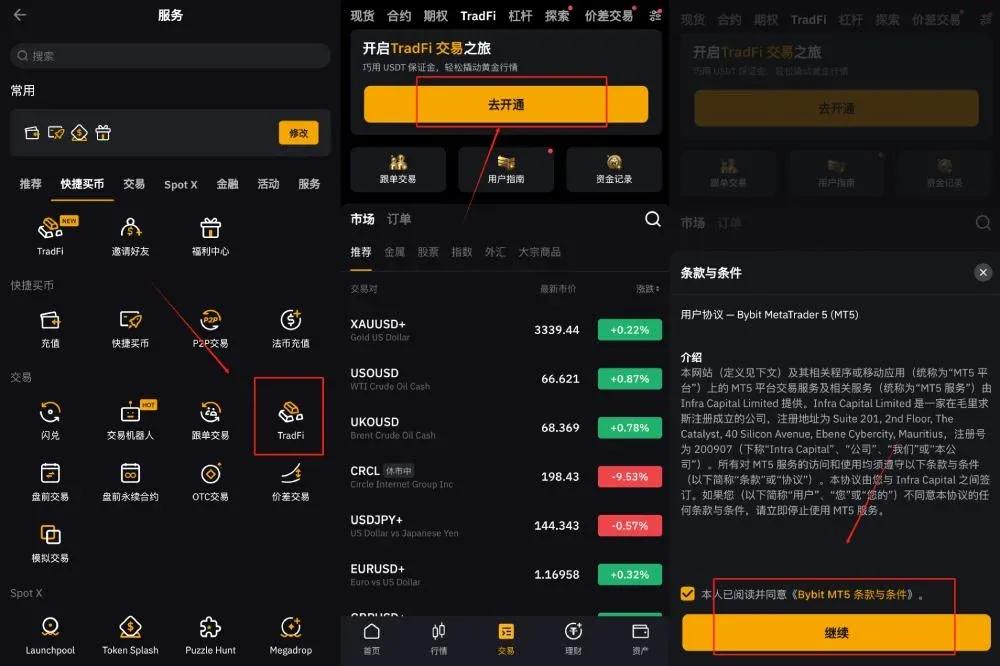
Step 2: Activate a TradFi (MT5) Account
- In the Bybit app, locate “TradFi” in the service list.
- Follow the prompts to open an MT5 account (available only to the primary account; sub‑accounts are not supported). The system will automatically generate login credentials.
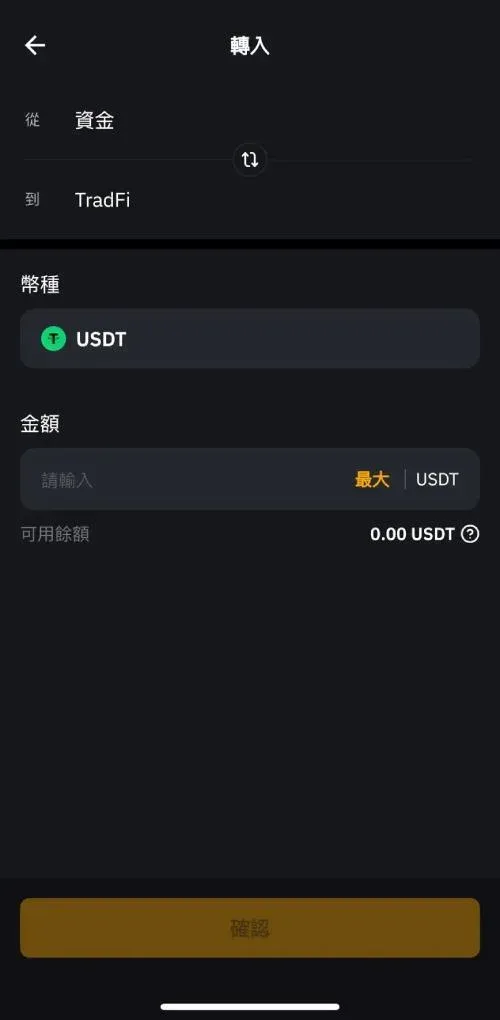
Step 3: Fund and Transfer
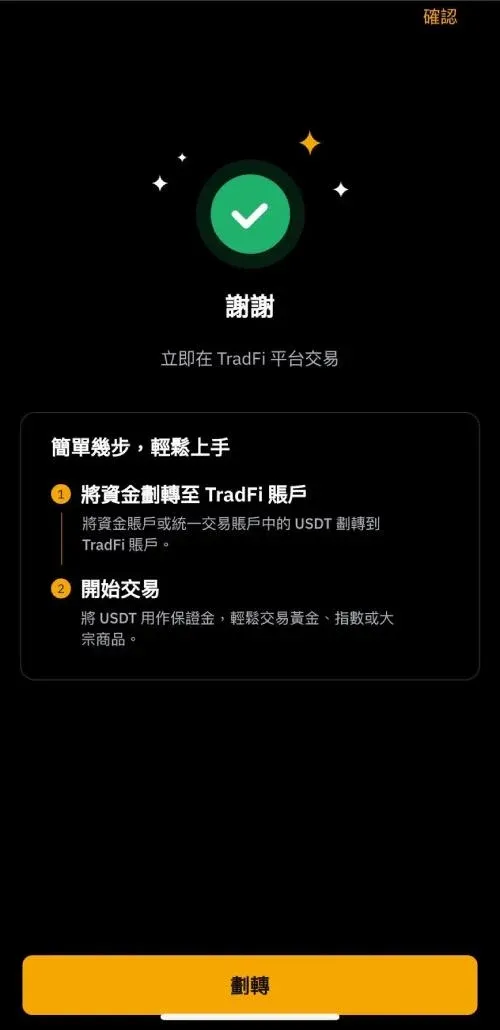
- Currently the MT5 account accepts USDT deposits only.
- Transfer USDT from your main Bybit account into the TradFi account.
- Once the balance is confirmed, you can start placing orders.
Step 4: Start Placing Orders
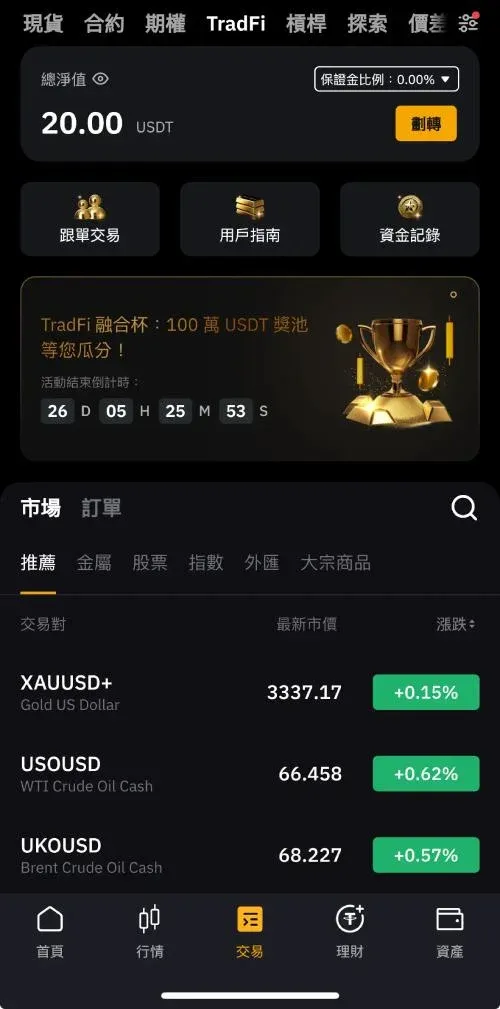
Bybit has fully embedded TradFi into the main app, so no separate MT5 installation is needed. The workflow is:
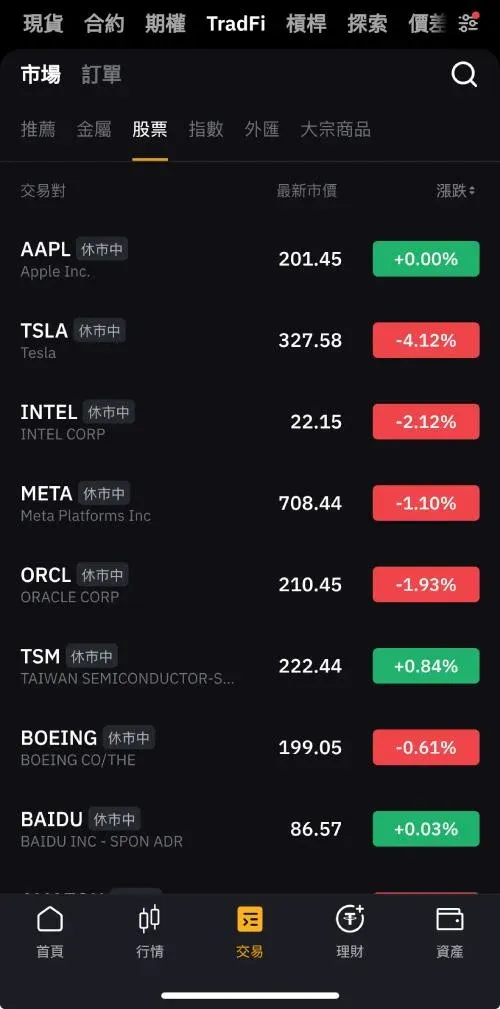
- Tap “TradFi” or “Stocks” within the app.
- Browse the 78 U.S. stock CFDs and select your target instrument.
- Submit market, limit, stop‑loss, or other order types directly from the app.
Key Trading Points
- Order Types: Market, limit, stop‑loss, etc., are all supported.
- Risk Management: It is advisable to set take‑profit and stop‑loss levels to guard against sudden moves.
- Trading Sessions: Orders must be placed during U.S. market hours.
Forced Liquidation Mechanism
According to the official documentation, MT5’s liquidation rules are:
- Stop‑Out Level: 50 %.
- When the account’s margin level ≤ 50 %, the system automatically triggers liquidation.
- Margin level = (Equity ÷ Used Margin) × 100 %.
Example: Deposit 1,000 USDT, use 5× leverage to buy an Apple CFD worth 5,000 USDT. If the price drops ~10 % (loss of 500 USDT), equity falls to 500 USDT, margin level reaches 50 %, and the system will liquidate the position.
---
Bybit Stock & U.S. Equity Trading Fees
Basic Fee Structure
| Item | Fee Standard | Notes |
|---|---|---|
| Opening Fee | 0.04 USDT per share | Charged when buying a CFD |
| Minimum Fee | 5 USDT per order | Applied even if calculated fee is lower |
| Closing Fee | Free | No extra charge when selling |
| Overnight Holding Fee | Calculated per contract | Interest applied for positions held overnight; Friday fees are three times the normal rate |
Fee Calculation Example
- Buy 100 AAPL shares: 100 × 0.04 = 4 USDT → Charged 5 USDT due to the minimum‑fee floor.
- Buy 200 AAPL shares: 200 × 0.04 = 8 USDT → Charged 8 USDT.
Fees for Other Asset Classes
| Asset Class | Fee Standard | Leverage Cap |
|---|---|---|
| Forex | 6 USDT per lot | Up to 500× |
| Precious Metals | 6 USDT per lot | Up to 500× |
| Commodities | 3 USDT per lot | Up to 20× |
| Indices | 0.1‑3 USDT per lot | Up to 500× |
| U.S. Stock CFDs | 0.04 USDT per share, minimum 5 USDT | Up to 5× |
Overnight Fee Details
- Charging Point: Fees accrue when a position crosses the server’s 00:00 UTC timestamp.
- Calculation Method: Based on position size, the applicable swap rate, and the number of days held.
- Weekend Rule: Friday incurs three times the normal overnight charge to cover the weekend period.
Note: While the platform primarily uses USDT, fiat deposits/withdrawals can be made via SEPA, SWIFT, or other international bank transfers in USD.
Tax Reminder: Crypto‑related gains, including CFD profits, may be taxable under the laws of your jurisdiction. Consult a tax professional for guidance.
---
Frequently Asked Questions (FAQ)
Q1: Is there a minimum deposit requirement?
A: No minimum deposit is imposed; users can fund the account according to their own capital preferences.
Q2: Does the platform support hedging?
A: Yes. MT5 allows simultaneous long and short positions on the same contract, enabling hedging strategies.
Q3: How are U.S. stock CFDs settled?
A: All CFDs are settled in USD. USDT deposited by the user is automatically converted to USD at the prevailing USDT‑USD rate at trade execution.
Q4: Can I adjust the leverage ratio myself?
A: Leverage is preset per contract; users cannot manually change it.
Q5: What triggers a forced liquidation?
A: When the account’s margin level falls to or below 50 %, the system automatically closes positions to protect against further loss.
Q6: How can I reduce the risk of forced liquidation?
A:
- Monitor margin levels in real time and avoid approaching the 50 % threshold.
- Use leverage conservatively; avoid excessive multiples.
- Set stop‑loss orders to cap potential losses.
- Keep sufficient free balance as a safety buffer.
---
This completes the comprehensive guide titled “Can You Buy U.S. Stocks on Bybit? Detailed Bybit TradFi Stock & U.S. Equity Trading Tutorial.” For more Bybit TradFi updates, you can search the Bitaigen (比特根) archive or continue reading the recommended articles below. We appreciate your ongoing interest and support for Bitaigen (比特根)!
Related Reading
- 2026 Top DEXes: Security, Liquidity & Fees
- Top Crypto Exchanges for Beginners: Safety, Ease & Low Fees
- Binance Registration & Verification Guide for Mainland China
💡 Register on Binance with referral code B2345 for the maximum trading fee discount. See Binance complete guide.



