
 Bitaigen Research
In this article we outline Aster DEX’s core mechanisms, the controversy behind its removal from DeFiLlama, and assess its future development potential. By deeply analysing wash‑trading risk and data credibility, we help readers clarify the project’s true nature and decide on subsequent positioning.
Overview of the DeFiLlama Delisting Controversy
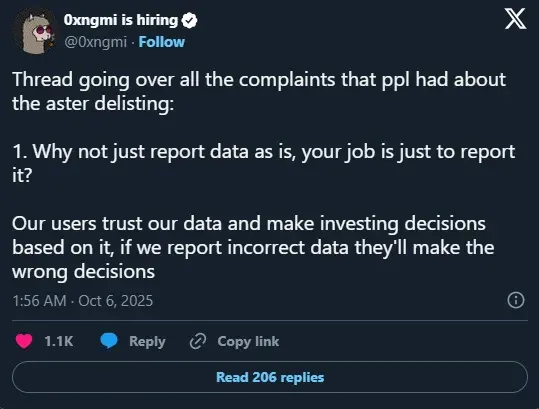
On October 5 2025, the DeFi data aggregation platform DeFiLlama announced that it would remove Aster’s perpetual futures volume data from its rankings. The decision sparked a heated debate within the community about the reliability of decentralized data. Platform founder 0xngmi claimed to have evidence that Aster engaged in wash‑trading: the reported perpetual futures volume matched Binance’s data almost linearly, with a correlation coefficient approaching 1, and the platform refused to provide order‑book‑level raw data for third‑party verification, deepening external suspicion.
*Before being delisted, Aster had claimed that its 24‑hour volume on October 7 reached $41.78 billion, four times the $9 billion reported by Hyperliquid on the same day. Considering that Aster is still an emerging project with a relatively limited open‑interest size, most observers regarded this figure as abnormal.*
Structural Risks of Wash‑Trading
Wash‑trading is not uncommon in crypto markets; roughly one‑quarter of exchanges have been affected by similar behaviour. Automated bots repeatedly open and close positions to generate “fake” volume without creating genuine economic activity. Aster’s airdrop mechanism further amplifies the issue: 53 % of the token supply is allocated for airdrops, leading some large wallets to generate up to $85 billion of trading volume within 30 days, most of it stemming from Sybil‑attack‑style bot operations.
After the controversy emerged, the community split into two camps: supporters accused DeFiLlama of “centralized censorship,” while critics suggested moving to Dune Analytics. However, several Dune dashboards still rely on DeFiLlama’s data sources, making the dispute even more complex.
Measuring Genuine Activity
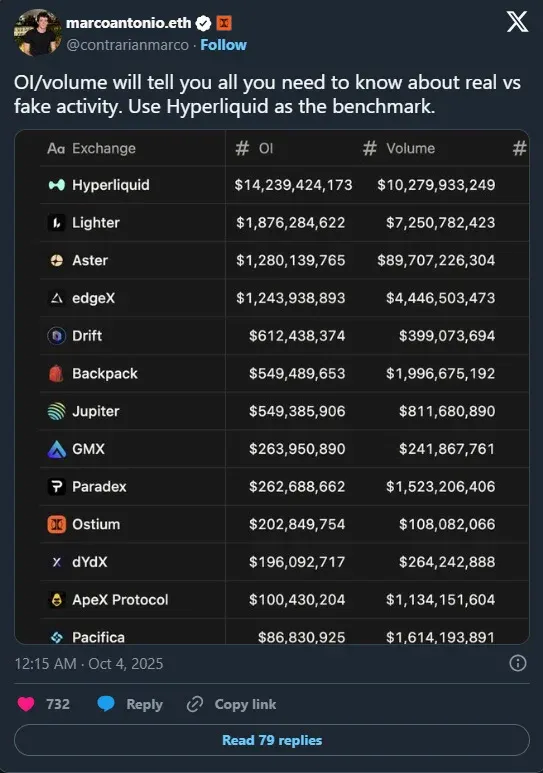
Beyond volume, Open Interest (OI) is considered a harder‑to‑fabricate indicator of activity. On‑chain data from October 3 2025 showed:
- Aster Open Interest: $4.86 billion
- Hyperliquid Open Interest: $14.68 billion
- Aster Volume: $41.78 billion
- Hyperliquid Volume: $9 billion
The pronounced imbalance between reported volume and open interest raised red flags for analysts regarding the authenticity of Aster’s data.
Core Positioning of Aster DEX
Aster is a decentralized trading platform that supports both spot and perpetual contracts, allowing users to trade with leverage while supplying collateral assets that can generate yield. The platform is deployed across four major blockchains—BNB Chain, Ethereum, Solana, and Arbitrum—aiming to solve the “yield vs. trading” trade‑off that many DeFi users face. Users retain full custody of their assets, trading runs 24 hours a day, and both crypto and traditional equity perpetual contracts can be accessed from a single interface.
“Trade & Earn” Model
The platform introduces two types of yield‑bearing collateral:
- asBNB: A liquid‑staking derivative of BNB that automatically accrues staking rewards.
- USDF: A yield‑bearing stablecoin pegged 1:1 to USDT. USDF earns relatively stable returns by deploying assets on centralized platforms and employing a delta‑neutral hedging strategy; however, its earnings depend to some extent on the continued operation of those external platforms.
Trading Interface and Leverage
Aster offers two distinct trading modes to cater to different user needs:
- 1001x Mode: A simplified “one‑click” opening experience with leverage up to 1001×. Smart order routing mitigates MEV attacks, helping newcomers get started quickly.
- Perpetual Mode: Targeted at professional traders, this mode provides a full order book, depth chart, and charting tools comparable to those on centralized exchanges, supporting multi‑asset margin.
Private Order Mechanism
Aster’s “Hidden Orders” feature has generated buzz in the industry. Large orders are fully encrypted before matching; only the smart contract decrypts them at execution time, preventing front‑running and MEV exploits and offering institutional‑grade privacy protection.
*Image source: @Aster_DEX*
Comparison with Competitors
In the perpetual‑contract DEX space, Aster’s main differences from Hyperliquid, dYdX, and GMX are summarised below:
| Feature / Project | Aster | Hyperliquid | dYdX | GMX |
|---|---|---|---|---|
| Trading Model | Order‑book + AMM hybrid | L1 order book | Application‑chain order book | AMM‑based |
| Multi‑chain Support | > 4 public chains | Proprietary L1 only | Proprietary chain only | Multi‑chain |
| Yield‑bearing Collateral | asBNB, USDF | None | None | None |
| Stock Perpetuals | Yes | No | No | No |
| Hidden Orders | Yes | No | No | No |
| Max Leverage | 1001× | 50× | 20× | 100× |
Aster’s competitive edge lies in its yield‑bearing collateral and multi‑chain deployment, allowing users to earn passive income while leveraging positions and to tap deeper liquidity across several ecosystems. By contrast, Hyperliquid leads in open‑interest size, dYdX benefits from years of operational stability, and GMX pioneered the liquidity‑provider model.
Tokenomics and Risks
ASTER Token Launch Overview
ASTER was officially listed on September 17 2025. Within the first six hours the price surged roughly 1,500 % to a peak of $2.30, before falling to about $1.83 on October 5. Daily average trading volume has consistently exceeded $300 million, providing ample liquidity for large traders while also giving a handful of whales noticeable price‑impact ability.
Token Distribution
| Allocation | Percentage | Token Amount |
|---|---|---|
| Airdrop | 53.5 % | 4.28 billion |
| Ecosystem & Community | 30 % | 2.4 billion |
| Treasury | 7 % | 560 million |
| Team | 5 % | 400 million |
| Liquidity & Listings | 4.5 % | 360 million |
On‑chain data shows that roughly 93 % of ASTER supply is concentrated in a small number of wallets; some analyses indicate that just six wallets control over 96 % of the tokens. This high concentration introduces governance risk—few holders can easily sway voting outcomes and market price.
Operational and Technical Risks
- USDF Dependence: USDF’s yield model relies on third‑party custodians and software services; any security or reliability issue with those providers could directly affect platform operations.
- Extreme Leverage: A 1001× leverage level may trigger cascade liquidations during volatile market moves, potentially leading to liquidity crises.
- Cross‑chain Attack Surface: Each additional supported chain expands the potential attack surface of cross‑chain bridges, requiring consistent security standards across all networks.
Backing Capital and Team
Support from YZi Labs
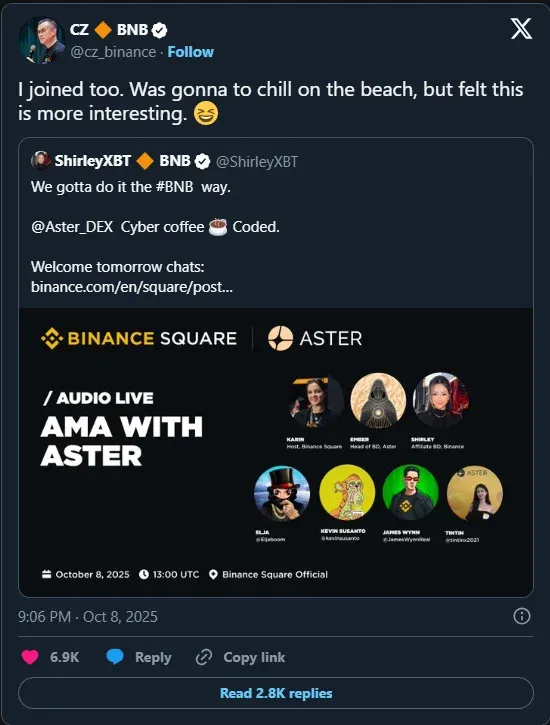
YZi Labs, co‑founded by CZ (Changpeng Zhao) and He Yi, manages approximately $10 billion in assets. At the end of 2024 it became the sole seed‑round investor in what was then called Astherus, providing capital, technical incubation, and marketing resources. The firm focuses on DEXs, real‑world assets (RWA), and AI‑driven DeFi, believing that decentralized exchange volume will eventually match that of centralized platforms.
The public endorsement briefly lifted ASTER’s price by about 400 % and spiked volume to $324 million. The platform later announced it would remain independently operated, though many industry insiders suspect that several former senior staff from large centralized exchanges are now part of the team.
Chief Executive Officer Leonard
Leonard joined a few‑hundred‑person exchange in 2019 as a product manager and grew with the company into an industry heavyweight. He witnessed capital inflows into centralized exchanges and observed Hyperliquid’s innovations in the decentralized space, experiences that shaped his vision for Aster. Leonard’s X (formerly Twitter) avatar is a silhouette wearing a hat; his real identity has never been disclosed. After creating the official account in March 2025, he announced a brand revamp within weeks.
The anonymity presents both regulatory and trust challenges. To mitigate information asymmetry, Leonard frequently participates in AMAs, emphasising that PeckShield completed a security audit and openly acknowledging that the mobile experience and depth of trading tools still lag behind industry standards, stating “these issues are common across Web 3 as a whole.” Such transparency is relatively rare in the sector.
Future Roadmap
Aster is planning several long‑term upgrades:
- Aster Chain: A proprietary Layer‑1 blockchain intended to give the project full control over transaction ordering and MEV defence.
- Zero‑Knowledge Proof (ZKP) Integration: Enabling fully private trades that hide positions and identities, appealing to institutions with stringent confidentiality requirements.
- Intent‑Based Cross‑Chain Automation: Allowing users to set complex cross‑chain trading conditions that the system executes automatically across multiple chains, lowering the technical barrier for multi‑chain operations.
Despite the ambitious vision, the platform must first resolve its current trust deficit. The DeFiLlama delisting has already dented its reputation; restoring credible volume data, improving the alignment between open interest and reported volume, and reducing token concentration will be critical tasks over the coming months. Additionally, evolving regulatory landscapes could materially affect the project—if policies become more supportive, the broader industry stands to benefit; if regulations tighten, Aster may face heightened pressure.
Frequently Asked Questions
What is Aster DEX?
Aster is a decentralized perpetual‑contract trading platform that offers spot and perpetual trading while supporting yield‑bearing collateral assets across multiple blockchains.
Who founded the project?
The platform’s anonymous CEO, Leonard, previously worked as a product manager at a large exchange beginning in 2019; his true identity remains undisclosed.
Why did DeFiLlama delist Aster?
The platform was accused of wash‑trading; its reported volume closely mirrored Binance data (U.S. users should use Binance.US) and it refused to share order‑book‑level data, leading to concerns about fabricated trading activity.
What role does YZi Labs play?
YZi Labs, founded by CZ and He Yi and managing roughly $10 billion, was the sole seed investor in Aster, providing funding, technical incubation, and marketing support.
How did the ASTER token perform after launch?
Following its September 17 2025 launch, the token rose about 1,500 % within six hours, peaking at $2.30.
How concentrated is the token supply?
Approximately 93 % of ASTER tokens are held by a small number of wallets; six wallets alone control over 96 % of the total supply.
Which blockchains are supported?
Aster is deployed on BNB Chain, Ethereum, Solana, and Arbitrum.
This article provides a comprehensive analysis of Aster DEX, the DeFiLlama delisting controversy, and the platform’s prospective outlook. For more details, refer to previous Bitaigen articles or follow the links below. Thank you for continuing to support Bitaigen!
*Please note that cryptocurrency gains may be taxable in your local jurisdiction. For fiat transfers, consider using SEPA, SWIFT, or other regulated channels.*
Related Reading
- Aster Exchange: ASTER Token & Cross‑Chain Perpetual DEX
- WLFI Token Economics: DeFi Risks & Mechanics Overview
- DODO Exchange Review: Tech, Product & Team Analysis
💡 Register on Binance with referral code B2345 for the maximum trading fee discount. See Binance complete guide.



