
 Bitaigen Research
 As competition intensifies on the Layer 1 track, public blockchains that focus on vertical niches are gradually standing out. This article, written in depth by the Bitaigen editorial team, aims to give you a comprehensive analysis of Atleta Network (ATLA), its core mechanisms, and its unique position within the sports ecosystem. We will not only examine how its technical architecture supports massive on‑chain transaction volumes, but also objectively assess how its token‑supply structure influences market pricing. By the end of this piece, you will have a deep insight into the value logic behind this emerging project and its recent market dynamics.
ATLA Market Performance and Current Price Trend
In the latest cycle of the cryptocurrency market, Atleta Network, thanks to its robust architectural design, has become one of the most watched projects in the Layer 1 arena. To date, the network has successfully processed over 24 million on‑chain transactions and has built a continuously expanding sports ecosystem.
Market observation shows that $ATLA hit an all‑time high of $181.05 on March 1, 2026. Compared with the low of $10.54 recorded in August 2025, this represents a rise of roughly 1,471 %. After reaching the peak, early investors took profit, and the token now mainly trades within a range of $124 – $166.
From a supply perspective, ATLA’s total maximum supply is capped at 3 billion tokens, while the circulating supply is currently about 825,000 tokens—only a tiny fraction of the total. This implies that future token unlocks will alter the market‑supply structure. Moreover, during the historical high‑price period, the 24‑hour trading volume spiked to between $35 million and $60 million, reflecting very high market activity.
Atleta Network: A Web 3 Foundation Tailored for the Sports Industry
Unlike general‑purpose layer‑1 chains such as Ethereum, Solana, or Avalanche, Atleta Network has chosen a vertically‑focused path. It positions itself as the dedicated blockchain layer for the global sports sector, with its development roadmap, ecosystem incentives, and toolset tightly aligned with the core needs of athletes, clubs, sports organisations, and fans.
Built as a modular Layer 1 protocol on the Substrate framework and written in Rust, Atleta offers the following core technical advantages:
- EVM compatibility – Developers can migrate existing Ethereum smart contracts to Atleta without rewriting code, dramatically lowering the technical barrier.
- High‑performance operation – The network supports roughly 80 TPS, has a block production time of 6 seconds, and can achieve near‑instant transaction finality.
- Full‑stack ecosystem – Beyond the base layer, Atleta provides a native wallet, a decentralized exchange (DEX), a cross‑chain bridge, and AI‑driven prediction and staking functionalities.
Core Architecture: Three‑Layer Collaborative Operation
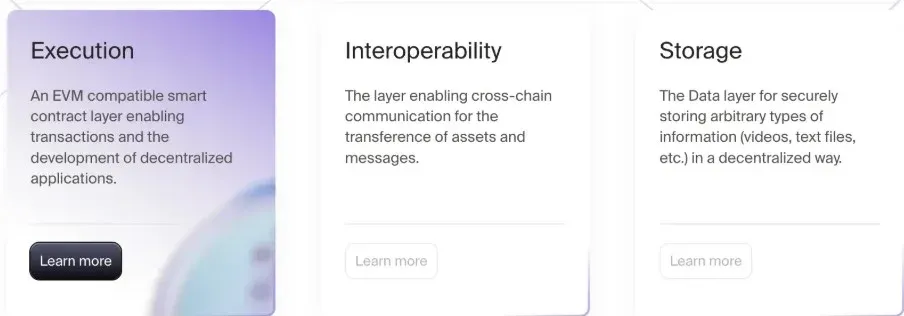
Atleta’s technical architecture consists of three interrelated layers that together support complex blockchain functions:
- Execution Layer – Supplies an EVM‑compatible smart‑contract environment, serving as the core venue for DApp development and transaction processing.
- Interoperability Layer – Utilises Cross‑Consensus Messaging (XCM) technology to ensure assets and data can move freely between Atleta and other blockchain networks.
- Storage Layer – Constructs a decentralized data‑archival space. This layer is especially important for sports media, enabling censorship‑resistant storage of videos, athlete data, and other sensitive files.
On the consensus side, Atleta adopts a dual‑mechanism design: BABE randomly produces blocks, while GRANDPA finalises them. Separating block production from finalisation provides higher security compared with single‑mechanism systems.
$ATLA Token: The Four Pillars of the Ecosystem
As the native token of the network, $ATLA is more than a medium of exchange; it powers the entire ecosystem. Its functions are manifested across four dimensions:
- Pricing and accounting – All operations inside the network are priced in $ATLA. For example, a basic transfer consumes roughly 0.02 $ATLA.
- Fee settlement – Regardless of the asset being transferred, on‑chain gas fees must be paid in $ATLA, requiring participants to hold a minimum amount for daily activity.
- Governance rights – Holders who stake $ATLA (minimum 10 ATLA) gain access to the ATLETAgov module, where they can vote on proposals, reject changes, or submit new initiatives.
- Parachain slot security – Projects wishing to connect to the Atleta ecosystem and share its security must lock a specified amount of $ATLA as a deposit. This not only constrains parachain behaviour but also provides a fallback safety net for the network.
NPoS Consensus Model and Staking Mechanism
Atleta employs a Nominated Proof‑of‑Stake (NPoS) model similar to Polkadot’s. Compared with traditional Delegated Proof‑of‑Stake, NPoS rotates validators randomly, effectively preventing power concentration and enhancing network democracy.
- Validators – The network currently supports up to 256 active validator slots (selected from 1,000 candidates). Validators must stake at least 75,000 $ATLA and lock their tokens for 3 days. They maintain nodes, produce blocks, and earn transaction‑fee rewards.
- Nominators – The entry barrier is low; any user holding 10 $ATLA can participate. Nominators delegate their tokens to trusted validators to share rewards without running hardware themselves. The system supports up to 512 nomination pools and an unlimited number of individual nominators.
Economic Model: Balancing Inflation and Burn
Atleta adopts a hybrid economic model that uses token burning to counteract inflation.
The network targets an annual inflation rate of about 4 %, allocated to validator rewards. To offset the new supply, the protocol includes a burn process. Initially, burns are governance‑driven: the community votes on how to handle treasury funds (originating from validator slashes, unallocated rewards, etc.) and sends the decided amount to an irretrievable “black‑hole” address.
Looking ahead, Atleta plans to implement an automatic burn mechanism similar to Ethereum’s EIP‑1559. Under that scheme, the base fee of each transaction will be burned directly. As network activity grows, this automated deflationary pressure is expected to offset—or even exceed—the inflation generated by staking rewards.
Frequently Asked Questions
What is the core positioning of Atleta Network?
It is a modular Layer 1 blockchain built specifically for the convergence of sports and Web 3, featuring EVM compatibility and ultra‑fast transaction finality.
What practical uses does the $ATLA token have?
Primarily for paying gas fees, settling transactions, participating in on‑chain governance, and serving as collateral for parachain deployments.
How can I participate in staking on the Atleta network?
You can act as a validator (requiring 75,000 $ATLA) or as a nominator (minimum 10 $ATLA). Nominators delegate tokens to validators to earn a share of the rewards.
What are Atleta’s performance specifications?
Block time is 6 seconds, throughput is roughly 80 TPS, and it supports one‑click deployment of Ethereum smart contracts.
What is the supply and burn mechanism of $ATLA?
The total supply is 3 billion tokens. Currently, manual governance‑driven burns are used to balance the 4 % inflation rate; future upgrades will shift to an automated base‑fee burn model.
---
*The content of this article is for informational purposes only and does not constitute any investment advice. Before participating in any cryptocurrency project, please conduct thorough research (DYOR).*
---
💡 Register on Binance with referral code B2345 for the maximum trading fee discount. See Binance complete guide.



