 Bitaigen Research
 In this article we start from the most intuitive transfer scenario and progressively dissect the underlying data structure of the Bitcoin blockchain. By using plain analogies, we help readers understand how blocks, block headers, and hash pointers are linked together into an immutable chain, laying the groundwork for later technical discussions. Anyone who wants to grasp how Bitcoin operates should not miss this.
The Data Structure of the Bitcoin Blockchain
We return to the process of two people transferring funds in order to understand the data structure of the Bitcoin blockchain.
After I initiate a transaction, I broadcast to the entire blockchain network: I want to send a certain amount of Bitcoin to your address—no additional permission from you is required.
However, the transaction is only considered truly completed once it is packed into the latest Bitcoin block. In typical practice, after the block containing the transaction is followed by five more blocks (i.e., six confirmations in total, including the block itself), the transaction can be regarded as fully confirmed. Assuming an average block time of roughly 10 minutes per Bitcoin block, the whole process takes about one hour.
This involves two steps:
- The transaction is packed into a candidate block—each node can generate a different candidate block according to the protocol rules;
- A node successfully mines, and the candidate block is formally added to the tail of the blockchain, becoming the newest official block.
So what does it actually mean to pack a transaction into a block? This touches on the most fundamental data structure of the blockchain and is precisely the root of its immutability.
The following material may seem a bit dry, but it is the cornerstone for understanding Bitcoin and blockchain, and I will strive to explain it in plain language.
The reason the blockchain is called a blockchain is that its data blocks are stored in a chain‑like fashion. Starting from the first block—the genesis block—subsequent blocks are continuously linked behind the previous block, forming a single chain.
Each block consists of two parts—the block header and the block body. Within the block header there is a hash pointer that points to the previous block; this pointer contains the hash value of the preceding block. A hash value can be thought of as the fingerprint of a data block, and the header of the later block stores the fingerprint of the earlier block’s data. If the content of the previous block were tampered with, its fingerprint would no longer match, and the tampering would be instantly detectable. To modify the data inside a given block, one would have to simultaneously modify every block that follows it, which is practically impossible.
The Bitcoin blockchain makes such modifications astronomically expensive through the Proof‑of‑Work (PoW) consensus and mining mechanism, which will be explained in more detail later.
The data inside a block is a collection of transactions that have been packed into that block. These transactions are organized according to a predefined rule into a specific binary‑tree structure—the Merkle tree. With the current capacity of a Bitcoin block, a block can hold roughly 2,000 transactions; for example, block #526,957 contains 1,804 transactions.
You can view Bitcoin blockchain data on sites such as https://blockchain.info/.
The Bitcoin blockchain’s data structure comprises two kinds of hash pointers that together form the immutable foundation. One set creates the “block + chain” linked‑list structure, and the other set builds the Merkle tree (see Figure 1). The chain structure makes any alteration of data inside a particular block easy to spot; the Merkle‑tree structure provides a similar verification mechanism for any transaction inside the block.
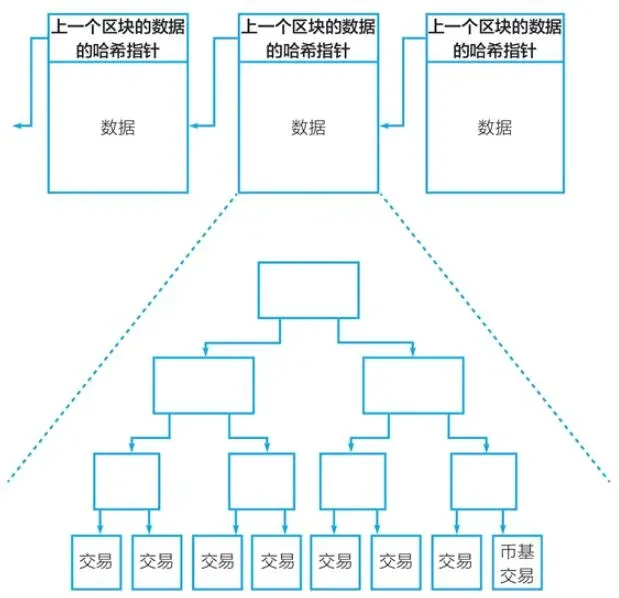
Figure 1: The “blockchain” and Merkle tree of the Bitcoin blockchain
The above provides a detailed explanation of the Bitcoin blockchain’s data structure. For more information about Bitcoin and blockchain, please follow the other articles published by Bitaigen (比特根)!
💡 Register on Binance with referral code B2345 for the maximum trading fee discount. See Binance complete guide.



