
 Bitaigen Research
 In this article we conduct an in‑depth analysis of Bitway’s underlying architecture and its native compatibility with Bitcoin, unveiling its gas‑free mechanism and cross‑chain verification advantages. The goal is to help you grasp the technical core and potential value of the project; later sections will further examine the token economics and future outlook.
Technical Architecture: A Bitcoin‑Native Layer‑1 Protocol
Bitway’s main competitive edge lies in its foundational layer—the Bitway Ledger. This is a high‑performance application chain built on the Cosmos‑SDK and CometBFT, essentially a Layer‑1 solution purpose‑made for the Bitcoin ecosystem. Unlike many protocols that force users to migrate to an EVM environment, Bitway achieves deep integration with Bitcoin’s native architecture.
Core Technological Advantages
- Native address compatibility: The protocol directly supports Bitcoin’s Taproot and native SegWit addresses, using the Bech32 and Bech32m formats. This means users can continue to sign transactions with existing Bitcoin wallets such as OKX Wallet, Unisat, Ledger, without having to set up MetaMask or any other EVM‑compatible wallet.
- Efficient verification mechanism: The Bitway Ledger embeds an SPV (Simple Payment Verification) client, ensuring that Bitcoin main‑net transactions are considered verified within the protocol after six confirmations.
- Innovative gas‑free experience: To lower the entry barrier, Bitway introduces a fee‑sponsorship model. When users transfer native Bitcoin‑backed assets (BTCT), they do not need to hold a separate gas token; the associated costs are managed internally by the protocol. This architecture not only enables instant settlement but also creates an ideal environment for subscription‑style payments and micro‑commerce integration.
Bitway’s Core Product Matrix: Lending and Earn
To unlock the massive value that has been accumulating within the Bitcoin ecosystem, Bitway has launched two core financial products, both designed to release liquidity in a non‑custodial manner.
1. Bitway Lending: Non‑Custodial Borrowing
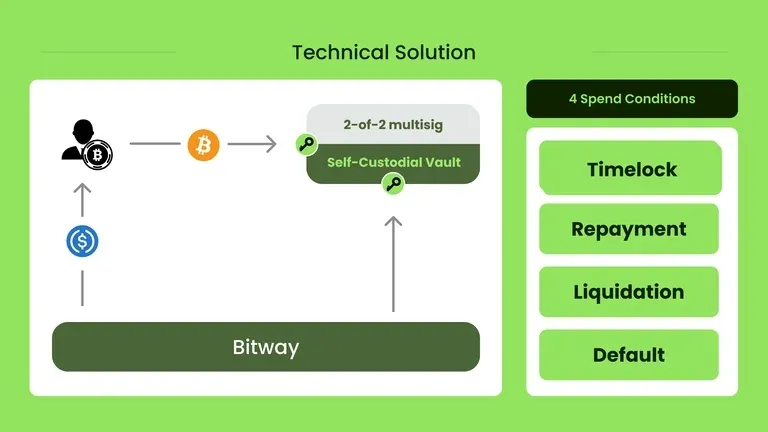
This is a lending protocol built on Bitcoin’s UTXO model and Discrete Log Contracts (DLC). Its most prominent feature is asset security: the collateralized Bitcoin remains locked in a dual‑signature vault on the Bitcoin mainnet rather than being transferred to a third‑party custodian.
- Instantaneous: Loan approval and disbursement require no credit checks or KYC, allowing funds to be received immediately.
- Liquidation mechanism: Collateral is only released via a pre‑signed Contract Execution Transaction (CET) under four specific conditions—debt default, price dropping to the liquidation threshold, failure to repay at maturity, or a system‑wide timeout.
- Role separation: By coordinating oracles, validators, and a Distributed Collateral Manager (DCM), the protocol minimizes reliance on any centralized entity.

2. Bitway Earn: A DeTraFi Practice
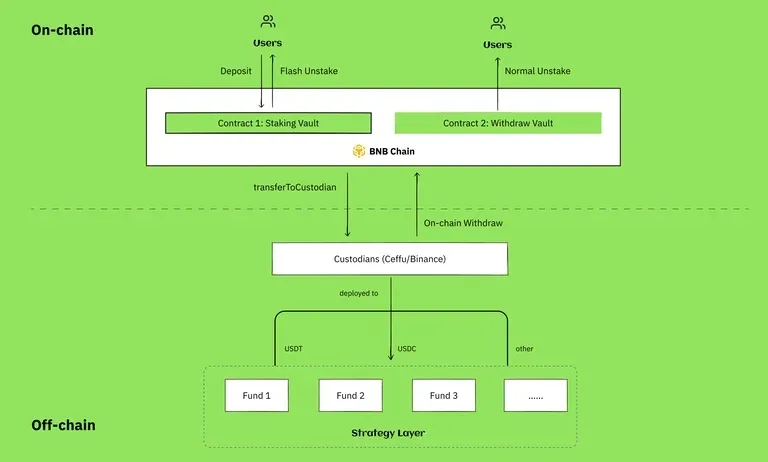
Bitway Earn puts forward the concept of “Decentralized + Traditional Finance” (DeTraFi). By deploying audited staking vaults on EVM‑compatible networks such as the BNB Chain, it offers users institution‑grade yield strategies.
- Transparent strategies: Utilizes market‑neutral (Delta‑Neutral) and other risk‑controlled approaches.
- Flexible exit options: Provides both regular and fast unstaking choices, with earnings reflected in real time on the user’s vault share balance.
Project Vision: Building an “Internet Capital Gateway”
In today’s crypto market, billions of digital assets sit idle, unable to generate stable returns while preserving security. Bitway positions itself as a neutral infrastructure that bridges Traditional Finance (TradFi) and Decentralized Finance (DeFi).
Traditional finance offers mature risk‑management tools but imposes high entry barriers; DeFi is transparent and open but often experiences high volatility and lacks regulatory safeguards. Bitway aims to construct a bridge that routes on‑chain capital toward strategies that combine transparency with robust risk management, thereby unlocking Bitcoin’s potential as “digital gold” within a financially sound framework.
Token Economics: Multiple Roles for BTW
BTW is the native core token of the Bitway ecosystem, with a fixed total supply of 10,000,000,000 tokens. Its functions span the entire platform:
- Network staking and security: As a PoS Layer‑1 chain, validators must stake BTW to participate in consensus, while delegators earn rewards for helping secure the network.
- Ecosystem governance: Holders possess voting rights to decide on protocol upgrades, economic parameter adjustments, and the allocation direction of vault funds.
- Economic incentives: BTW is used to reward product usage, provide liquidity, and stimulate community growth.
In addition, Bitway introduces a BW points system. Users of Bitway Earn earn points based on their asset utilization; these points may later be redeemable for BTW tokens.
BTCT: The Cross‑Chain Bridge Asset
BTCT is the wrapped Bitcoin asset embedded within the Bitway ledger. It operates on the FROST protocol and is collectively maintained by network validators. Unlike conventional cross‑chain bridges, BTCT focuses on gas‑free transfers and multi‑chain liquidity routing, allowing users to move assets across chains without the cumbersome manual bridging steps.
Development Milestones and Future Roadmap
Bitway originated as Side Protocol, founded in 2021. After years of architectural refinement and fundraising, the project has entered a rapid‑growth phase:
- Testing phase: Private tests with partners have been completed. An incentivized public testnet will follow, using stress‑testing to fine‑tune network performance.
- V1 mainnet launch: Core features such as non‑custodial lending and gas‑free payments become officially live.
- V2 evolution: Plans include integrating Zero‑Knowledge (ZK) technology to further enhance privacy protection and horizontal scalability.
The ultimate ambition of Bitway is to transcend the limits of a single blockchain, becoming the central settlement layer for a Bitcoin‑aggregated ecosystem.
Risk Assessment and Challenges
Although the technical design is forward‑looking, Bitway still faces three core challenges:
- Technical and security risk: While the project has passed a security audit by BlockSec, the safety of cross‑chain bridges (e.g., BTCT) heavily depends on the validator set. Smart‑contract vulnerabilities remain an ever‑present threat in the DeFi space.
- Market competition: The Bitcoin Layer‑2 arena is fiercely contested. Bitway must attract sufficient developers and liquidity while operating outside the EVM‑compatible ecosystem, competing against established networks such as Ethereum.
- Regulatory uncertainty: Global regulatory frameworks for non‑custodial lending and DeFi are still evolving. Future compliance requirements could introduce operational variances for the project.
Frequently Asked Questions (FAQ)
Q: Do I need to switch wallets to use Bitway?
A: No. Bitway is fully compatible with existing Bitcoin wallets—including OKX Wallet, Unisat, Xverse, and Ledger—so users can operate directly with their current Bitcoin addresses.
Q: Which address formats does Bitway support?
A: It supports Taproot addresses, native SegWit addresses, and Bitway Native addresses. Because the address structure mirrors Bitcoin’s underlying format, users can send and receive assets seamlessly.
Q: How does Bitway achieve “gas‑free” transactions?
A: The protocol incorporates a fee‑sponsorship mechanism. For BTCT transfers, the network allows a sponsor account to cover transaction fees or provides direct subsidies, enabling smooth trades without the user holding a native gas token.
Q: What is the difference between Bitway Lending and BTCT?
A: Both are integrated into the Bitway Ledger but operate differently. Bitway Lending is a self‑custodial loan platform built on DLC, with collateral staying on the Bitcoin mainnet. BTCT, by contrast, is a wrapped token based on FROST threshold signatures, designed for on‑chain liquidity.
---
Global Market Note: All fiat‑denominated values referenced in the Bitway ecosystem are typically quoted in USD for international users, with SEPA or SWIFT transfers available for fiat on‑ramps and off‑ramps. U.S. residents should access the service through Binance.US rather than the global Binance platform.
*Tax disclaimer:* Cryptocurrency transactions, including gains from lending, staking, or trading BTCT, may be subject to taxation in your jurisdiction. Users are advised to consult local tax regulations and professional advisors.
Related Reading
- Bitway (BTW) Review: Binance Booster Airdrop & Pre‑TGE Sale
- Bitway (BTW) Token Economics, Supply & Investment Outlook
- Bitway (BTW): Bitcoin Layer‑1 Solution & Future Outlook
💡 Register on Binance with referral code B2345 for the maximum trading fee discount. See Binance complete guide.



