
 Bitaigen Research
Enso Network aims to address the increasingly visible problem of blockchain fragmentation. With thousands of roll‑ups, application‑specific chains and Layer 1 networks expanding at breakneck speed, Enso acts as a cross‑chain “interpreter,” unifying disparate smart contracts onto a single execution layer.
In this article we outline Enso Network’s core mission, the cross‑chain technical implementation path, and the functional positioning and incentive design of the ENSO token, helping readers quickly grasp its value and potential use cases within a fragmented blockchain ecosystem. Subsequent sections provide deeper analysis, making the piece well worth a careful read.
Overview of ENSO Token Economics
ENSO is the native utility token, also endowed with governance capabilities. Its genesis supply is 100 million tokens, following a ten‑year inflation model that ultimately caps the total at 127.339703 million tokens.
Token Allocation Details
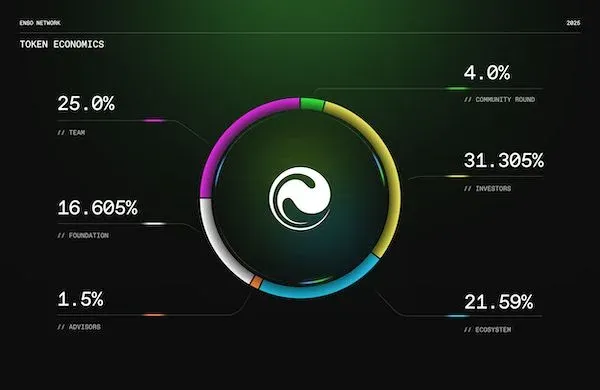
| Beneficiary | Percentage | Description |
|---|---|---|
| Investors | 31.305% | Early strategic supporters, subject to a 1‑year lock‑up plus 2‑year linear release |
| Team | 25.00% | Rewards for core developers and long‑term contributors |
| Ecosystem | 21.59% | Funds for R&D, protocol extensions, community projects (e.g., the **EnsoDrop** airdrop) |
| Foundation | 16.605% | Covers operational expenses, governance support and network sustainability |
| Community round | 4.00% | Public sale via CoinList with oversubscription, expanding the base of decentralized holders |
| Advisors | 1.50% | Key advisors providing strategic guidance to the project |
Primary Functions of the Token
- Network fees: When executing intents or state changes on the Enso Layer 1, users pay fuel fees in ENSO.
- Staking & security: Validators must lock ENSO to participate in consensus; by early 2026 a substantial portion of the circulating supply was already staked.
- Governance rights: Holders can vote in the Enso DAO on protocol upgrades, asset listings and treasury allocations.
- Incentive mechanism: A unique auction system lets participants bid ENSO to obtain cross‑chain execution fees, ensuring value flows back to the network.
What Is Enso Network and the Concept of Chain Abstraction?
Enso Network is built on Tendermint consensus and positions itself as a decentralized Layer 1 whose core component is the “Intent Engine.” Its goal is to enable developers and ordinary users to interact with smart contracts on any chain through a single interface, without needing to understand the underlying implementation details of each individual chain.
In traditional development workflows, a new protocol typically requires manual writing of adapter code. Enso allows developers to submit an intent (the desired outcome); the network then automatically generates the corresponding executable bytecode, eliminating cumbersome integration steps.
Enso’s operation rests on three pillars:
- Shared network state – Constructs a global mapping that records contract data from platforms such as Ethereum, Solana, and the Move family of chains as unified entities.
- Modular components – Decomposes on‑chain actions into basic “operations” (e.g., deposit, borrow) and composable “shortcuts” (pre‑defined workflows, such as borrowing on Aave and immediately swapping on Uniswap).
- Decentralized collaboration – A network of professional nodes competes to provide the optimal execution path, guaranteeing the best efficiency and cost.
How Enso Works
Enso replaces the traditional fixed transaction pipeline with a competitive execution market, shifting focus from *how* a transaction is performed to *what* final result the user wants to achieve. The core workflow proceeds as follows:
1. Submit an Intent
A user or dApp writes the target intent into Enso’s memory pool, for example: “Swap 1,000 USDC on Ethereum for the highest‑yielding asset on Arbitrum.” At this stage the user does not need to specify which bridge or DEX to use—only the end goal is required.
2. Path Competition (Renderers)
Renderers in the network compute over Enso’s smart‑contract mapping to discover the most efficient execution path. Because only one solution can win, renderers compete to offer the highest output with the lowest gas cost.
3. Verification & Simulation (Validators)
Before any code is actually deployed, validators simulate the proposed solution in a forked environment, checking bytecode safety, state‑transition validity, and alignment with the user’s intent. This step prevents failed transactions and blocks malicious code.
4. Execution & Fee Distribution
The winning solution’s executable bytecode is dispatched to the target chain for execution. The fees generated by the transaction are then distributed in ENSO to the nodes that performed the actions, the renderer, and the validators, forming a closed‑loop incentive structure.
Key Components of the Enso Ecosystem
Enso supplies developers with a full toolchain and on‑chain primitives, aiming to collapse complex multi‑step DeFi strategies into a “one‑click” experience.
Operations & Shortcuts
- Operations – Atomic building blocks that abstract a single contract call into a reusable primitive such as deposit, borrow, or mint.
- Shortcuts – Pre‑assembled templates that combine multiple operations into shareable workflow patterns. Developers select the appropriate shortcut and can deploy a complete application within minutes.
DeFi Navigator
Acting as a real‑time dashboard, the DeFi Navigator helps builders quickly browse integrated protocols, filter by TVL, APY and other metrics, and instantly generate the corresponding SDK code snippets, ensuring that on‑chain data remains up‑to‑date.
Enso Settlement
Dubbed the “Web 3 version of Stripe,” Enso Settlement offers cross‑chain payment solutions. Users can pay for services with tokens from any chain; the system automatically handles the necessary swaps and bridges in the background, delivering a Web 2‑like checkout experience.
Market Performance and Ecosystem Partnerships
As of February 2026, Enso has facilitated more than $17 billion in on‑chain transaction volume and completed major integrations with high‑performance networks such as Monad, laying the groundwork for truly seamless chain abstraction. During the same period, Enso’s price on BingX recorded a monthly increase of 70.67%, with a market capitalization of roughly $23.13 million, reflecting market recognition of its technical value.
Note for U.S. users: Trading ENSO on global exchanges should be done via Binance.US or other U.S.-compliant platforms; the global Binance platform is not available to U.S. residents.
Fiat considerations: When converting between crypto and fiat, use USD transfers via SEPA/SWIFT corridors where applicable.
Tax disclaimer: Crypto gains, including any profit from ENSO, may be taxable under the holder’s local jurisdiction. Users should consult a tax professional for guidance.
Conclusion: Should You Keep an Eye on Enso in 2026?
Enso Network abstracts away the fragmentation costs that currently burden DeFi, delivering a notable boost to blockchain usability. Positioned as a critical middleware for a multi‑chain future, it has already demonstrated solid fundamentals through main‑net launch and deep integrations with chains like Monad.
Nevertheless, as an infrastructure‑level project, the token’s market value remains heavily tied to actual developer adoption. Investors should monitor token unlock schedules and the competitive landscape of cross‑chain solutions. If you believe that “intent‑driven” interactions will become the mainstream paradigm for crypto applications, and you trust that users will eventually no longer need to manage bridges directly, Enso merits ongoing attention.
This article ends here. For more in‑depth information about ENSO, you can search for previous Bitaigen (比特根) articles or continue browsing the related links below. Thank you for supporting Bitaigen (比特根)!
💡 Register on Binance with referral code B2345 for the maximum trading fee discount. See Binance complete guide.



