
 Bitaigen Research
From the three dimensions of technical evolution, supply‑demand model, and value‑capture, we conduct an in‑depth analysis of the core forks and key objectives of Ethereum’s 2029 roadmap. The article outlines how the upgrades may affect gas burning, staking demand, and price expectations, helping readers grasp the structural changes that may shape ETH’s future.
Value‑Capture Logic: Potential Shifts in ETH Supply‑Demand Structure
Higher Gas Consumption → Larger Burn Volume
When the mainnet’s throughput rises and Layer‑2 solutions continue to scale, the total amount of gas used is expected to increase. Under the EIP‑1559 mechanism, more gas consumption translates directly into a higher amount of ETH burned, exerting a suppressive effect on the supply side.
Possible Changes in Staking Demand
If the network’s value grows alongside technical upgrades, validator yields are likely to remain relatively stable. In that scenario, ETH may increasingly be regarded as:
- An asset with digital‑goods characteristics
- A financial instrument that generates network revenue
- The base token used for settlement
Price‑Level Projections
Current Price Performance
As of 26 February 2026, ETH’s market price hovered around $2,050, with a short‑term trading range of $1,880–$2,130. This band reflects both the market’s cautious optimism regarding upcoming upgrades and the influence of macro‑economic conditions and overall crypto sentiment.
Note for U.S. users: When purchasing ETH with fiat, platforms such as Binance.US (instead of the global Binance) must be used to remain compliant with U.S. regulations. Fiat transactions are typically processed via USD, SEPA, or SWIFT channels.
Tax reminder: Crypto gains may be taxable in your local jurisdiction; consult a tax professional for guidance.
Short‑Term (0–3 Months)
In the immediate aftermath of the roadmap’s publication, ETH is expected to trade primarily within the $1,900–$2,200 corridor. Although the roadmap lifts sentiment, short‑term price movements will still be dominated by:
- Correlation with Bitcoin’s price trajectory
- Changes in global liquidity conditions
- The fact that upgrade benefits have not yet materialised
Consequently, the near‑term outlook points to continued range‑bound trading rather than a clear‑cut trend reversal.
Medium‑Term (3–12 Months)
If the following substantive progress materialises:
- Rapid finality or throughput improvements are empirically verified
- Layer‑2 usage shows a marked increase
- Gas consumption begins to climb again
the market may reassess ETH’s “execution‑power premium,” pushing the price median above $2,000 and into a higher band.
Long‑Term (1–3 Years)
Assuming the seven planned forks proceed largely on schedule and the ecosystem continues to expand, ETH’s valuation narrative could shift from a “story‑driven asset” to a “high‑performance settlement layer.” At that stage, the primary price drivers would be:
- Network cash flow generated by the burn mechanism
- An increasing proportion of ETH locked in staking
- The scale of real‑world economic activity on the chain
Sustained upside would stem from concrete technical deployment, growing usage, and steady governance—not merely from roadmap publicity.
Competitive Landscape Impact
Current competition among mainstream high‑performance blockchains centres on:
- Transactions‑per‑second (TPS) capacity
- Low transaction fee levels
- The overall architecture of a single chain
If Ethereum can deliver a noticeable on‑chain throughput boost, the competitive narrative may shift from “security vs. performance” to “modular high‑performance vs. monolithic high‑performance.” This would reshape industry storytelling, accentuating Ethereum’s advantage in the modular infrastructure space.
Reinforcing the Modular Architecture: Re‑defining L1 and L2 Roles
With gigagas‑scale L1 and teragas‑scale L2 advancing in tandem, Ethereum’s layered structure is expected to become clearer:
- L1 provides a fast and secure settlement layer
- L2 handles massive execution and interaction workloads
- Zero‑knowledge (ZK) technologies permeate the verification path, boosting overall efficiency
Such a division of labour further cements Ethereum’s position as the foundational modular network.
Five Core Objectives Deconstructed: Technical Logic and Implementation Pathways
Rapid L1 Finality
The current Proof‑of‑Stake (PoS) consensus determines the economic finality confirmation window. Shortening this window matters because it:
- Accelerates the settlement of large‑scale clearings
- Narrows the risk window for cross‑chain bridges
- Increases confidence among institutional users
If finality can be significantly sped up, Ethereum will acquire more attributes of a financial‑infrastructure protocol.
Gigagas L1: 10k TPS Mainnet Vision
Leveraging zkEVM to optimise execution and verification, per‑block gas capacity could rise to support roughly 10,000 TPS. This would break the long‑standing perception that “the mainnet focuses solely on security while scaling is delegated to Layer 2.” Potential consequences include:
- Some applications that previously relied on L2 may migrate back to L1
- Further expansion of ETH burn volume
- Additional compression of L2 fee structures
Teragas L2: Data Availability Sampling
Data Availability Sampling (DAS) enables nodes to verify data availability without downloading the entire dataset, thereby supporting far larger data publication volumes. The resulting changes are:
- Rollups can accommodate a larger user base
- The blob mechanism may undergo further evolution
- L2 scaling enters a quantitative‑leap phase
Post‑Quantum Cryptography
Although quantum computers have not yet posed a direct threat to blockchains, laying post‑quantum security foundations at the protocol layer remains prudent. Upgrading signature algorithms offers long‑term benefits such as:
- Reducing future security debt
- Avoiding forced hard forks driven by quantum‑era vulnerabilities
- Providing security guarantees for the next 10‑20 years
Native L1 Privacy
Implementing native private transfers would give ETH a programmable privacy attribute. Possible impacts include:
- Enhancing the privacy experience of on‑chain financial activities
- Triggering new regulatory discussions
- Adding technical complexity to protocol implementation
Balancing technical feasibility with compliance requirements will be essential.
Upgrade Cadence Analysis: Why “One Fork Every Six Months”?
Adopting a fixed semi‑annual upgrade rhythm reflects a shift in both governance and engineering practices. Compared with earlier, longer‑interval, narrative‑heavy single upgrades, a six‑month cadence brings:
- Institutionalisation of protocol evolution, improving predictability
- Developers can plan product roadmaps with greater confidence
- Risk is broken into multiple smaller phases, reducing the impact of any single change
However, a higher upgrade frequency also introduces challenges:
- Increased maintenance burden on client teams
- Higher adaptation costs for the broader ecosystem
- Greater probability of coordination failures across clients
Thus, the schedule represents a trade‑off between operational efficiency and system complexity.
Event Summary: Signals from the “strawmap” Roadmap Release
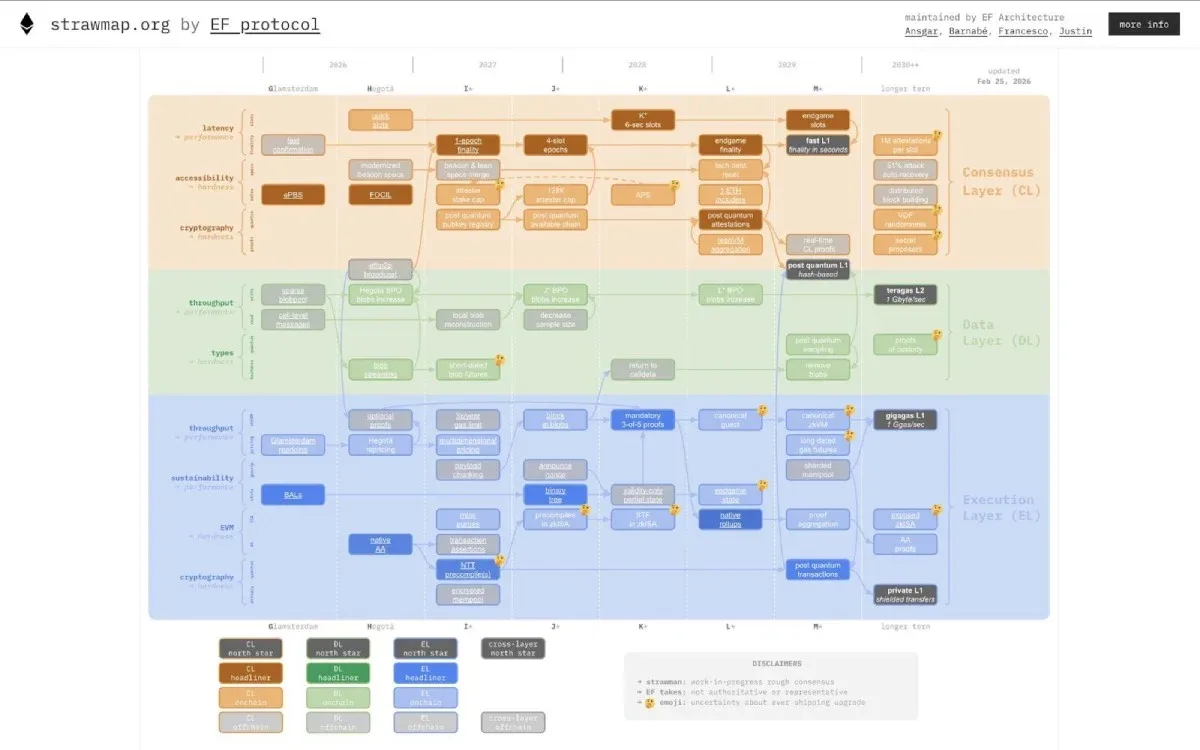
On 26 February 2026, Ethereum Foundation researcher Justin Drake publicly unveiled a medium‑to‑long‑term roadmap dubbed “strawmap.” The plan targets the completion of seven protocol forks by the end of 2029, advancing at a bi‑annual pace. Unlike previous one‑off, large‑scale upgrades (e.g., The Merge, Dencun), this roadmap resembles a continuous engineering‑iteration framework designed to give Ethereum a systematic evolution cadence.
The five core objectives are:
- Rapid L1 finality
- Achieving a 10k TPS gigagas L1 through zkEVM
- Supporting teragas‑level L2 via Data Availability Sampling
- Introducing post‑quantum cryptographic support
- Realising native L1 privacy (shielded ETH transfers)
The document serves both as a technical checklist and a vision statement for the future architecture.
Risks and Execution Variables
The roadmap’s success hinges on implementation capability. Key uncertainties include:
- The high technical complexity of each upgrade component
- Coordination difficulty among multiple client implementations
- Potential conflicts between privacy features and regulatory policies
- Macro‑economic conditions that may shift over the multi‑year horizon
It is important to emphasise that strawmap is a directional guide, not a locked‑in list of EIPs.
Conclusion: An Engineering Blueprint, Not a Sentiment Catalyst
Ethereum’s 2029‑focused roadmap reads more like a structural engineering declaration than a short‑term price‑pump playbook. It conveys three core messages:
- The protocol is moving toward a systematic, periodic upgrade regime
- The modular architecture is being further reinforced
- Long‑term security and privacy have been elevated to central agenda items
The roadmap outlines a long‑term technical trajectory rather than a quick‑fix for price movements. The most critical factor to watch is whether the first wave of upgrades can be delivered on schedule within the next two years. Execution strength will determine whether this blueprint becomes a turning point for the industry or remains an aspirational plan.
The above provides a deep dive into how the exposure of Ethereum’s 2029 roadmap, its seven planned forks, and the five major objectives may reshape ETH’s technical boundaries and value structure. For further details on the roadmap, you can search for past Bitaigen (比特根) articles or continue browsing the related content below. Thank you for following and supporting Bitaigen (比特根)!
💡 Register on Binance with referral code B2345 for the maximum trading fee discount. See Binance complete guide.
⚠️ Risk Disclaimer: Crypto prices are highly volatile. This is not investment advice.



