
 Bitaigen Research
 Ethereum, the second‑most important core asset after Bitcoin, stands out in the crypto market thanks to its technological innovation and broad ecosystem. After completing the Merge upgrade and transitioning to a Proof‑of‑Stake (PoS) mechanism, Ethereum has made notable progress in scaling efficiency and energy consumption control, and its token price once climbed to a historic high of 4,954.59 USD in August. Although a correction followed, investors continue to wonder whether Ethereum can keep rising and if there is still upside potential. Based on the available data, Ethereum still possesses substantial upward potential, and the following sections explain this in detail.
We examine Ethereum’s potential drivers from three major dimensions—technology roadmap, ecosystem deployment, and market sentiment—after the Merge, and assess its growth space over the next several years. If you want to know whether Ethereum still has the possibility of further gains and what its price trajectory might look like in 2026, this article provides a systematic basis for your judgment. Please continue reading.
Will Ethereum continue to rise?
From the current market view, the likelihood of further price appreciation for Ethereum is relatively high. The price now hovers around 1,919 USD, well below its all‑time high of 4,954.59 USD but far above the launch price of 0.308 USD, representing a cumulative return of roughly 6,197 ×. Its market cap stands at about 230.424 billion USD, with a circulating supply of 120,693,507 ETH, and it is listed on 86 exchanges (U.S. users should use Binance.US rather than the global Binance platform). Overall, Ethereum still enjoys a solid development outlook.
Ethereum is a decentralized blockchain that has become popular because it can host and deploy DeFi protocols, dApps, and NFTs. Its native token, ETH, funds transaction fees that keep the ecosystem running, and anyone can create an account and either use or develop applications.
The chain employs smart contracts to automate transactions and utilizes Proof‑of‑Stake to further improve efficiency. Thanks to these innovations, transactions on Ethereum are generally faster and cheaper than on many other networks. Moreover, massive capital inflows and continuous platform improvements have bolstered network security—factors that all point to continued growth potential for Ethereum.
Ethereum’s growth trajectory reflects strong technical capability, a deflationary token‑economic model, and increasing institutional adoption. As the ecosystem evolves, Ethereum is more than just a cryptocurrency; it is a foundational platform for decentralized finance and the broader global financial system. While challenges remain, its potential to reshape finance should not be overlooked.
Does Ethereum still have upside?
With ongoing development aimed at enhancing scalability and security, combined with a bullish market environment, Ethereum is expected to gain further momentum. Forecasts suggest that by the end of 2025 the price could reach 4,183.12 USD. By 2030, even as competing chains such as Solana and Avalanche emerge and intensify competition, Ethereum is still projected to maintain an upward trend, with an average price around 6,752.14 USD.
Broad institutional adoption is one of the key drivers of Ethereum’s growth. Often dubbed the “Wall Street token,” ETH has become the preferred asset for staking, validator operations, and participation in decentralized finance (DeFi). Its robust infrastructure supports smart contracts, dApps, and the tokenization of real‑world assets (RWA), making it attractive to institutional players.
The rise of Layer‑2 solutions like Arbitrum, Optimism, and zkSync plays a crucial role in relieving congestion on the Ethereum mainnet, lowering gas fees, and speeding up transaction throughput, thereby making the network more appealing to a wider user base.
An increasing number of companies are adding Ethereum to their treasury reserves, citing its utility, security, and long‑term growth prospects. For example, firms such as SharpLink Gaming not only hold ETH but also stake it to earn rewards, demonstrating Ethereum’s dual nature as both a store of value and a yield‑generating asset.
Ethereum Price Forecast (February 2026)
The projected low, average, and high prices for Ethereum in February 2026 are 2,299.58 USD, 2,541.64 USD, and 2,614.25 USD, respectively.
| Year | Projected Low (USD) | Average Price (USD) | Projected High (USD) |
|------|---------------------|---------------------|----------------------|
| 2026‑02 | 2,299.58 | 2,541.64 | 2,614.25 |
Ethereum Price Forecast (2026)
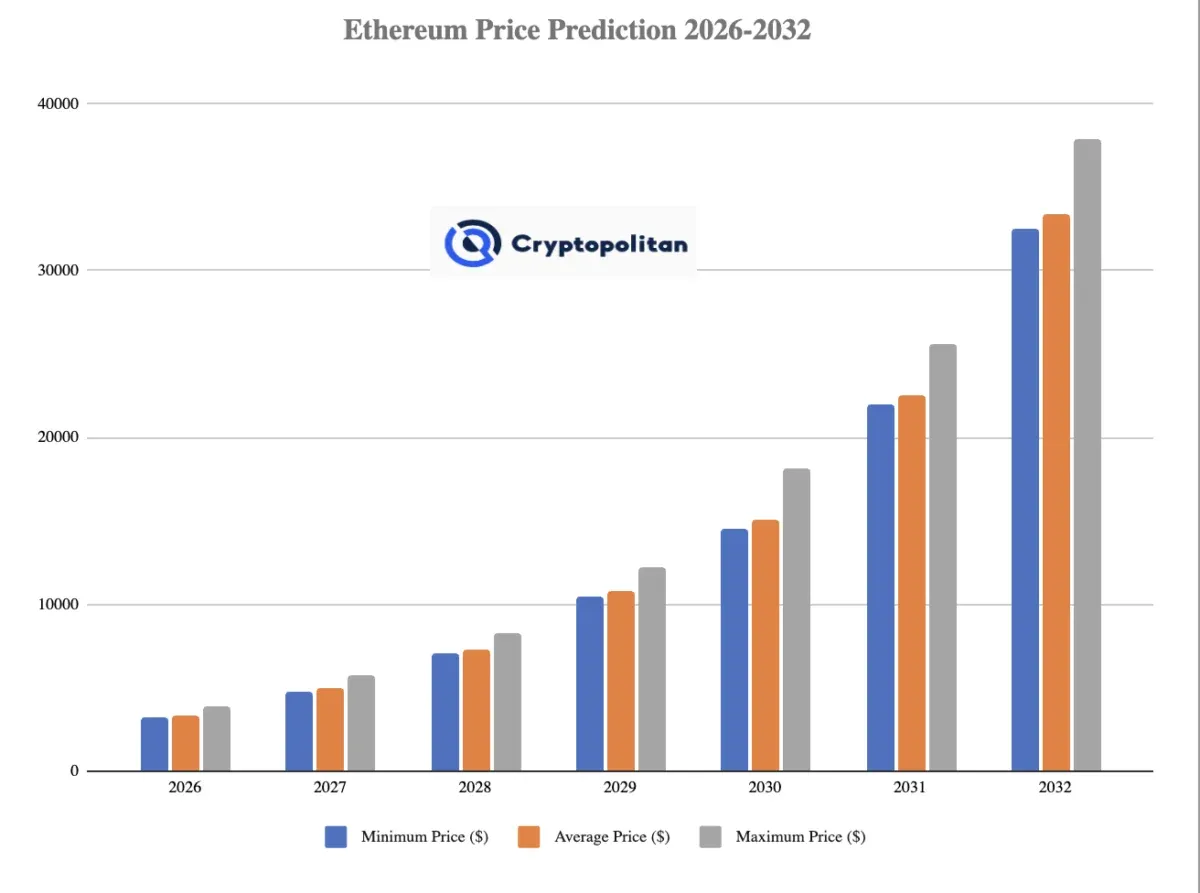
For the full year, the estimated low is around 3,187.88 USD, the high could reach 3,881.72 USD, and the average is about 3,284.71 USD.
| Year | Projected Low (USD) | Average Price (USD) | Projected High (USD) |
|------|---------------------|---------------------|----------------------|
| 2026 | 3,187.88 | 3,284.71 | 3,881.72 |
Ethereum Price Forecast 2027‑2032
| Year | Projected Low (USD) | Average Price (USD) | Projected High (USD) |
|------|---------------------|---------------------|----------------------|
| 2027 | 4,797.09 | 4,961.33 | 5,760.02 |
| 2028 | 7,079.83 | 7,278.29 | 8,235.00 |
| 2029 | 10,419 | 10,783 | 12,210 |
| 2030 | 14,532 | 15,071 | 18,135 |
| 2031 | 21,942 | 22,545 | 25,611 |
| 2032 | 32,496 | 33,398 | 37,909 |
2027 Forecast
The low is projected at 4,797.09 USD, the high could reach 5,760.02 USD, and the average is expected to be 4,961.33 USD.
2028 Forecast
Price range: 7,079.83 USD – 8,235.00 USD, with an average of 7,278.29 USD. Growth is expected to be driven by mass adoption of Layer‑2 solutions, institutional‑scale DeFi expansion, and the mainstreaming of blockchain in finance and governance. Deflationary supply dynamics and global settlement‑layer recognition will further boost demand.
2029 Forecast
The low is estimated at 10,419 USD, the average at 10,783 USD, and the high at 12,210 USD. By then, ETH should see broader usage across finance, enterprise solutions, and asset tokenization. Advanced scaling approaches and the deflationary mechanism are likely to trigger a surge in demand.
2030 Forecast
Low around 14,532 USD, average 15,071 USD, high 18,135 USD. Ethereum’s role as a pillar of global finance and digital infrastructure is expected to solidify further, with real‑world asset tokenization, enterprise‑grade applications, and governmental blockchain initiatives accelerating.
2031 Forecast
Low could rise to 21,942 USD, average 22,545 USD, high 25,611 USD, indicating continued attractiveness to investors.
2032 Forecast
Low projected at 32,496 USD, average 33,398 USD, high 37,909 USD. Deep integration with global finance and corporate infrastructure, extensive tokenization, institutional dominance, and the deflationary token‑economy model are expected to push ETH into a core digital asset status, supporting long‑term demand and scarcity.
What factors influence Ethereum’s price?
Ethereum’s price volatility is driven by multiple factors, primarily including supply‑and‑demand dynamics, network usage, technological innovation and upgrades, and competition from other blockchains. As with other cryptocurrencies, the overall market environment also impacts its price. Specific drivers are outlined below:
- Supply‑and‑Demand Balance
The price at which buyers and sellers are willing to transact determines ETH’s value. Limited supply combined with strong demand pushes the price upward; the opposite scenario leads to declines.
- Network Usage
A large number of dApps, DeFi protocols, and NFT projects on Ethereum increase the demand for ETH to pay gas fees, thereby supporting higher prices.
- Innovation and Updates
Technological advances, the rollout of new features, and favorable regulatory developments attract more users and can lift ETH’s price; adverse news or setbacks may cause pull‑backs.
- Competition from Other Blockchains
Ethereum’s value is affected by the performance of competing ecosystems. If Ethereum consistently outperforms rivals over the long term, its price is likely to benefit.
Ethereum remains a cornerstone of blockchain technology, maintaining a central role in dApp and DeFi sectors. With the scalability, security, and energy‑efficiency improvements brought by Ethereum 2.0, the platform retains a dominant advantage despite the continued push from emerging chains such as Solana and Avalanche. Several analytical firms anticipate continued price appreciation, making Ethereum a focal point for developers and market participants alike.
The above constitutes the full content of “Will Ethereum continue to rise? Is there still upside? Ethereum 2026 price forecast.” For more information, please follow Bitaigen (比特根) and explore other related articles!
💡 Register on Binance with referral code B2345 for the maximum trading fee discount. See Binance complete guide.
⚠️ Risk Disclaimer: Crypto prices are highly volatile. This is not investment advice.



