
 Bitaigen Research
 We have compiled the latest crypto tax regulations from the European Union, Israel, Hong Kong and other regions, revealing how policy directions affect investors’ compliance costs and asset allocation, and we analyze why Bitcoin’s price remains constrained by macro‑economic factors. Read on to keep up with regulatory developments and improve your risk management.
New Global Trends in Crypto Tax Policies

In February, the Dutch House of Representatives introduced a tax draft aimed at savings and liquidity investments—including crypto assets—that would levy a 36 % capital‑gains tax on unrealised profits. The proposal received the backing of 93 out of 150 members but also sparked heavy criticism, with concerns that it could trigger capital flight. Following the formation of a new cabinet, the Dutch government said it would reassess the measure and intends to discuss it with the Senate and other parliamentary bodies. As a cabinet spokesperson put it: “The actual‑return bill is facing widespread doubts; we must revise it.”
In Israel, reforms to the crypto tax regime are also being contemplated. A lobbying campaign launched by the Israel Crypto‑Blockchain and Web 3.0 Companies Forum highlighted that the public generally wants looser regulation on stablecoins and tokenised assets, as well as a simplification of compliance procedures. Forum leader Nir Hirshmann‑Rub disclosed that more than 25 % of Israeli residents have traded crypto at least once in the past five years, and over 20 % still hold digital assets today.
Hong Kong’s Financial Secretary Paul Chan announced that the “Tax Ordinance” will incorporate the OECD‑developed Crypto‑Asset Reporting Framework (CARF) to align with global standards for crypto‑tax information exchange. The framework obliges crypto service providers to report users’ transaction activity to tax authorities, aiming to curb cross‑border tax evasion.
Vietnam has put forward a tax draft for cryptocurrency transactions: while regular value‑added tax (VAT) will be exempted for crypto transfers, asset movements conducted through licensed service providers will be subject to a 0.1 % personal‑income‑tax based on the transaction amount.
India’s situation remains relatively static. Although a flat 30 % tax on crypto gains is in place and losses cannot be offset, calls for tax‑system reform have yet to receive a response. The 2026 budget did not contain any adjustments to crypto taxation, leaving the outlook for reforms uncertain.
*Please note that crypto gains may be taxable in your jurisdiction; consult a local tax professional for advice.*
---
Crypto ATM Numbers Rise Back to Nearly 40 000 Units
The latest data from Coin ATM Radar shows that after the market correction in 2022, the global count of cryptocurrency self‑service terminals added 290 new machines in February 2023, bringing the total close to 40 000—essentially back to the 2021 peak. Over the past few years the number of units has fluctuated, with the 2022 market downturn causing a sharp contraction.
Regulators remain highly vigilant about the money‑laundering and fraud risks associated with these machines, and several countries have issued warnings. In response to an increasingly strict regulatory environment, operators are taking proactive steps. For example, the United States’ largest Bitcoin ATM operator, Bitcoin Depot, rolled out user‑identity‑verification features on its U.S. machines throughout February, meeting regulatory requirements and lowering compliance risk. U.S. users should use Binance US rather than the global Binance platform.
---
Bitcoin Price Suppressed by Multiple Factors, Still Below $70,000
Bitcoin’s recent price action has been consistently restrained, with February prices lingering below the $70,000 mark and failing to achieve the anticipated breakout.
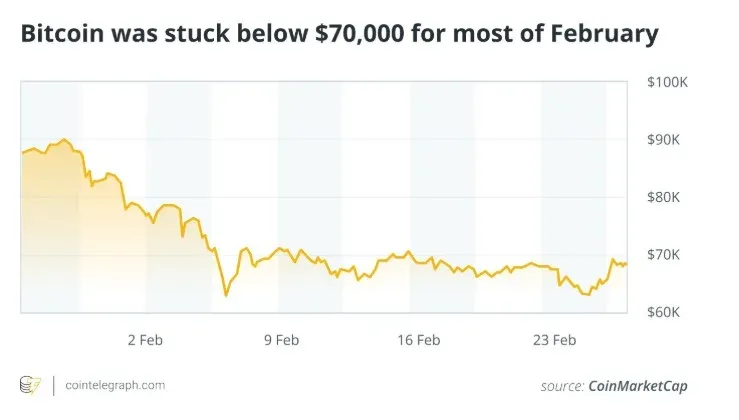
Analysts point to macro‑level drivers as the primary source of pressure. Progress on the U.S. “CLARITY Act,” which seeks to create a comprehensive regulatory framework for crypto, has been slow. Lawmakers have yet to reach consensus on ethical clauses and potential rescue measures, and lobbying groups from both the crypto sector and traditional finance have clashed over stablecoin interest‑rate policies. Federal Reserve Governor Chris Waller expressed disappointment: “The continued delay of the CLARITY Act is disheartening for the market.”
Tariff policy has also weighed on Bitcoin. The U.S. Supreme Court once ruled that former President Trump’s tariffs, imposed under the 1977 International Emergency Economic Powers Act (IEEPA), were invalid. He subsequently relied on the 1974 Trade Act to raise global tariffs by 10 %.
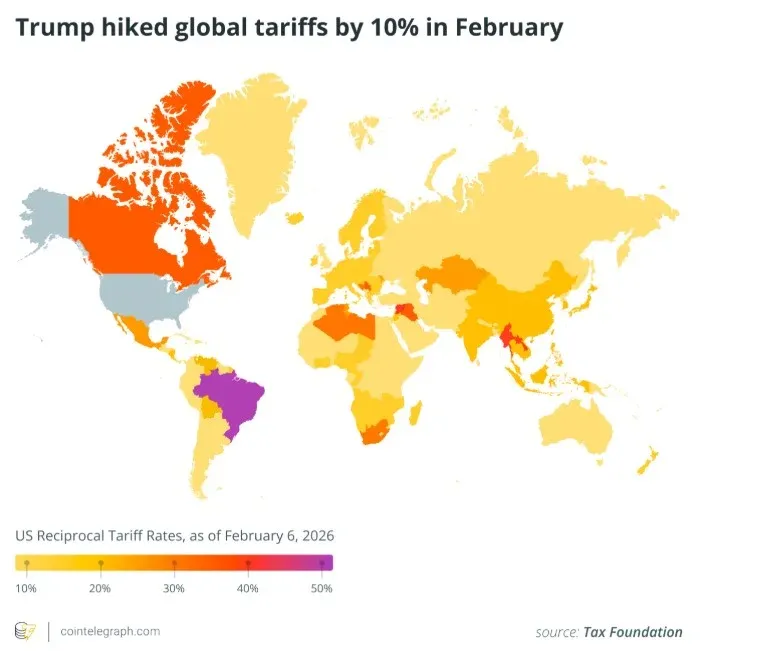
Observers in the crypto space consider tariffs to have been the biggest negative catalyst for Bitcoin over the past year. Swan’s CEO Cory Klippsten noted: “Tariffs have significantly dragged down risk assets overall, especially Bitcoin, whose uncertainty is particularly pronounced.”
---
Japan’s Declining Inflation and Political Landscape: Potential Market Impact
Japan’s February inflation rate fell below 2 %, hitting the lowest level in nearly three years and sitting beneath the United States’ inflation rate.
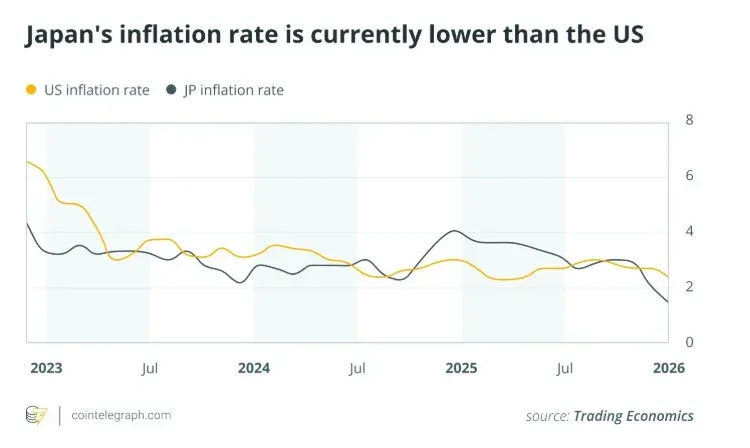
Against this backdrop, Prime Minister Kishida announced a snap election aimed at helping the Liberal Democratic Party (LDP) regain a majority in the Diet. The election results gave the LDP 316 seats in the House of Representatives (the lower house), securing a two‑stage majority. Japan’s stock market responded positively, with the Nikkei 225 climbing roughly 10 % in the month and showing a clear rally after the election concluded on February 9.
Some analysts believe Japan’s fiscal stance could exert short‑term pressure on Bitcoin. XWIN Research Japan highlighted that Bitcoin often moves in tandem with U.S. equities; as Japanese bonds become more attractive, capital that might have flowed into U.S. ETFs could slow, indirectly affecting Bitcoin demand.
At the same time, Warren Buffett disclosed that Berkshire Hathaway will continue increasing its holdings in Japan’s major sogo‑shosha (general trading companies), including Itochu, Marubeni, Mitsubishi, Mitsui and Sumitomo.
---
Conclusion
In summary, the combination of February’s worldwide tax‑policy adjustments, tighter regulatory scrutiny, and macro‑economic forces has kept Bitcoin from breaking the $70,000 threshold. Meanwhile, the rebound in crypto‑ATM numbers demonstrates that the industry retains a degree of vitality despite compliance pressures. Going forward, the direction of tax reforms, changes in tariff regimes, and inflation trends in major economies will remain key variables shaping the digital‑asset market.
*(End of article)*
💡 Register on Binance with referral code B2345 for the maximum trading fee discount. See Binance complete guide.



