
 Bitaigen Research
 Hyperliquid prices commodities such as crude oil and gold in real‑time through on‑chain perpetual contracts, while Polymarket turns war‑related events into probability markets that price the likelihood of those events occurring.
From the perspectives of on‑chain perpetual contracts and probability markets, we dissect the pricing mechanisms employed by Hyperliquid and Polymarket during geopolitical crises. This analysis helps readers interpret price signals for both assets and events, and suggests avenues for further thought.
1. First Things First: What Assets Do the Two Platforms Trade?
Before comparing the advantages of Hyperliquid and Polymarket, it is essential to clarify the underlying instruments each platform offers.
1.1 Polymarket: Converting Information Asymmetry into Probability
Polymarket trades the events themselves. Every market slices a vague geopolitical development into a contract that can be priced, and the price equals the implied probability—a quote of 0.65 means the market believes there is a 65 % chance the event will happen. During the recent US‑Iran air‑strike episode, the platform launched several crisis‑related markets, such as “US strikes Iran by …?” and “Khamenei out as Supreme Leader of Iran by …?”.
1.2 Hyperliquid: 24/7 Asset Pricing
Hyperliquid is an on‑chain perpetual contract exchange that runs continuously, offers leverage, and settles contracts every second. The assets most directly affected by the current conflict are:
- Crude Oil – The Strait of Hormuz is a chokepoint for global oil shipments; any expectation of a closure is reflected instantly in oil prices.
- Gold – A traditional safe‑haven; heightened geopolitical tension typically draws capital into gold.
In a nutshell: Polymarket lets you trade the probability of an event, whereas Hyperliquid lets you trade the price movement of assets after the event occurs.
2. Live‑Action Recap: Timeline From Evacuation Orders to the Air‑Strike
2.1 Polymarket Timeline – Probability Swings Triggered by the Evacuation Order
- Before the clash
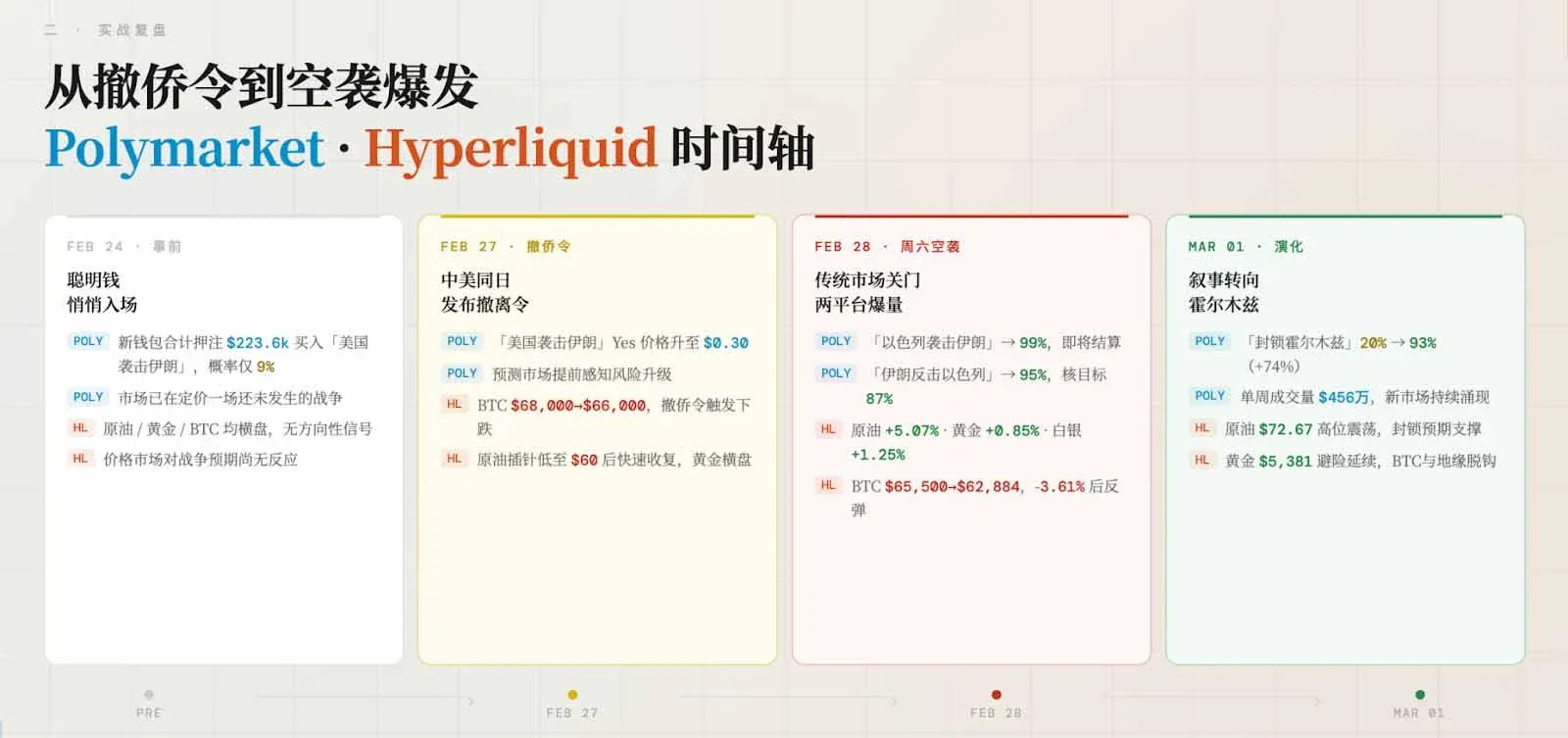
- A handful of new wallets collectively wagered $59.1 k on “US will strike Iran before 2/28”. Later, two fresh accounts placed a combined $164.5 k on “US will strike Iran before 2/28, 3/15, or 3/31”, when the market probability was only 9 %.
- That evening, China’s Ministry of Foreign Affairs warned Chinese citizens in Iran to evacuate, and the U.S. State Department authorized non‑essential U.S. officials and their families to leave Israel. U.S. Ambassador to Israel Hecabi stressed “Leave today”. Consequently, the “Yes” probability for “US will strike Iran before 2/28” jumped to 30 %.
- February 28 (Saturday) – Air‑strike occurs
- Israel launched missile strikes on multiple targets in central Tehran.
- The probability for “Israel will strike Iran before 2/28” surged to 99 %, poised to settle as a “Yes”.
- At the same time, in the market “Who will strike Iran first, the US or Israel?”, the “US strikes first” probability collapsed from 58.5 % to 3.5 %, then modestly recovered to 33 % after media reports.
- After the US‑Israel joint strike was confirmed
- The probability for “Will Iran close the Strait of Hormuz?” quickly rose to 93 %.
2.2 Hyperliquid Timeline – Continuous Asset Pricing
- After the evacuation order
- Crude Oil: Traded sideways in the $66‑68 range, briefly dipping to $60 before rebounding sharply.
- Gold: Hovered around $5,160, with safe‑haven flows not yet massive.
- BTC: Fell from roughly $68,000 to $66,000.
- When the air‑strike unfolded
- Crude Oil: Jumped from $68 to $71.76, marking the first on‑chain reflection of Hormuz‑closure expectations.
- Gold: Leapt from $5,160 to $5,480, indicating safe‑haven inflows, though the move lagged behind oil.
- BTC: Plummeted to $62,884 after the strike confirmation, a decline of about ‑3.61 %.
A side‑by‑side look shows that Polymarket’s probability shifts generally precede Hyperliquid’s price reactions, illustrating the early‑warning capability of prediction markets.
3. Dimension Clash: Comparing Asset Scope and Temporal Scope
3.1 Data Comparison
| Platform | Key Metric | Volume / Open Interest | Remarks |
|---|---|---|---|
| **Polymarket** | Cumulative volume on “US strikes Iran by …?” | **$529 M** | Largest single market since its launch in Dec 2023 |
| Volume on “Khamenei out as Supreme Leader” | **$57 M** | Biggest single profit recorded: **$577 k** | |
| Six new wallets betting “US will hit Iran before 2/28”, total profit ≈ **$1.2 M** | — | Largest wallet grew from **$61 k** to **$493 k** | |
| **Hyperliquid** | Silver perpetual 24 h turnover | **$386 M** | Most active commodity that day |
| Gold perpetual 24 h turnover | **$154.9 M** | Open interest **$201.6 M**, net‑long bias | |
| BTC 24 h turnover | **$2.153 B** | Open interest **$1.438 B**, deepest liquidity | |
| Crude oil 24 h turnover | **$7.45 M** | Open interest **$6.91 M**, price rise **+5.07 %** (peak) |
Key observations
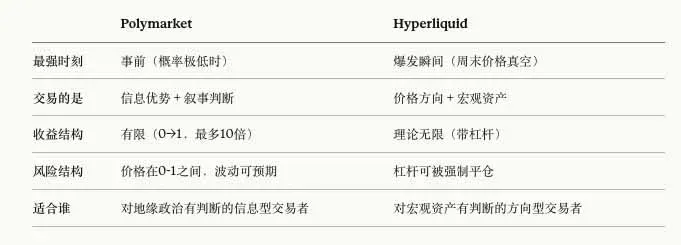
- Polymarket creates market categories that have no direct analogue in traditional finance, effectively inventing a new asset class.
- Hyperliquid transports conventional commodity futures onto the blockchain, delivering 7 × 24 trading and allowing assets that normally close on weekends to be priced continuously.
3.2 Synergistic Effect: A “1 + 1 > 2” Strategy
- Probability as a leading indicator
When the “US strikes Iran” probability on Polymarket climbs from 9 % to 30 %, it signals rising geopolitical risk. Traders could simultaneously go long on crude oil and gold on Hyperliquid to capture the anticipated price uptick.
- Risk hedging
If you hold a long position on oil on Hyperliquid but remain uncertain about the conflict’s breakout, you can buy the corresponding No outcome on Polymarket. Should the conflict fail to materialize and oil prices retreat, the No position provides a partial offset; if the conflict erupts, the oil long profits while the No position expires worthless, leaving a net gain.
- Insider‑style warning signals
Large, newly‑created wallets that concentrate bets on “US hits Iran” are often interpreted as insider activity. A sudden surge of capital backing the “Yes” side should raise caution, as the information may already be reflected on‑chain.
4. Closing Thoughts: The Societal Value of On‑Chain Finance
When the Middle‑East conflict forces traditional markets to pause over the weekend, the on‑chain ecosystem keeps 24/7 operation. Polymarket supplies a market‑based estimate of an event’s true probability, while Hyperliquid offers a venue to trade the resulting asset volatility. Although betting on wars can raise ethical concerns, the probability signals themselves carry valuable social‑early‑warning information. When Polymarket’s odds spike sharply and oil prices swing violently, ordinary individuals receive earlier cues for evacuation or risk mitigation.
Thus, on‑chain finance is more than a speculative tool; it constitutes a system that helps the broader public obtain real‑time, mission‑critical information.
This article compares the crisis‑pricing mechanisms of Hyperliquid vs. Polymarket. For more related analysis, search for previous pieces by Bitaigen or continue reading the recommended articles below. We appreciate your continued interest and support for Bitaigen!
*Please note that crypto‑related gains may be taxable in your jurisdiction; consult a tax professional for guidance.*
*U.S. residents should use Binance.US rather than the global Binance platform for fiat on‑ramps via SEPA or SWIFT.*
Related Reading
- Hyperliquid Surge & Aster: On‑Chain Perpetual Dex Boom
- Polymarket 2026 Guide: Deposits, Taiwan Legal Risks & Safe Use
- Hyperliquid: Decentralized Exchange with On‑Chain Order Book & Perps
💡 Register on Binance with referral code B2345 for the maximum trading fee discount. See Binance complete guide.



