
 Bitaigen Research
 As of 2025, Hyperliquid remains the leading decentralized exchange (DEX) thanks to higher stability and sustained institutional‑grade liquidity, but Aster is rapidly catching up with aggressive leverage, innovative features, and Binance backing, and could potentially overtake it later.
The perpetual‑contract DEX market grew explosively in 2025, with September’s trading volume exceeding $1.14 trillion, up 49 % from the previous month. This surge put Hyperliquid and Aster in the spotlight: the former has already accumulated more than $2 trillion in total volume, maintaining its market‑leader status; the latter, buoyed by Binance co‑founder CZ’s support, surged to capture nearly 40 % of the market share within just a few months, posing a strong challenge to Hyperliquid’s dominance.
This article compares the two platforms across six dimensions—trading volume, fees, token economics, leverage, speed, and key features—and, based on data, draws a conclusion about which is more likely to lead the market in 2025.
We dissect Aster and Hyperliquid’s competitive landscape from six angles: institutional liquidity, leverage mechanisms, fee structures, and more. The analysis is data‑driven, offering unique insights that merit a careful read.
Aster vs. Hyperliquid: 2025 Trading Volume and Market Share
Trading volume is the core metric for assessing the competitiveness of perpetual DEXs. At the start of the year, Hyperliquid led with roughly 71 % market share and $330 billion in monthly volume. By September, however, Aster’s meteoric rise had cut Hyperliquid’s share down to about 38 %.
- Aster: As of early October, monthly volume reached $76 billion, with a peak daily volume of $41.78 billion—approximately four times Hyperliquid’s average daily volume. On 29 September, Aster recorded $13 billion in 24‑hour trading, surpassing Hyperliquid’s $9 billion. In the same period, Aster’s daily fees on open‑interest topped $13 million, indicating active user participation and fresh liquidity inflows.
- Controversy: On 5 October, DeFiLlama delisted Aster, citing a one‑to‑one mirroring of XRP trades with Binance that raised concerns about potential wash‑trading. The episode triggered a price drop of roughly 10 %, a noticeable reduction in institutional positions, and sparked questions about the authenticity of some of Aster’s reported data.
Hyperliquid sustains its edge through a robust infrastructure, while Aster’s growth is driven by aggressive incentives and prospective token rewards. The next sections examine their fee structures, reward models, and tokenomics in detail.
Aster vs. Hyperliquid: Fees, Rewards, and Token Economics
- Fee revenue
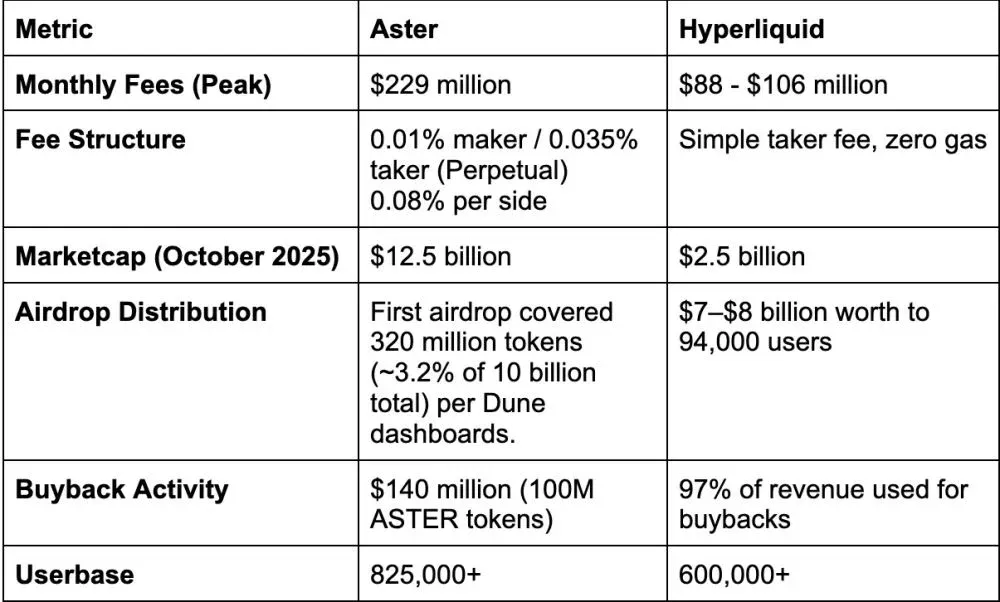
- Aster: Monthly fees surged to $229 million, and on 15 October 2025 a single 24‑hour period recorded $14.3 million in fees, ranking it second among fee‑collecting protocols in the crypto space.
- Hyperliquid: Monthly revenue ranges between $88 million and $106 million, with 97 % of that income earmarked for HYPE token buy‑backs rather than team reserves. Its zero‑gas‑fee model and streamlined taker‑fee schedule attract cost‑conscious high‑frequency traders.
- Token economics
- HYPE (Hyperliquid): Market capitalization sits around $12 billion (as of October 2025). The token was distributed entirely via community airdrops, with no venture‑capital involvement. Ongoing buy‑backs create a deflationary pressure that offers long‑term value support for holders.
- ASTER (Aster): By the same month, the project had completed $140 million in token buy‑backs and enjoys substantial fee income. However, a large tranche of tokens worth several hundred million dollars is slated for future release, which could exert downward price pressure in the short term.
Note: In many jurisdictions, gains from crypto trading are taxable. Users should consult local tax regulations and may need to report profits using SEPA/SWIFT‑compatible fiat conversions (e.g., to USD) where applicable.
Aster vs. Hyperliquid: Leverage, Speed, and Key Features
- Leverage
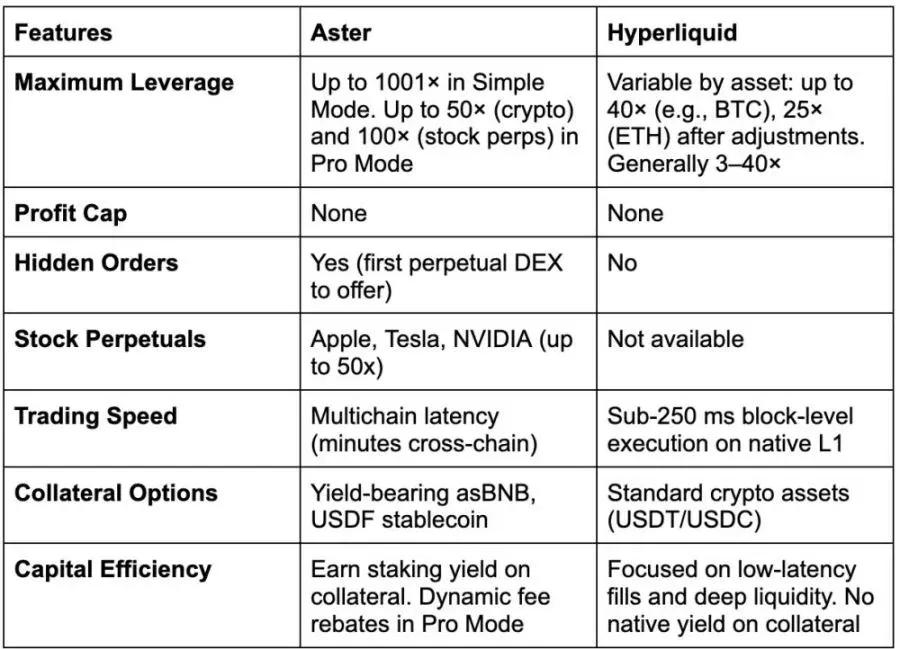
- Aster offers a maximum of 1001× leverage, the highest available in the market and aimed at high‑risk speculators. Profit caps depend on the asset class, ranging from 300 %‑500 %.
- Hyperliquid focuses on professional‑grade execution, providing standard leverage levels together with stop‑loss, take‑profit, and advanced conditional order capabilities.
- Speed and Execution
- Hyperliquid achieves transaction latency under 250 ms, supporting same‑block execution—ideal for short‑term strategies and institutional users.
- Aster employs a multi‑chain architecture that introduces a slight latency premium, but compensates with capital efficiency. Its collateral tokens, such as asBNB (yielding 5‑7 % APY) or the USDF stablecoin, generate passive income while positions remain open.
Feature Comparison: Hyperliquid vs. Aster
Why This Competition Matters More Than It Might Appear
Perpetual derivatives have moved from the fringe of DeFi to the core of crypto trading. Tens of billions of dollars flow through these platforms each day; whoever controls this segment essentially shapes the future trajectory of crypto finance.
- Volume: Platforms process several hundred billion dollars in monthly turnover.
- User base: Millions of traders seek leveraged exposure.
- Industry impact: The victor will dictate the mainstream trading model for the next decade.
Round 1: Total Value Locked (TVL)
- Hyperliquid: TVL stands at roughly $670 million, with a peak that briefly approached $5 billion, reflecting strong institutional‑grade liquidity and capital stickiness.
- Aster: Locked $655 million within days of launch, and its market cap surged past $2 billion shortly thereafter, driven largely by migration bonuses and airdrop incentives. Long‑term retention remains to be seen.
Conclusion: Hyperliquid enjoys superior sustainability; Aster’s explosive early growth draws attention but is less proven over time.
Round 2: Trading Volume – Capital Flows
- Hyperliquid: Over a 30‑day window, cumulative volume reached $329 billion, averaging about $8 billion per day and representing 57‑73 % of the perpetual DEX market. Platform fees total roughly $86 million, with 97 % funneled back into HYPE buy‑backs, creating a positive feedback loop.
- Aster: Its first 24 hours logged $4.34 billion in volume; the first month summed to $33 billion, demonstrating strong initial market interest. However, the lack of a steady liquidity foundation poses an ongoing challenge.
Conclusion: Hyperliquid remains ahead, while Aster shows the potential to join the “big league” if it can sustain its inflows.
Round 3: Token Valuation and Economic Model
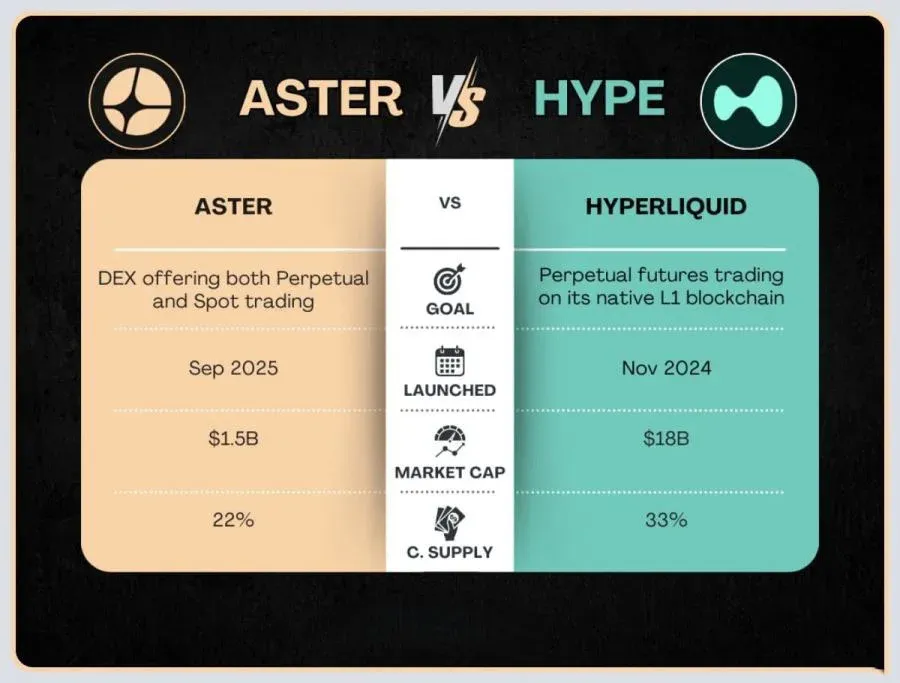
- $HYPE: Market cap around $18 billion; the buy‑back mechanism induces deflation, enhancing holder value.
- $ASTER: Valued at roughly $1.5 billion, with a potential market cap estimated at 10 × the current level. Heavy reliance on airdrops could generate inflationary pressure; if trading demand does not keep pace, long‑term holders may see diluted returns.
Conclusion: Hyperliquid’s token model appears more robust.
Round 4: User Base and Real‑World Adoption
- Hyperliquid: Hosts several million genuinely active users, whose loyalty stems from speed, reliability, and pragmatic perpetual‑contract offerings.
- Aster: Saw a short‑term surge of about 2 million users; within six hours of CZ’s public endorsement, an additional 400 k accounts were created, showcasing Binance’s ecosystem pull. Yet a sizable fraction of these users are airdrop hunters, and retention will be the key determinant of lasting value.
Conclusion: Hyperliquid’s user community is of higher quality and stability.
Round 5: Technological Innovation
- Hyperliquid: Built on a custom Layer‑1 chain optimized for ultra‑low‑latency trading, featuring up to 1000× leverage and HIP‑3 position tokenization.
- Aster: Supports multi‑chain trading on BNB Chain, Ethereum, and Solana, offering dark pools, MEV protection, privacy tools, and plans to launch crypto‑collateralized stock perpetual contracts in 2026, aiming to attract participants from traditional finance.
Conclusion: Aster leads in feature innovation, while Hyperliquid’s focused engineering delivers a compelling performance niche.
Differences in Support Ecosystems
- Hyperliquid: Grows organically without celebrity endorsements or major exchange backing; users choose the platform primarily for its product merits.
- Aster: Benefits from strong endorsements by CZ, Binance’s incubator, and the YZi accelerator, granting it access to the world’s largest crypto ecosystem, potential listing pathways, and instant credibility.
Regulatory reminder for U.S. users: If you reside in the United States, you must trade on Binance.US rather than the global Binance platform to remain compliant with local regulations.
Verdict: Which DEX Will Win in 2025?
Hyperliquid continues to be the preferred venue for institutions and professional traders, having processed $2 trillion in cumulative volume, holding roughly $15 billion in open interest, and maintaining zero downtime even during volatile market periods. Its transparent on‑chain data, solid infrastructure, and rapid execution set the performance benchmark for perpetual‑contract DEXs.
Aster shines in innovation and accessibility, offering 1001× leverage, hidden order types, and tokenized stock perpetuals that open new possibilities for DeFi participants. Nonetheless, the controversy over the authenticity of its trading figures and DeFiLlama’s delisting have dented its credibility. Should Aster improve transparency and achieve sustainable user retention, it could secure a larger breakthrough later in the year.
In summary, each platform has distinct strengths: Hyperliquid wins on stability and institutional‑grade infrastructure, while Aster attracts high‑risk‑appetite traders with rapid growth and cutting‑edge features. Traders should align their choice with personal priorities regarding security, cost, leverage, and innovation.
*This concludes the full comparative analysis titled “Aster vs. Hyperliquid: Which DEX Will Prevail in 2025?” For more related content, follow Bitaigen (比特根) and its other articles.*
Related Reading
- Aster (ASTER) Coin: Decentralized Perpetual Futures Guide
- Top 10 Safest Crypto Exchanges for Beginners in 2026
- Hyperliquid vs Aster: Decentralized Perpetual Trading Review
💡 Register on Binance with referral code B2345 for the maximum trading fee discount. See Binance complete guide.



