
 Bitaigen Research
 Pi Coin Overview
----------------
Pi Coin is the digital asset issued by the mobile mining application Pi Network, launched in 2019. Unlike traditional on‑chain mining such as Bitcoin, users only need to install and open the app on their phone to earn Pi through daily check‑ins and inviting new members. Because of its unique acquisition method and an as‑yet‑incomplete economic model, Pi has long been a focal point of debate within the community.
We systematically examine Pi Coin from three perspectives—technology, economic model, and regulatory compliance—to help readers clarify its core mobile‑mining mechanism, token issuance logic, and the upcoming KYC process. The article balances theory with practical steps and is suitable for users who wish to dive deep into or evaluate the project’s potential value. Continue reading for the full analysis.
Pi Coin Mining Mechanism
- Zero‑Cost Mining
Simply download Pi Network, complete registration, and tap the “lightning” icon once every 24 hours to receive a certain amount of Pi.
- Referral Levels
The platform classifies users into four tiers: “Pioneer,” “Contributor,” “Ambassador,” and “Node.” The more users you invite, the higher your tier and the faster your mining rate.
Such “phone mining” already has precedents in the industry (for example, certain GameFi projects on the TON blockchain). Ultimately, its value is determined by market consensus.
Pi Coin Token Economics
The official whitepaper splits the supply into two phases:
- Before Mainnet Launch
As the user base expands, the mining rate is gradually halved; this phase does not set a hard cap on total supply.
- After Mainnet Launch
- The maximum supply is capped at 100 billion Pi.
- 80 % of the supply is allocated to the community, while 20 % is reserved for the core team to support long‑term ecosystem development and incentive mechanisms.
Mainnet Launch and Exchange Listings
Pi Network officially launched its mainnet on 2025‑02‑20. To date, more than 10.14 million users have completed the migration, and over 19 million have finished KYC identity verification.
The mainnet has integrated 100+ applications, creating a relatively complete ecosystem.
In February of the same year, OKX announced that it would open a Pi deposit channel at 2025‑02‑12 10:45 (UTC+8) and planned to start spot trading at 2025‑02‑20 16:00, allowing users to swap Pi for USDT directly after the market opens.
KYC Verification and Pre‑Withdrawal Steps
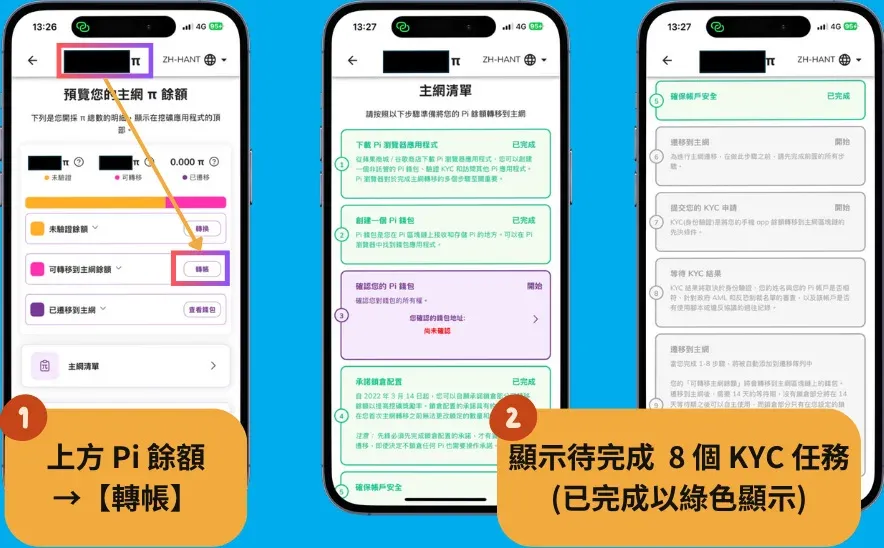
Within Pi Network, moving the Pi you have mined to the mainnet—and subsequently withdrawing it to an exchange—requires completing the KYC process first. The navigation path is: tap the balance at the top of the app → [Transfer], where the system lists the pending KYC tasks.
There are eight tasks; once all are completed a green checkmark appears:
- Download Pi Browser – This wallet app (iOS/Android) is used to manage Pi.
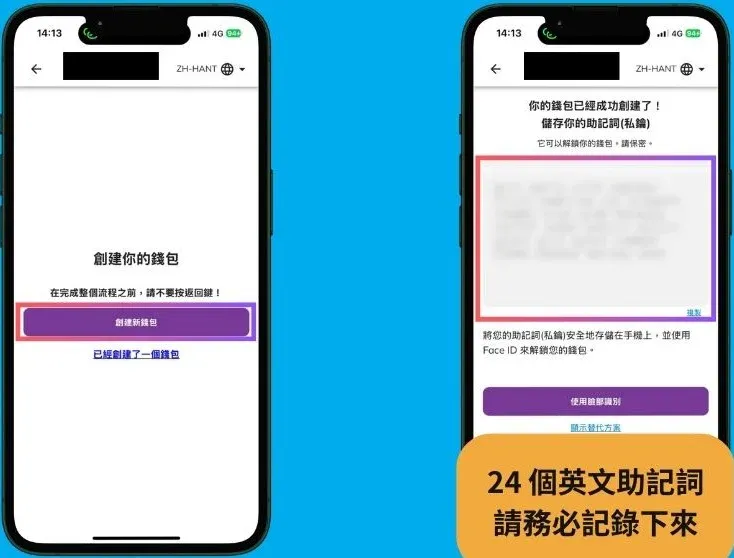
- Create Wallet – Choose “Create New Wallet”; the system generates 24 English seed words, which must be saved on paper.
- Confirm Wallet – Paste the seed words back into the app to verify ownership.
- Lock‑up Configuration – The higher the amount and longer the lock‑up period you set, the richer the future mining rewards; users can configure this themselves.
- Account Security – After completing the first four steps, the system automatically marks this step as passed.
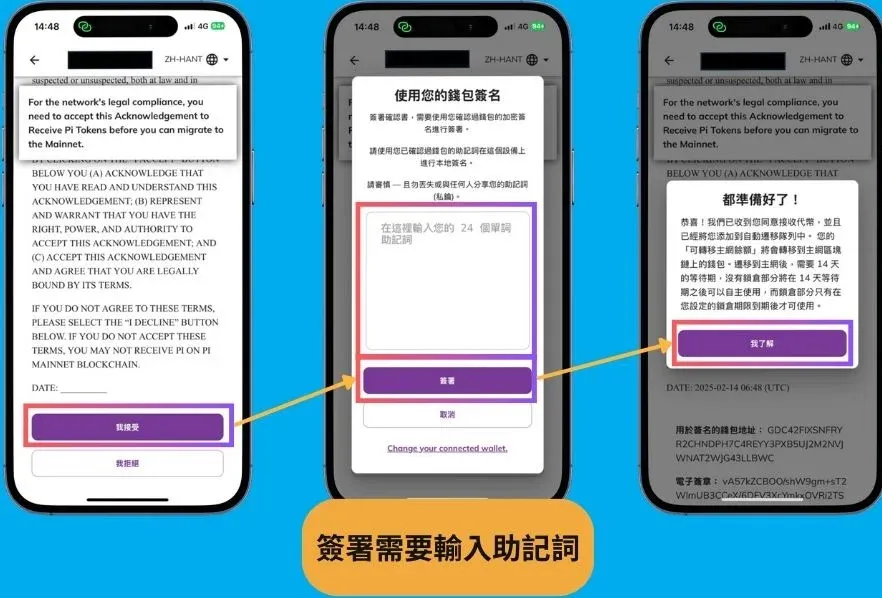
- Migrate to Mainnet – Enter the seed words and sign the agreement to complete the migration.
- Submit KYC Application – A fee of 1 Pi is required for verification. The process includes:
- Identity Document: Choose one of ID card, passport, or driver’s license.
- Information Entry: Fill personal details in the language used on the document.
- Facial Recognition: Confirm that the applicant is a real person.
- Await Review – Once all prerequisite tasks are finished, the system automatically moves the account into the review stage.
After approval, users enter the mainnet transfer queue; even after the transfer to mainnet, a 14‑day waiting period must elapse before the funds become usable.
Tax Note: Crypto gains, including any Pi received after migration, may be subject to taxation in the user’s jurisdiction. Please consult local tax regulations or a professional advisor.
Pi Coin Consumption Scenarios
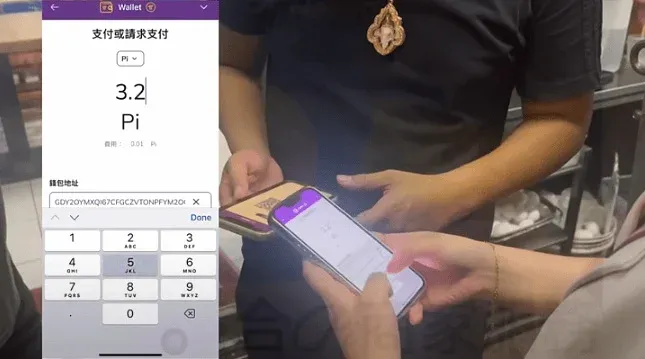
As of August 2025, 136 merchants have joined the Pi Payment Alliance, covering sectors such as food & beverage, retail, and hospitality. Consumers simply open the Pi app and scan the QR code provided by the merchant to complete payment.
It should be noted that each merchant sets its own exchange rate, and not all goods accept full‑amount Pi payments. Users are advised to contact the merchant in advance to confirm the exact payment method and rate.
Common Withdrawal Obstacles
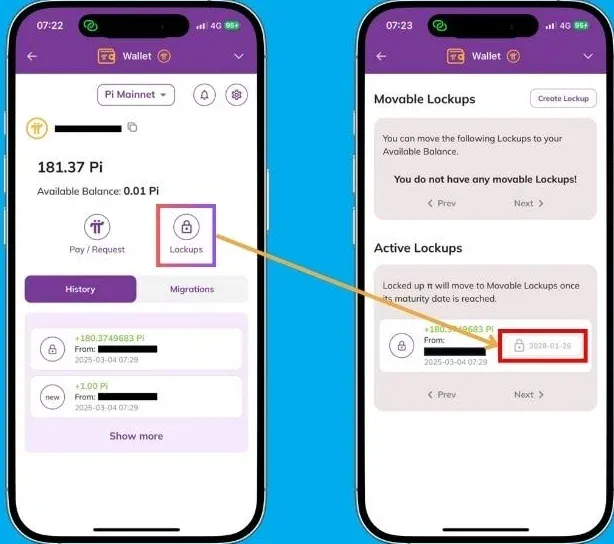
Many users, after migrating to the mainnet, see a balance in the Pi Browser but the Available Balance shows 0.01, preventing withdrawal. The main reasons are:
- Unfinished 14‑Day Waiting Period – After mainnet migration, a 14‑day lock‑up is required before any transfer can be executed.
- Lock‑up State – Even after the 14‑day period, if Pi is still locked, it cannot be freely moved. The lock‑up expiry can be checked on the [Lockup] page.
Locked Pi cannot be unlocked early; users can only reduce the lock‑up term for newly mined Pi in future configurations.
P2P Trading Compliance Risks
Since 2024‑11‑30, Article 6 of China’s Anti‑Money‑Laundering Law has been amended, prohibiting virtual‑asset services that have not been registered with the Financial Regulatory Commission. Some Pi community members conduct over‑the‑counter (Person‑to‑Person) trades, which lack supervision, may involve fraud, and could breach legal boundaries. Investors should exercise extreme caution.
Price and Market‑Cap Analysis
According to the token model, Pi’s maximum mainnet supply is 100 billion. The table below shows the theoretical Full‑Dilution Valuation (FDV) at various price points:
| Pi Price (USD) | FDV (Maximum Market Cap) |
|----------------|---------------------------|
| $0.01 | 10,000,000,000 USD (10 billion) |
| $0.10 | 100,000,000,000 USD (100 billion) |
| $1.00 | 1,000,000,000,000 USD (1 trillion) |
| $10.00 | 10,000,000,000,000 USD (10 trillion) |
| $100.00 | 100,000,000,000,000 USD (100 trillion) |
Pi’s price volatility is heavily influenced by FDV; if supply increases without sufficient capital inflow, the price may face downward pressure. Historically, Pi’s peak after listing reached $2.98, corresponding to an FDV of $298 billion. By comparison, Trump Coin’s early‑2025 high of $73.43 implied an FDV of $734.3 billion. Insufficient funding inflows can therefore pressure the price lower.
In the project’s early stage, scarce circulation and bullish sentiment often produce short‑term price spikes; however, as lock‑up periods expire and supply is gradually released, the long‑term trend may turn negative.
Future Roadmap of Pi Network
The Pi team plans to embed the token further into digital payments, goods trading, and other real‑world use cases. Some merchants in certain regions already accept full or partial Pi payments, and the ecosystem is gradually expanding. Pi’s long‑term value will continue to depend on technical progress, community activity, and the successful implementation of practical applications.
Closing Remarks: Points to Consider When Dealing with Pi Coin
The free‑mining model attracts a large user base; treating it as a casual experiment with modest mining is relatively safe. Nevertheless, potential value should be approached with caution. Any investment decision must be based on a thorough understanding of project developments, regulatory environment, and associated risks, and should never exceed one’s financial capacity.
For deeper information on Pi Coin, you can search for earlier Bitaigen (比特根) articles or continue with the recommended follow‑up content below. Thank you for your continued interest in Bitaigen (比特根)!
💡 Register on Binance with referral code B2345 for the maximum trading fee discount. See Binance complete guide.



