
 Bitaigen Research
 Pi Network is a unique case in the cryptocurrency space. Since its launch in 2018, it has attracted a considerable amount of attention and interest despite numerous uncertainties. The project's goal is to let anyone participate in the crypto world by mining Pi coins with a smartphone—no electricity costs beyond the phone’s own consumption and no other expenses are required.
Pi coin entered mainnet on February 20 2025 and was listed on exchanges the same day. The announcement sparked a frenzy in the community, and the Pi IOU price briefly surged to $100.
So, what will Pi’s price be after listing? Could it ever reach $100? What factors could influence Pi’s price? This article analyses historical data and summarizes possible future price scenarios.
We examine Pi’s price movement from three major dimensions—technology, ecosystem, and market—by mapping key milestones and potential drivers since the mainnet launch. The analysis dissects the logic behind its price trends and provides an objective assessment of whether Pi can break the $100 barrier. For a more detailed dive, keep reading.
How much is Pi worth right now?
According to the latest data, the reference price for 1 Pi is $0.5725 (approximately 18.47 TWD).
The upcoming Pi2Day event on June 28 gave Pi a short‑term boost. The market showed Pi climbing from roughly $0.53 to $0.63, a rise of about 30 % from the weekly low of $0.47. This movement broke a seven‑week consolidation pattern and reignited bullish sentiment among long‑term holders.
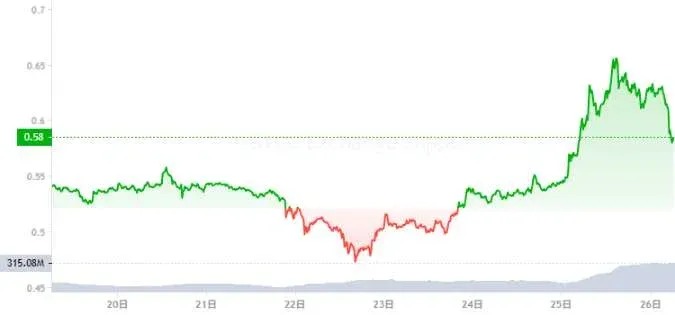
Pi’s price movement over the past week
Pi2Day is regarded as a pivotal moment for the core team to unveil the latest ecosystem developments. The official preview indicated that the event could introduce generative AI (GenAI) features, signalling the next phase of Pi’s roadmap. Additionally, the team will roll out a KYC sync update—integrating the Pi Browser with the main Pi app so users can complete identity verification and migrate to mainnet in a single step.
Countdown to Pi2Day 2025: What is Pi2Day and how might it affect Pi’s price?
Even though the market looks bullish, caution is also present. A large‑scale token unlock of 268.4 million PI is scheduled for July, representing the biggest release before the end of 2027. Analysts warn that the added supply could exert downward pressure on Pi’s value, especially while confidence in the ecosystem remains fragile.
Technical indicators such as MACD and RSI also show early signs of weakening momentum. If the hype surrounding Pi2Day fails to translate into tangible progress, the price may retreat to the $0.57‑$0.60 band; a sharper decline could test the $0.51 support level.
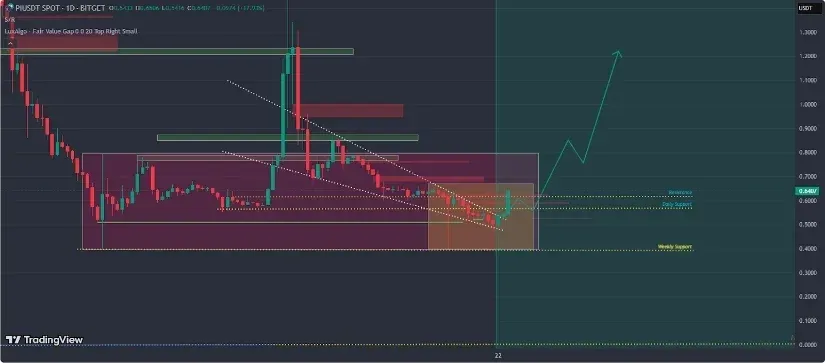
*Technical analysis for Pi coin sourced from SL‑Trades on TradingView.*
Pi Network officially opened its mainnet and began trading on February 20 2025, briefly reaching an all‑time high of $2.98. The price later fell, and because major exchanges such as Binance (U.S. users must use Binance.US), Bybit, and others were slow to list Pi, the coin slid below $1.
Related coverage: *Why Pi fell below $1 and what caused the dip.*
What is Pi Network (Pi coin)?
Pi coin is the native cryptocurrency of the Pi Network, obtainable by mining on a smartphone.

Basic information about the Pi token
- English name: Pi Network
- Coin name: Pi
- Ticker: PI
- Founders: Nicolas Kokkalis, Chengdiao Fan
- Founded: 2018
- Total supply: — (not disclosed)
- Circulating supply: — (not disclosed)
- Underlying technology: Stellar Consensus Protocol (SCP)
- Mineable: Yes
- Official website: <https://minepi.com/>
- Whitepaper: —
1. Introduction to Pi Network
Pi Network is a highly distinctive project that gained fame even before its token was listed, largely because of its easy‑to‑use mining model. The development team claims that Pi is the first cryptocurrency that can be fully mined on a mobile phone. Users simply download the Pi app and, using an invitation code from a trusted member, start mining.
Mining is straightforward: open the Pi app once every 24 hours and tap the lightning button.
The platform offers several ways to boost mining speed. Early‑adopter members receive higher rates; inviting new users yields a 25 % bonus. Unlike other mining apps, Pi Network is marketed as environmentally friendly—it does not drain the phone’s battery and relies on a web‑of‑trust model among users to secure the ledger.
2. How Pi Network Works
The core aim of Pi Network is to make cryptocurrency mining accessible to the masses. Unlike Bitcoin, which requires specialized hardware, Pi can be mined with a standard smartphone. Its consensus mechanism is based on the Stellar Consensus Protocol (SCP), where nodes validate transactions on a distributed ledger and reach agreement.
A Pi node consists of a security group of 3‑5 people, forming a global trust network that helps prevent fraudulent transactions. A transaction is recorded on the shared ledger only after all trusted nodes approve it.
3. Pi Token Economics
To date, the development team has not disclosed the exact number of tokens that will be in circulation at launch, nor the maximum supply.
4. Pi Network (Pi coin) Summary
- Pi Day on March 14 2019 officially launched the project with the mission “to let everyone participate in the crypto revolution.”
- Mining is performed on mobile devices without harming battery life.
- Utilises Stellar’s Federated Byzantine Agreement (FBA) mechanism, which is considered safer and more modern than Proof‑of‑Work (PoW).
- Mining rewards diminish as the ecosystem grows, employing a halving‑style model to protect value.
- Mainnet launch date: February 20 2025.
- After launch, exchanges such as OKX, BTCC, and Pi Network’s own market listed Pi trading pairs.
- Some experts still view the project as risky.
The Pi Network Ecosystem
Pi Network has evolved from a simple mining app into a full‑service ecosystem.
1. Pi Wallet
The Pi Wallet was released in early 2021, designed specifically for storing Pi coins. The beta version boasts a fast 8‑second transaction speed. Note that the wallet is still in beta and cannot yet be used for real‑world transactions.
2. Pi Browser
The Pi Browser enables developers to test and launch decentralised third‑party Pi applications.
3. Pi Nodes
Users may opt to become Pi nodes, validating transactions and earning a share of transaction fees once mainnet is live. Running a node consumes electricity; the network currently has over 12,000 active nodes.
Use Cases for Pi Coin
Key application scenarios for Pi include:
- Governance – A DAO is planned for the future; Pi tokens would serve as governance tokens, allowing holders to vote on network proposals.
- Network transaction fees – All on‑chain transactions will be settled in Pi; smart‑contract developers must hold a minimum amount of Pi.
- Mining incentives – Users earn rewards by logging in and tapping the “My” button, encouraging network security.
- Cross‑chain trust extension – Pi aims to enable permissionless, decentralised asset transfers, reducing reliance on third‑party custodians.
- Scarcity balancing – Inspired by Bitcoin’s halving, Pi reduces mining rewards over time to control supply and enhance scarcity.
History of Pi Network
In 2018, Nicolas Kokkalis and Chengdao Fan founded Pi Network with the vision of lowering the mining barrier via smartphones, offering an alternative to PoW blockchains like Bitcoin. The project has progressed through three stages: pre‑mainnet, closed mainnet, and open mainnet.
- Pre‑mainnet: Launched on Pi Day (March 14 2019); the first month saw over 100,000 active users.
- Phase 2: Active users grew to 3.5 million; the first advertisement aired in May 2020, and by Nov 25 2020 the active user base reached 29 million.
- Halving mechanism: Mining speed halves when active users hit 100 k, 1 million, and 10 million, reducing rates to 0.4, 0.2, etc.
- Phase 3: Announced on December 29 2021; Pi Wallet and Pi Browser were released on April 1 2021.
- Mainnet launch: Officially opened on February 20 2025, commencing public trading.
Pi Network (PI) Price Trend Analysis
As of June 27 2025, the latest market data for Pi coin are:
| Metric | Value |
|--------|-------|
| Symbol | PI |
| Current price | $0.5725 |
| 24 h change | -9.44 % |
| Trading volume | $338.3 M |
| All‑time high (ATH) | $2.9754 |
| All‑time low (ATL) | $0.4069 |
| 1‑hour high | $0.6298 |
| 1‑hour low | $0.5505 |
| Period high | $1.6148 (2025‑05‑12 07:40) |
| Period low | $0.4069 (2025‑04‑05 04:50) |
Price changes over the past year:
- 1 hour: -0.94 %
- 1 day: -9.44 %
- 7 days: +6.40 %
- 30 days: -23.59 %
- 90 days: -30.70 %
- 1 year: -59.23 %
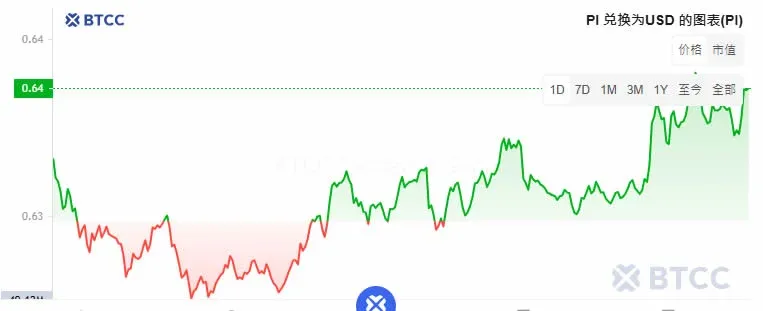
Note: Cryptocurrency gains may be taxable in your jurisdiction. Consult a tax professional for guidance.
Technical Analysis and Market Sentiment for PI
1. Technical Analysis
As of June 2025, Pi’s price remains below $1, hovering around $0.63. Major technical indicators suggest weak market momentum:
- RSI has been under the neutral zone since the end of May, indicating insufficient buying pressure.
- The current price sits just above a key support level at $0.61.
- If that support breaks, the price could slide to $0.57; a strong rebound might push it up to $0.71, provided a clear momentum reversal occurs.
Overall, without external catalysts or fundamental improvements, the risk of breaking the support zone is considerable.
Technical analysis examines historical price and volume data to help assess possible future movements, offering a reference point for market participants.
2. Market Sentiment
Sentiment currently leans bearish, driven by several factors:
- Rumor effect: Some positive rumors lack substantive backing.
- Related projects: Initiatives like Qubetics and VeChain have a modest positive impact on the broader crypto market but are only loosely connected to Pi2Day.
- Trading activity: Volume exceeds certain forecasts, suggesting enthusiasm that may already be priced in.
- AI announcement: Content about AI during Pi2Day caused an 11 % price drop, fostering negative sentiment.
- Overall market: Movements of major assets such as Ethereum have limited influence on Pi.
Factors That Could Influence Pi’s Future Price
- User growth: Over 29 million active miners and users are on the network, providing a large community base.
- Overall crypto market trend: A strong performance of digital assets in 2024‑2025 could benefit Pi if the market stays bullish.
- Listing on centralized exchanges: If major platforms like OKX, eToro, Binance (U.S. users must use Binance.US) list Pi, liquidity could improve dramatically, potentially pushing the price higher.
Long‑Term Pi Price Outlook (2026‑2050)
Below are long‑term price forecasts from BTCC analysts (values in USD):
| Year | Low | Average | High |
|------|-----|---------|------|
| 2026 | 0.5656 | 0.8166 | 0.9029 |
| 2027 | 0.5016 | 0.6967 | 0.8006 |
| 2028 | 0.4857 | 0.6840 | 0.8252 |
| 2029 | 0.8519 | 1.2287 | 1.4172 |
| 2030 | 0.7109 | 1.0908 | 1.3225 |
| 2031 | 0.7476 | 1.1201 | 1.2961 |
| 2035 | 0.8994 | 1.3788 | 1.6267 |
| 2040 | 1.5429 | 2.1416 | 2.5217 |
| 2045 | 1.8446 | 2.7307 | 3.2844 |
| 2050 | 1.8573 | 2.9995 | 3.8135 |
2026 Outlook
If the mainnet settles into a relatively stable phase after the 2025 launch, the supply cap and token‑unlock schedule will provide a predictable influx of new coins. The ecosystem’s allocation of 10 % of tokens for utility could alleviate sell‑pressure stemming from mining rewards. Coupled with industry‑wide bullish expectations for Bitcoin in 2026, Pi’s price range by year‑end could be $0.5656‑$0.9029, averaging around $0.8166.
2030 Outlook
Network effects are the decisive factor. With an estimated 47 million users forming a closed‑loop network, intrinsic value may be generated for the ecosystem. If supply shocks are absorbed efficiently after mainnet activation, Pi could maintain its value; persistent sell pressure might push it down to $0.7109. In a bullish scenario, the price could climb to $1.3225, with an average projection of $1.0908.
2050 Outlook
By 2050, circulating Pi tokens are expected to approach the maximum supply, and the user base could exceed 100 million. Assuming a global crypto‑asset CAGR of ~11.1 % and Pi’s growth slightly outpacing half of that rate, the price band might sit between $2.38 and $4.12.
Expert Price Predictions for Pi Network (PI)
Because Pi has not yet been fully listed on major
💡 Register on Binance with referral code B2345 for the maximum trading fee discount. See Binance complete guide.
⚠️ Risk Disclaimer: Crypto prices are highly volatile. This is not investment advice.



