
 Bitaigen Research
 In this article we outline the core principles and use‑cases of synthetic assets, revealing how they break through geographic and asset‑class barriers so that ordinary users can access global underlying assets on‑chain. Through a step‑by‑step analysis we help you quickly clarify the concept and assess potential opportunities; subsequent sections will dive deeper into technical implementation and risk considerations, so a careful read is worthwhile.
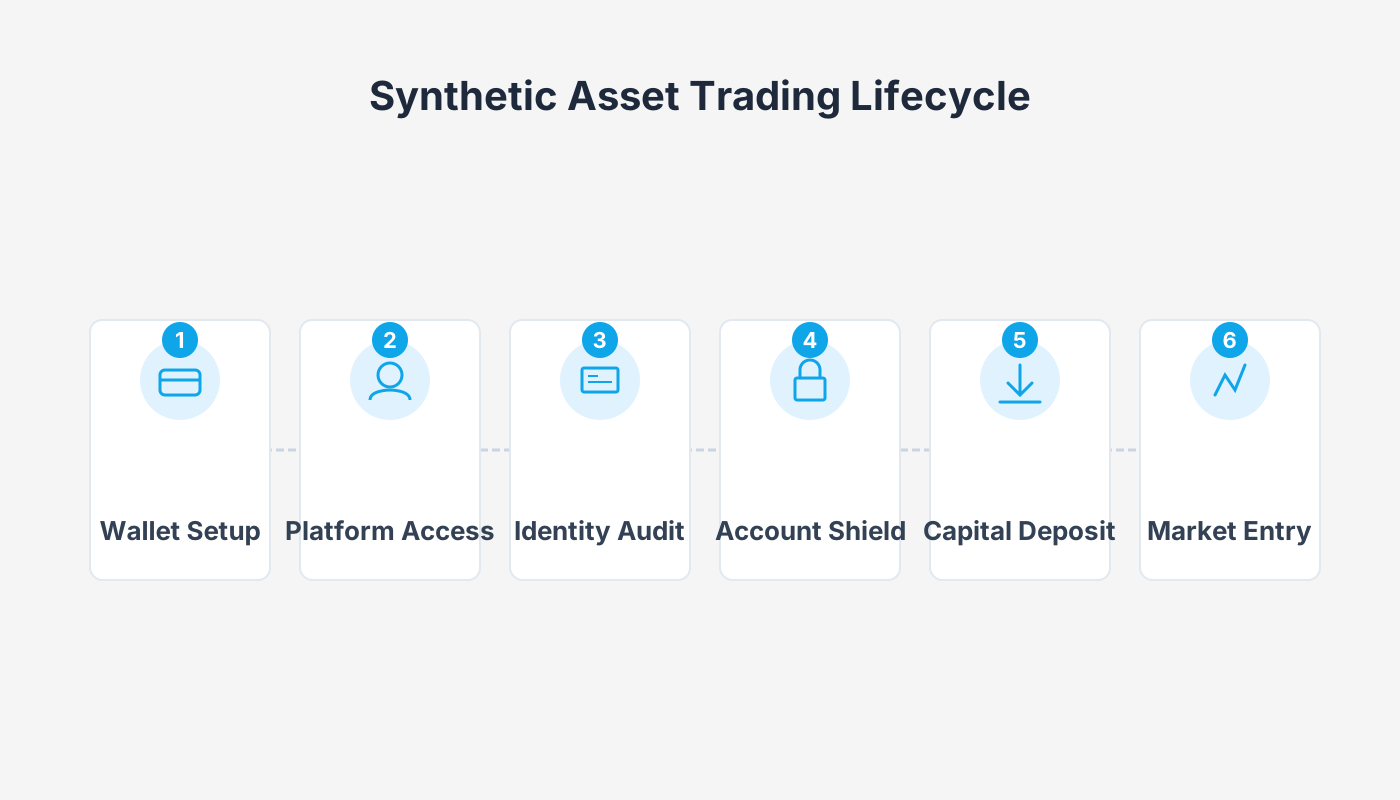
In the explosive growth of decentralized finance (DeFi), sectors such as decentralized exchanges (DEXes) and lending protocols have become widely known to investors because they faithfully replicate traditional financial services. Yet within DeFi’s vast landscape there exists a hardcore niche that even many seasoned participants find opaque—synthetic assets. For most people the term is as elusive as a flower seen through fog. What exactly is a synthetic asset? How does it operate? This article will dissect this highly imaginative on‑chain financial innovation in depth.
Why Do We Need Synthetic Assets?
To grasp the concept we first have to understand the pain points it addresses. Synthetic assets play a crucial role in the blockchain ecosystem, and their core value manifests in three main dimensions:
1. Lowering entry barriers and enabling borderless investing
Take U.S. equity investing as an example. Ordinary investors often face cumbersome cross‑border account opening, complex account management, and high capital thresholds denominated in USD. If those investment targets can be transformed into on‑chain synthetic assets, users anywhere in the world can participate with any amount of capital, seamlessly gaining exposure to high‑quality global assets. This not only removes geographic walls but also dramatically improves the efficiency of global capital flows. (For U.S. residents, access to such services typically requires using Binance.US rather than the global Binance platform.)
2. Bringing off‑chain real‑world assets into the Web 3 universe
The appeal of synthetic assets lies in their ability to mirror virtually any type of asset in token form. Whether it’s the stock of a giant like Tesla or Apple, or any other tradable real‑world asset, a price oracle can fetch the real‑time price and a corresponding synthetic token can be minted on the blockchain. This “on‑chain‑ization” of traditional assets opens limitless imaginative space for the DeFi world.
3. Unlocking asset liquidity and reducing the cost of obtaining funds
Put simply, synthetic assets provide a channel to obtain new capital without selling the original holdings, similar to a collateralized loan. Users act as borrowers, locking up mainstream tokens they already own to generate new synthetic assets. The most iconic example is MakerDAO—users lock ETH as collateral and mint the decentralized stablecoin DAI. Through this mechanism investors can secure liquidity without liquidating promising long‑term positions, thereby achieving leveraged exposure.
What Is a Synthetic Asset?
From a definitional standpoint, a synthetic asset is a novel financial derivative whose underlying value is derived from one or more base assets (in the crypto world these are typically on‑chain native assets such as BTC or ETH). To make this more concrete, we can examine two classic projects and their operational mechanisms:
- In the Synthetix protocol, users lock the platform token SNX to mint sETH or sUSD. Here SNX functions as the “native asset,” while the minted sETH and sUSD are the corresponding “synthetic assets.”
- In MakerDAO, users collateralize ETH to generate the decentralized stablecoin DAI. In this model DAI is likewise a synthetic asset, with ETH serving as the underlying native asset.
These examples illustrate that a synthetic asset is essentially a multidimensional financial tool that can be constructed by recombining and encapsulating one or several underlying assets—or even other derivatives.
Summary
In essence, synthetic assets constitute a highly intricate financial architecture. As a groundbreaking on‑chain derivative, they provide a fresh technological pathway for expanding the application frontier of blockchain. It is undeniable that synthetic assets have historically sparked market turbulence in traditional finance due to excessive speculation, and they may also carry as‑yet‑unrevealed protocol‑level security risks within the DeFi ecosystem. Nevertheless, they are undeniably evolving from a cornerstone of conventional finance into an indispensable pillar of the DeFi movement. The field remains in its early exploratory stage, and future progress will depend on developers and finance enthusiasts conducting further trial‑and‑error and knowledge‑building.
Related Reading
- Cross-Chain Bridges Explained: Function, Types & Security
- Bitcoin Price Surge: Decentralization & Institutional Demand
- Cryptocurrency Mining: How It Secures Blockchain Transactions
💡 Register on Binance with referral code B2345 for the maximum trading fee discount. See Binance complete guide.



