
 Bitaigen Research
 In this article we map out the key milestones that have propelled Tether’s rapid rise over the past two years, dissect its asset allocation, regulatory positioning, and strategic investments, and explain how these factors are reshaping the wealth landscape of the crypto economy. By closely tracking the movements of the senior management team, readers can grasp emerging industry trends; the piece is worth a careful read.
Background and Timeline
Tether’s valuation surge was not accidental; it is the cumulative result of a series of actions taken during 2025‑2026.
- 2025: After posting roughly $13.7 billion in profit in 2024, Tether continued to generate strong cash flow. CEO Paolo Ardoino disclosed in October 2025 that the company’s annual profit was approaching $15 billion, yielding a profit margin of 99 %. This performance was largely driven by the composition of its reserve assets—more than 80 % of USDT reserves were deployed into short‑term U.S. Treasury securities and money‑market funds, directly benefiting from the high‑interest‑rate environment.
- January 2026: The firm announced the launch of a compliant stablecoin for the U.S. market, USAT, issued by Anchorage Digital Bank. The company also appointed former White House cryptocurrency liaison Bo Hines as CEO of its U.S. operations, signaling Tether’s formal alignment with the regulatory framework established by the GENIUS Act.
- February 2026: Secondary‑market trading ranges revealed institutional buyers’ willingness to price the token, while Tether disclosed that its balance sheet now held approximately $23 billion in gold and $6.4 billion in Bitcoin. The company also completed several strategic investments, including stakes in video platform Rumble, e‑commerce marketplace Whop, and other ventures.

Valuation and Executive Wealth
The most recent private‑share transaction pushed Tether’s overall valuation into the $350‑$375 billion range. Even if a more conservative $200 billion figure is used—still a 300 % increase over the $50 billion valuation recorded in 2025—Tether would rank among the world’s most valuable privately held companies, alongside technology powerhouses such as OpenAI and SpaceX.
Within this valuation framework, the personal fortunes of senior executives have expanded dramatically. Assuming the lower bound of $350 billion, Chief Financial Officer Giancarlo Devasini, who holds roughly 44‑45 % of the equity, would see his stake valued at over $156 billion, surpassing Warren Buffett’s estimated net worth of $147.8 billion and placing him within the global top‑ten richest individuals. CEO Paolo Ardoino and former CEO Jean‑Louis van der Velde each own about 19 % of the company, corresponding to personal valuations of approximately $66.5 billion each.
Data and Structural Analysis
Tether’s valuation core stems from its distinctive “reserve‑spread” model: the firm issues USDT to capture user deposits, then allocates those funds into interest‑bearing assets, effectively acting as a “shadow central bank” on‑chain.
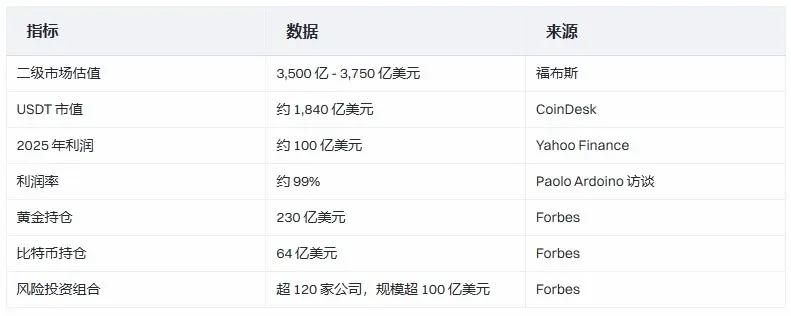
| Item | Data (as of February 2026) |
|------|----------------------------|
| Annual profit | ~$15 billion |
| Profit margin | 99 % |
| USDT reserve allocation | 80 %+ placed in short‑term U.S. Treasuries and money‑market funds |
| Gold holdings | ~$23 billion |
| Bitcoin holdings | ~$6.4 billion |
| Strategic investments | Rumble, Whop, etc. |
Public Discourse and Viewpoint Breakdown
Different audiences perceive Tether’s soaring valuation in clearly stratified ways:
- Traditional financial media (e.g., *Forbes*) highlight the “private‑company valuation miracle” and “executive wealth creation,” drawing parallels with SpaceX and OpenAI and emphasizing the structural opportunity captured during a high‑interest‑rate cycle.
- Native crypto communities praise Tether as a showcase of “capital accumulation without a public listing,” viewing its diversified forays into AI, energy, and payments as attempts to build a “crypto‑driven real‑world economy.”
- Critics and skeptics continue to raise concerns about reserve transparency and centralization. The `freezeAccount` function embedded in the USDT smart contract is seen as eroding the token’s decentralized nature, meaning users’ asset safety ultimately depends on the issuer’s regulatory willingness.
Industry Impact Analysis
The uplift in Tether’s valuation reverberates across the broader crypto ecosystem in several ways:
- Fortifying the “moat”: USDT is no longer merely a transactional medium; it now functions as a cash‑flow‑generating asset, reinforcing first‑mover advantage and making it difficult for rivals to challenge its liquidity and network effects in the short term.
- Accelerating compliance: The launch of USAT and the recruitment of former government officials signal a proactive move toward regulatory integration. This may pressure other offshore stablecoins to hasten their own compliance programs, lest they face entry barriers in the United States.
- Liquidity‑structure shift: Despite the higher corporate valuation, USDT’s on‑chain supply contracted for two consecutive months in February 2026, falling from a historic peak of $186.8 billion to roughly $183.6 billion. Exchange reserves also dropped from $60 billion to $51.1 billion, edging toward the critical support level of $50 billion. The contraction suggests that a portion of capital is migrating toward alternative stablecoins such as USDC or toward real‑world‑asset (RWA) yield‑generating channels.
Multi‑Scenario Evolution Forecast
Based on the current data, three plausible future pathways can be sketched for Tether:
- Scenario 1: Power expansion under regulatory integration (most likely)
USAT’s penetration of the U.S. market would position Tether as a regulated digital conduit for the dollar, nudging its valuation closer to that of traditional financial infrastructure providers. The firm could then pursue M&A activity in payments, media, AI, and related ecosystems.
- Scenario 2: Profit pullback from a reversing interest‑rate cycle (mid‑term risk)
The current 99 % profit margin is heavily dependent on yields from U.S. Treasury securities. Should the Federal Reserve enter a rate‑cutting phase, spread‑derived earnings would shrink, forcing Tether to rely on scale efficiencies or higher‑risk assets to sustain profitability, thereby prompting a reassessment of risk management.
- Scenario 3: Tightening regulation or a black‑swans event (tail risk)
Tether’s offshore history and the opacity of its reserves remain focal points for regulators. An extreme regulatory move—such as prohibiting non‑bank entities from issuing stablecoins—or a large‑scale freeze that triggers a loss of user confidence could precipitate a “bank‑run‑style” redemption surge, jeopardizing liquidity across the entire crypto market.
Narrative Authenticity Review
- Fact‑based layer: Tether indeed posted close to $10 billion in profit for 2025, and USAT is already live. Secondary‑market pricing reflects genuine institutional demand, offering a solid reference point for valuation.
- Opinion layer: It is crucial to separate “valuation” from “liquidatable value.” The $350 billion figure stems from a private‑equity transaction and does not equate to a publicly traded market cap. If CFO Devasini wishes to convert his paper wealth into cash, he would confront substantial liquidity constraints.
- Speculative layer: Assertions that Tether could become the “Federal Reserve of the crypto world” or be fully absorbed by traditional finance remain conjectural. Nevertheless, the 99 % profit margin does reveal a core truth: in the current dollar‑rate environment, stablecoin issuers act as low‑risk yield conduits. Their sustainability will hinge on the direction of U.S. monetary policy and the evolution of the regulatory framework.
Summary
Tether’s valuation breakthrough past $350 billion is far more than a headline about executives out‑earning Warren Buffett. It signals that stablecoins have evolved from pure transaction tools into pivotal financial infrastructure capable of influencing global dollar liquidity. The company is transitioning from an “offshore wild‑child” to a “compliant gatekeeper,” while the crypto sector witnesses a deep‑seated shift in power: the moat is no longer solely technical censorship resistance but a regulated efficiency that dances with the U.S. dollar system. Future developments at Tether will serve as one of the most indicative case studies in the worldwide rollout of a digital dollar.
*Note: Crypto gains may be taxable in your jurisdiction; consult a local tax professional. For U.S. residents, trading on Binance.com is not supported—use Binance.US or other compliant platforms that handle USD, SEPA, or SWIFT transfers.*
The above constitutes the in‑depth analysis titled “Tether Executive Wealth Surpasses Buffett: A New Wealth Paradigm in the Crypto Economy.” For more related coverage, follow Bitaigen (比特根) and its other articles.
💡 Register on Binance with referral code B2345 for the maximum trading fee discount. See Binance complete guide.
⚠️ Risk Disclaimer: Crypto prices are highly volatile. This is not investment advice.



