
 Bitaigen Research
The so‑called “asset‑backed” cryptocurrency market continues to expand, and an increasing number of projects claim to peg real‑world commodities such as gold, real estate, or even oil to blockchain tokens. The US Oil Reserve Token (AOR) was launched on this very premise.
The US Oil Reserve Token (AOR) is a narrative‑driven token built on Solana, not linked to actual oil reserves, and its price is driven by market sentiment. Its 2026‑2030 trajectory will depend on narrative hype and community activity.
But how much substantive content lies behind the project? Is it an innovative commodity token, or merely a speculative crypto experiment? In this fact‑check we will calmly examine the AOR token, analyse its promises, potential risks, and the criteria for assessing its investment merit.
In this article we dissect the newly launched US Oil Reserve Token (AOR) from multiple angles—technical implementation, narrative positioning, and community engagement—to help readers determine whether it belongs to the category of innovative commodity tokens or pure speculation, and we provide a framework for thinking about its future price movement. Please continue reading.
1. What is the US Oil Reserve Token (AOR)?
US Oil Reserve Token (AOR) is a brand‑new token issued on the Solana blockchain at the beginning of 2026. The project adopts the United States oil reserves as its narrative theme and aims to leverage Solana’s high‑speed, low‑fee network characteristics to create an easily tradable energy‑themed token.
- On‑chain location: Primarily traded on Solana‑based decentralized exchanges (DEXs), such as the Jupiter aggregator and the trading interface integrated into the Phantom wallet.
- Token attributes: Classified as a “meme token / narrative token”; it is not a commodity token and does not represent ownership of physical oil or shares in energy companies.
Basic Information
| Project | Details |
|---|---|
| **Blockchain** | Solana |
| **Total Supply** | 1,000,000,000 AOR |
| **Category** | Meme token / Narrative token |
| **Launch Date** | 2026 |
| **Primary Trading Platform** | Jupiter (Solana DEX) |
| **Official Website** | americanoilreserve.com |
The core of the project is “narrative‑driven”. It borrows the symbolic weight of U.S. oil reserves and energy policy, but it is not a tokenized oil; holders do not receive any claim to physical assets or corporate equity. Its value is entirely determined by market interest, liquidity, and community activity.
2. Why did the US Oil Reserve Token suddenly go viral?
Since its launch in early 2026, AOR’s discussion volume within the Solana community has surged. Three main factors explain the hype:
- Energy‑policy Narrative
- Media outlets repeatedly cover U.S. oil production, energy geopolitics, and Venezuela’s oil reserves, raising the profile of energy‑sovereignty topics.
- Investors tend to seek tokens that align with current hot‑button issues, and AOR fits neatly into the “U.S. oil reserve” narrative.
- Solana Meme Season
- Solana’s low transaction fees, rapid confirmations, and easy token issuance (e.g., via pump.fun) have made it fertile ground for meme coins.
- This infrastructure enables a token to achieve massive exposure within just a few days.
- Community and Social‑Media Amplification
- Within days of launch, the number of wallet holders surpassed roughly 5,000, indicating rapid community diffusion.
- Viral propagation on platforms such as X (formerly Twitter), Telegram, and Discord often drives short‑term meme‑coin hype more powerfully than fundamental analysis.
3. Credibility and Risk Assessment of AOR Coin
AOR debuted at the start of 2026, making it one of the youngest projects in the Solana ecosystem. On‑chain data shows that its full supply of 1 billion tokens is already in circulation, making future minting or inflation adjustments unlikely.
Opportunity Factors
- Strong Narrative: Taps into the hot topic of U.S. energy policy, boosting visibility.
- Solana Ecosystem: Low fees and fast finality suit meme tokens that need swift, cheap transfers.
- Active Community: Over 5,000 holders shortly after launch suggest solid early participation.
- Fully Circulating Supply: No risk of later token unlocks diluting existing holdings.
Risk Points
| Risk Category | Key Explanation |
|---|---|
| **No Physical Backing** | AOR is not a commodity token and is not linked to real oil reserves. |
| **Sentiment Dependency** | Demand is highly sensitive to social‑media mood and trending narratives. |
| **Early‑Stage Project** | Only a few weeks on the market, resulting in limited depth. |
| **Liquidity Constraints** | Market cap in the low‑millions of USD; large orders can cause severe price swings. |
| **Intense Competition** | Competes with other energy‑themed narrative tokens such as USOR and WAR. |
Overall Assessment
Structurally, AOR resembles a highly speculative narrative token. It may generate short‑term profits when the related hype is strong, but once the buzz fades, both attention and liquidity can decline rapidly. Short‑term traders who excel at reading market sentiment might find AOR attractive; long‑term investors seeking solid fundamentals should consider the risk profile to be significantly elevated.
4. Current Price Situation of the US Oil Reserve Token
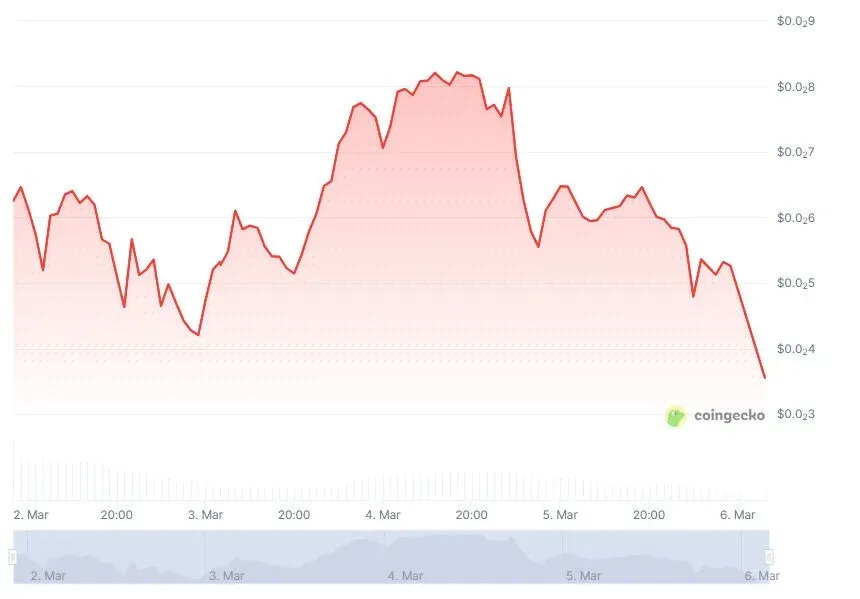
As of March 2026, AOR’s key market metrics are:
- Price: Approximately $0.0043 USD
- Market Capitalisation: Roughly $4.3 million USD
- 24‑Hour Trading Volume: About $168 k USD
- Circulating Supply: 999,999,846 AOR (almost the entire issuance)
During the preceding 24 hours the price dropped about 30 %, a level of volatility that is common among emerging narrative tokens. The tokenomics are straightforward—full supply already in circulation, so future dilution from new issuance is not a concern, but the small market cap makes the price highly sensitive to single large trades.
Main Drivers of Price
- Energy‑policy news: Relevant articles can instantly boost search interest.
- Solana ecosystem activity: A new wave of meme‑coin cycles typically lifts many tokens simultaneously.
- Listing venues: Inclusion on a major centralized exchange would markedly improve liquidity.
- Social‑media momentum: Community activity on X, Telegram, etc., is the core engine behind price swings.
- Overall market sentiment: When the broader crypto market weakens, speculative tokens are often the first to feel the impact.
Note: Crypto gains may be taxable in your jurisdiction. Be sure to consult local tax regulations.
5. Price Forecast for 2026‑2030
Because AOR is an emerging meme token without a stable revenue stream, any forecast carries a high degree of uncertainty. The table below draws on historical cycles of comparable tokens to outline possible ranges; it is provided for reference only.
Forecast Overview
| Year | Potential Market‑Cap Range | Potential Price Range (USD) | Remarks |
|---|---|---|---|
| 2026 | $10 M ‑ $30 M | $0.01 ‑ $0.03 | Early speculative activity |
| 2027 | Highly speculative phase | Dependent on narrative hype | Media attention is the key driver |
| 2030 | Community‑sustained phase | $0.03 ‑ $0.10 | Requires continued community and narrative support |
Bullish Scenario
- Ongoing media coverage of energy‑policy developments.
- A fresh Solana meme‑coin surge.
- Successful listing on a major centralized exchange.
- Viral community growth.
If these factors align, AOR’s market cap could reach $20 M ‑ $50 M, translating to a price 3‑7 times its current level.
Bearish Scenario
- “Meme fatigue” and waning interest in energy‑related topics.
- Market narrative shifts toward other sectors (e.g., AI, metaverse).
- Sharp liquidity drop and shrinking trading volume.
- Arrival of competing tokens that capture attention.
Under such conditions, AOR could experience a 70 %‑90 % price correction.
Realistic Expectation
The most probable outcome lies between the two extremes:
- Short‑term traders may still capture profit from volatility.
- Mid‑to‑long‑term performance hinges on whether the community stays active and whether new narrative hooks emerge.
- Without a sustainable use case or lasting community support, the token will struggle to maintain a high valuation; conversely, if it can ride multiple hype cycles, it may continue to play a role within Solana’s meme ecosystem.
6. Comparing AOR with Other US‑Energy‑Themed Tokens
Within the narrative‑token niche, USOR and AOR both centre on U.S. energy policy, but they emphasize slightly different angles:
| Feature | **AOR** | **USOR** |
|---|---|---|
| **Narrative Focus** | “U.S. Oil Reserves” | “U.S. Strategic Petroleum Reserve” |
| **Blockchain** | Solana | Solana |
| **Token Type** | Meme / Narrative token | Meme / Narrative token |
| **Community Size** | ~5,000+ holders (Q1 2026) | Similar scale |
| **Technical Implementation** | Fully compatible with Solana DEXs | Fully compatible with Solana DEXs |
Both tokens occupy the same sub‑segment, relying on community‑driven market behaviour.
7. Step‑by‑Step Guide to Buying the US Oil Reserve Token
AOR remains in its early phase and is not listed on major centralized exchanges; trading occurs mainly through Solana DEXs. Follow these steps to purchase safely:
Step 1: Create a Solana‑Compatible Wallet
- Download and install the Phantom Wallet browser extension.
- Generate a new wallet and store the seed phrase securely.
- Copy your wallet address; you will need it to receive SOL and AOR.
Step 2: Acquire SOL (or USDT)
- Complete KYC on Binance (or Binance.US for U.S. residents) via the official registration link.
- Deposit fiat (USD via SWIFT, EUR via SEPA, or other supported methods) and purchase SOL or USDT.
- Withdraw the purchased assets to your Phantom wallet address.
Important: U.S. users must use Binance.US rather than the global Binance platform.
Step 3: Swap for AOR via Jupiter
- Open Jupiter (the Solana aggregation router) and connect your Phantom wallet.
- Select SOL (or USDT) as the input token, then paste the official AOR contract address published by the project.
- Confirm the amount and execute the on‑chain transaction.
Tip: Always verify the contract address from the official website to avoid counterfeit token scams.
Conclusion – Should You Keep an Eye on the US Oil Reserve Token?
US Oil Reserve Token (AOR) is a quintessential narrative token within Solana’s meme ecosystem. It builds its story around U.S. energy policy but does not tokenize real oil reserves. Its value stems primarily from:
- Suitable Investors: Traders who focus on short‑term narratives and are adept at spotting social‑media‑driven spikes; users comfortable with Solana‑based operations.
- Unsuitable Investors: Those seeking long‑term fundamentals, genuine commodity exposure, or high transparency.
If AOR’s community and narrative continue to ferment, short‑term gains may be possible; however, if hype fades and no new demand emerges, the token will revert to a highly speculative market state with pronounced volatility.
Frequently Asked Questions
What is the US Oil Reserve Token?
US Oil Reserve Token (AOR) is a Solana‑based crypto token that uses the United States oil reserve narrative as its theme. It is classified as a meme / narrative token and does not represent any physical asset.
Is AOR backed by actual oil?
The project claims a thematic link to oil reserves, but there is currently no independently verifiable physical backing.
What drives AOR price increases?
Price movements are mainly driven by short‑term market sentiment, social‑media hype, and news related to energy policy. Fundamental factors play a limited role.
Where can I buy AOR?
At present, AOR trades primarily on Solana decentralized exchanges such as Jupiter and on smaller crypto platforms. It has not yet been listed on major centralized exchanges.
How trustworthy is AOR?
Given limited disclosure about the team, reserve holdings, and regulatory compliance, investors should exercise caution and conduct their own due diligence.
---
For more AOR price forecasts and related analysis, search for “Bitaigen” to access previous articles or continue browsing the related posts below. Thank you for your attention and support!
Related Reading
💡 Register on Binance with referral code B2345 for the maximum trading fee discount. See Binance complete guide.



