
 Bitaigen Research
 USD.AI (CHIP) Token Overview
The USD.AI (CHIP) token is the utility and governance token of the USD.AI protocol. It is used to provide on‑chain collateralized loans and revenue sharing for artificial‑intelligence infrastructure. Whether it is worth allocating capital to this token depends on the project’s real‑world implementation, market demand, and the investor’s risk tolerance.
USD.AI combines decentralized finance with physical infrastructure, redefining how capital flows within the AI sector.

From the perspectives of technology, governance, and financial modelling, we conduct an in‑depth analysis of the USD.AI (CHIP) token’s ecosystem layout and value drivers. By integrating the latest listing information, we assess potential risks and opportunities to help readers make a rational judgment on whether to include this asset in their portfolios.
Latest Developments for the USD.AI (CHIP) Token
Binance (official registration link | official download link) officially launched the CHIP token on April 21, 2026, marking a key milestone in the project roadmap. Spot trading pairs such as CHIP/USDT, CHIP/USDC and CHIP/TRY are now live.
At 12:20 UTC on the same day, Binance Alpha was the first platform to list CHIP and airdropped 750 CHIP to users holding at least 230 Alpha Points on a first‑come, first‑served basis.
After the listing, trading activity surged quickly. By the time the announcement was released, the token price had already reached $0.04493, representing a 27.7 % increase in the preceding 24 hours, indicating strong market interest.
Important for U.S. users: Binance.US (the U.S.‑specific platform) is the only Binance service available to residents of the United States. Global Binance accounts cannot be used for U.S. trading.
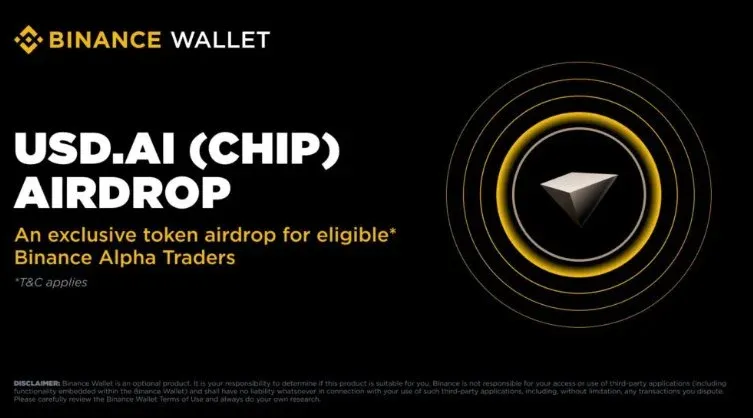
Listing Highlights
How to Participate in the Binance Alpha USDAI Airdrop
- Connect Your Wallet – Open the Binance app, go to the wallet section, and make sure your Web3 wallet is active.
- Apply for the Airdrop – In the airdrop tab, locate USDAI.
- Claim the Tokens – Tap CHIP and select “Claim”. The system will credit 750 CHIP to your Alpha account within 24 hours.
Note: Claiming the airdrop consumes 15 AP.
What Is USD.AI?
Amid the rapid global expansion of artificial intelligence, the financing demand for high‑performance hardware—especially GPUs—has become increasingly acute. Conventional financial institutions impose long approval cycles and high thresholds for loans against such assets, leaving many AI infrastructure operators unable to secure the necessary capital.
USD.AI addresses this gap by tokenising AI‑hardware assets on‑chain through a synthetic‑USD protocol. These tokenised assets serve as collateral for financial products that deliver 10 %–15 % annualised yields via a high‑yield bond index backed by both sovereign bonds and GPU loans.

Operational Advantages of USD.AI
- On‑Chain Collateralisation – GPU assets are directly minted onto the blockchain, improving standardisation and liquidity in the credit market.
- Revenue Sources – Dual income streams from government bonds and GPU‑backed loans enable continuous pricing of the capital pool.
- Risk Mitigation – Reduced reliance on traditional private credit lowers opacity and enhances transparency.
Leadership Team and Investors
The protocol is developed by Permian Labs, with Ivan Sergeev serving as Chief Technology Officer. Sergeev’s team brings extensive experience from the Bitcoin hardware‑debt market. Early backers include Framework Ventures, Dragonfly, Arbitrum, YZi Labs (formerly Binance Labs), Coinbase Ventures, and Bullish. A strategic partnership with PayPal provides settlement in PYUSD and a $1 billion liquidity incentive.
What Is the CHIP Token?
CHIP is the core utility and governance token of the USD.AI protocol. It governs system standards, revenue distribution, and protocol‑level decision‑making.
- Token Name: USD.AI
- Symbol: CHIP
- Blockchain: Ethereum
- Standard: ERC‑20
CHIP Token Economics
Token Allocation
Token Functions
- Interest‑Rate Control – Holders can set reference rates and asset‑valuation thresholds for GPU loans.
- Revenue Governance – Token holders decide how protocol fees (issuance, service, liquidation, etc.) are allocated, including buy‑backs or reinvestment.
- Staking Model – Users may stake CHIP in the safety module to earn a share of protocol fee rewards. In the event of a deficit, stakers are liable for proportional penalties.
Price Volatility and Liquidity
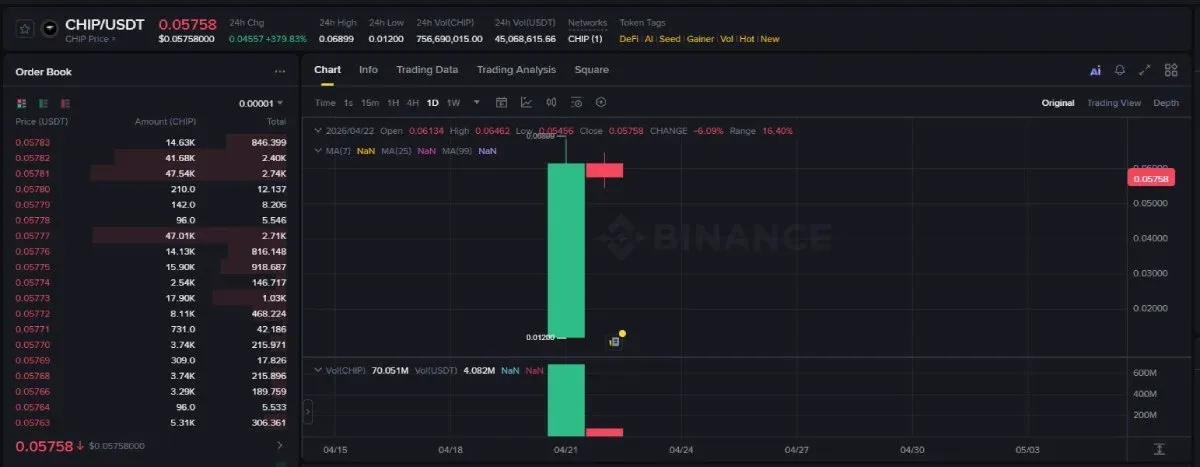
Real‑time data from April 22, 2026 shows that CHIP/USDT fluctuated between a low of $0.012 and a high of $0.06899 within a 24‑hour window, settling around $0.05758 at the time of writing. This represents a cumulative gain of roughly 379.83 %. The daily chart indicates a strong upward trend followed by a modest correction—a typical pattern of early‑investor profit‑taking.
Tax Reminder: Crypto‑related gains may be subject to taxation in your jurisdiction. Consult a tax professional to understand your obligations.
Bullish and Bearish Perspectives on CHIP
Bullish Factors
- Real‑Asset Backing – The protocol currently secures more than $656 million in Total Value Locked (TVL), with reserve funds verified on‑chain via sovereign bond holdings.
- Conservative Operations – By pairing government‑bond reserves with a gradual rollout of GPU loans, the platform has reported zero defaults to date.
- Clear Market Need – Financing gaps for AI infrastructure are substantial; traditional banks are slow and selective. USD.AI can complete a loan cycle in seven days, effectively filling the void.
- Institutional Endorsement – Multi‑million‑dollar funding rounds from Framework Ventures, Dragonfly, Coinbase Ventures, and others, plus a liquidity partnership with PayPal, reinforce credibility.
- Credit Line Allocation – The protocol has secured a $1.5 billion credit line, with a $100 million GPU‑loan tranche slated for Q1 2026. Data reliability is further bolstered by Chainlink as the oracle provider.
Bearish Factors
- Under‑Utilisation of Capital – Current loan book stands at roughly $70 million, only about 10 % of the total TVL. The majority of funds remain in sovereign bonds, meaning most yield is derived from government debt rather than AI‑related lending.
- Incentive‑Driven TVL – A large portion of liquidity is attracted through Allo points mining. If those incentives cease, a 15 %–30 % outflow could occur.
- Premature Token Valuation – CHIP launched with an estimated $300 million Fully Diluted Valuation (FDV) before the core loan model proved itself at scale. Should borrowing demand fall short, the token may face a downward re‑pricing.
- Borrower Profile – The protocol primarily serves small‑scale GPU operators and DePIN projects. Competing with large enterprises that obtain cheaper financing could keep borrowing costs relatively high (15 %–20 % APR).
- Narrative‑Reality Gap – Marketing material positions the project as a “liquid GPU debt” platform, yet the actual asset composition is still heavily weighted toward sovereign bonds, potentially leading to misconceptions about intrinsic value.
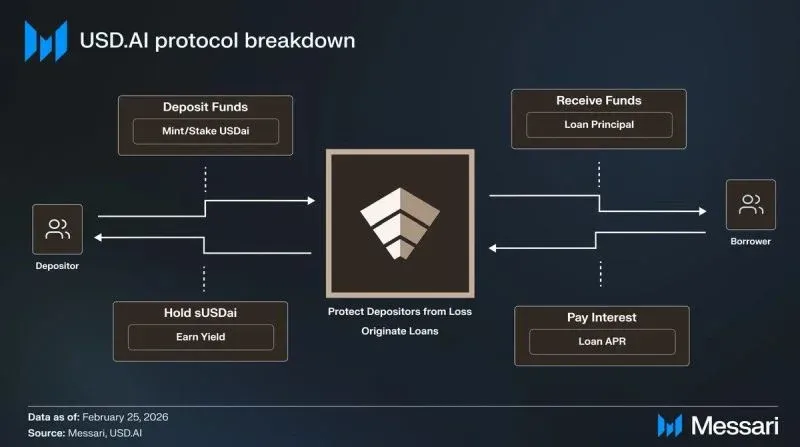
How USD.AI Operates
The system facilitates transparent capital movement across AI infrastructure through three participant roles.
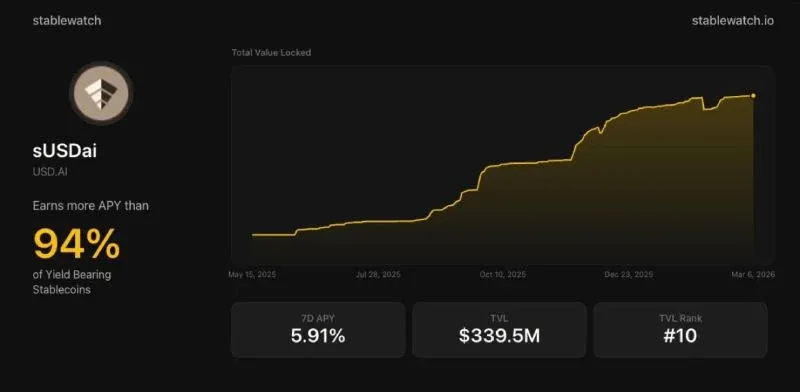
Three Technical Pillars
- CALIBER – An asset‑tokenisation framework that converts physical devices into on‑chain revenue‑generating assets.
- FiLo – A risk‑monitoring workflow that assesses financing needs and secures public‑fund contributions.
- QEV (Queue‑Extractable Value) – A priority‑auction mechanism that enables capital extraction and liquidity optimisation.
The model resembles Aave’s collateral approach, focusing solely on the value of GPU assets without evaluating borrower creditworthiness.
InfraFi Market Outlook
Opportunity from the Funding Gap
Elon Musk has estimated that the financing shortfall for AI infrastructure could reach trillions of dollars. USD.AI aims to become the specialised financial platform for this cycle, offering fast, low‑cost on‑chain funding to small‑ and medium‑size operators that are overlooked by traditional lenders.
Analogy to the “Petrodollar”
Historically, Tether achieved stability by holding U.S. Treasury bonds, while Bitcoin benefitted from the hardware‑debt market. USD.AI seeks to replicate this dual‑asset backing, positioning itself as a foundational currency for the forthcoming era of Artificial General Intelligence (AGI).
Composable DeFi Primitives
The project inherits the MetaStreet architecture, delivering highly composable modules. The QEV‑Boost system functions similarly to Flashbots, orchestrating auction‑based capital extraction; stakers can participate to obtain priority liquidity, while non‑participants continue to share in fees and overall returns.
Conclusion
This article has systematically examined the definition, tokenomics, price performance, and bullish/bearish considerations surrounding the USD.AI (CHIP) token. For further information on USD.AI (CHIP), you may explore past articles on Bitaigen or continue reading the recommended pieces listed below. Thank you for following along, and we look forward to your continued support of Bitaigen!
Related Reading
💡 Register on Binance with referral code B2345 for the maximum trading fee discount. See Binance complete guide.



