
 Bitaigen Research
 This article provides an in‑depth examination of the core value, operating mechanism, and pivotal role of the USD‑denominated stablecoin USDC (USD Coin) within the cryptocurrency market projected for 2025. Written from an objective third‑party perspective, it dissects how USDC maintains a stable value through a one‑to‑one asset reserve backed by U.S. dollars, and details how the issuer Circle upholds market trust through stringent regulatory compliance and transparent audit reporting.
The text also offers a comparative analysis of USDC versus its main competitor USDT, focusing on reserve transparency, regulatory compliance, and market application differences, thereby highlighting USDC’s advantages in compliance and security.
Furthermore, the article explains USDC’s cross‑chain interoperability across multiple blockchain networks and its extensive usage in decentralized finance (DeFi), global payments, and institutional fund management. The goal is to give both retail and professional investors a comprehensive and deep understanding of why USDC is regarded as a more robust and trustworthy digital‑dollar option on licensed exchanges such as HashKey Exchange, which are regulated by the Hong Kong Securities and Futures Commission (SFC).
From the three dimensions of regulatory compliance, asset transparency, and cross‑chain interoperability, we systematically dissect USDC’s core mechanism and compare it with USDT, helping investors understand why, in DeFi and institutional‑finance scenarios, USDC is often the preferred choice. Continue reading to obtain a full analysis of its operating principles and real‑world applications.
What Is USDC? From Basic Concept to Operating Principle
Before we dive into the limitless possibilities of digital assets, we must first establish a solid foundation of understanding. Imagine standing at one end of a bridge: on one side lies the traditional financial world—Hong Kong dollars, U.S. dollars, bank accounts, and credit cards; on the other side lies the innovative and opportunity‑rich crypto world—Bitcoin, Ethereum, and decentralized finance (DeFi). The bridge we are discussing today is the stablecoin, and USDC (USD Coin) is one of the most solid and trustworthy planks of that bridge.
What is USDC? Literally, USDC is defined as a “stablecoin.” The term itself embeds its core mission: to provide a value‑stable digital asset within the highly volatile cryptocurrency market. Unlike Bitcoin or Ethereum, whose prices can swing dramatically, USDC is designed to be strictly pegged to one U.S. dollar. In theory, you can exchange 1 USDC for 1 USD at any time, and vice‑versa.
This stability does not appear out of thin air; it stems from a careful and transparent financial design. The issuers, led by Circle within the CENTRE consortium, pledge that every USDC token circulating on a blockchain is backed by an equivalent amount of U.S. dollars or high‑quality liquid assets. You can think of it as a bank’s safety‑deposit certificate: you deposit one dollar, the bank gives you a certificate worth one dollar; USDC is that certificate in the digital realm, while Circle’s reserve acts as a vault that is subject to strict regulation and audit.
The Birth and Mission of USDC
USDC was launched in 2018 by the CENTRE alliance, a joint effort of Circle and Coinbase. At that time, the crypto market was experiencing extreme volatility, prompting investors to worry about pure speculation and to look for a reliable medium of exchange and store of value. Bitcoin’s original design was a “peer‑to‑peer electronic cash system,” but its price swings made it unsuitable for everyday payments. No one wants to buy a coffee today with Bitcoin worth HK$50 and see it rise to HK$100 tomorrow.
USDC was created precisely to solve this pain point. Its mission is to combine the stability of the U.S. dollar with the efficiency, global reach, and transparency of blockchain technology. By “tokenizing” the world’s primary reserve currency—the U.S. dollar—USDC aims to build a more open and inclusive global financial system (BIS and BIS CPMI, 2024). It not only offers crypto traders a safe harbor where they can temporarily park assets during market turbulence, but more importantly, it supplies blockchain‑based applications (such as DeFi, global payments, and digital settlement) with a reliable accounting unit and exchange medium.
How USDC Works: Minting and Redemption
Understanding USDC’s operating mechanism can be likened to a bank’s deposit‑withdrawal process and consists of two main steps: minting and redeeming.
Minting: Converting Dollars into USDC
- Request Initiation – An institutional user (for example, a licensed exchange like HashKey Exchange) that needs additional USDC sends a request to Circle.
- Dollar Deposit – The institution wires the corresponding amount of U.S. dollars through the traditional banking system into Circle’s designated, regulated bank account.
- Smart‑Contract Execution – Once Circle confirms receipt of the dollars, it triggers a smart contract deployed on a chosen blockchain (e.g., Ethereum) to automatically mint an equivalent amount of USDC. The contract follows pre‑programmed rules to ensure the process is accurate and efficient (Norton Rose Fulbright, 2019).
- USDC Distribution – The newly minted USDC is transferred to the institution’s digital wallet, after which it can be offered to retail users on the platform or used for other financial activities.
Redemption: Converting USDC Back into Dollars
- Redemption Request – When the institutional user wants to turn USDC back into fiat, it submits a redemption request to Circle.
- USDC Transfer – The institution sends the USDC slated for redemption to the blockchain address specified by Circle.
- Smart‑Contract Burn – Upon receiving the USDC, the contract instantly “burns” (destroys) the tokens, permanently removing them from circulation and guaranteeing that the total supply always matches the dollar reserve.
- Dollar Return – After confirming the burn, Circle wires an equivalent amount of U.S. dollars back to the institution’s bank account via the traditional banking system.
This closed‑loop system forms the cornerstone of USDC’s price stability, ensuring that every token in circulation is backed by real‑world dollars, thereby cementing confidence in the 1:1 peg. The entire process emphasizes transparency, compliance, and the rigor associated with conventional finance.
Key Point 1: Transparency of USDC Reserves and the Auditing Mechanism
When discussing USDC, the most fundamental issue is its underlying reserve. A stablecoin’s reputation is entirely built on the quality and transparency of its backing assets. If we compare USDC to a building, the reserves are the foundation; any doubt about the foundation’s solidity can cause the entire structure to collapse. Circle understands this deeply and has placed transparency at the highest operational priority from day one.
Composition of the Reserve: More Than Cash
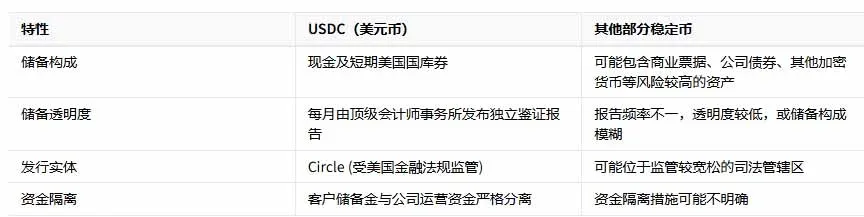
Many people mistakenly assume that USDC’s reserve consists of 100 % cash deposits. In reality, to enhance capital efficiency while preserving safety and diversifying risk, Circle adopts a more prudent asset allocation. According to its periodic reports, USDC’s reserve is primarily composed of two parts:
- Cash and Cash Equivalents – Held in segregated accounts at U.S.‑regulated financial institutions (e.g., BNY Mellon). This segregation ensures that user assets are kept separate from Circle’s operating funds, meaning that even if Circle were to encounter financial trouble, the user reserve would remain untouched.
- Short‑Term U.S. Treasury Bills – Debt instruments issued by the U.S. government that are considered “almost risk‑free” by global markets. Investing in Treasury bills provides safety while generating a modest interest income that helps cover USDC’s operating costs.
Circle explicitly commits not to invest reserve funds in cryptocurrencies, corporate bonds, commercial paper, or any other high‑risk assets. This conservative reserve strategy is a key reason USDC has maintained its value during extreme market stress events that caused other stablecoins to lose their pegs.
Monthly Attestation Reports: A Commitment to Openness
Commitments must be verified. To prove the authenticity and adequacy of the reserves, Circle commissions leading global accounting firms (historically working with Grant Thornton LLP) to perform an independent third‑party attestation each month.
These attestation reports are publicly posted on Circle’s official website and are accessible to anyone. Each report lists:
- The total amount of USDC in circulation as of a specific point in time (typically the last day of the month);
- The total amount of U.S. dollar cash held in the reserve accounts;
- The market value of U.S. Treasury Bills held within the reserve portfolio.
The core conclusion of each report confirms whether the total market value of reserve assets is equal to or exceeds the total USDC supply. This monthly “health check” provides continuous market confidence, acting like a transparent glass box that lets observers see the assets inside, thereby dispelling doubt. This level of transparency is regarded as the gold standard in the stablecoin arena and is the primary reason USDC can be described as a publicly verifiable, fully backed digital dollar.
The table below offers a concise side‑by‑side comparison of USDC’s transparency and reserve composition characteristics, helping readers quickly grasp its robustness.
Key Point 2: A Compliance‑First Regulatory Framework
In the digital‑asset sector, innovation often outpaces regulation. However, once technology begins to interact with billions of dollars of real capital, compliance shifts from optional to essential. For USDC, “compliance first” is not just a slogan; it is the core strategic pillar that underpins its survival and growth. Understanding USDC therefore requires insight into its positioning within an increasingly stringent global financial regulatory environment.
The U.S. Regulatory Landscape
Circle, the primary issuer of USDC, is headquartered in Boston, United States, and has pursued a regulatory‑friendly path since its inception. Circle holds multiple Money Transmitter Licenses across U.S. states and operates under the close supervision of both federal and state financial regulators.
Regulatory requirements span several dimensions:
- Anti‑Money‑Laundering (AML) – Circle must comply with the Bank Secrecy Act and related statutes, establishing robust AML procedures that include Know‑Your‑Customer (KYC) checks, transaction monitoring, and filing Suspicious Activity Reports (SARs) to prevent USDC from being used for illicit purposes.
- Counter‑Terrorist Financing (CFT) – Similar obligations exist to ensure the platform is not leveraged to fund terrorism.
- Sanctions Compliance – Circle must adhere to the U.S. Treasury’s Office of Foreign Assets Control (OFAC) sanctions list. If a blockchain address appears on the OFAC list, Circle has the technical ability to freeze the USDC held at that address. While this capability sparks debate about centralization and censorship resistance, from a compliance standpoint it is an indispensable function for a regulated financial institution.
Operating under the world’s strictest regulatory regime and voluntarily embracing oversight are key steps that have earned USDC the trust of institutional players. When large financial institutions evaluate potential partners, regulatory compliance is usually the top criterion, making USDC’s positioning more readily acceptable to the mainstream financial system.
Hong Kong’s Licensed Regime and USDC’s Role
Hong Kong, as an international financial hub, is actively shaping a clear licensing framework for Virtual Asset Service Providers (VASP). The Securities and Futures Commission (SFC) has begun issuing licences to virtual‑asset trading platforms, permitting them to serve retail investors.
Within this context, the role of stablecoins becomes especially significant. The SFC’s regulatory framework imposes strict standards on the types of tokens that licensed platforms may list for retail customers, focusing on two core criteria: the token must not be classified as a security and must exhibit high liquidity. USDC, with its transparent reserve backing, broad global adoption, and clear regulatory posture, naturally aligns with these prudential standards.
For Hong Kong investors, trading USDC on a compliant platform that holds both a Type 1 (Securities Trading) and Type 7 (Automated Trading Service) licence—such as HashKey Exchange—means an additional layer of protection. These platforms are required to comply with stringent rules, including:
- Asset Security – At least 98 % of user crypto assets must be stored in cold wallets (offline storage) to reduce the risk of large‑scale theft via hacking.
- Insurance Coverage – Platforms must purchase insurance for assets, providing compensation in the event of extreme loss scenarios.
- Financial Audits – Regular independent audits are mandatory.
- Conflict‑of‑Interest Safeguards – Proprietary trading or other activities that could disadvantage customers are prohibited.
Consequently, when USDC is discussed in the Hong Kong environment, it is not merely a stable digital dollar; it is a compliance‑driven bridge linking local investors to the global crypto economy. Trading USDC within a regulated setting allows participants to explore digital assets with reduced fear of platform failures or asset theft—exactly the protective intent behind the SFC’s licensing regime (European Parliament, 2023).
Key Point 3: Cross‑Chain Ecosystem and Broad Use‑Case Spectrum
If transparent reserves and strict compliance represent USDC’s “inner beauty,” its powerful cross‑chain ecosystem and wide‑ranging applications constitute its “outer value.” The vitality of a digital asset hinges on how extensively and deeply it is used. USDC demonstrates remarkable dynamism and adaptability in this regard, functioning not only as a passive store of value but also as an active economic catalyst.
Cross‑Chain Interoperability: Breaking Down Silos
Early blockchain ecosystems resembled a collection of isolated islands; assets minted on Ethereum could not be directly utilized on other chains such as Solana or Polygon, limiting liquidity and application scope.
From the outset, USDC set out to overcome this limitation. Circle has actively partnered with leading blockchains to issue USDC in a native form on multiple networks. As of 2025, USDC is natively available on more than ten major chains, including Ethereum, Solana, Polygon, Avalanche, TRON, Stellar, and others.
“Native” issuance means that each chain’s USDC is minted and supported directly by Circle, rather than being a wrapped version that relies on a bridge. While bridges enable asset movement, they have historically been vulnerable points that hackers target. Native USDC sidesteps these risks, guaranteeing that USDC held on any supported chain enjoys the same security and redeemability guarantees.
This extensive cross‑chain deployment turns USDC into a “universal currency” for the entire crypto universe. Developers can build applications on whichever chain offers the best performance or cost profile without worrying about the availability of a stable settlement token. Users can seamlessly move value across ecosystems, dramatically improving capital efficiency.
The Bedrock of DeFi: Fuel for Decentralized Finance
DeFi seeks to create an open, permission‑less financial system without intermediaries. USDC acts as the “blood” that circulates through this system, providing liquidity and stability to a myriad of protocols.
- Decentralized Exchanges (DEXs) – On platforms such as Uniswap and Curve, USDC is one of the primary trading pairs. Users can swap other assets for USDC with ease, while liquidity providers earn transaction fees by supplying USDC.
- Lending Platforms – Protocols like Aave and Compound allow users to deposit USDC to earn interest or to collateralize Bitcoin, Ethereum, and other assets in order to borrow USDC, giving asset holders flexible ways to generate yield or obtain liquidity.
- Derivatives and Structured Products – Many sophisticated DeFi offerings (perpetual contracts, options, structured notes) are denominated and settled in USDC, whose price stability simplifies financial calculations and risk management.
Without a reliable stablecoin such as USDC, the DeFi ecosystem would struggle to reach its current scale and complexity. USDC supplies the steady anchor that lets the volatile crypto world operate with confidence.
Beyond DeFi: Global Payments and Institutional Treasury Management
USDC’s reach now extends beyond crypto‑native environments, permeating traditional finance and commercial use cases.
- Global Payments and Remittances – Conventional cross‑border transfers often require multiple correspondent banks, taking days and incurring high fees. With USDC, businesses or individuals can settle worldwide transfers in minutes—or even seconds—paying only the modest blockchain network fee, which is typically negligible. This capability holds disruptive potential for international trade, freelance invoicing, and diaspora remittances.
- Institutional Treasury Management – An increasing number of fintech firms, crypto funds, and even legacy enterprises are incorporating USDC into their digital treasury strategies
💡 Register on Binance with referral code B2345 for the maximum trading fee discount. See Binance complete guide.



