
 Bitaigen Research
Starting from on‑chain data, we deeply analyze how USDC managed a contrarian breakout against USDT this month, explore the driving forces behind it, and assess the potential impact on the stable‑coin landscape. The full article will help you grasp market dynamics and anticipate possible future developments.
Key Takeaways
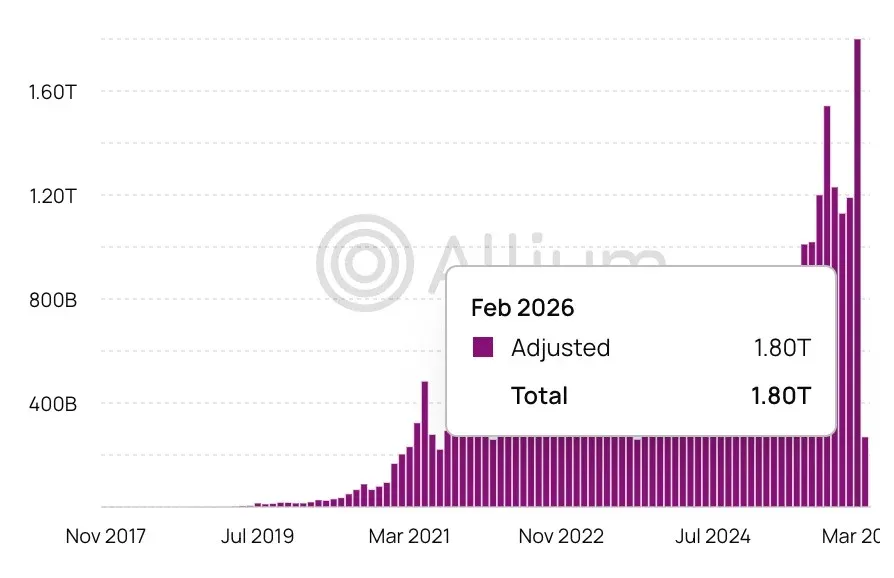
- In February, the total monthly transfer volume of all stablecoins surpassed the $1.8 trillion mark.
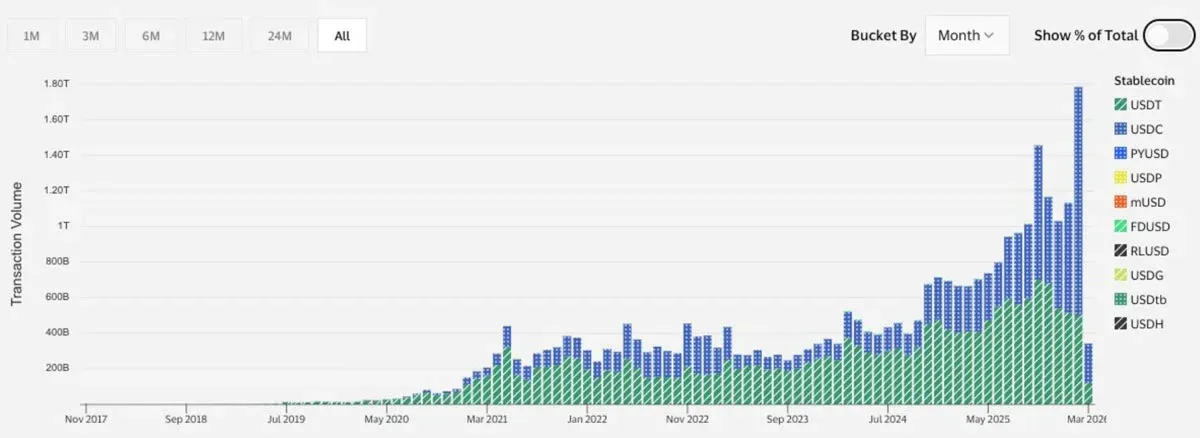
- USDC alone accounted for roughly 70 % of that volume, cementing its leading position.
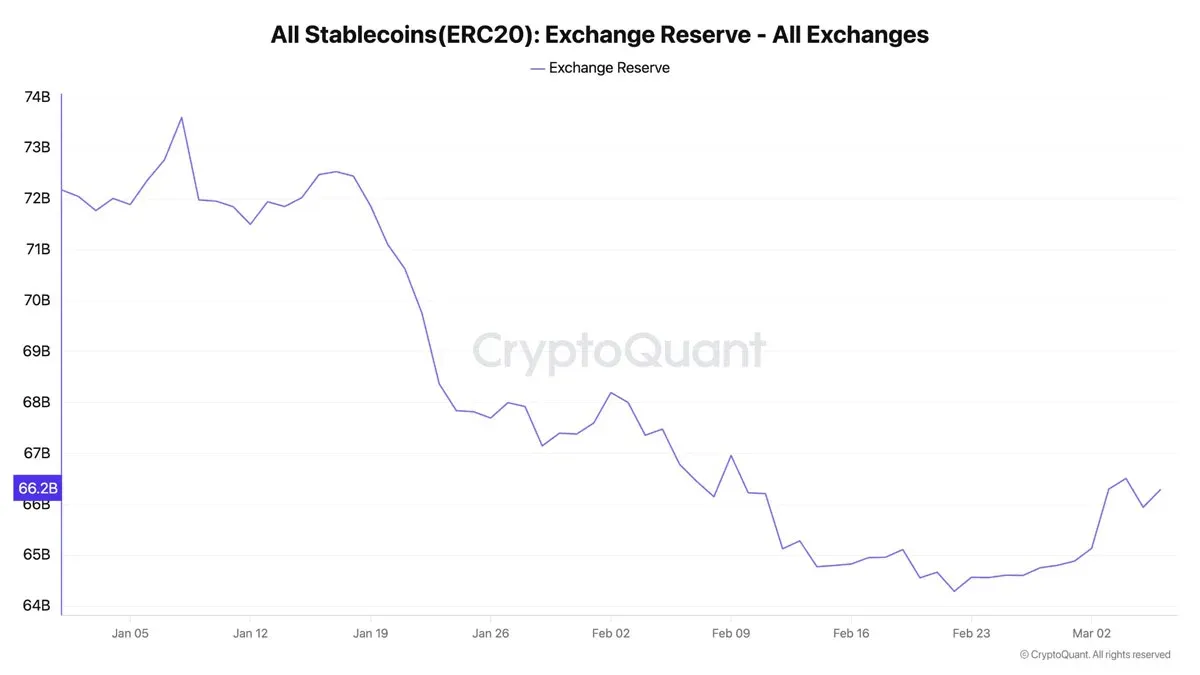
- The rise in stable‑coin supply on exchanges has provided strong support for the broader crypto market’s recovery.
USDC Continues to Capture USDT Share
Data from Allium shows that February’s overall stable‑coin transfer volume reached $1.8 trillion, a historic high. USDC’s transfer volume this month surged to $1.26 trillion, more than twice the $514 billion handled by USDT. Since the first batch of stablecoins launched in September 2018, USDC has achieved a milestone growth that positions it as the second‑largest stablecoin by market cap.
Simon Dedic, founder of Moonrock Capital, disclosed on X that over the past several months USDC’s transfer volume “has been reversing” USDT’s lead. He noted that the sheer scale of USDC usage is striking given its market cap is only about half that of USDT—approximately $77.4 billion for USDC versus close to $184 billion for USDT.
Accelerating on the Supply Side
According to market‑intelligence firm Arkham, USDC’s minting rate in March far outpaced that of USDT. In the first week of March alone, Circle minted more than $3 billion worth of USDC on Solana, and the cumulative minting is expected to exceed $12 billion by the end of the month. By contrast, USDT’s supply has remained essentially flat.
“CIRCLE just minted another $250 million of USDC on Solana. In the first week of March they minted over $3 billion.”
— Arkham (@arkham), March 7 2026
Cointelegraph reported that Circle Internet Group’s Q4 2025 earnings release highlighted rapid USDC business expansion and the broadening of payment‑use cases as the primary drivers of revenue growth.
Stable‑Coin Liquidity and Market Buying Power
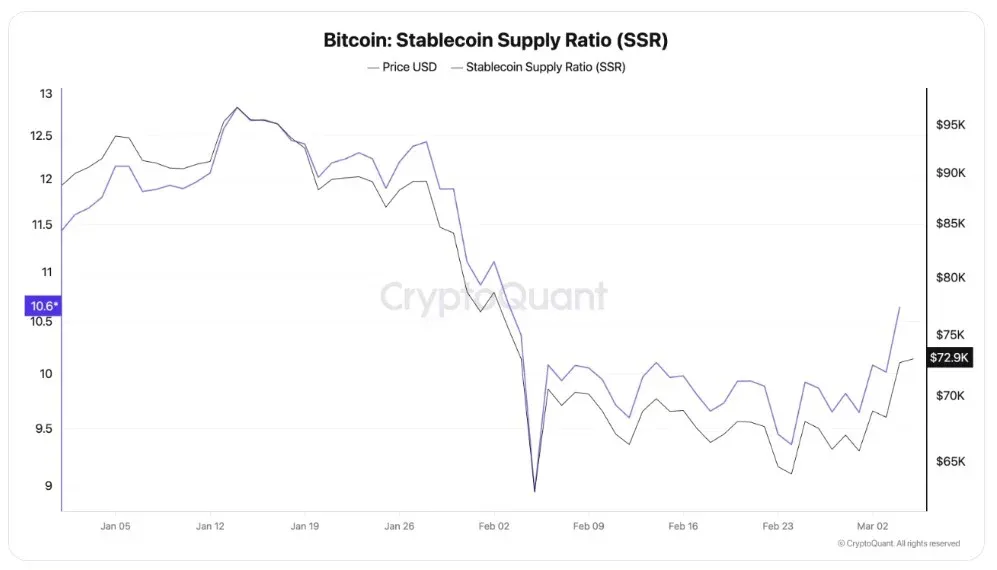
CryptoQuant analyst Sunny Mom indicated in Friday’s briefing that after a sharp decline, the total market cap is gradually recovering in February, “signalling that buying power is returning.” The Stablecoin Supply Ratio (SSR) for Bitcoin rose accordingly, and Bitcoin’s price has recently stabilized around $74,000.
Exchange‑level stable‑coin supply also showed a rebound. By March 5, the amount of stablecoins flowing into exchanges had reached nearly $5.14 billion, up sharply from $1.14 billion on March 1. As more stablecoins move onto exchanges, overall buying power improves, a factor often viewed as a potential catalyst for a Bitcoin bull market. *(U.S. users should access exchange services via Binance.US rather than the global Binance platform.)*
The above data illustrate how USDC’s $1.8 trillion monthly transfer volume is challenging Tether’s long‑standing dominance. For further insight into whether USDT’s leading position is truly wavering, follow the coverage from Bitaigen.
💡 Register on Binance with referral code B2345 for the maximum trading fee discount. See Binance complete guide.
⚠️ Risk Disclaimer: Crypto prices are highly volatile. This is not investment advice.



