
 Bitaigen Research
Artificial intelligence is rapidly finding a foothold in the blockchain space. From automated trading bots to AI‑driven decision‑making tools, on‑chain agents are being built to perform complex tasks without continuous human supervision. While the idea of self‑running smart agents is alluring, it also raises a fundamental question: how can we trust an AI to interact directly with crypto assets? Traditional blockchains were not designed with agent‑level permissions, auditability, or security guarantees in mind, and handing private keys over to an AI introduces a host of risks.
Warden Protocol (WARD) proposes a solution. It positions itself as a “global agent network,” offering a suite of security‑focused infrastructure that lets AI agents operate independently within strict policy and verification boundaries. By combining programmable permissions, cross‑chain communication, and verifiable execution, Warden aims to inject order and safety into the fast‑evolving world of on‑chain autonomous activity. This article explains what Warden Protocol (WARD) is, who built it, how it works, where its funding comes from, and what role its token plays in the broader crypto‑and‑AI narrative.
From both a technical and an ecosystem perspective, we break down how the Warden Protocol (WARD) provides a trustworthy on‑chain runtime for AI agents, dissect its core mechanisms, token model, and roadmap, and help readers assess its potential value within a decentralized security framework. Keep reading to learn about the design philosophy behind the project and its future development direction.
What Is Warden Protocol (WARD)?
Warden Protocol is a blockchain network purpose‑built to support AI agents that run autonomously on‑chain. Its core goal is to allow those agents to execute tasks such as managing digital assets, initiating transactions, or interacting with other protocols within a secure and verifiable boundary. Warden is built on the Cosmos SDK and functions as a Layer 1 chain that provides a programmable, cross‑chain environment where each agent possesses its own on‑chain identity and reputation. Agent behavior is governed by custom policy rules that explicitly delineate which actions are permissible, thereby preventing unexpected conduct and reducing the risk of exploitation.
To guarantee reliability, Warden implements a Statistical Proof of Execution (SPEx) mechanism. This system randomly samples and checks an agent’s output, generating an on‑chain receipt that details what operation was performed and why. In this way, agent activity becomes transparent and auditable. Warden also integrates an interoperability framework, enabling agents to operate across multiple blockchains while remaining constrained to the permissions allocated to them. In short, Warden is constructing an infrastructure layer that lets AI agents act independently in the crypto ecosystem without sacrificing control, oversight, or security.
Who Created Warden Protocol (WARD)?
Warden Protocol was developed by a team of blockchain developers, AI engineers, and infrastructure specialists under the umbrella of Warden Labs. The founding members include David Pinger, who leads ecosystem and partnership efforts; Antonio Pitasi, the protocol’s chief architect; former Equilibrium DeFi CEO Alex Melikhov; and Jon Heywood, responsible for product design and user‑facing applications. Their backgrounds span companies such as Uber, Binance, EOSIO, and Tendermint, providing the project with comprehensive experience in both blockchain infrastructure and product development.
The broader leadership team is headed by former Binance and Huobi executive Josh Goodbody, who serves as CEO. Josh, together with Luis Vaello Garcia and other members, co‑founded Warden Labs. According to the official statement, the team initially bootstrapped the protocol with its own capital and later brought in strategic partners. The project has also enlisted advisors and engineers with deep expertise in cryptography, AI model optimization, and Web3 security. This interdisciplinary mix reflects the technical complexity required to securely integrate AI with on‑chain execution.
Which Venture Capitalists Support Warden Protocol (WARD)?
Warden Protocol follows a strategic fundraising approach, emphasizing partnerships over traditional venture capital rounds. In January 2026, the project raised US $4 million in a strategic financing round at an approximate valuation of US $200 million. The round attracted investors active in AI and crypto‑infrastructure, including the AI‑focused blockchain infrastructure firm 0G, the well‑known crypto analysis platform Messari, and Venice.AI, which concentrates on decentralized AI applications.
The team noted that this round was not heavily publicized; the capital mainly came from entities whose missions align with the protocol—largely developers and infrastructure providers directly involved in building the Warden ecosystem. Prior to that, in early 2024, the project secured a modest US $450 k seed from a handful of angel investors. By deliberately avoiding a massive seed round, Warden has been able to grow alongside contributors who share a long‑term vision, focusing on building secure, verifiable AI agents on‑chain.
How Does Warden Protocol (WARD) Operate?
Warden Protocol’s design enables AI agents to run securely, with permissions and verifiability, across multiple blockchains. Rather than handing full control to autonomous agents, Warden introduces a system of policies, key‑security practices, and built‑in verification governance that creates a trust‑minimized environment. Agents can therefore function without jeopardizing user assets or network integrity.
- Agent Accounts and Identity: Every agent deployed on Warden has its own on‑chain account and cryptographic identity. These accounts publicly record behavior, performance, and permission data, helping to establish trust and accountability within the network.
- Policy‑Based Permissions: Developers and users can define concrete rules that limit an agent’s operational scope. Programmable policies may restrict access to specific tokens, set transaction caps, or require multi‑sig approval for sensitive actions.
- MPC Threshold Key Management: Warden employs Multi‑Party Computation (MPC) threshold cryptography to protect private keys. No single party ever holds the complete key, reducing the attack surface. Agent transactions must receive partial approvals from multiple nodes before execution.
- Cross‑Chain Communication: Agents on Warden can use IBC, Hyperlane, deBridge and other cross‑chain technologies to send and receive instructions to other blockchains, enabling interaction with assets and protocols across the wider crypto ecosystem.
- Statistical Proof of Execution (SPEx): To validate agent outputs, Warden uses a statistical audit system. SPEx does not perform a full‑scale check on every AI decision; instead, it samples a subset of outputs to ensure accuracy and consistency, and it generates an on‑chain proof or receipt for each verified task.
- Developer and User Tools: Warden provides user‑facing applications that let participants browse, activate, and interact with agents; developers can publish and manage agents via Warden Studio, which also supports monetization and reuse of agent services.
Together, these components create a complete environment where secure, verifiable, and autonomous AI agents can operate within the blockchain ecosystem.
Warden Protocol (WARD) Tokenomics
WARD is the native utility token of the Warden Protocol ecosystem, designed to support the secure cross‑chain operation of AI agents and on‑chain verification. It aligns incentives among developers, validators, users, and infrastructure providers while ensuring the long‑term sustainability of the global agent network. Within the protocol, WARD functions as the primary medium for payment, staking, and governance.
Token Details
- Ticker: WARD
- Total Supply: 1 000 000 000 WARD (fixed)
- Launch Date: January 2026
- Supply Model: Controlled release with vesting; the supply cap is fixed, and the initial adjustable inflation target is 8 % annualized
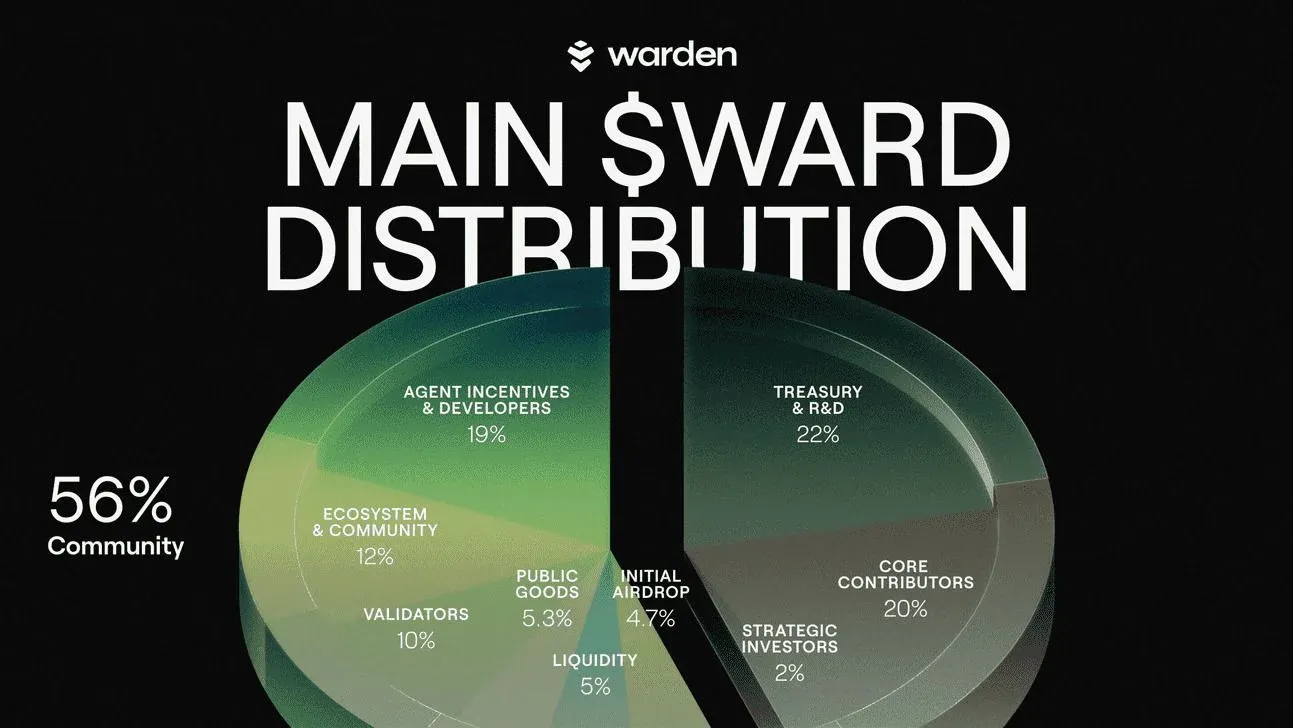
Token Distribution
- Initial Airdrop (4.70 %) – 47 million WARD allocated to early users; 30.32 million released at genesis, the remainder linearly over six months.
- Public Treasury (5.30 %) – Supports user incentives via activity‑based rewards. 10 million unlocked at launch, the rest linearly over 30 months.
- Ecosystem & Community (12.00 %) – Funds marketing, partnerships, events, and infrastructure. 20 million released at genesis, the remainder linearly over 30 months.
- Liquidity (5.00 %) – 50 million reserved for exchange listings and market‑making; fully unlocked at genesis.
- Agent Incentives & Developers (19.00 %) – Grants and rewards for deploying agents and applications. 20 million available at launch, released linearly over 12 months.
- Validators (10.00 %) – 100 million dedicated to network security delegation. Permanently locked, never entering circulation.
- Treasury & R&D (22.00 %) – Covers operating costs, research & development, and future strategic financing. 120 million unlocked at genesis, an additional 100 million linearly over 12 months.
- Strategic Investors (2.00 %) – 20 million set aside for participants in the 2026 strategic round. After a 12‑month cliff, released linearly over the following 12 months.
- Core Contributors (20.00 %) – Reserved for the founding team and advisors, with a 6‑month cliff and a 2‑year linear release schedule.
Token Use Cases
- Agent Execution Fees – Calling an AI agent requires payment in WARD, covering computation, verification, and cross‑chain operation costs on supported blockchains.
- On‑Chain Verification (SPEx) – Fees for the statistical proof of execution are paid in WARD; the probabilistic audit mechanism records and validates agent behavior on‑chain.
- Publishing & Upgrades – Developers spend WARD to publish, update, and register AI agents or reusable agent modules (AVR) within the Warden ecosystem.
- Staking & Network Security – Validators and delegators stake WARD to protect the protocol and earn rewards, contributing to consensus and infrastructure reliability.
- Ecosystem Access & Premium Features – Holders may obtain higher‑tier agent services, elevated usage limits, or controlled‑access functionalities within Warden applications and tools.
- Governance (Future) – WARD is slated to become the governance token, enabling proposals and voting on protocol upgrades, fund allocations, and parameter adjustments.
Warden Price Forecast
2026 Price Forecast
The projected price range for WARD in 2026 is $0.008683 – $0.04314, with an average around $0.0259. Under the best‑case scenario, the overall price may experience an approximate ‑5.66 % correction during the year.
2027‑2032 Price Forecast
For the period 2027‑2032, forecasts span $0.017152 – $0.134823. If the upper bound materializes, the price could reach $0.227528 by 2029, representing a rise of roughly 194.84 % from current levels.
2032‑2037 Price Forecast
From 2032‑2037, the range widens to $0.1150099 – $1.55. Should the highest estimate be achieved, the price may climb to $2.45 in 2037, an increase of about 3,292.85 % over today’s price. These figures are for general reference only and should not be construed as investment advice.
Tax Note: Crypto‑related gains may be taxable in the holder’s jurisdiction. Users should consult local tax professionals to understand reporting obligations.
| Year | Potential Low (USD) | Average (USD) | Potential High (USD) |
|---|---|---|---|
| 2027 | 0.008335 | 0.017152 | 0.025968 |
| 2028 | 0.015218 | 0.031990 | 0.048763 |
| 2029 | 0.042117 | 0.134823 | 0.227528 |
| 2030 | 0.027388 | 0.090881 | 0.154374 |
| 2031 | 0.034090 | 0.059707 | 1.000000 |
| 2032 | 0.050004 | 0.115010 | 0.180015 |
| 2033 | 0.152665 | 0.450124 | 0.747583 |
| 2034 | 0.089990 | 0.227088 | 0.364185 |
| 2035 | 0.114612 | 0.197479 | 0.280346 |
| 2036 | 0.176261 | 0.435225 | 0.694189 |
| 2037 | 0.646638 | 1.550000 | 2.450000 |
2026 Price
According to the latest experimental model, WARD’s value in 2026 is expected to lie between $0.008683 and $0.04314, with an overall possible correction of roughly ‑5.66 %.
2027 Price
The model indicates that 2027 could see a price range of $0.008335 – $0.025968, with a worst‑case decline of about ‑43.21 %.
2028 Price
In the best scenario, 2028 could reach $0.048763, with the annual range spanning $0.015218 – $0.048763, implying a modest upside of roughly 6.64 %.
2029 Price
If the upper bound is achieved, 2029 could climb to $0.227528, a full‑year range of $0.042117 – $0.227528, suggesting a potential gain of about 397.57 %.
2030 Price
Forecasts show a 2030 high of $0.154374, with a yearly band of $0.027388 – $0.154374, representing a rise of roughly 237.59 %.
2031 Price
The model estimates a 2031 peak of $0.085323, with a range of $0.034090 – $0.085323, indicating an increase of about 86.59 %.
2032 Price
Under the most optimistic scenario, 2032 could hit $0.180015, with a band of $0.050004 – $0.180015, a gain of roughly 293.67 %.
2033 Price
The highest forecast for 2033 is $0.747583, with a range of $0.152665 – $0.747583, implying a surge of about 1,534.85 %.
2034 Price
The 2034 peak is projected at $0.364185, with a band of $0.089990 – $0.364185, a rise of roughly 696.42 %.
2035 Price
The top estimate for 2035 is $0.280346, with a range of $0.114612 – $0.280346, indicating a gain of about 513.07 %.
2036 Price
The 2036 high forecast is $0.694189, with a band of $0.176261 – $0.694189, a potential increase of roughly 1,418.09 %.
2037 Price
The highest projection for 2037 is $2.45, with a range of $0.646638 – $2.45, suggesting a massive upside of about 5,271.59 %.
Fiat Conversion Note: All price figures are quoted in U.S. dollars (USD). Users purchasing WARD with fiat outside the United States may do so via SEPA or SWIFT transfers, depending on their local banking options. U.S. residents should use Binance.US (or other regulated U.S. exchanges) rather than the global Binance platform.
Future Development and Roadmap
The future of the token is tightly linked to the successful execution of the project’s roadmap. Warden Protocol has laid out an ambitious plan to build a robust, interoperable future for blockchain interaction.
Key Roadmap Milestones
- **Mainnet V
💡 Register on Binance with referral code B2345 for the maximum trading fee discount. See Binance complete guide.



