
 Bitaigen Research
 In a relatively quiet holiday‑trading environment, XRP is hovering around $1.89, edging close to a key technical support level. The 24‑hour trading volume is roughly $167.8 million, indicating a dip in institutional participation. With no significant fundamental catalyst, the price action is now largely dependent on chart‑based support and resistance. The Relative Strength Index (RSI) sits near 39.89, placing it in a neutral zone without clear over‑bought or over‑sold signals. Moreover, all major moving averages sit above the current price, suggesting that the long‑term trend still faces downward pressure.
In this article we break down XRP’s current technical shape, institutional dynamics, and regulatory environment. By combining these observations with a long‑term trend model, we assess the token’s potential value over the next decade and beyond. Detailed data and chart analysis are provided to help readers form a rational view on whether the cryptocurrency can realistically reach higher price levels.
What Is XRP?
XRP is the native token of the Ripple network, launched by the U.S. company Ripple Labs in 2012 with a total supply of 100 billion units. Ripple’s mission is to build a cross‑border payments network tailored for financial institutions, and XRP serves as the settlement currency that enables rapid, low‑cost conversion and transfer between fiat currencies within 2‑5 seconds.
Compared with Bitcoin and Ethereum, XRP offers faster transaction speed, lower fees, and higher throughput, giving it a distinct advantage in certain financial use cases such as swift asset movement and inexpensive settlement. In 2024, Ripple announced an entry into the stablecoin arena, planning to release a U.S. dollar‑backed stablecoin later in the year that will operate on both Ethereum and its own XRP Ledger (XRPL). In the same month, the company completed the acquisition of Standard Custody, a holder of a New York Department of Financial Services (NYDFS) BitLicense, laying the groundwork for regulated digital‑asset custody services in New York.
It is worth noting that many newcomers mistakenly conflate XRP with Ripple or even think of it as a Bitcoin variant. In reality, XRP is an independent digital token, while Ripple is the corporate entity that provides the underlying payment network and related services.
Core Drivers for XRP Toward 2035
Looking a decade ahead, XRP’s outlook hinges on several fundamental factors:
- Deflationary Mechanism – The total supply is capped at 100 billion tokens. Each transaction incurs a tiny fee that is permanently destroyed. Currently about 5,000 XRP are burned daily. If network activity were to increase substantially, the circulating supply could shrink by roughly 40 % over ten years, creating scarcity that, in theory, could push the price toward $4.17 solely on a supply‑demand basis.
- Prospects for a Spot ETF – In July 2025, Bloomberg’s ETF analysts assigned a 95 % probability that a spot XRP ETF would receive approval that year. Regulatory clearance would give traditional capital a regulated channel to gain exposure, potentially attracting large inflows and reshaping valuation models.
- Real‑World Adoption – Unlike pure speculation tokens, XRP’s core value proposition lies in providing banks and financial institutions with low‑cost, instant cross‑border payment solutions. As Ripple expands its global partner network and XRPL deepens its role in tokenizing real‑world assets, demand could see material growth.
XRP Price Forecast for 2035
Aggregating analyses from several research houses, market participants hold relatively high expectations for XRP in 2035, though the underlying scenarios differ.
The most bullish outlook comes from Telegaon:
- 2030 – Average price around $42.34, with peaks possibly reaching $48.03.
- 2035 – Average price projected at $78.16, with a high of $87.49.
- 2040 – Average price further climbing to $146.86.
If an investor were to allocate $2,300 today (approximately the price of 1,000 XRP at $2.30 each) and hold until 2035, the market value of that position could approach $78,000 under Telegaon’s scenario.
A different model focuses on supply‑demand balance: assuming a 40 % supply reduction due to token burn and a 50 % demand increase by 2035, the price might settle near $6.25. If demand were to double, the price could breach $8. Tradeship University’s analyst Cameron Scrubs goes even further, suggesting that XRP could become the highest‑market‑cap crypto asset before 2030.
How Beginners Can Buy and Trade XRP
The steps below guide first‑time users through a straightforward purchase and trading process.
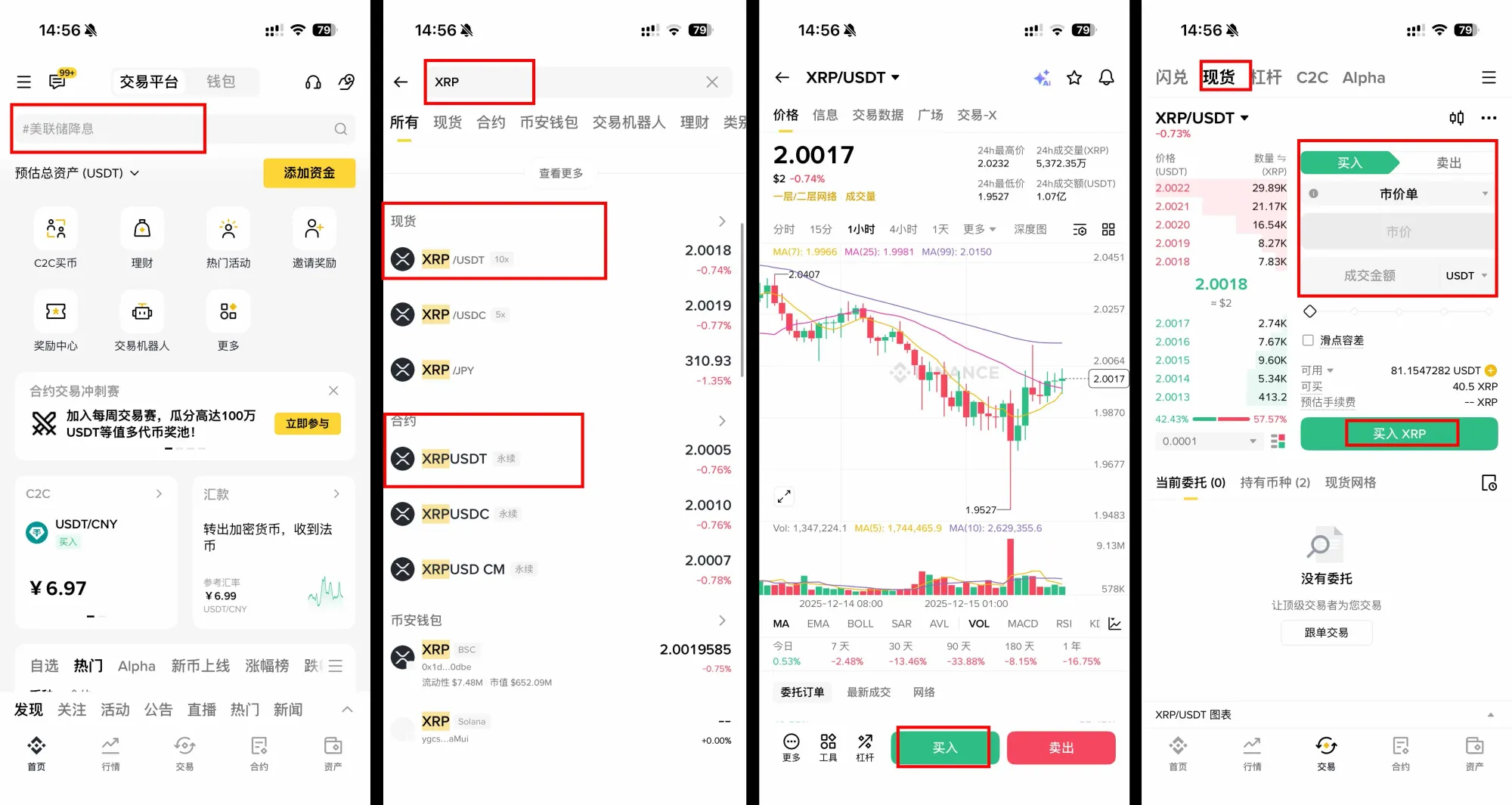
Step 1 – Choose a Trading Platform
Select a reputable exchange that supports your region and preferred fiat‑on‑ramp method (e.g., USD via SEPA, SWIFT, or domestic ACH). Popular options that list XRP include Binance, OKX, and Bybit.
- Important for U.S. residents: Use Binance.US rather than the global Binance platform, as the latter is not available to U.S. customers.
Check whether the exchange is available in your jurisdiction, and compare fee structures, liquidity, security measures, and user experience.
Step 2 – Register an Account and Complete KYC
After creating an account, you will need to submit personal details such as full name, date of birth, and residential address, along with a government‑issued ID for Know‑Your‑Customer (KYC) verification. Once approved, you can fund the account via bank transfer (SEPA/SWIFT), credit/debit card, or other supported payment methods.
Step 3 – Place a Purchase Order
Navigate to the “Buy Crypto” section, select XRP, and enter the amount you wish to spend in USD. The platform will display the applicable fee; confirm the details to execute the purchase.
Step 4 – Trade and Exit
When the funds are credited, you can trade on the spot market using a market order for immediate execution or set a limit order to buy or sell at a specific price. Technical indicators such as RSI, MACD, and moving averages can help inform intra‑day decisions.
To cash out, choose “Sell,” specify the amount of XRP, and confirm. The proceeds will be converted back to fiat (USD) or another cryptocurrency and withdrawn via your chosen fiat gateway.
Example on Binance
Tax Considerations
Cryptocurrency transactions may be subject to taxation in many jurisdictions. In the United States, for example, capital gains from selling XRP are generally taxable, and similar rules apply in most countries. Users should consult local tax regulations or a qualified tax professional to ensure compliance.
Potential Risks and Challenges for XRP
Although the long‑term outlook appears positive, the path to 2035 is fraught with uncertainty. Key risks include:
- Evolving Competitive Landscape – Since 2017, the environment surrounding XRP has changed dramatically. It now competes not only with other settlement solutions but also with smart‑contract platforms such as Ethereum and Solana, as well as the growing ecosystem of stablecoins. The “10‑x” growth conditions that existed in the early days are no longer guaranteed.
- Holder Sentiment Fluctuations – On‑chain data shows that long‑term holders currently exhibit a sentiment more akin to the “skeptical” phase observed at the 2021 bull‑run peak, rather than the “euphoric‑greedy” mood of 2017. This cautious outlook could dampen upward price momentum.
- Relative Weakness vs. Bitcoin – The XRP/BTC trading pair remains about 90 % below its 2017 all‑time high and has been confined to a narrow range for an extended period, indicating that XRP’s performance relative to Bitcoin lags behind the broader crypto market.
A Rational Outlook and Strategy for XRP
When dealing with expectations that span more than a decade, maintaining composure is essential. Turning $10,000 into $1 million would require an annual compound growth rate of roughly 58 %, a figure typically seen in nascent markets or early‑stage startups. For Ripple’s ecosystem, which has been operating for over ten years, achieving such explosive growth is highly challenging.
A more pragmatic perspective treats XRP as an asset with a 5‑10× upside potential, contingent upon Ripple successfully delivering inter‑bank settlement solutions and real‑world asset tokenization. Retail investors might consider a dollar‑cost averaging (DCA) approach—regularly investing a fixed USD amount—to smooth out entry prices and reduce the risk associated with market timing.
Future Outlook for XRP
As of December 25, the XRP trading pair on the Gate.io platform continues to oscillate around the psychological $2 level. Short‑term attention is focused on a $1.81 support and a $2.35 resistance; a decisive breakout could spark a new trend cycle. Looking ahead to 2035, whether XRP can leverage its unique role in financial infrastructure to achieve steady appreciation, or become marginalized amid the constantly evolving crypto ecosystem, will depend on the tangible execution of cross‑border payments, deepening of institutional partnerships, and the clarity of the regulatory environment.
*This concludes the full analysis titled “XRP 2035 Price Prediction: Is a $78 Future Feasible?” For more in‑depth articles on XRP price movements, follow Bitaigen’s (比特根) upcoming reports.*
💡 Register on Binance with referral code B2345 for the maximum trading fee discount. See Binance complete guide.
⚠️ Risk Disclaimer: Crypto prices are highly volatile. This is not investment advice.



