
 Bitaigen Research
 To discuss the lifespan of mining graphics cards, a typical consumer GPU used 8 hours per day, 5 days a week can generally operate for about 3 to 5 years, whereas continuously running at full load for mining usually leads to failures after 1 to 2 years.
We examined the hardware characteristics of GPUs and the practical realities of mining operations, systematically outlining the key factors that affect a card’s lifespan and analysing the cost‑benefit relationship under different workload scenarios. By delving into details such as cooling, power delivery, and model selection, the article helps readers evaluate a GPU’s usable life and profit potential. The following sections also contain practical advice on card selection and maintenance, which are worth a careful read.
How long does a mining GPU typically last?
GPU lifespan is influenced by a combination of factors. Below is an overview of the most important ones:
- GPU model: High‑end dedicated graphics cards are built with superior materials and craftsmanship and can often exceed 10 years of service; mainstream cards more commonly last 3 to 5 years.
- Workload intensity: Running at full capacity or continuous mining generates high temperatures, typically shortening lifespan to 1 to 2 years.
- Cooling environment: Case ventilation, heatsink quality, and dust accumulation all affect temperature control.
- Power supply stability: Unstable power can accelerate component aging.
- Usage frequency: Daily operating hours directly determine cumulative stress.
Definition: When a GPU operates under sustained high temperature and overclocked conditions, the solder joints, video memory, and circuitry age faster, thereby reducing the overall service life.
In summary, a standard mainstream GPU used under normal conditions (8 hours per day, 5 days a week) can remain functional for 3 to 5 years, but if it is employed for 24 hours a day, 365 days a year mining, performance degradation or failure is expected after 1 to 2 years.
How does GPU mining generate profit?
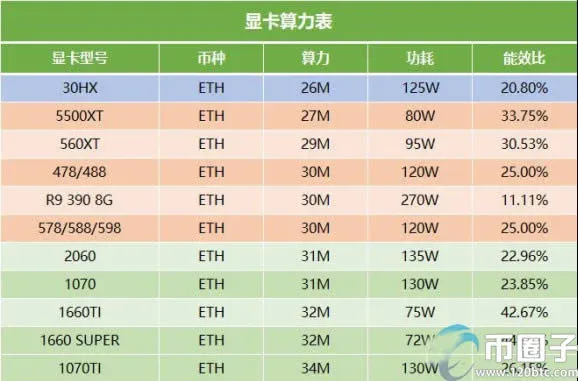
GPU mining earns block rewards by calculating the hash of a cryptocurrency. Profitability depends on hash rate, video memory size, and electricity costs. The table below lists currently common mining‑card series and their market prices (for reference only):
| Mining‑Card Series | Key Models | Remarks |
|---|---|---|
| NVIDIA CMPHX series | 30HX, 40HX, 50HX, 90HX | Designed specifically for mining; supply constraints have lengthened resale cycles |
| NVIDIA RTX series | 3080, 3090 | The RTX 3080 now trades above **USD 1,000**; the RTX 3090 around **USD 1,600** |
| AMD Radeon series | 5500XT, 560XT, Radeon VII, Vega 56, Vega 65 | 5500XT/560XT are frequently out of stock; Radeon VII prices have doubled, and the Vega line has seen significant appreciation |
- Video‑memory requirement: Mining imposes a hard minimum on VRAM; cards with < 4 GB of memory can no longer mine most algorithms. It is advisable to choose models with 6 GB or more.
- Second‑hand mining cards: Some used cards marketed as 5 GB actually have usable memory of roughly 4.5 GB, which may cause mining interruptions or hardware faults.
Key factors that affect profitability
- Hashrate: The GPU model determines how many hashes can be computed per second; higher hashrate translates to higher earnings.
- Electricity cost: Power expenses represent the largest portion of total outlay. Selecting cards with a favorable performance‑per‑watt ratio can reduce costs. When quoting electricity rates, consider using USD or the applicable SEPA/SWIFT pricing for international contexts.
- Cryptocurrency price volatility: Market price swings directly impact the fiat value of mining rewards.
- Network difficulty: An increase in blockchain difficulty lowers the revenue per card.
Tip: When purchasing a mining GPU, be sure to verify the VRAM size, cooling design, and power‑supply compatibility to avoid hardware limitations that could diminish earnings or cause frequent failures.
*Please note that earnings from cryptocurrency mining may be subject to tax in your jurisdiction; consult a tax professional for guidance.*
*For users in the United States, mining‑related fiat withdrawals should be performed via Binance.US rather than the global Binance platform.*
This completes the full analysis of “How long does a mining GPU typically last?” and “How does GPU mining generate profit?”. For more information on GPU mining, stay tuned to upcoming articles from Bitaigen (比特根).
Related Reading
- Chia: Scam or Green Mining Opportunity 2024?
- Top 10 Cloud Mining Platforms for 2026 – Best Choices for Investors
- Mining Node Explained: Concept, Operation & Node Difference
💡 Register on Binance with referral code B2345 for the maximum trading fee discount. See Binance complete guide.



