
 Bitaigen Research
 BlockDag Overview
BlockDag is a distributed ledger technology that blends blockchain with a Directed Acyclic Graph (DAG). Its native token, BDAG, may be worth considering based on the technical implementation, ecosystem adoption, and market risk.
Below, the Bitaigen editorial team will give you a thorough introduction to BlockDag, an innovative blockchain solution. It uses DAG technology to improve scalability, security, and decentralization, making it suitable for DeFi, real‑time payments, IoT, and other high‑throughput use cases.
In this article we outline BlockDag’s technical fundamentals, ecosystem layout, and the core value proposition of the BDAG token. We focus on how the project leverages DAG to boost scalability while maintaining security and decentralization. By interpreting the roadmap and industry use‑cases, we aim to help you gauge the chain’s potential opportunities within the competitive landscape. For deeper mechanism details and an investment perspective, keep reading.
Introduction
Since Bitcoin’s inception, blockchain technology has evolved rapidly, yet it still faces bottlenecks in transaction throughput and confirmation speed. Traditional chains rely on a linear sequence of blocks; during traffic spikes they become congested, fees rise, and real‑world deployment in DeFi, instant payments, and IoT is hampered.
BlockDag merges the strengths of blockchains and DAGs, enabling parallel block processing that dramatically raises TPS (transactions per second) while preserving security and decentralization. Its core goal is to solve the “blockchain trilemma” – achieving scalability, security, and decentralization within a single system.
Technical Data and Links
- Official website: <https://blockdag.network/>
- Whitepaper: blockdag.network/白皮书
- Security audit: <https://blockdag.network/security>
- Current pre‑sale price: $0.0248 (Batch 27)
- Target listing price: $0.05
- Pre‑sale end date: 13 May 2025
- Total supply: 15 billion BDAG
What Is BlockDag?
*Source: website*
BlockDag is a decentralized distributed ledger technology that combines the security of traditional blockchains with the high‑throughput parallelism of a DAG. Unlike conventional chains where each block references only a single predecessor, BlockDag allows a block to reference multiple previous blocks, enabling parallel transaction processing, higher network throughput, and shorter confirmation times.
In Bitcoin‑style chains, blocks are appended sequentially to the longest chain, which leads to latency and fee spikes under heavy load. BlockDag’s multi‑block parallel addition removes the linear bottleneck, allowing the network to handle many more transactions per second (TPS).
BlockDag employs the PHANTOM and GHOSTDAG consensus algorithms to efficiently order blocks while preserving security, mitigating malicious behavior, and balancing scalability, decentralization, and safety.
Moreover, BlockDag is fully EVM‑compatible, so developers can deploy existing Ethereum smart contracts directly, lowering the entry barrier and fostering ecosystem integration.
History, Origins, and Key Figures
Origins of DAG Technology
DAG (Directed Acyclic Graph) was initially explored to address blockchain scalability. Early projects such as IOTA and Nano demonstrated the potential of parallel transaction processing, but they still faced challenges in security and decentralization.
Evolution of BlockDag
BlockDag blends conventional blockchain consensus mechanisms (e.g., PoW, PoS) with DAG’s parallel processing, proposing a fresh approach to the “trilemma.” By leveraging PHANTOM, GHOSTDAG, and other algorithms, it achieves synchronized multi‑block validation, raising throughput while maintaining network integrity.
Core Contributors

*Source: website*
- Chief Executive Officer (CEO) – Antony Turner: Oversees overall strategy; co‑founder of SwissOne Capital with extensive finance and entrepreneurship experience.
- Chief Technology Officer (CTO) – Jeremy Harkness: Focuses on blockchain, AI, data engineering, and decentralized systems; has led multiple technical teams.
- Chief Security Officer (CSO) – Youssef Khaoulaj: Handles smart‑contract audits and blockchain security consulting, ensuring platform robustness.
How BlockDag Works
*Source: website*
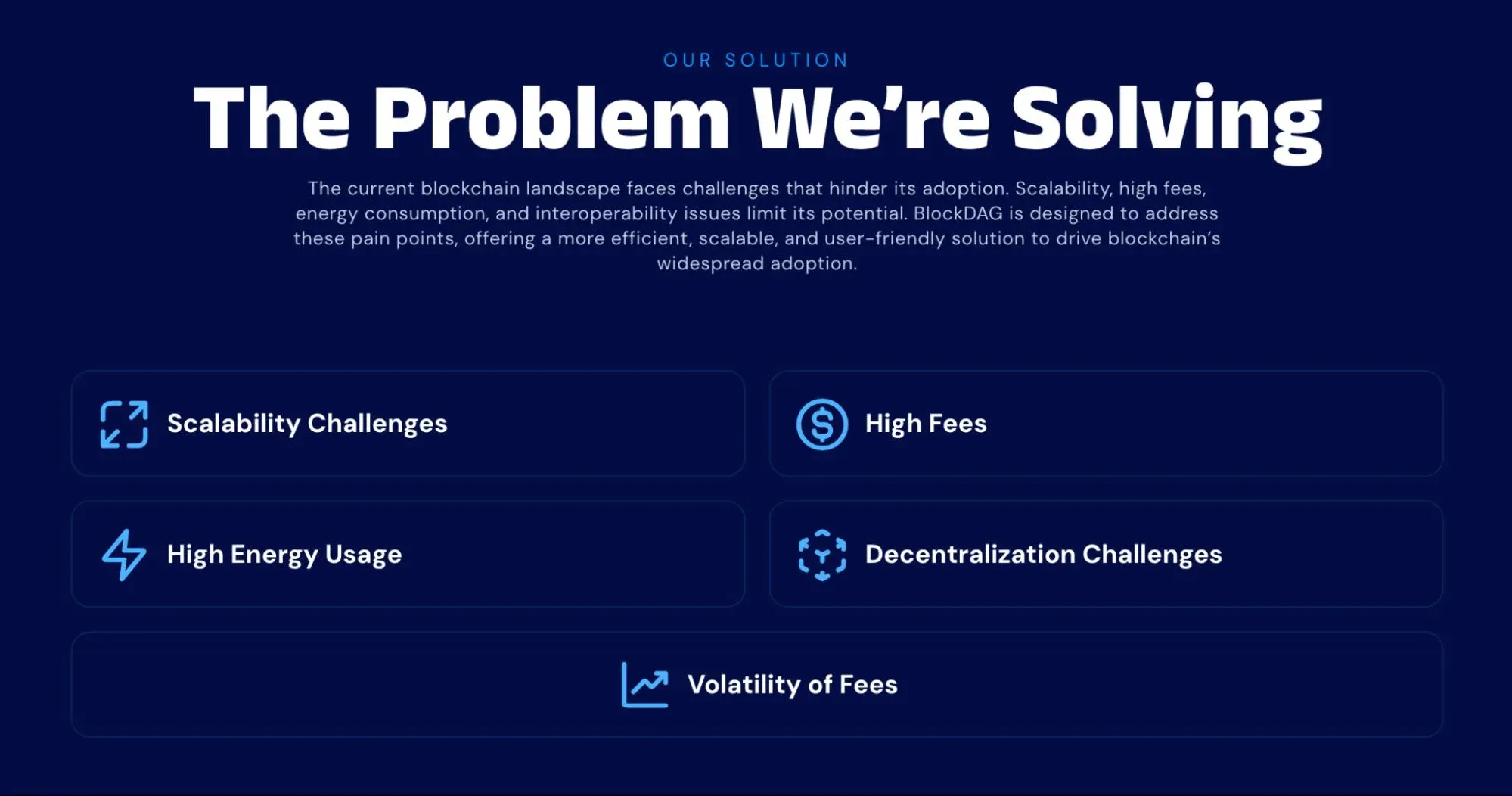
BlockDag fuses a linear chain skeleton with DAG‑style flexibility, enabling parallel block creation and verification. The core consensus flow proceeds as follows:
- Block referencing – Each new block cites multiple “tips” (blocks that currently have no children), reducing the risk of orphaned blocks.
- Topological sorting – A global topological algorithm orders the DAG, establishing a uniform transaction sequence.
- Weight selection – Blocks are weighted by the number of references they receive; those recognized by the majority of nodes are confirmed first.
GHOSTDAG and PHANTOM
- PHANTOM: Constructs a “heavy sub‑graph” to identify honest blocks and suppress the influence of malicious ones.
- GHOSTDAG: Extends PHANTOM by calculating reference weight for each block, selecting the “heaviest” sub‑graph and ensuring a unified transaction order even when parallel blocks appear.
Security Mechanisms
- Honest majority assumption: The system presumes most validators are honest, and the algorithm preferentially processes honest blocks.
- Multi‑reference anti‑attack: Citing multiple predecessor blocks makes it difficult for an attacker to isolate or fork the chain; malicious blocks are filtered out during sorting.
Transaction Flow
- User submits a transaction.
- Miner/validator packages the transaction into a new block.
- The new block references several tip blocks, forming a DAG.
- The network validates and orders the block using PHANTOM / GHOSTDAG.
- Once confirmed, the transaction is written into the DAG, completing the ledger entry.
Key Features of BlockDag
*Source: website*
| Feature | Description |
|---|---|
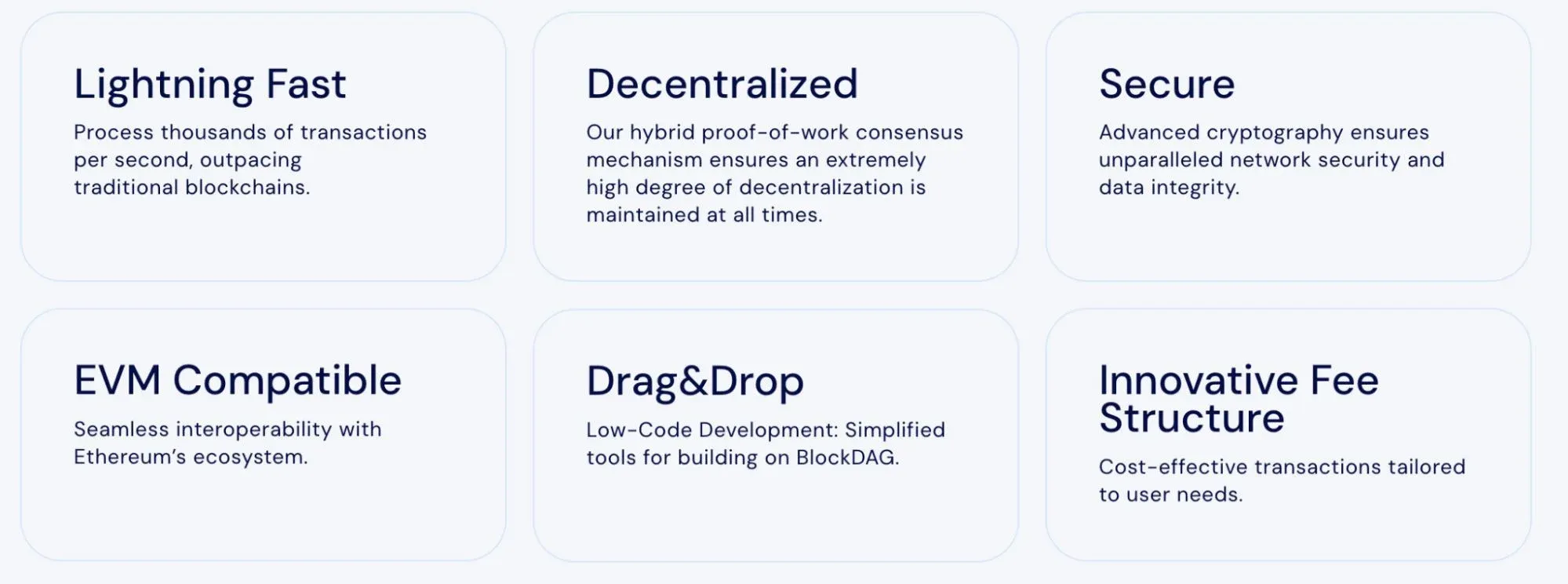
| **Enhanced scalability** | DAG enables parallel block generation; TPS can reach **10,000‑15,000**, suitable for high‑volume scenarios. |
| **Fast confirmation** | Transactions finalize within seconds, eliminating single‑chain propagation and mining delays. |
| **Robust security** | **PHANTOM**, **GHOSTDAG**, and the honest‑majority model lower the risk of attacks. |
| **Low transaction fees** | Parallel processing reduces computational costs; fees are far below those of traditional PoW chains. |
| **EVM compatibility** | Supports Ethereum smart contracts; developers can migrate existing DApps directly. |
| **Energy efficiency** | Consensus does not rely on high‑intensity hash power, markedly reducing energy consumption. |
| **Decentralization innovations** | Offers low‑code/no‑code tools, staking rewards, and mining incentives to nurture ecosystem growth. |
| **Micro‑payment capability** | Low fees and rapid confirmation make BlockDag ideal for gaming, tipping, IoT, and other micro‑payment use cases. |
Is BDAG Worth Investing?
BDAG is the native token of the BlockDag network and carries several potential value drivers:
- Technical advantage: High throughput, low fees, and EVM compatibility attract developers.
- Ecosystem demand: BDAG is used to pay transaction fees, stake for rewards, and access DApp functionalities, creating intrinsic demand.
- Market risk: Price is influenced by overall crypto market sentiment, regulatory developments, and project milestones, leading to volatility.
- Project timeline: Delays in technical delivery or ecosystem expansion could pressure the token’s value.
Prospective investors should evaluate implementation progress, ecosystem size, and regulatory environment while exercising appropriate risk management. *(Note: Cryptocurrency gains may be taxable in your jurisdiction; consult a tax professional for guidance.)*
How to Acquire BDAG
- Pre‑sale – Participate before the mainnet launch to obtain discounted tokens.
- Mining – Earn BDAG by providing hash power or validation services (requires dedicated hardware).
- Staking – Hold and stake BDAG to receive network rewards while contributing to security.
- Exchange trading – After the mainnet goes live, BDAG will list on several exchanges; you can purchase it via spot markets.
When acquiring BDAG, users in the United States should use Binance.US (or another U.S.-compliant platform) rather than the global Binance site. For fiat purchases, the platform accepts USD via SEPA/SWIFT transfers.
After obtaining the tokens, store them in a cold wallet or hardware wallet to protect against loss.
Tokenomics and Pre‑Sale Details
| Parameter | Value |
|---|---|
| **Pre‑sale price** | **$0.0248** (Batch 27) |
| **Initial price** | **$0.0001** (Batch 1) |
| **Growth rate** | **2,531 %** since issuance |
| **Funds raised** | **$23.5 billion** |
| **Total supply** | **15 billion BDAG** |
| **Pre‑sale allocation** | **33 %** (≈ 5 billion) |
| **Community allocation** | **66 %** |
| **Team allocation** | **1 %** |
| **Target listing price** | **$0.05** (analyst estimate) |
| **Pre‑sale end date** | **13 May 2025** |
| **Pre‑sale cap** | **$60 billion** (current progress below cap) |
BDAG Tokenomics Explained
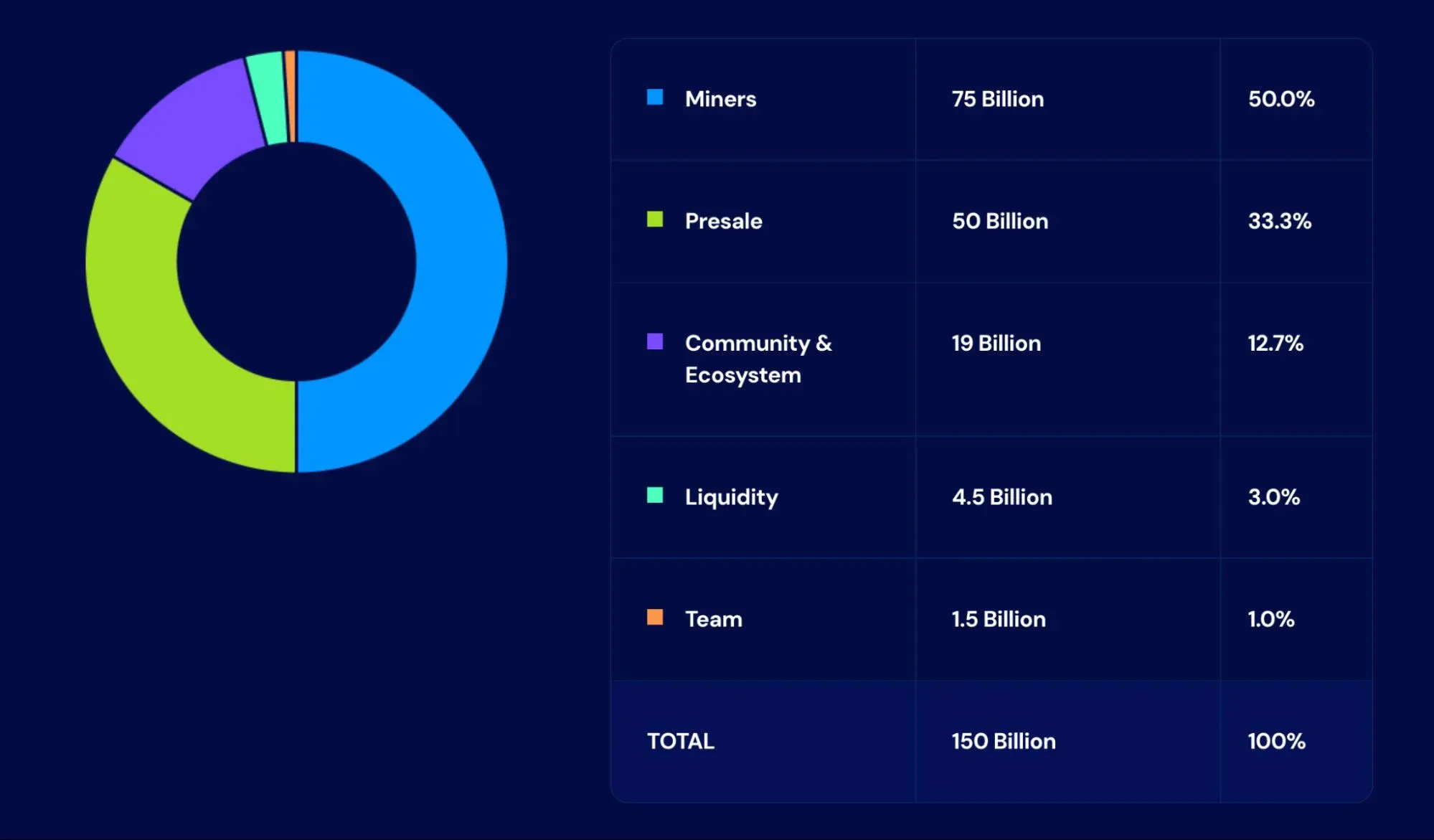
*Source: website*
Total Supply
BDAG has a hard cap of 15 billion tokens, a fixed limit intended to curb inflation.
Distribution Breakdown
- Pre‑sale: 33.3 %
- Miner rewards: 50 %
- Community building: 15 %
- Liquidity pools: 5 %
- Team: 1 %
Halving Mechanism
Every 12 months, the newly minted amount is halved, mirroring Bitcoin’s halving design to increase scarcity and support long‑term value.
Token Utility
- Transaction fees – BDAG is burned or transferred to validators when users send funds or invoke contracts.
- Staking – Validators lock BDAG to secure consensus and earn rewards.
- DApp access – Certain decentralized applications require holding BDAG to unlock specific features.
Price Forecast and Outlook
| Scenario | Forecast Range |
|---|---|
| **Bullish** | ~**$0.08** in 2025; potentially >**$0.15** by 2030 |
| **Base case** | ~**$0.032‑0.041** in 2025 |
| **Bearish** | Might dip to ~**$0.02** shortly after listing |
Key factors that could influence future price:
- Successful delivery of promised throughput and decentralization levels.
- Speed of ecosystem expansion enabled by EVM compatibility.
- Number of exchange listings and depth of liquidity provision.
- Adoption metrics of flagship applications (e.g., X1 Miner) such as downloads and active users.
Summary and Risk Assessment
BlockDag proposes a technically sound solution that blends scalability with security, theoretically delivering low‑latency, low‑fee transactions in high‑throughput environments. Its main strengths are:
- Parallel blocks and DAG architecture that boost TPS.
- PHANTOM / GHOSTDAG consensus ensuring safe ordering.
- EVM compatibility that widens the developer base.
Nevertheless, the project faces several risks:
- Technical execution risk – Some promised features have yet to be validated on mainnet.
- Liquidity risk – A prolonged pre‑sale could generate selling pressure once the token lists.
- Regulatory risk – Shifts in global regulatory policies may affect token circulation.
Potential investors should monitor:
- Real‑world technical progress and third‑party audit reports.
- Listing schedules and liquidity‑provision strategies.
- Community activity and partnership developments.
Development Roadmap
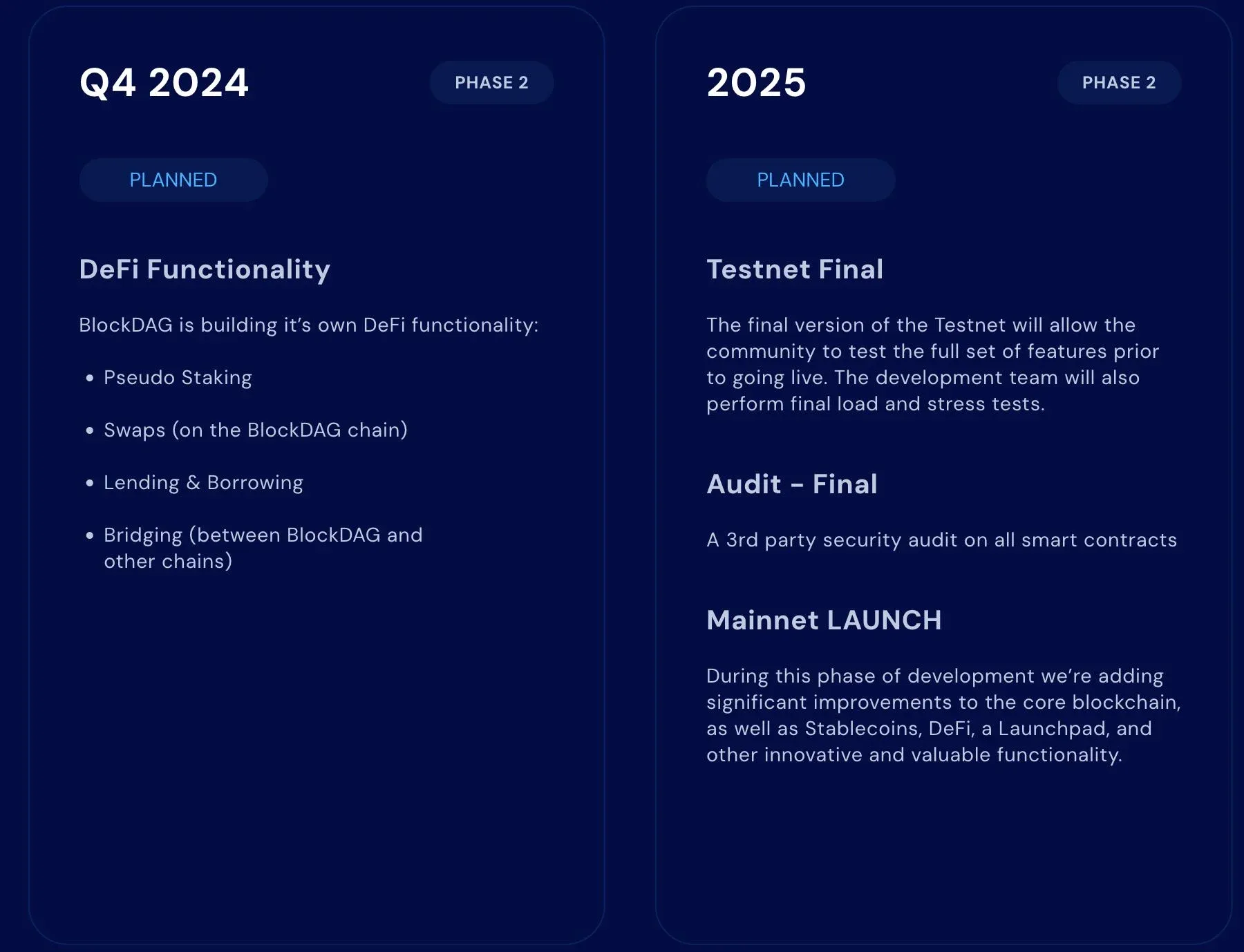
*Source: website*
- Q4 2024 – Refine DeFi modules, including pseudo‑staking and on‑chain token swaps.
- 2025 – Complete mainnet testing, conduct stress tests and security audits, and prepare for official launch.
- 2025‑2026 – Deploy cross‑chain bridges, lending services, and stablecoin support to enrich the ecosystem.
Potential Exchange Listings for BDAG
| Exchange | Status |
|---|---|
| Binance | Not listed yet |
| Huobi | Not listed yet |
| OKX (formerly OKEx) | Not listed yet |
| Gate.io | Not listed yet |
| Bitget | Not listed yet |
| Bybit | Not listed yet |
Important note: Some platforms offer registration rebates; you must complete the sign‑up process to receive the applicable rebate percentage.
Conclusion
BlockDag adds a notable scalability and efficiency layer to the blockchain evolution. Through PHANTOM, GHOSTDAG, and full EVM compatibility, it claims the ability to process 10,000‑15,000 transactions per second while keeping fees low and security high—making it a fit for DeFi, micro‑transactions, and high‑frequency payment use cases.
BDAG, as the native token, features a fixed supply, annual halving, and multiple utility functions designed to sustain long‑term ecosystem value. The project remains in the pre‑sale and testing phases, exposing it to technical, liquidity, and regulatory risks. Prospective participants should conduct thorough due diligence—reviewing technical milestones, audit outcomes, and market conditions—before deciding on involvement.
Related Reading
- BlockDAG (BDAG) Deep Dive: Architecture, Hybrid Consensus & Mobile‑First Mining
- BlockDAG (BDAG) Token: Mainnet, TGE & Listings in Feb 2026
💡 Register on Binance with referral code B2345 for the maximum trading fee discount. See Binance complete guide.



