
 Bitaigen Research
 Virtual currency exchanges are one of the main channels for investors to purchase Bitcoin, Ethereum and other cryptocurrencies. However, over the past 15 years of crypto development, a number of platforms have collapsed due to prolonged market downturns, severe hacking attacks, fraud, or poor management, resulting in user fund losses.
Although the crypto market is difficult to predict, understanding these bankrupt exchanges and the reasons behind their failures helps us see more clearly how to select a reliable exchange and how to protect assets.
Therefore, this article reviews the collapse histories of several well‑known virtual‑currency exchanges and analyzes the causes of their failures, helping you assess how to choose an exchange and which exchanges are relatively safe.
Exchanges that have gone bust include Genesis, FTX, BlockFi and others. When selecting an exchange, pay attention to security, regulation, fees, etc.; Binance, OKX, Gate.io and similar platforms are comparatively safer.

In this article we summarize recent landmark exchange failures, dissect the underlying security and compliance risks, and provide key evaluation points for choosing a platform, helping readers distinguish trustworthy entry points in a crowded market. To learn which exchanges still enjoy safety advantages, keep reading.
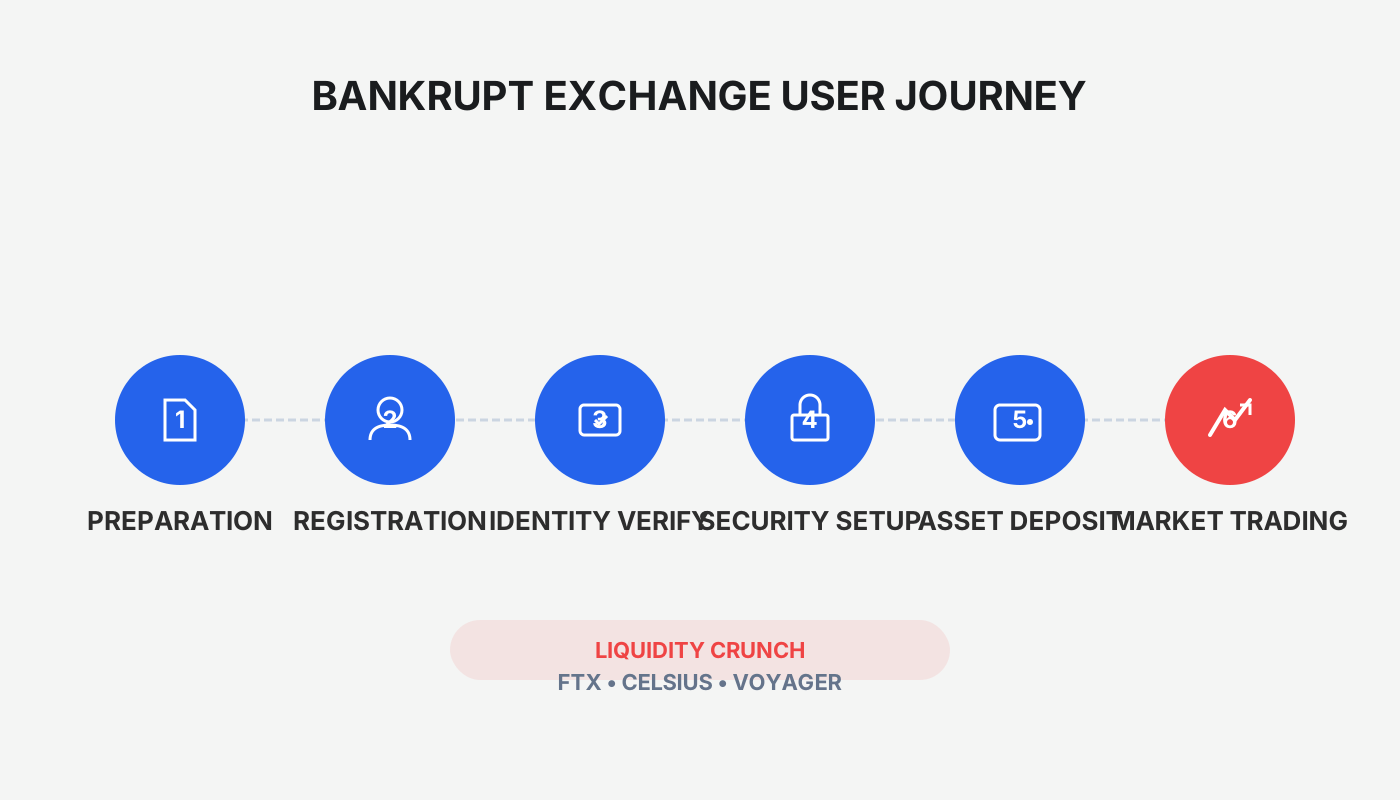
A Look at the Top Ten Virtual‑Currency Exchanges That Have Failed in Recent Years
Every year a large number of exchanges go under because of poor operations. Below are ten of the more notable cases:
1. Genesis (Bankruptcy date: January 2023)
Genesis was founded in 2013 and was the first U.S. over‑the‑counter (OTC) Bitcoin trading platform. Together with Grayscale it formed the “twin stars” of Digital Currency Group (DCG), offering trading, lending and custodial services. On 19 January 2023, Genesis filed for Chapter 11 bankruptcy in a Manhattan court. Impacted by the fallout from the FTX collapse, the platform suffered an approximate $1 billion funding shortfall in November 2022 and halted loan redemptions. Unable to secure external financing, it ultimately declared bankruptcy.
2. FTX (Bankruptcy date: November 2022)
FTX was once among the world’s top three crypto exchanges. On 11 November 2022, FTX filed for Chapter 11 bankruptcy in the United States. The trigger was a media report exposing its affiliated trading firm Alameda Research’s roughly $8 billion debt and its large holdings of the ill‑liquid native token FTT. Binance then sold off FTT, causing the price to plunge and prompting a user run. Investigations showed that FTX transferred customer funds to Alameda for high‑risk trading, creating a liquidity crisis. Over $7 billion of assets have been recovered to repay customers, and the firm has reached settlements with several regulators.
3. BlockFi (Bankruptcy date: November 2022)
BlockFi, launched in 2017, offered interest‑bearing accounts and crypto‑linked credit cards. A sharp decline in crypto asset values in 2022 caused a liquidity crunch. Although it briefly received assistance from FTX, the latter’s collapse removed that support. On 28 November, BlockFi and its eight subsidiaries filed for bankruptcy protection and began laying off staff.
4. Three Arrows Capital (3AC, Bankruptcy date: July 2022)
Three Arrows Capital was one of the largest crypto hedge funds at the time, managing close to $10 billion in assets. In July 2022, the collapse of the UST stablecoin erased about $500 million of its investments, and DeFi leveraged positions were liquidated, leaving roughly $3.5 billion in debt. The firm subsequently declared bankruptcy.
5. Voyager Digital (Bankruptcy date: July 2022)
Voyager Digital, a U.S.-based crypto trading platform, was hit by the 3AC default and halted withdrawals in early July, announcing bankruptcy. Its original plan to offset risk with a 15,000 BTC loan from Alameda Research fell through when 3AC went bust. A proposed acquisition by Binance.US was later cancelled due to regulatory resistance.
6. Celsius (Bankruptcy date: June 2022)
Celsius primarily provided crypto lending and staking services. Continued bear‑market pressure and the Luna/UST incident depleted its liquidity in 2022, forcing the liquidation of DeFi leveraged positions and leaving a balance‑sheet deficit of about $1.2 billion. By the end of January 2023, Celsius completed its bankruptcy process and pledged to pay creditors more than $3 billion. *(Note: crypto gains may be taxable under the laws of your local jurisdiction; consult a tax professional.)*
7. Blockchain Global (Bankruptcy date: November 2021)
Blockchain Global (BGL) was the parent company of the Australian crypto exchange ACX. In February 2020 the platform abruptly stopped operating, after which 94 investors sued and a court froze 117.33 BTC. BGL eventually filed for voluntary liquidation with liabilities of roughly AUD 15 million.
8. FCoin (Bankruptcy date: February 2020)
FCoin, headquartered in Singapore, once reported trading volume exceeding the combined total of Huobi, OKEx and Binance. In July 2018 a massive withdrawal of about 10,000 BTC sparked panic. In 2020 the platform suddenly ceased operations without explanation, causing investors to lose approximately 13,000 BTC (about $125 million).
9. Quadriga (Bankruptcy date: 2019)
Quadriga’s founder Gerald Cotten held the private keys to the cold wallet and is alleged to have used customer funds for personal trades. After his death, the whereabouts of client assets remained unknown, exposing the extreme risk of a single individual controlling an exchange.
10. Mt. Gox (Bankruptcy date: 2014)
Mt. Gox once processed more than 70 % of global Bitcoin transactions. In 2014 a massive hack resulted in the loss of roughly 850,000 BTC, after which the exchange declared bankruptcy. Although about 200,000 BTC were later recovered, the majority of users never reclaimed their assets.
Why Do Crypto Exchanges Fail?
The cases above can be grouped into two broad categories of factors:
1. External Factors
- Market volatility – Bear markets cause trading volume to plummet and liquidity to dry up, making it hard for platforms to stay afloat. Both Three Arrows Capital and BlockFi were driven into crisis by sustained price declines.
- Regulatory policies – After a wave of collapses in 2022, regulators worldwide tightened oversight. In 2023 the U.S. SEC filed lawsuits against Binance and Coinbase, further increasing compliance pressure.
- Hacking attacks – Exchanges with weak security become prime targets. On 21 February 2025, Bybit suffered a theft of over $1.4 billion, marking the largest single‑incident hack in industry history.
2. Internal Factors
- Management chaos – FTX misappropriated user funds, leading to a breakdown of internal governance and eventual bankruptcy.
- Fraudulent behavior – Some platforms lured users with promises of high returns and then vanished, such as Taiwan’s T‑SET exchange.
How to Choose a Virtual‑Currency Exchange
Security
- Verify that the platform holds a licensed operating permit, maintains a risk reserve fund, and undergoes regular security audits.
- Check community forums and technical discussion boards for historical attack records and how the exchange responded.
- Confirm the issuing regulator’s credibility to avoid situations similar to the JPEX regulatory gap.
Fees
Assuming security standards are met, compare trading and withdrawal fees across platforms. If fee differences are marginal, prioritize the exchange with higher security.
Number of Supported Coins
Major coins (BTC, ETH, XRP, etc.) are available on virtually every exchange. If you need to trade low‑market‑cap tokens, you may have to look at secondary or tertiary platforms for the appropriate pairs.
User Experience
- Transaction speed and system stability become critical during periods of extreme volatility.
- A friendly interface, robust charting tools, and other features should meet your personal trading style.
Which Exchanges Are Considered Relatively Safe?
| Exchange | Highlights | Main Advantages |
|---|---|---|
| **Binance** | World’s largest trading volume, supports 400+ assets | High liquidity, low fees, comprehensive compliance framework (U.S. users must use **Binance.US**, not the global platform) |
| **OKX** | One of the top two digital‑asset platforms, offers spot, futures, OTC | Multi‑business model, global service, strong reputation |
| **Gate.io (Sesame Open Door)** | Over 500 assets, robust security architecture | SSL encryption, cold‑wallet storage, multi‑factor authentication |
| **HTX (formerly Huobi)** | Covers 40+ assets, strong tech backbone | Global operations, deep risk‑control system |
How to Protect Your Assets When Trading Crypto?
- Diversify storage – Do not keep all assets on a single exchange; use cold wallets or multiple hot wallets to spread risk.
- Keep long‑term holdings offline – Apart from funds needed for daily trading, transfer the remainder to a hardware or paper wallet.
- Beware of high‑return promises – High‑yield staking products often carry run‑risk; stay vigilant.
Which Exchanges Are Worth Considering?
According to data from CoinMarketCap, MyToken and other analytics platforms, Binance ranks first in security, liquidity, asset coverage and user base, making it suitable for most investors. If you are concerned about centralization, you might explore decentralized exchanges (DEXs) such as Uniswap, which offers thousands of tokens across Ethereum, Avalanche, Polygon and other chains.
This concludes the full analysis of “A Review of Defunct Crypto Exchanges – How to Choose an Exchange and Which Ones Are Safer.” For more related content, follow Bitaigen (比特根) and its other articles.
Related Reading
- Top 5 Crypto Apps 2026: Binance, OKX, Bybit, Gate.io, Kraken
- 2026 Crypto Asset Security: Find the Most Reliable Exchange
- Ether (ETH) Explained: Origin, Tech Features & Buying Guide
💡 Register on Binance with referral code B2345 for the maximum trading fee discount. See Binance complete guide.



