
 Bitaigen Research
 Where Can You Buy and Sell Bitcoin and Altcoins?
In 2026, the ten leading exchanges for trading Bitcoin and altcoins are Binance, Huobi, OKX, Gate.io, Bitget, Bybit, KuCoin, MEXC, HTX, and Crypto.com.
Below, the Bitaigen editorial team provides a detailed overview of the 2026 top‑ten cryptocurrency exchanges for buying and selling BTC and altcoins (latest rankings). Please refer to it carefully.
In this article we have compiled the ten most trusted centralized exchanges for 2026, evaluating each platform’s security, liquidity, and user experience. The guide helps both newcomers and more experienced investors quickly locate a suitable entry point for buying and selling. Keep reading for practical comparisons and selection tips.
What Is a Cryptocurrency Exchange?
A cryptocurrency exchange is an online platform where users can purchase or sell digital assets using fiat currency or other cryptocurrencies. This article focuses on centralized exchanges (CEXs)—companies that operate user‑friendly interfaces, making it easy for beginners to convert fiat into crypto assets. Decentralized exchanges (DEXs) run on blockchain smart contracts, usually offering lower fees but requiring more technical knowledge and limiting users who do not already hold crypto.
Differences Between Investing in Crypto and Investing in Stocks
| Dimension | Cryptocurrency | Stock |
|---|---|---|
| Regulation | Lightly regulated, high volatility | Strictly regulated, relatively stable |
| Ownership | Holds a digital asset | Holds a share of a company |
| Market Hours | 24/7 trading | Limited to exchange sessions |
| Volatility | Price swings can be extreme | Price movements are generally milder |
| Intrinsic Value | Dependent on blockchain ecosystem and speculation | Based on company assets and earnings |
Expert Insight
“When selecting an exchange, I prioritize platform reliability and the variety of assets offered. Success depends not only on timing the market but also on understanding the technology and community behind each asset and being prepared for rapid price swings.”
Types of Cryptocurrency Exchanges
- Centralized Exchange (CEX): Managed by a central authority, high liquidity, many trading pairs, intuitive UI, but users must trust the platform to custody assets.
- Decentralized Exchange (DEX): Operates without a central entity; users keep their private keys, offering strong privacy, though liquidity can be lower and the learning curve higher.
- Peer‑to‑Peer (P2P) Exchange: Directly matches buyers and sellers, flexible payment methods, suitable for privacy‑focused users.
- Broker Platform: Sells crypto at a fixed rate, very easy to use, but typically carries higher fees.
- Hybrid Exchange: Combines CEX liquidity with DEX security, aiming for a balanced trading experience.
- Futures Exchange: Offers crypto futures contracts for leveraged trading and hedging.
- Options Exchange: Provides options contracts for advanced strategies.
- Margin Trading Platform: Allows users to borrow funds to amplify positions, increasing both potential profit and risk.
In addition, there are specialized platforms focused on lending, automated trading, anonymous trading, copy‑trading, perpetual contracts, staking rewards, and other niche use‑cases, catering to diverse user needs.
How to Choose a Cryptocurrency Exchange
- Trading Fees – Compare transaction fees, withdrawal charges, and any discounts for holding the exchange’s native token.
- Liquidity – High daily volume and active users ensure fast order execution and tighter spreads.
- Supported Assets – More listed coins give you greater portfolio flexibility.
- Payment Methods – Support for bank transfers (SEPA/SWIFT), credit cards, PayPal, and other channels eases fund inflows and outflows.
- Security Features – Two‑factor authentication (2FA), cold‑wallet storage, and robust encryption are baseline requirements.
- Accessibility – Responsive web and mobile apps, multilingual support, and compliance with local regulations matter.
- Customer Support – 24/7 live chat, email, or phone assistance can resolve issues quickly.
- User Experience – Clean UI and straightforward workflows reduce the learning curve.
- Reputation and Compliance – Review user feedback and regulatory filings to pick a transparent, trustworthy venue.
Expert Tip
“My first check is the exchange’s order‑execution speed and stability under high‑traffic conditions—far more convincing than any marketing slogan.”
Overview of Exchange Fees
- Trading Fees – Usually a fixed percentage of the transaction value; makers (limit orders) pay less than takers (market orders). Some platforms advertise zero fees but embed a spread.
- Withdrawal Fees – Vary by blockchain; several exchanges waive fees up to a certain amount.
Tax Note: Crypto gains may be taxable in your jurisdiction. Be sure to consult local tax regulations and report any realized profits accordingly.
In‑Depth Look at Six Major Exchanges in 2026
1. Binance
The world’s leading digital‑asset platform, serving users in more than 190 countries and regions.
Pros
- Over 350 tradable tokens
- Among the lowest trading fees in the industry
- Spot, margin, P2P, and many other trading modes
- Rich ecosystem: derivatives, NFTs, Binance Pay, Trust Wallet, etc.
- High security, fast matching engine, professional education resources
- Multi‑platform support (Web, Android, iOS)
- 24/7 customer service
Cons
- In certain jurisdictions (e.g., the United States) only about 150 tokens are available; U.S. residents must use Binance.US.
- Feature‑rich interface can be steep for beginners.
- No native wallet; users typically pair it with Trust Wallet.
- Faces regulatory restrictions in several countries.
Access
- Referral code: `B2345`
- Binance Global website (U.S. users should be directed to Binance.US)
- Binance App download
---
2. Huobi (HTX)
Founded in 2013, Huobi has built a full‑stack digital‑economy ecosystem that includes its own public chain, exchange, wallet, mining pool, and more.
Pros
- Comprehensive feature set and mature service framework
- Long‑standing operation, suitable for high‑volume traders
Cons
- Has suffered several security incidents in the past; all losses were fully compensated.
- Higher minimum trade sizes, which can be unfriendly to small‑scale users.
Access
- Referral code: `b6yq8223`
- HTX (Huobi) official site *(link placeholder; actual HTX URL should be used)*
- HTX App download
---
3. OKX
Offers a unified trading account, the MetaX multi‑chain custodial wallet, an NFT marketplace, DEX, and is actively expanding into the metaverse and Web3.
Pros
- Supports Chinese language and RMB trading, low fees
- Strong liquidity and a large user base
- User‑friendly UI, reliable security
Cons
- Fees are slightly higher than some competitors
- Occasional technical glitches have been reported
Access
- Referral code: `B2345`
- OKX official website
- OKX App download
---
4. Gate.io (Gate)
Founded in 2013, Gate.io provides both centralized and decentralized security layers, with a full suite of APIs and SDKs.
Pros
- No mandatory KYC for many functions
- Supports a huge number of altcoins
- Developer‑friendly with comprehensive documentation
Cons
- Infrequent app updates
- Interface can feel cluttered; advanced features are limited on mobile
Access
- Referral code: `VLIWUGTFAA`
- [Gate.io official site]
- [Gate.io App download]
---
5. Bitget
Lists more than 500 tokens, holds licenses in several jurisdictions (Canada, United States, Australia), and offers wealth‑management products, contracts, and token‑listing voting.
Pros
- Over 800 tradable assets
- Prominent copy‑trading functionality
- Low fees; BGB token holders receive discounts
- Robust security with a US$300 million protection fund
Cons
- Some services are restricted in certain regions
- Mandatory KYC; U.S. residents have limited access
Access
- Referral code: `vxje`
- Bitget official website
- Bitget App download
---
6. Bybit
Provides spot trading, derivatives, copy‑trading, an NFT marketplace, and other diversified services for both beginners and professionals.
Pros
- Among the market leaders in terms of volume and scale
- Clean, intuitive interface
- Allows non‑KYC trading (completion is recommended to raise withdrawal limits)
- Secure and competitively priced fees
Cons
- Does not support direct deposits in New Taiwan Dollar (TWD)
Access
- Referral code: `B2345`
- Bybit official website *(link placeholder; actual Bybit URL should be used)*
- Bybit App download
Global Crypto Exchange Rankings (Spot + Derivatives – 2024‑04‑18)
Spot Exchange Ranking (Top 20)
| Rank | Exchange | 24h Volume (USD) | Avg. Liquidity | Weekly Visits | Supported Coins | Fiat Options |
|---|---|---|---|---|---|---|
| 1 | **Binance** | $9,550,324,375 | 9,349,455,731 | 208,463 | 2,032 | ARS, AUD, BRL, etc. (86+ currencies) |
| 2 | **Coinbase Exchange** | $1,806,896,782 | 753,900,000 | 824,503 | 386 | USD, AED, ARS, etc. (61+ currencies) |
| 3 | **Upbit** | $1,003,115,870 | 531,100,000 | 905,487 | 705 | KRW |
| … | … | … | … | … | … | … |
| 20 | **XT.COM** | $2,095,565,505 | 7,933,095,153 | 169,111 | 35 | KRW, USD, EUR, etc. (103+ currencies) |
Tip: Beginners are advised to start with exchanges that offer a Chinese-language interface to avoid mistakes caused by language barriers.
Derivatives Exchange Ranking (Top 20)
| Rank | Exchange | Open Interest (USD) | 24h Volume (USD) | Maker Fee | Taker Fee | Markets |
|---|---|---|---|---|---|---|
| 1 | **Binance** | $21,272,750,969 | $47,806,427,598 | 0.02% | 0.04% | 639 |
| 2 | **OKX** | $5,842,925,255 | $21,148,894,336 | 0.02% | 0.05% | 290 |
| 3 | **Gate** | $9,803,911,776 | $15,351,528,899 | 0.015% | 0.05% | 634 |
| … | … | … | … | … | … | … |
| 20 | **Pionex** | $206,470,854 | $10,156,583,178 | 0.02% | 0.05% | 500 |
Risk Warning: Leverage in derivatives amplifies both gains and losses. New traders should master spot trading before venturing into leveraged products.
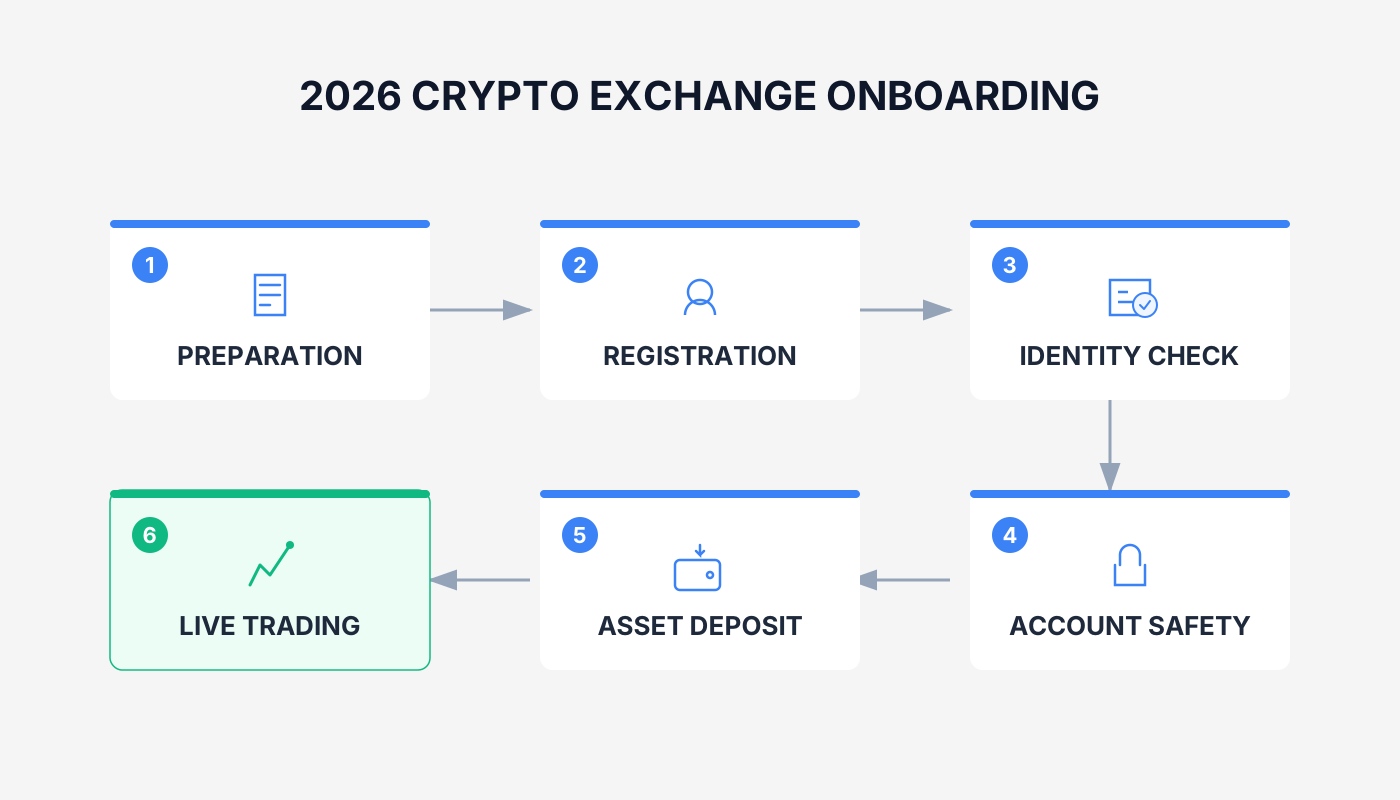
OKX Account Registration Guide
Referral code: `B2345`
- Official portal: OKX China website
- App download: OKX Official App
Registration Steps
- Visit the website and click “Register Now.” Using the referral link grants a permanent 20 % fee discount.
- Select the region “China.”
- Read and accept the Terms of Service, then click “Create Account.”
- Enter an email address (recommended providers: 163.com, Outlook, Gmail) and the referral code `B2345`.
- A 6‑digit verification code will be sent to your inbox (check spam folders) – enter it.
- Bind a mainland China mobile number (+86) and verify the SMS code.
- After successful registration, you can log in immediately.
Identity Verification (KYC)
OKX uses a two‑tier verification system: Level 1 (basic) and Level 2 (advanced, unlocks all features). Chinese users can verify with their national ID:
- In the user center, click “Identity Verification.”
- Choose “China” as the country/region.
- Select the document type (ID card or passport) and upload front‑ and back‑side photos.
- Complete facial recognition.
Common Reasons for Verification Failure
- Blurry or reflective photos – use natural lighting and turn off flash.
- Expired document – provide a current, valid ID.
- Name mismatch – ensure the registration details match the ID exactly.
How to Safely Download a Crypto Exchange App (Using Binance as an Example)
- Go to the official download page <https://www.bitaigen.com/binance/download> and click “I understand the risks, continue download.”
- If the system shows a warning “Potential risk detected,” proceed by selecting “Continue.”
- Verify the file’s SHA‑256 checksum (provided on the download page) to confirm authenticity.
- Install the app and enable Two‑Factor Authentication (2FA) immediately.
*Remember: always download apps from the official links provided by the exchange to avoid malicious versions.*
💡 Register on Binance with referral code B2345 for the maximum trading fee discount. See Binance complete guide.



