
 Bitaigen Research
After a turbulent 2025, investors are re‑examining the crypto‑asset cycle. In 2026, crypto investment is expected to concentrate on three major themes: whether Bitcoin will continue to follow its four‑year halving cycle, the rapid rollout of stablecoins and the infrastructure that supports them, and the tokenization of real‑world assets. The following three investment themes are poised to shape the next phase of the market in 2026.
2025 did not unfold as many crypto investors had anticipated.
Although Bitcoin’s peak price almost perfectly matched the historical four‑year pattern, the much‑heralded sell‑off peak never materialised. Notably, Bitcoin’s rally failed to spill over into the broader market, meaning expectations of a full‑blown alt‑coin bull market largely went unfulfilled.
Consequently, the start of 2026 is shrouded in uncertainty. Investor sentiment is extremely bearish, characterised by caution and doubt, even as the entire industry finds itself in an unprecedented position. For the first time in the 15‑year history of crypto, institutions, corporates and regulators are broadly moving in the same direction, laying groundwork for wider adoption rather than actively resisting it.
After a year filled with unexpected outcomes, pinpointing the most attractive opportunities for 2026 is far from straightforward. Nevertheless, a strong case can be made that instead of relying solely on the predictability of a Bitcoin‑halving‑linked four‑year market cycle, focus should shift toward assets and sectors that possess durable, long‑term value.
Moreover, an increasing body of evidence suggests that Bitcoin’s market structure has evolved. Institutional capital with longer horizons and stricter mandates is exerting a growing influence on price dynamics and liquidity patterns.
In this process, these participants may be reshaping crypto‑market behaviour, gradually moving the narrative focus away from miners, long‑term holders and Bitcoin whales toward a broader ecosystem.
Against this backdrop, the three crypto‑investment themes worth watching in 2026 are outlined below.
In this article we distil the three core trends for crypto assets in 2026—Bitcoin’s cyclical trajectory, the rollout of stablecoins and their underlying infrastructure, and the outlook for tokenized real‑world assets. By combining macro‑ and micro‑level perspectives, the piece helps investors reassess positioning after a period of volatility. A careful read is recommended.
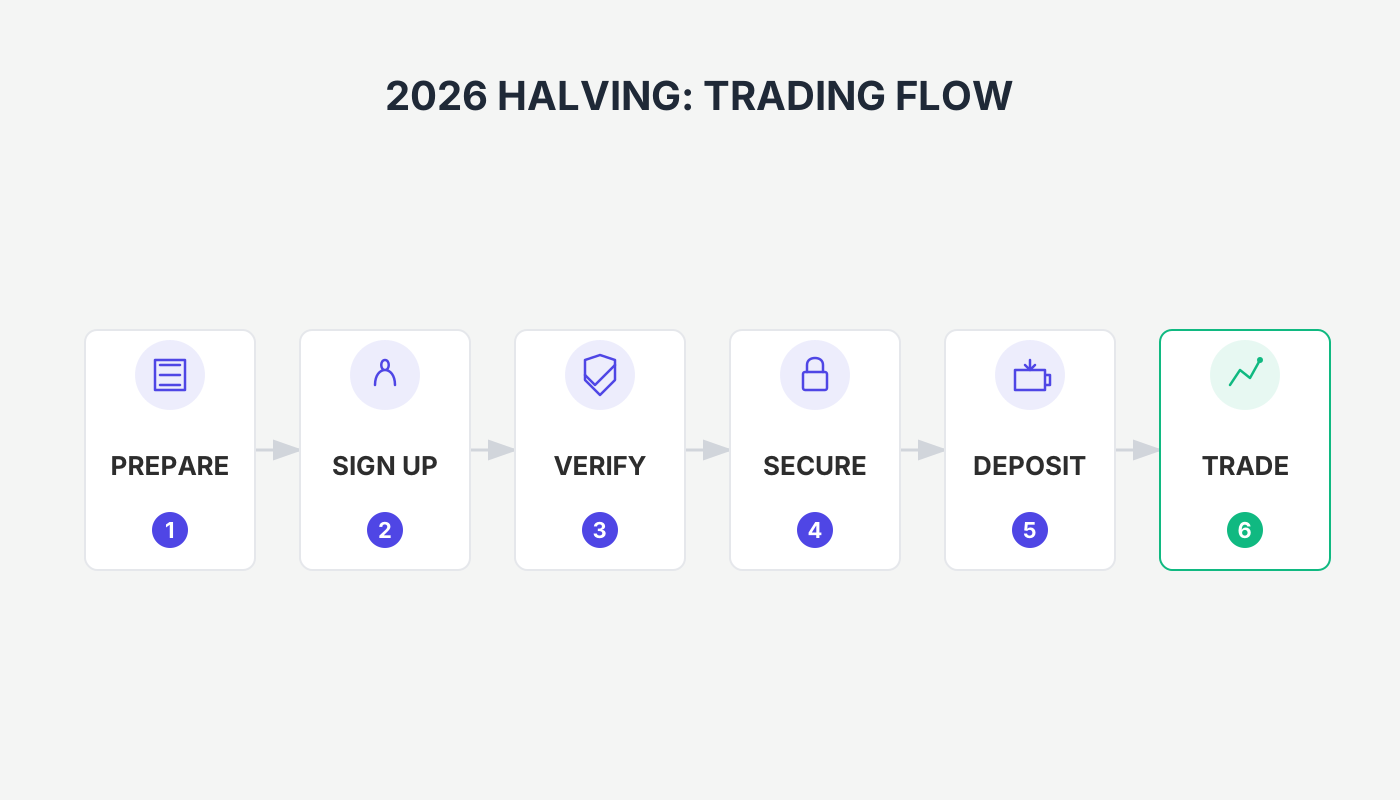
Bitcoin: Will History Repeat, or Is the Cycle Breaking?
- Bitcoin has entered its fourth halving era. Historically, each halving is followed by the most intense phase of a bull market roughly 12‑18 months later.
- Traditional cycle models predict that, if history repeats, Bitcoin could have reached its cyclical high in October 2025, representing a gain of more than 600 % from the 2022 trough.
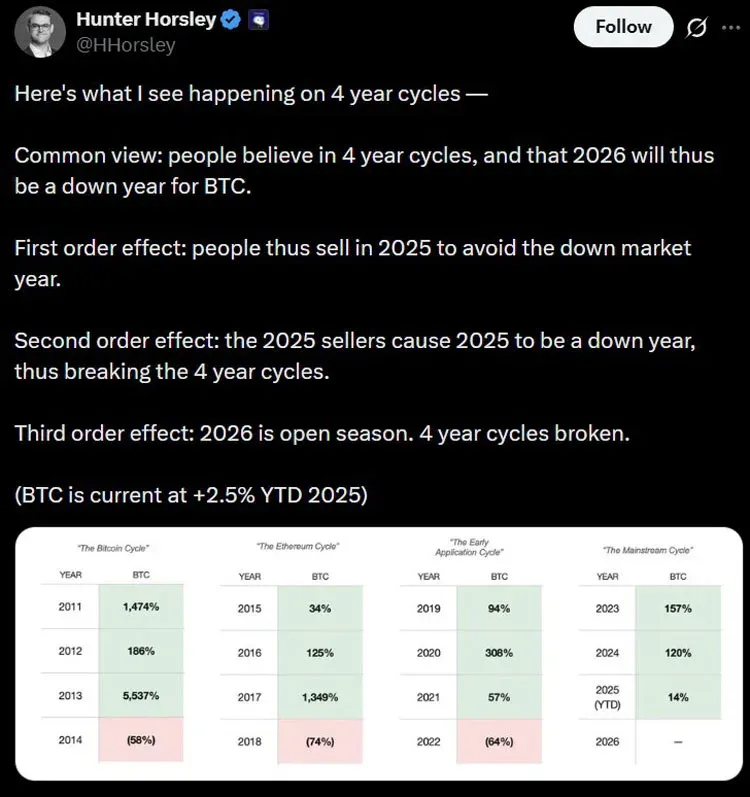
*Source: Hunter Horsley*
If the above trajectory holds, the rise would still be relatively moderate, confirming the tendency for diminishing returns as an asset matures.
However, not all analysts agree that past cycles remain applicable. Bitwise analysts Matt Hogan and Ryan Rasmuussen argue that Bitcoin may be moving away from the four‑year rhythm:
“In 2026, Bitcoin will break the four‑year cycle and set a new all‑time high.” They contend that the traditional drivers—halving‑induced supply shock, interest‑rate swings and high‑leverage speculation—have lost much of their potency.
The aggressive deleveraging at the end of 2025 erased tens of billions of dollars in open‑interest value by October, reducing the probability of a classic, explosive price peak.
Even more crucial is the view that institutional capital will be the decisive factor in the next stage. The spot Bitcoin ETF approved in 2024 opened the door for institutional inflows, and it is expected that 2026 will see an acceleration of that trend. Wealth‑management platforms such as Morgan Stanley, Wells Fargo and Merrill Lynch are expanding access channels and allocating client assets accordingly.
A looser monetary environment could also reinforce this tendency. Expectations of Federal Reserve rate cuts are likely to improve liquidity, and historical data show that such conditions are favourable for risk assets, including Bitcoin.
“From the perspective of business cycles, financial conditions and overall liquidity, this cycle could extend well beyond 2026,” writes analyst Peter Bittel, “the four‑year‑cycle narrative is essentially fading away.”
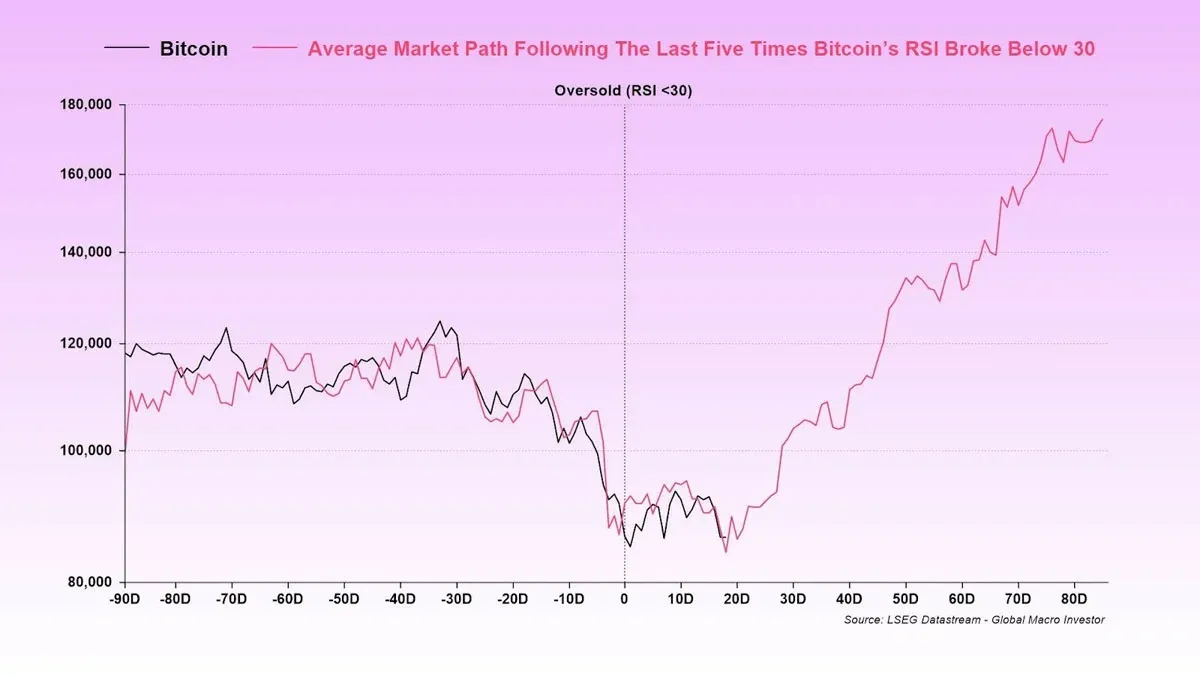
From a technical standpoint, Bitcoin’s price has entered a deep oversold region on the Relative Strength Index, a level that, in previous cycles, has often preceded sharp trend reversals.
*Source: Julien Bittel*
Stablecoin Infrastructure: The Low‑Key Success Story of Crypto
- Stablecoins are digital tokens pegged to fiat currencies (e.g., the US Dollar), designed to keep their value stable.
- Over the past 18 months, total circulating supply has broken $300 billion, with USD‑denominated tokens leading the growth. USDC, in particular, has evolved from a mere trading instrument to a foundational layer for payments, settlements and on‑chain liquidity.
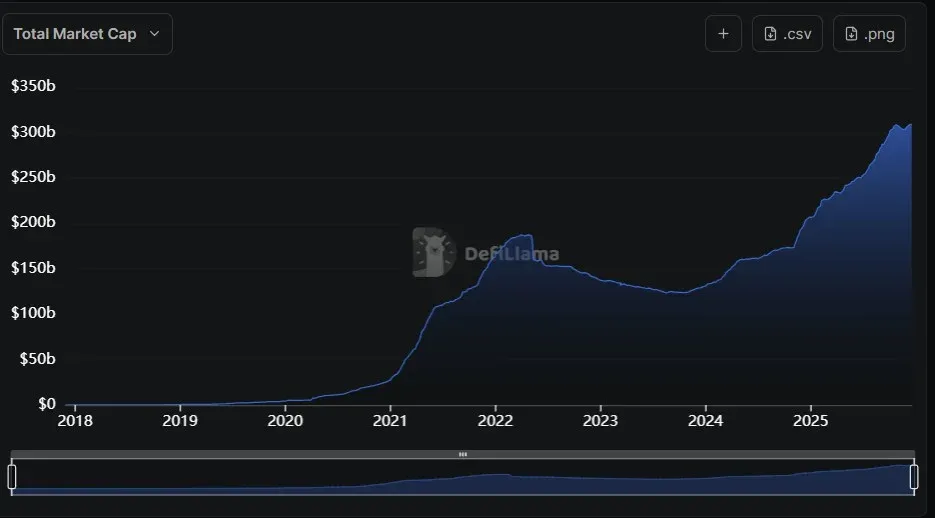
*Stablecoin market cap. Source: DeFiLlama*
Regulation plays a central role in this transformation. In mid‑2025, U.S. legislators introduced the GENIUS Act, establishing clear rules for stablecoin issuance, reserve requirements and supervisory oversight. The framework is seen as a turning point, aiming to foster financial innovation while bringing issuers under a regulated regime.
At the same time, U.S. regulators are laying the groundwork for broader bank participation. The Federal Deposit Insurance Corporation (FDIC) has proposed a rule‑making pathway that would allow regulated banks, through approved subsidiaries, to issue payment‑type stablecoins and integrate them directly into the traditional banking system.
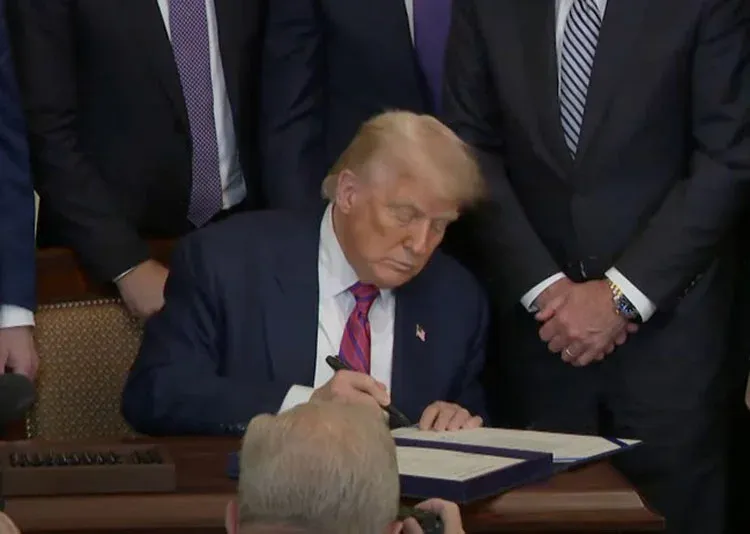
*July 18, 2025 – U.S. President Donald Trump signs the GENIUS Act. Source: AP*
In a continuously evolving environment, stablecoins are being viewed as multifunctional financial tools capable of delivering faster cross‑border payments, on‑chain settlement and serving as the base layer for yield‑bearing treasury‑style instruments backed by short‑term government bonds. Policymakers also position them as a mechanism to reinforce the global role of the US Dollar, especially in jurisdictions where dollar‑denominated banking services are limited.
The trend is not confined to the United States. Stablecoins pegged to the Euro and other emerging‑market currencies are gaining traction, underscoring their potential as a global settlement layer.
From an investment perspective, USD‑pegged stablecoins themselves have virtually no upside—they are designed not to deviate from the peg. The real opportunity lies in the infrastructure that underpins these stablecoins, including:
- Issuers and custodians
- Compliance‑as‑a‑service providers
- Blockchain networks and payment channels
As adoption widens, the value of these platforms is expected to rise in tandem.
Traditional capital markets have already started to take notice. Circle, the issuer of USDC, has become a public‑facing brand, while PayPal has launched its own USD‑stablecoin, signalling that fintech firms view stablecoins as a core component of future payment infrastructure.
Tokenized Real‑World Assets Move from Theory to Wall Street Reality
- BlackRock CEO Larry Fink has declared that “the tokenization of all assets” is underway, marking a shift of blockchain applications from academic theory to mainstream finance.
- Tokenization of Real‑World Assets (RWA) has become a vibrant segment driven by institutions; giants such as BlackRock, Franklin Templeton and Goldman Sachs have launched or participated in tokenized funds, bonds and settlement platforms.
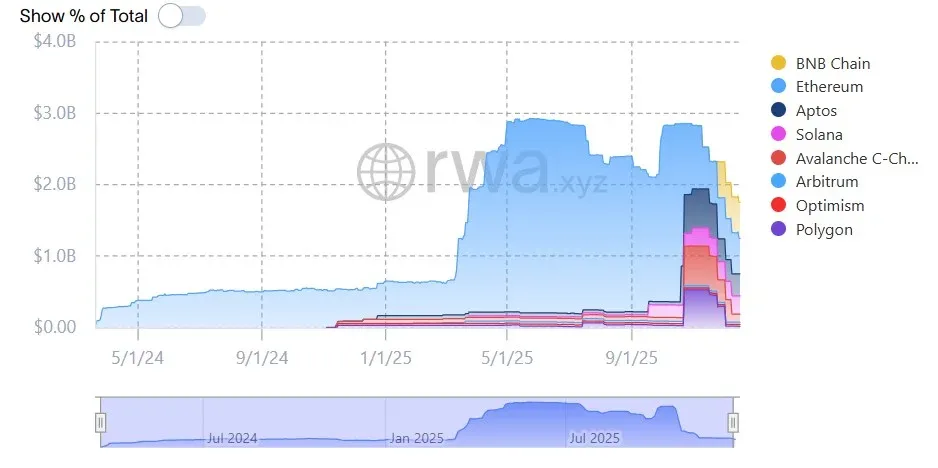
*BlackRock’s USD Institutional Digital Liquidity Fund (BUIDL) is currently the largest tokenized fund, managing close to $2 billion in assets. Source: RWA.xyz*
Industry data indicate that by the end of 2025, the on‑chain value of tokenized real‑world assets will surpass $30 billion, with private‑credit and US‑Treasury‑backed products leading the pack. These instruments attract institutions seeking yield while desiring faster settlement, yet they retain the familiar risk‑return profile of the underlying assets.
The scope of tokenization is expanding further. Tokenized equities and equity‑like instruments are drawing attention, especially outside the United States, where exchanges and fintech platforms are experimenting with blockchain‑based representations of stocks and ETFs.
- Kraken has rolled out tokenized equities in select international markets, highlighting demand for 24/7, programmable access to traditional assets.
- After Coinbase entered the stock‑trading arena, its partner portfolio‑management firm Glider’s CEO Brian Huang noted that Coinbase’s regulatory positioning and custodial infrastructure will serve as a strategic gateway into the tokenized‑asset market.
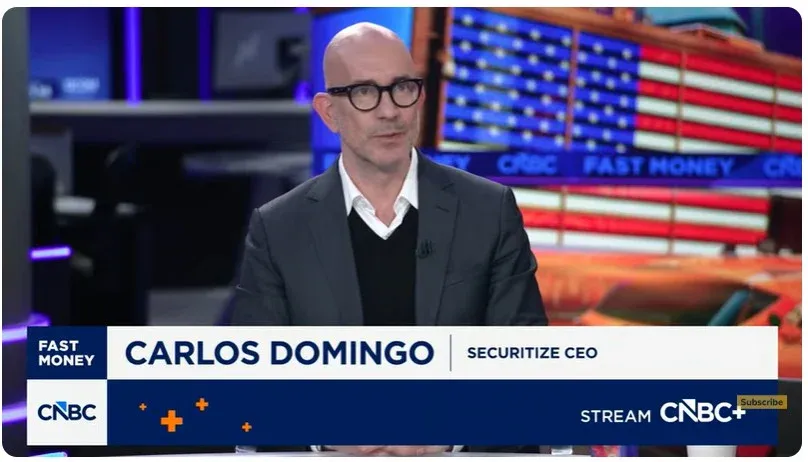
*Carlos Domingo, CEO of Securitize, attributes RWA growth to regulatory shifts, a new SEC leadership, and broad industry adoption of blockchain technology. Source: CNBC*
For investors, the appeal of RWAs lies not in short‑term speculation but in structural benefits: accelerated settlement, reduced counter‑party risk and global accessibility. As regulatory frameworks mature and traditional financial institutions deepen their on‑chain operations, RWAs are poised to become one of the most enduring crypto‑investment themes before the end of 2026.
Note: Crypto‑related gains may be taxable in many jurisdictions. Investors should consult local tax advisors to understand obligations, especially when converting crypto profits to fiat via SEPA, SWIFT or other cross‑border payment methods.
Regional Access Reminder: U.S. residents must use Binance.US for trading services, as the global Binance platform is unavailable to them.
That concludes the detailed “Cryptocurrency Investment Guide 2026: Bitcoin (BTC), Stablecoin Infrastructure, Tokenized Assets.” For more information on 2026 crypto trends—including BTC, stablecoins and RWAs—please follow additional articles on Bitaigen (比特根).
Related Reading
- Binance Coin (BNB): Uses, How to Buy & Price Outlook
- 2025 Real-World Asset Tokenization Surpasses $17.9B, 37% MoM Growth
- Privacy Coins 2024: Roadmaps, Ecosystem & Investment Outlook
💡 Register on Binance with referral code B2345 for the maximum trading fee discount. See Binance complete guide.



