
 Bitaigen Research
 Contract address is the unique identifier of a smart contract on a blockchain. Ownership can be attempted to be pinpointed through blockchain analysis, exchange KYC, IP‑address analysis, and address tagging, but because of anonymity and legal constraints, accurately locating the real identity is often difficult.
In this article we outline the methods used to trace the hidden identities behind contract addresses, from blockchain analysis to exchange KYC, then IP and address tagging, dissecting their principles and limitations step by step. Through examples we help readers distinguish which techniques are reliable and which remain blocked by anonymity, allowing an assessment of whether an actual investigation can truly lock down the holder. For details, keep reading.
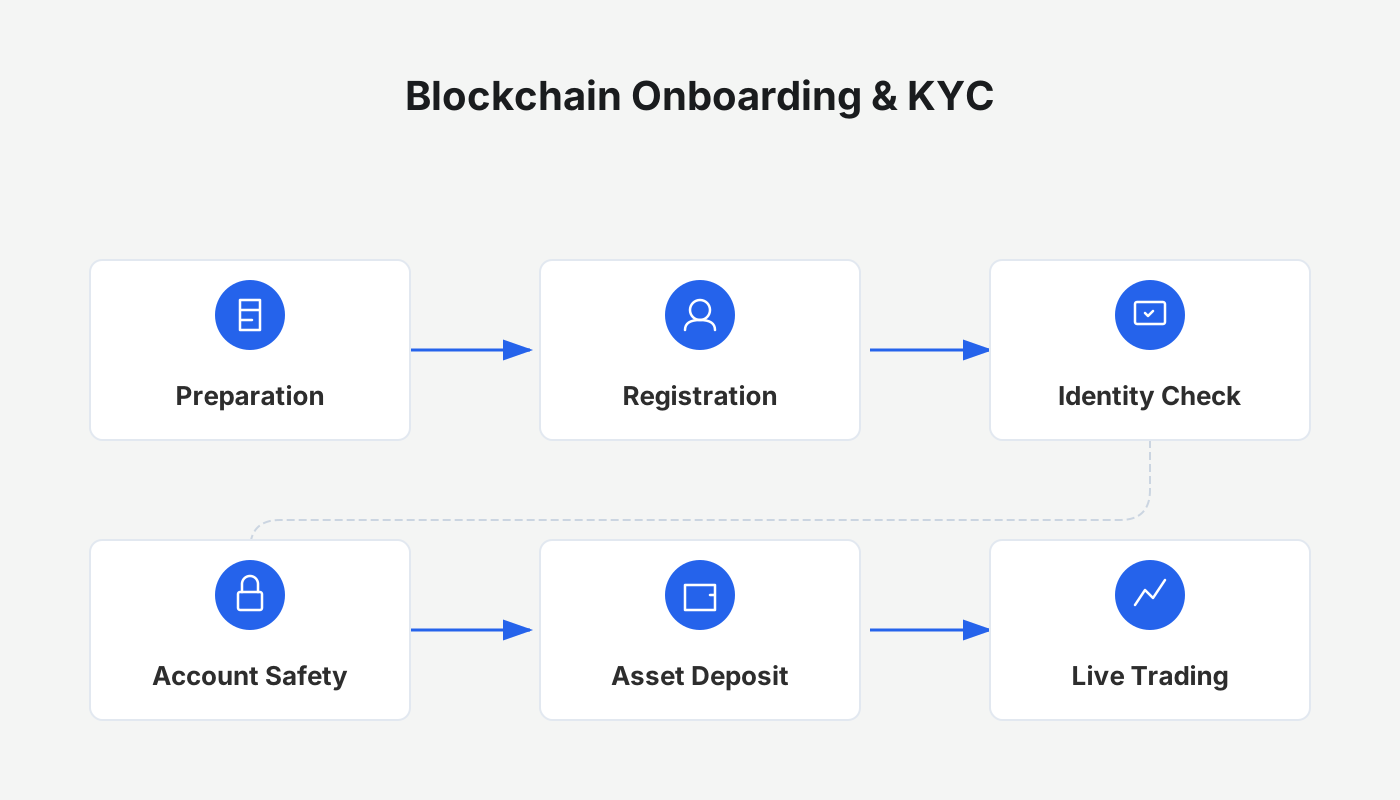
How can a contract address be used to find a person?
Blockchain analysis, exchange KYC, IP‑address analysis and address tagging are the four common approaches. Because cryptocurrencies inherently provide pseudonymity and privacy, determining the real owner of a Bitcoin or Ethereum address is usually challenging. The following explains each method’s implementation logic and its constraints.
- Blockchain analysis
- Examine the blockchain ledger and trace every inbound and outbound transaction of a specific address.
- By following the flow of funds, the address can be linked to known exchanges, mixing services, or other previously tagged entities.
- Limitation: If mixers, on‑chain privacy protocols, or decentralized exchanges are used, the tracing effectiveness drops dramatically.
- Exchange KYC
- Many centralized exchanges require users to complete “Know‑Your‑Customer” (KYC) verification. If an address has ever deposited to or withdrawn from such platforms, law‑enforcement agencies can, with proper legal authority, request the user’s information from the exchange.
- Limitation: Ordinary individuals cannot obtain this data; it is typically only accessible during police investigations or judicial proceedings.
- *Note:* When fiat is involved, most exchanges accept USD via SEPA or SWIFT transfers. U.S. residents must use Binance.US rather than the global Binance platform.
- IP‑address analysis
- When a node directly interacts with the blockchain, the server logs the visitor’s IP address. Correlating logs can give clues about the user’s geographic location or internet service provider.
- Limitation: IPs can be hidden with VPNs, proxies, or Tor, making the analysis often inconclusive.
- Address tagging
- Some individuals or organizations voluntarily publish their wallet addresses on social media, forums, or dedicated platforms to receive donations or showcase holdings.
- Using search engines or the tagging feature of blockchain explorers, these public addresses can be located quickly.
- Limitation: Publicly disclosed addresses represent a tiny fraction of all addresses and may have been replaced or become inactive.
Can you really find a person through a contract address?
A contract address itself is the unique identifier of a smart contract, consisting of code and state, but it has no private key, cannot receive direct transfers, and can only be invoked by external accounts or other contracts. When attempting to locate an individual via a contract address, keep the following two points in mind:
- Legal and privacy considerations: Even with technical means, tracking without authorization may violate privacy rights and breach applicable laws. Only law‑enforcement bodies, following due legal process, may obtain user information.
- Technical limitations: A contract address typically interacts with many users, and those users can hide their true source through anonymous wallets, mixers, or cross‑chain bridges, severely reducing identification accuracy.
Consequently, without legitimate authorization, a contract address alone rarely yields a precise personal identity. Users should safeguard their personal data and avoid exposing wallet addresses or related identity information in untrusted contexts.

Is a contract address usable by anyone?
A contract address is publicly accessible to everyone, but actual operability depends on the contract’s permission design:
| Contract type | Access permissions | Typical use cases |
|---|---|---|
| Public contract | Any wallet can call public functions | Token issuance, decentralized exchanges |
| Permissioned contract | Restricted to specific addresses or roles (e.g., owner) | Governance contracts, fund‑pool management |
| Private contract | Only the deployer or authorized accounts can interact | Internal testing, enterprise‑private chains |
- Sending/receiving tokens: Users transfer tokens to the contract address; the contract then distributes, locks, or otherwise processes them according to its internal logic.
- Calling functions: By sending a transaction from a wallet or DApp to the contract address, one can query balances, verify identity, execute trades, etc.
- Connecting DApps: Decentralized applications interact with the smart contract via its address to provide lending, NFT minting, and other services.
Why can anyone use a contract address?
Smart contracts run on open blockchain networks, which are decentralized, transparent, and permissionless, making contract addresses inherently visible to the public:
- Public ledger: Anyone can view the contract’s code, transaction history, and state through explorers such as Etherscan.
- Permissionless access: As long as you own a valid wallet address and are connected to the appropriate network, you can call the contract’s public functions.
- Immutable code: Once deployed, the bytecode remains fixed (unless an upgrade mechanism is built in), guaranteeing consistent execution logic.
- Open‑source auditability: Most contract source code is published, allowing the community to audit it, which improves security and trust.
- Globally reachable: No geographic or political barriers exist; anyone with an internet connection can use the services offered by the contract.
These characteristics together give contract addresses the nature of a “public resource,” fueling innovation and collaboration across the blockchain ecosystem.
How to look up a token’s contract address?
Method 1: Check the official website
- Visit the token’s official site (verify the URL to avoid phishing).
- Look for sections labelled “Token Info”, “Contract”, or similar.
- Copy the officially published contract address and verify it on a blockchain explorer.
Example: Shiba Inu (SHIB) lists its Ethereum contract address on the official “Token” page as `0x95aD61b0a150d79219dCF64E1E6Cc01f0B64C4cE`.
Method 2: Use a blockchain explorer
Ethereum’s most common explorer is Etherscan, Binance Smart Chain uses BscScan, and Polygon uses PolygonScan. The steps are:
- Open the relevant explorer (e.g., etherscan.io).
- Enter the token name or symbol in the search bar (e.g., “USDT”).
- Choose the result marked as “Token”.
- On the token details page, the “Contract” field displays the address.
Example: USDT’s contract address on Etherscan is `0xdAC17F958D2ee523a2206206994597C13D831ec7`.
Method 3: Via CoinMarketCap or CoinGecko
- Go to CoinMarketCap (coinmarketcap.com) or CoinGecko (coingecko.com).
- Search for the target token.
- In the token’s page, locate the “Contracts” or “合约” section to see addresses for each supported chain.
Note: Native‑chain tokens such as Bitcoin or Dogecoin do not have contract addresses because they operate directly on their own blockchains.
Method 4: Through a wallet or exchange
- MetaMask: When you click “Add Token” and type the token symbol, the wallet automatically fetches and displays the contract address.
- Centralized exchanges: On deposit/withdrawal pages, after selecting a token the platform lists the corresponding network and contract information (e.g., Binance, OKX).
Method 5: Community and social‑media sources
- Identify the project’s official social channels (Twitter, Telegram, Discord, etc.).
- Search for the phrase “contract address” or ask the administrators directly.
- Once obtained, double‑check the address on a blockchain explorer to avoid spoofed information.
Friendly reminder: Always verify any contract address you receive through an independent explorer to protect against phishing or impersonation.
---
Contract addresses are the core entry points of the blockchain ecosystem. Through them users can check balances, transfer assets, invoke contract functions, and interact with decentralized applications. Because of their transparent nature, verifying the authenticity of a contract address is especially critical. Mastering the lookup methods above helps improve safety and efficiency when handling digital assets.
*Disclaimer: Gains from cryptocurrency transactions may be taxable in your jurisdiction. Consult a tax professional to ensure compliance.*
For deeper analysis of contract address discovery and usage, stay tuned to Bitaigen’s upcoming articles.
Related Reading
- Blockchain Explorers: Track Transactions, Addresses & Blocks
- KYC in Crypto: Challenges, Compliance & Future Outlook
- TVL in DeFi: How It’s Calculated, Why It Matters
💡 Register on Binance with referral code B2345 for the maximum trading fee discount. See Binance complete guide.



