
 Bitaigen Research
 In this article we outline the core concepts of cryptocurrency and blockchain for beginners, dissect the underlying technology, consensus mechanisms, and token classifications, enabling you to quickly build a systematic understanding. Subsequent sections will delve deeper into real‑world use cases and risk considerations, so a careful read is worthwhile.
Overview of Cryptocurrency and Blockchain Technology
In the digital age, cryptocurrency is no longer a distant abstraction; it has become a tool tightly linked to everyday payments and cross‑border transfers. At its heart lies the blockchain—a distributed ledger technology that records every transaction on a peer‑to‑peer network spanning the globe. By employing cryptographic techniques, these records are permanently stored and extremely difficult to alter, allowing users to move value at low cost and high speed without relying on traditional financial intermediaries.
Mining, Proof‑of‑Work, and Staking on Blockchain Networks
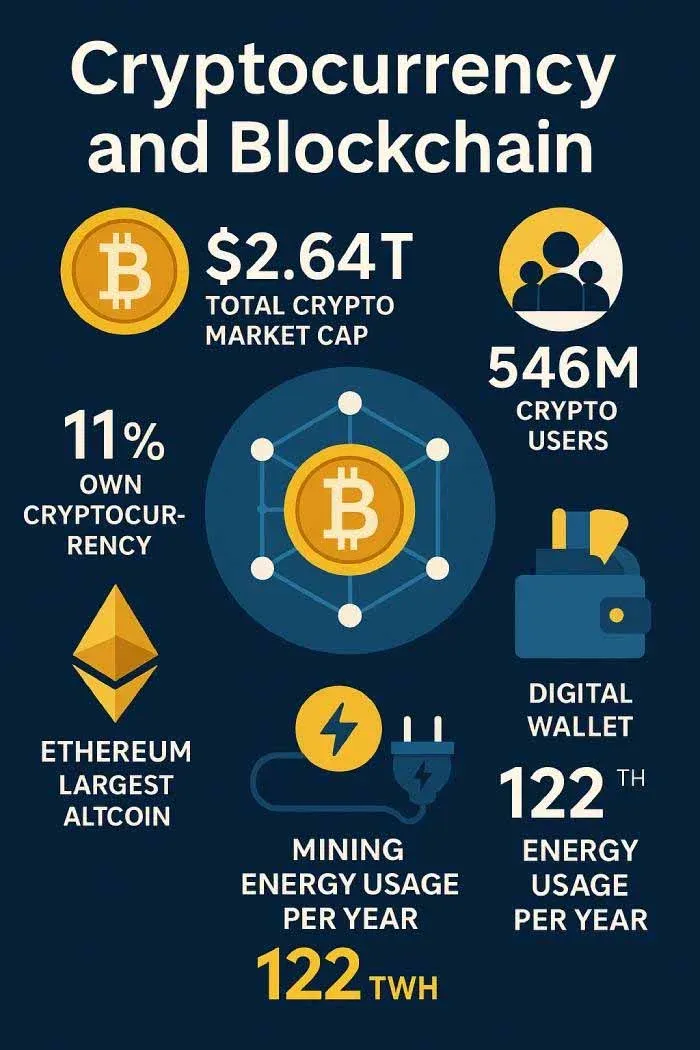
Bitcoin employs a Proof‑of‑Work (PoW) consensus mechanism, wherein miners solve complex computational puzzles to validate transactions and earn newly minted bitcoins as a reward. Ethereum, by contrast, has transitioned to Proof‑of‑Stake (PoS); token holders lock up their ETH to take part in block validation, achieving decentralized security in a different way. Both models protect network integrity but have sparked ongoing debates about energy consumption—by 2025, Bitcoin’s total electricity usage was roughly equivalent to supplying power to more than eight million U.S. households each year.
Types and Functions of Cryptocurrencies
Different tokens play distinct roles within the blockchain ecosystem:
- Utility tokens – e.g., Ethereum’s ETH, used to pay for on‑chain services and gas fees.
- Transaction tokens – Bitcoin focuses primarily on value transfer.
- Governance tokens – holders can vote on protocol upgrades and parameter changes.
- Platform tokens – such as Solana, which underpins the operation of its own network.
- Security tokens – represent ownership of traditional assets (e.g., equities or real‑estate) on a blockchain.
- Meme coins – like Dogecoin, whose price is largely driven by community sentiment.
- Stablecoins – USDT, USDC and others that are pegged to fiat currencies, offering low volatility.
Bitcoin’s History and Market Position
In 2009, an individual—or group—under the pseudonym “Satoshi Nakamoto” launched Bitcoin, the first project to achieve decentralized monetary issuance. Bitcoin’s supply is capped at 21 million coins, a scarcity that has earned it the nickname “digital gold.” By mid‑2025, Bitcoin accounted for roughly 55 %‑57 % of the total cryptocurrency market, which was valued at about USD 3.9‑4.1 trillion, cementing its status as the flagship digital asset.
Beyond Bitcoin: Ethereum and Other Leading Coins
Following Bitcoin, Ethereum introduced smart‑contract functionality, creating a full‑stack ecosystem that supports decentralized finance (DeFi), gaming, and digital asset management. In addition, projects such as Cardano, Solana, and the stablecoins USDT and USDC have each carved out substantial niches within their respective sub‑markets.
Fundamentals of Cryptocurrency and Use of Digital Assets
Globally, nearly 560 million people—about 6.8 % of the world’s population—hold some form of cryptocurrency, indicating that the sector has entered mainstream awareness. To participate, the first step is acquiring a cryptocurrency wallet, which can be a cloud‑based app, desktop software, or mobile application. Inside the wallet are a private key and a public key; the private key signs transactions, while the public key serves as the address visible on the blockchain. Together they guarantee that the holder retains ownership of the assets recorded on the distributed ledger.
Wallets, Private Keys, and Digital‑Asset Security
Hardware wallets (e.g., USB‑style devices) store private keys offline and are currently regarded as the most secure solution. Software wallets are more convenient but are also more exposed to network‑based attacks. Data from 2025 shows that roughly 983 thousand wallets each hold at least one full Bitcoin, illustrating a trend toward decentralized asset distribution. Regardless of the wallet type you choose, always create a reliable backup; losing the device without a backup means the assets become permanently unrecoverable.

Cryptocurrency Exchanges and Trading
To buy or sell digital assets, users typically turn to centralized exchanges (CEXs) such as Coinbase, Binance, or, for U.S. residents, Binance.US, as well as to decentralized exchanges (DEXs). Centralized platforms offer a more user‑friendly interface but usually charge higher fees; decentralized platforms enable peer‑to‑peer trades directly on‑chain, eliminating an intermediary. Some brokers also provide direct token transfers to a user’s personal wallet, lowering the operational barrier for newcomers.
Trading Activity in Crypto Markets
Trading strategies fall into two broad categories: short‑term and long‑term. Short‑term traders focus on price swings to capture spread profits, while long‑term holders (often called “HODLers”) emphasize the potential appreciation of assets like Bitcoin and Ethereum, typically retaining them for years in anticipation of value growth.
Risks Associated with Crypto Investment and Trading
Compared with fiat currencies, digital assets are still in an early developmental stage, characterized by pronounced price volatility and a lack of the safety nets typical of traditional finance. Because assets are not held by banks, loss or theft is usually irreversible. The following practices can help mitigate risk:
- Educate before you act – understand how cryptocurrencies work, the contexts in which they are used for payments, and the secure procedures for buying and selling.
- Choose reputable wallets – avoid storing large sums in applications of unknown provenance.
- Back up your keys – a reliable backup enables recovery in case of device failure or loss.
Note: Tax authorities in many jurisdictions treat crypto gains as taxable events. In the United States, for example, crypto is taxed as property, and gains must be reported on federal tax returns. Always consult local regulations or a tax professional to ensure compliance.
Cryptography and Password Security in Crypto
The term “cryptocurrency” derives from cryptography—the science of encoding and decoding information. Blockchains leverage modern cryptographic algorithms to ensure that only authorized parties can read a transaction and to prevent tampering. Although cryptography dates back to ancient times, in the blockchain era it provides the fundamental anti‑fraud shield for digital currencies such as Bitcoin.
Blockchain Technology and Distributed Ledger Systems
A blockchain is essentially a distributed ledger composed of blocks linked together in chronological order. Once data is written to a block, it becomes immutable, a property that opens up vast possibilities across finance, supply‑chain management, healthcare, and even electronic voting. Financial institutions are actively experimenting with the technology; for instance, JPMorgan Chase uses a private blockchain to reduce settlement costs and improve payment efficiency.
Cryptocurrencies vs. Traditional Money and Central Bank Digital Currencies (CBDCs)
Legal tender is issued by central banks and regulated by financial institutions, whereas cryptocurrencies reside on blockchains and can be accessed solely with a private key. Losing that key is equivalent to losing the underlying asset. This fundamental distinction is reshaping the global financial landscape. Simultaneously, several central banks are developing their own CBDCs—such as China’s digital yuan, the European Union’s digital euro project, and the United States’ research into a digital dollar—to retain a leading role in the emerging digital economy.
Legal Status of Cryptocurrencies Worldwide and Central Authorities
- United States – Bitcoin and similar assets are legal but are treated as property for tax purposes; regulatory bodies monitor exchanges for compliance.
- Asia – Japan recognizes Bitcoin as a legal asset; China bans trading and mining but vigorously promotes the digital yuan; India is still drafting comprehensive regulations.
- Europe – The European Union has introduced the MiCA framework to provide a unified regulatory regime for crypto‑assets.
- El Salvador – Became the first nation to adopt Bitcoin as legal tender.
Why People Invest in Cryptocurrencies and Digital Assets
Motivations are diverse: speculative profit, portfolio diversification, belief in the underlying technology, and hedging against inflation. In 2025, about 28 % of U.S. adults (roughly 65 million people) owned some form of crypto, demonstrating that the user base has expanded far beyond early adopters.
Pros and Cons of Crypto and Blockchain Applications
Advantages
- Potential for high returns.
- Distributed ledger removes the need for intermediaries.
- Participation is possible wherever an internet connection exists.
- Blockchain data is immutable.
- Staking can generate passive income.
Disadvantages
- Extreme price volatility.
- Energy consumption associated with Proof‑of‑Work.
- Susceptibility to scams and criminal exploitation.
- Uncertain regulatory environment.
- Transaction fees can spike during network congestion.
Is Cryptocurrency Safe? Protecting Your Digital Assets
From a technical perspective, blockchain and cryptography offer a solid security foundation. In practice, however, several risks remain: transactions are irreversible, exchanges can be hacked, smart‑contract code may contain bugs, and markets can be manipulated. Nevertheless, by 2025 the total market capitalization of cryptocurrencies is still projected to lie between USD 3.98‑4.11 trillion, with Bitcoin alone accounting for more than half of that value.
How to Generate Returns with Crypto
- Staking – lock tokens to help secure a PoS network and receive rewards.
- Lending – provide liquidity on decentralized finance platforms and earn interest.
- Holding – retain major coins over the long term, hoping for price appreciation.
Getting Started: Buying and Storing Cryptocurrency
- Open an account on a reputable exchange or brokerage platform (U.S. users should use Binance.US, Coinbase, Kraken, etc., and may fund the account via USD transfers, SEPA, or SWIFT).
- Purchase mainstream assets such as Bitcoin or Ethereum.
- Transfer the acquired tokens to a digital wallet of your choice; you can opt for a hot wallet (online) for frequent use or a cold wallet (offline) for long‑term storage.
This article constitutes the complete content of “Cryptocurrency and Blockchain Concepts: A User‑Friendly Guide to Digital Currency.” For further information, search for previous Bitaigen (比特根) articles or continue reading the recommended pieces below. We appreciate your ongoing interest and support for Bitaigen.
💡 Register on Binance with referral code B2345 for the maximum trading fee discount. See Binance complete guide.



